
TL;DR:
- Learning Japanese involves mastering three writing systems, grammar, and cultural context for effective communication.
- A structured, layered approach using tools like Anki, WaniKani, and HelloTalk allows adults to reach conversational fluency within two years.
- Early focus should be on kana recognition, vocabulary building, and speaking practice to avoid common beginner mistakes.
Learning the Japanese language means mastering three writing systems, a distinct grammar structure, and a rich cultural context that shapes every conversation. Conversational proficiency at the JLPT N3 level requires 18–24 months of daily practice averaging 30–60 minutes. That timeline is achievable for any adult who follows a structured, layered approach. This guide gives you the exact roadmap, from hiragana on day one to real conversations in under two years, using tools like Anki, WaniKani, BunPro, and HelloTalk alongside modern AI tutors.
What are the best tools and resources to learn Japanese language?
The foundation of any successful study plan is the right toolkit. Hiragana and katakana are the two phonetic alphabets you must master first. Each has 46 characters, and most learners recognize both within one to two weeks. Skipping this step and relying on romaji (the Latin-script representation of Japanese sounds) is the single most common beginner mistake.
Here are the core resource categories every learner needs:
- Writing system tools: Anki flashcard decks for hiragana and katakana recognition; free worksheets from sites like Tofugu for stroke order practice.
- Vocabulary apps: WaniKani for kanji and vocabulary through mnemonics; Anki with a curated deck for spaced repetition of the top 2,000 words.
- Grammar platforms: BunPro for structured grammar point review with SRS (spaced repetition system) built in; Genki textbooks for classroom-style grammar explanation.
- Conversation practice: HelloTalk for text and voice exchange with native speakers; italki for one-on-one lessons with certified tutors.
- AI-powered learning: LearnAI builds adaptive course structures that adjust to your goals and accelerate early conversational skills.
Pro Tip: Drop romaji within your first seven days. Experienced learners confirm that staying on romaji prevents your brain from recognizing actual Japanese characters, slowing every stage that follows.
The table below compares the primary tools by function so you can build your stack intentionally.
| Tool | Primary function | Best for |
|---|---|---|
| Anki | Spaced repetition flashcards | Vocabulary and kana retention |
| WaniKani | Kanji and vocabulary mnemonics | Kanji acquisition from N5 upward |
| BunPro | Grammar SRS | Structured grammar review |
| HelloTalk | Language exchange | Speaking and writing with natives |
| LearnAI | AI-driven adaptive courses | Goal-based conversational practice |
No single app covers everything. Skill pillars develop best when you combine structured courses, spaced repetition, audio comprehension, and speaking practice at the same time.
How to structure your Japanese study plan for fastest progress
A phased plan prevents overwhelm and keeps momentum steady. The four phases below reflect realistic timelines based on 30–60 minutes of daily practice.
-
Phase 1 (weeks 1–2): Master kana. Focus entirely on hiragana and katakana recognition and writing. Use Anki or a dedicated kana app. Do not move forward until you can read both scripts without hesitation.
-
Phase 2 (months 1–3): Build beginner vocabulary and core grammar. Target 500–800 words using spaced repetition. Pair vocabulary study with BunPro grammar points covering basic sentence structure, verb conjugation, and particles. JLPT N5 level is reachable within 4–6 months at this pace.
-
Phase 3 (months 4–6): Expand to intermediate vocabulary and reading. Push toward 1,500–2,000 words. The top 2,000 vocabulary words cover roughly 90% of everyday conversation. Start reading simple content like NHK Easy News and graded readers. Introduce kanji study through WaniKani at this stage.
-
Phase 4 (month 7 onward): Active production and immersion. Prioritize speaking, writing, and listening. Use HelloTalk or a tutor from TUTOROO for personalized speaking practice. Aim for JLPT N4 within 6–12 additional months and N3 by the 18–24 month mark.
Pro Tip: Micro-study sessions of 5–10 minutes spaced throughout the day move vocabulary to long-term memory more effectively than one single hour-long session. Use Anki on your commute, during lunch, and before bed.
The table below summarizes the phase timeline and key milestones.

| Phase | Duration | Key milestone |
|---|---|---|
| Kana mastery | 2 weeks | Read hiragana and katakana fluently |
| Beginner vocabulary and grammar | Months 1–3 | 500–800 words; JLPT N5 ready |
| Intermediate vocabulary and reading | Months 4–6 | 2,000 words; read simple texts |
| Active production and immersion | Month 7 onward | JLPT N4–N3; conversational fluency |
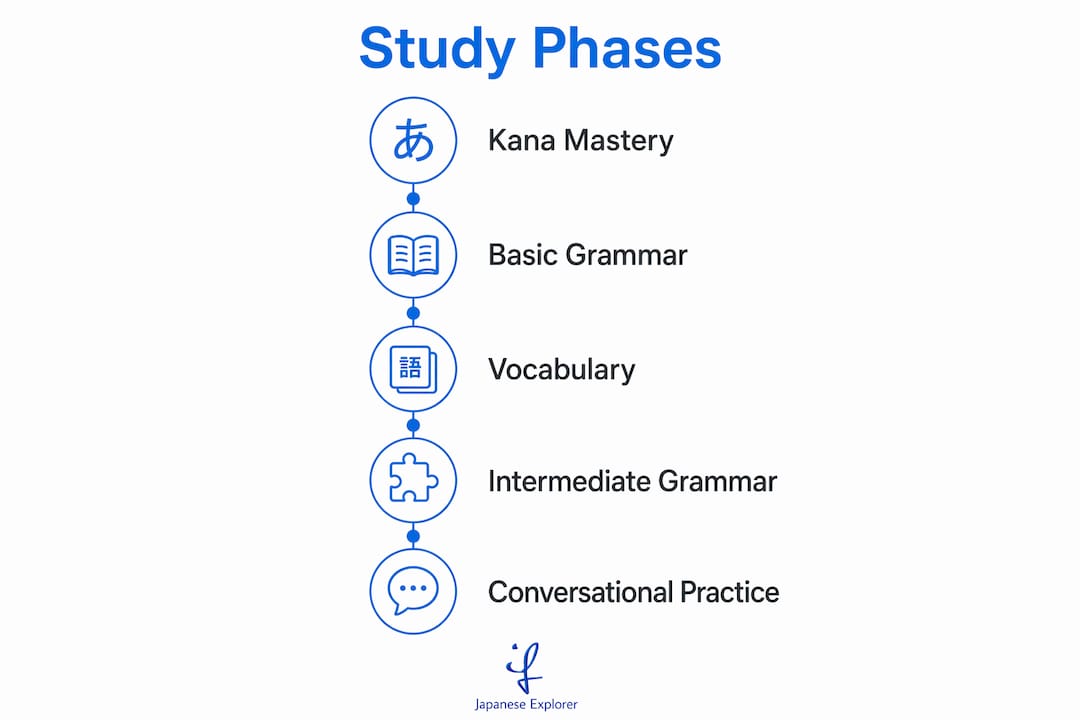
Adult learners hold a real advantage here. Cognitive abilities in adults favor explicit grammar learning and pattern recognition, which means you can progress through structured phases faster than younger learners who rely on implicit acquisition.
What mistakes should you avoid when studying Japanese?
Most learners hit the same walls. Knowing where they are lets you step around them.
- Staying on romaji too long. Romaji feels comfortable but prevents character recognition. Switch to kana by day seven, no exceptions.
- Studying kanji in isolation. Memorizing a kanji character without a word context means the meaning and reading slip away within days. Learn kanji alongside vocabulary so each character is anchored to sound and meaning from the start.
- Delaying speaking practice. Many learners wait until they feel “ready” to speak. That moment rarely arrives on its own. Brief speaking sessions started early close the gap between preparation and real conversation faster than any other method.
- Ignoring spaced repetition. Reviewing vocabulary in random order wastes time. Tools like Anki and Brainscape schedule reviews at the exact interval your brain needs to retain a word long term.
- Burning out on intensity. Studying for three hours on Saturday and nothing the rest of the week produces far less retention than 30 minutes every day. Consistency is the mechanism, not volume.
“The learners who progress fastest are not the ones who study the hardest on any single day. They are the ones who show up every day, even for just ten minutes.”
Pro Tip: When kanji start to blur together, that is a signal to slow down and review, not push harder. Check your vocabulary retention techniques and reduce your daily new-card count in Anki until recall feels solid again.
How to practice Japanese skills effectively beyond your study sessions
Structured study builds the framework. Real practice fills it in. These five methods turn passive knowledge into active fluency.
-
Listen to comprehensible input. Choose audio and video content you understand 70–80% of. That range stretches your knowledge without causing frustration. JapanesePod101 and Nihongo con Teppei for Beginners are strong starting points.
-
Shadow native speakers. Shadowing means listening to a sentence and repeating it aloud at the same time, matching rhythm and pitch accent. This trains your mouth and ear together and accelerates natural pronunciation.
-
Read authentic materials early. NHK Easy News uses simplified vocabulary and furigana (small kana above kanji) to make news articles accessible for learners at the N4–N5 level. Manga with furigana is another practical option that keeps reading enjoyable.
-
Write daily in Japanese. Keep a short journal in Japanese, even two or three sentences. Writing forces you to recall grammar and vocabulary actively rather than just recognize them passively.
-
Use conversation platforms consistently. HelloTalk connects you with native speakers for text and voice exchange. For more structured speaking practice, a qualified tutor through a practical language guide can give you targeted feedback on grammar and pronunciation.
Beyond these methods, cultural immersion deepens your understanding of context. Watch Japanese films without subtitles after your first three months, even if you catch only fragments. Follow Japanese social media accounts. The goal is to make Japanese a part of your daily environment, not just a subject you study.
- Follow Japanese creators on YouTube or Instagram for casual, real-world language exposure.
- Set your phone language to Japanese once you reach N5 level.
- Cook a Japanese recipe using a Japanese-language recipe site. Context makes vocabulary stick.
- Track your JLPT readiness with a placement test to identify gaps before they become habits.
Key Takeaways
Learning Japanese language rewards a structured, phased approach that builds writing systems first, then vocabulary and grammar, then active speaking and immersion in parallel.
| Point | Details |
|---|---|
| Master kana first | Learn hiragana and katakana within two weeks before tackling vocabulary or grammar. |
| Use spaced repetition daily | Tools like Anki and BunPro schedule reviews at optimal intervals for long-term retention. |
| Start speaking early | Brief conversation practice from month one closes the gap between study and real fluency faster. |
| Learn kanji in context | Anchor every kanji to a vocabulary word so sound, meaning, and character reinforce each other. |
| Consistency beats intensity | Thirty minutes every day outperforms three hours once a week for vocabulary retention and motivation. |
Why I think most Japanese learners overcomplicate the early stages
The most common thing I see is learners spending weeks researching the perfect app stack before writing a single hiragana character. I understand the impulse. Japanese looks complex from the outside, and the three writing systems feel like a wall before you even start. But the research is clear and the experience of thousands of learners confirms it: the writing systems fall into place within two weeks of focused daily practice. The wall is shorter than it looks.
What actually derails people is not the difficulty of Japanese. It is the expectation that progress should feel dramatic every week. Language acquisition is cumulative and often invisible in the short term. You will have weeks where nothing seems to click, and then a conversation will happen where you understand far more than you expected. That moment is the payoff for all the quiet, unglamorous repetition.
My honest advice is to pick three tools, commit to them for 90 days, and measure your progress against the JLPT N5 word list at the end. If you can recognize 500 words and read hiragana and katakana without hesitation, you are exactly on track. Do not switch apps. Do not restart. Keep going.
The learners who reach conversational fluency are not the ones with the best resources. They are the ones who stayed consistent long enough for the language to become familiar. Japanese is learnable. You just have to show up.
— Paul
Ready to take your Japanese further with structured classes?
Self-study gets you started, but structured learning with experienced teachers accelerates your progress in ways apps alone cannot match. Japanese Explorer offers small group Japanese classes designed specifically for adult learners in Singapore, covering conversational and business Japanese from beginner to advanced levels. Classes are guided by the Association for Japanese-Language Teaching curriculum, so every lesson builds grammar, speaking, and listening together.

If your schedule or location makes in-person classes difficult, Japanese Explorer’s online Japanese course delivers the same quality instruction via Zoom with certified bilingual teachers. Corporate training programs are also available for teams. Japanese Explorer is located at 10 Anson Road, Level 22, International Plaza, Singapore 079903, right above Tanjong Pagar MRT. Reach out today and join a community of adult learners who are making real progress.
FAQ
How long does it take to reach conversational Japanese?
Conversational fluency at JLPT N3 level takes 18–24 months at 30–60 minutes of daily practice. JLPT N5 is reachable within 4–6 months for most adult learners.
What should I learn first in Japanese?
Start with hiragana and katakana. Most learners achieve solid recognition of both 46-character scripts within one to two weeks, which unlocks every other learning resource.
Is Japanese hard to learn for English speakers?
Japanese grammar and writing systems differ significantly from English, but adult learners benefit from strong pattern recognition skills. Structured study with spaced repetition makes early progress faster than most beginners expect.
What is the best app for learning Japanese vocabulary?
Anki with a curated SRS deck is the most effective tool for vocabulary retention. WaniKani is the top choice specifically for kanji and vocabulary acquisition through mnemonics.
Do I need to learn kanji to speak Japanese?
You do not need kanji to hold basic conversations, but learning kanji alongside vocabulary from month four onward significantly improves reading comprehension and overall fluency at the N4 level and above.