
TL;DR:
- Mastering Japanese involves a three-step sequence: first, learn hiragana and katakana, then build vocabulary, grammar, and kanji together, and finally start speaking and writing from week one. Consistent active output, such as speaking and writing daily, accelerates fluency faster than passive listening or reading alone.
The fastest path to Japanese for most learners is three steps: master hiragana and katakana first, layer in core grammar and vocabulary alongside early kanji, then start speaking and writing from week one. That sequence is not arbitrary. Each step removes a specific bottleneck before it forms.
Your 3-step starter plan:
- Learn kana (weeks 1–2). Hiragana and katakana are the foundation of everything. Without them, you cannot read pronunciation guides, type Japanese, or follow a textbook. Most learners finish both scripts within a few weeks with daily 20-minute sessions.
- Build grammar, vocabulary, and kanji together (weeks 3–12). High-frequency grammar patterns and the top 500 vocabulary words cover the vast majority of everyday conversation. Start kanji at the same time, not later.
- Start active output immediately (week 1 onward). Speaking and writing from the very beginning builds automatic grammar patterns faster than any amount of passive reading or listening.
First-week checklist:
- Complete hiragana recognition and writing practice (15–20 minutes daily)
- Download a spaced repetition system (SRS) app such as Anki and create your first kana deck
- Watch one short Japanese video with subtitles for ear training (15 minutes)
- Write out five simple sentences using the words you already know
- Find one language exchange partner or community forum to join
TL;DR — do these three things today:
- Spend 20 minutes learning the first row of hiragana
- Set up a free SRS tool for daily review
- Say one Japanese sentence out loud, even if it is imperfect
Table of Contents
- What should you learn first when studying Japanese?
- How to study effectively: active practice beats passive exposure
- Which resources should you use, and how do you choose?
- What does a weekly study plan look like at each level?
- How long does it take, and how do you measure progress?
- What are the most common struggles, and how do you fix them?
- When do structured lessons help you progress faster?
- How do you build accurate pronunciation and listening skills?
- How do you memorize kanji beyond the basics?
- Key Takeaways
- The habit that changed everything for me
- Ready to move faster with guided Japanese lessons?
- Useful resources and your next-step checklist
- FAQ
What should you learn first when studying Japanese?
The right sequence matters more than the number of hours you put in. Start in the wrong order and you will spend months re-learning things you could have done correctly from the start.
Hiragana and katakana come before everything
Hiragana and katakana together contain 46 base characters each, and both scripts are phonetically consistent. Once you know them, every word you see has a clear pronunciation. Skipping them and relying on romanized Japanese (romaji) is one of the most common beginner mistakes because it creates a crutch that slows reading speed later.

Prioritize learning to read and type kana first because typing covers most day-to-day digital writing. Handwriting is a worthwhile skill to add later, but it should not delay your progress in the first two weeks.
When to start grammar and vocabulary
Once you can read hiragana and katakana reliably, begin grammar and vocabulary together. Focus on high-frequency patterns: the verb conjugations, particles, and sentence structures that appear in almost every conversation. The 80/20 rule applies strongly here. A core set of roughly 500 vocabulary words and a handful of grammar patterns will get you through most beginner interactions.
Use a structured textbook like Genki or Minna no Nihongo alongside your SRS flashcard practice. The textbook gives you context and grammar explanation; the SRS locks vocabulary into long-term memory.
Start kanji early, not later
Integrating kanji early with mnemonics and an SRS prevents the bottleneck that stops many intermediate learners cold. When kanji blur together because you delayed them, reading comprehension stalls and vocabulary acquisition slows down. Aim to learn some kanji early on, tied directly to vocabulary you are already learning.
Timeline callouts:
| Milestone | Expected timeframe |
|---|---|
| Kana fluency (read and type) | A few weeks |
| A moderate number of vocabulary words and basic grammar | A few months |
| Several hundred kanji and basic reading | Several months |
| Comfortable conversation, N4–N5 level | Within a year or so |
How to study effectively: active practice beats passive exposure
Passive exposure — watching dramas, listening to music, reading without output — feels productive. It rarely is, at least not on its own. The learners who progress fastest are the ones who speak and write from day one.

Active vs. passive practice
Active practice means producing language: speaking, writing, answering questions, recalling vocabulary without a hint. Passive practice means receiving language: watching, listening, reading. Both have a role, but short focused active sessions consistently outperform longer passive exposure for retention and production skills. Thirty minutes of concentrated output practice is usually more effective than two hours of passive watching.
A repeatable study session template
Use this structure for a 45–60 minute daily session:
- Warm-up (5 minutes): Review yesterday’s SRS cards. This primes your memory and catches anything slipping.
- Focused SRS review (10–15 minutes): New vocabulary and kanji cards. Keep the session tight; do not add more than 10–15 new cards per day.
- Targeted grammar (10–15 minutes): One grammar point from your textbook. Write three example sentences using it.
- Output practice (15–20 minutes): Speak or write. Use a language partner, a tutor, or even a voice recorder. The goal is production, not perfection.
Research note: Speaking early and putting yourself in environments where natural interaction occurs accelerates spoken fluency more reliably than passive immersion alone.
For interactive lesson formats that build this kind of active practice into every session, structured classes are worth considering.
Pro Tip: Record yourself speaking Japanese for 60 seconds every day. Play it back at the end of each week. The improvement you hear is one of the strongest motivators to keep going, and it forces you to produce language even when no partner is available.
Mistakes are data, not failures. Every error tells you exactly where your grammar or vocabulary needs reinforcement. Embrace them early, when the stakes are low and the corrections are most useful.
Which resources should you use, and how do you choose?
The best resource is the one you will actually use consistently. That said, not all tools are equal for every goal or level.
Resource types and what each does well
Bite-sized app lessons like those on Duolingo are effective for habit formation and basic vocabulary exposure, especially for beginners who need a low-friction daily touchpoint. They work best as a supplement, not a primary study tool.
SRS tools like Anki give you full control over your flashcard decks and review schedule. WaniKani-style systems combine kanji and vocabulary in a structured progression. Both are highly effective for long-term retention when used consistently.
NHK World-Japan offers graded listening materials and Easy Japanese programs that are genuinely useful for intermediate learners building comprehension. The level charts help you find content that is challenging but not overwhelming.
Tutors and structured classes provide real-time feedback, accountability, and targeted correction that no app can replicate. For business Japanese or JLPT preparation, they are often the most efficient route.
Language exchange partners and communities (HelloTalk, Tandem, local Japanese cultural organizations) give you authentic conversation practice. Making Japanese-speaking friends is often easier than learners expect, and the conversational practice you get is irreplaceable.
For vocabulary habit-building, WordByWord is a useful partner tool that supports daily study routines and SRS-style review.
How to pick and combine resources
| Resource type | Best for | Cost range | Expected outcome |
|---|---|---|---|
| Apps (Duolingo, etc.) | Daily habit, beginner vocab | Free–$15/month | Vocabulary exposure, habit |
| SRS (Anki, WaniKani) | Kanji, vocabulary retention | Free–$10/month | Long-term recall |
| Textbooks (Genki, etc.) | Grammar structure | $30–$60 one-time | Systematic grammar |
| Tutors / structured classes | Accountability, speaking, JLPT | $20–$80/hour | Measurable skill gains |
| Language exchange | Conversation, cultural context | Free | Fluency, confidence |
| Graded listening (NHK) | Listening comprehension | Free | Comprehension, vocabulary |
The most effective setup is one primary resource plus two supporting tools. A structured class or textbook as your primary, an SRS tool for daily vocabulary review, and a listening or speaking resource for output. Adding more than three tools at once tends to scatter focus rather than accelerate progress.
Selection criteria to apply:
- Does it match your current level (beginner, intermediate, business)?
- Does it give you feedback, not just exposure?
- Can you realistically use it 5–6 days a week?
- Does it push you to produce language, not just recognize it?
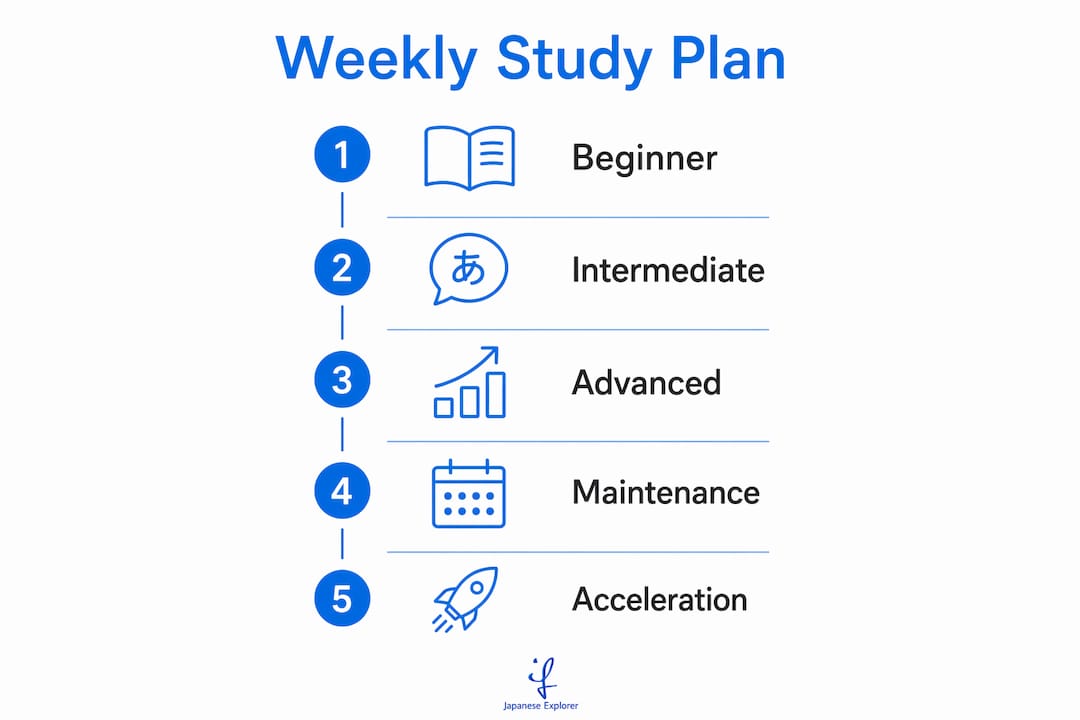
What does a weekly study plan look like at each level?
A well-structured study plan is the difference between slow drift and measurable progress. Here are ready-to-use weekly schedules you can copy and adapt.
Beginner: weeks 1–6
Goal: Kana fluency, 300–500 vocabulary words, basic grammar patterns, 50–100 kanji basics.
Time commitment: 45–60 minutes daily, 5–6 days per week.
- Days 1–14: Hiragana and katakana only. 20 minutes of kana drills, 10 minutes of SRS review, 10 minutes of listening to native audio.
- Days 15–28: Add basic grammar (greetings, particles, verb forms). Begin your first 50 vocabulary cards in Anki. Write 3 sentences daily.
- Days 29–42: Introduce kanji (start with the most common 50). Continue SRS daily. Add one 15-minute speaking session per week with a partner or tutor.
Milestone checkpoint: By week 6, you should read hiragana and katakana confidently, recognize basic kanji, and hold a simple self-introduction in Japanese.
Intermediate: weeks 7–18
Goal: 300–800 kanji, expanded vocabulary, reading practice, regular conversation.
Time commitment: 60–90 minutes daily.
- Daily SRS review: 20 minutes (new kanji + vocabulary)
- Grammar study: 20 minutes (one new pattern per session)
- Reading practice: 15 minutes (NHK Easy News or graded readers)
- Speaking/writing output: 20–30 minutes (language partner, tutor, or journaling in Japanese)
Milestone checkpoint: By week 18, you should handle basic conversations on familiar topics, read short texts with occasional dictionary use, and recognize several hundred kanji in context.
Advanced: ongoing maintenance and acceleration
Goal: Production fluency, specialized vocabulary, business Japanese drills.
- Daily: 20 minutes SRS (advanced vocabulary, business terms)
- 3x per week: 30-minute conversation session with a native speaker or tutor
- 2x per week: Writing practice, including Japanese essay writing or business email drafting
- Weekly: One structured lesson focused on a specific gap (business keigo, formal presentations, industry vocabulary)
Mix one-on-one lessons with self-study at every level. Private lessons are most valuable when you use them to address specific weaknesses, not as a substitute for daily independent practice.
How long does it take, and how do you measure progress?
Realistic timelines prevent two common traps: quitting too early because you expected faster results, and coasting because you have no clear benchmark to aim for.
Hours to common milestones
Research from KanaDojo puts the study hours for common milestones at:
| Milestone | Estimated study hours |
|---|---|
| Hiragana and katakana fluency | 30–50 hours |
| Tourist survival phrases | 50–100 hours |
| Basic conversation | 200–400 hours |
| Comfortable conversation | 800 hours |
Milestone reality check: Reaching comfortable conversation typically requires many hundreds of hours of focused study. At one hour per day, this can take several years. At higher daily practice levels with active output, the timeline can shorten significantly.
Converting weekly hours into a projected timeline
A simple formula: divide your target milestone hours by your weekly study hours to get the number of weeks. If you study regularly and your goal is basic conversation, you might expect about a year with consistent weekly practice, allowing for typical interruptions.
Immersion and focused output shift this timeline. Learners who speak regularly, consume Japanese media actively, and use SRS consistently tend to reach milestones noticeably faster than those relying on passive study alone.
Practical progress metrics to track
Use these to check whether your study is actually working:
- SRS retention rate: Aim for 85–90% correct on review sessions. Below 80% means you are adding cards faster than you can retain them.
- Speaking minutes per week: Track how many minutes you spend producing spoken Japanese. Aim to increase this number every month.
- New kanji per month: A steady pace of 30–50 new kanji per month keeps you on track for 300–500 kanji in your first year.
- Mock JLPT-style checkpoints: Take a practice N5 or N4 test every 8–12 weeks to get an objective read on your level.
For a concrete breakdown of what skills look like at each level, the Japanese language skills guide is a useful reference.
What are the most common struggles, and how do you fix them?
Every learner hits the same walls. Knowing what they are in advance means you can plan around them rather than stall when they appear.
- Inconsistency: The single biggest killer of progress. Fix it by scheduling micro-sessions of 15–20 minutes rather than waiting for a free hour that never comes. Five short sessions beat one long one you skip three days a week.
- Fear of speaking: Most learners wait until they feel “ready” to speak. That moment rarely comes on its own. Commit to one speaking session per week from week one, even if it is just reading sentences aloud to yourself.
- Ignoring kanji: Delaying kanji study is a common pitfall that creates a reading bottleneck at the intermediate level. Integrate kanji via radicals and mnemonics from the start, linking each character to vocabulary you already know.
- Poor resource mix: Using five apps simultaneously and finishing none of them. Pick one primary resource and stick with it for at least 8 weeks before evaluating whether to switch.
- Passive-only routines: Watching anime and calling it study. Passive exposure builds familiarity but not production ability. Every session needs at least one output component.
Quick recovery hacks after a break:
- Return to SRS review immediately, even if the backlog is large. Clear it over three days rather than resetting.
- Do a 10-minute speaking warm-up using sentences you already know to rebuild confidence before tackling new material.
- Review your milestone chart and pick the next closest checkpoint to re-anchor your motivation.
Cultural etiquette tip: In Japanese language exchanges, it is polite to ask your partner to correct you explicitly. Native speakers often avoid correcting out of politeness unless invited. A simple “Please correct my mistakes” (間違いを直してください, machigai wo naoshite kudasai) signals that you welcome feedback and sets the right tone for productive practice.
For more ideas on taking practice outside the classroom, community activities and immersion events can add variety and real-world context to your routine.
When do structured lessons help you progress faster?
Self-study works well for motivated learners with clear goals. But there are specific situations where guided instruction produces results that independent study rarely matches.
Situations where classes provide outsized value
Business Japanese is the clearest case. Workplace vocabulary, keigo (formal speech levels), and meeting etiquette require precision that apps and textbooks cannot fully teach. A single misused honorific in a professional context carries real consequences. Structured classes with a qualified instructor catch these errors before they become habits.
Accountability crises are another. If you have started and stopped Japanese three times, the missing ingredient is usually external structure, not more resources. A scheduled class with a teacher who tracks your progress changes the dynamic entirely.
Targeted outcomes like JLPT preparation or specific workplace phrases also benefit from guided instruction. A teacher can identify exactly which grammar points or vocabulary gaps are holding you back and address them directly, rather than leaving you to guess.
What to expect from guided instruction
Structured classes provide targeted vocabulary, real-time correction, and measurable outcomes through regular assessments. After 6–12 weeks of guided instruction with consistent attendance, most learners report noticeably improved speaking confidence, a measurable increase in vocabulary recall, and clearer grammar accuracy in production tasks.
Course formats and which learner each fits
Japanese Explorer offers several formats mapped to different learner needs:
- Small-group classes: Best for learners who want peer interaction, structured progression, and a social learning environment. Small-group classes are available in-person and online.
- Private lessons: Ideal for learners with specific goals, irregular schedules, or who want to accelerate faster than a group pace allows.
- Online Zoom modules: Suited for remote learners or those balancing work schedules who need flexibility without sacrificing structure.
- Corporate training: Designed for teams and organizations that need workplace-specific Japanese, from meeting phrases to client communication.
How do you build accurate pronunciation and listening skills?
Pronunciation in Japanese is more forgiving than many learners expect, but a few specific features need deliberate attention early.
The basics of Japanese pronunciation
Japanese has five pure vowel sounds (a, i, u, e, o) that stay consistent regardless of surrounding consonants. This is different from English, where vowel sounds shift constantly. Getting these five sounds right early prevents accent fossilization later.
Pitch accent is the feature most learners overlook. Japanese is a pitch-accent language, meaning the high-low pitch pattern of a word can change its meaning. Tokyo dialect pitch accent is the standard, and while perfect pitch accent is not required for basic communication, being aware of it from the beginning helps you sound more natural.
Shadowing is one of the most effective pronunciation techniques available. It means listening to a native speaker and repeating what they say simultaneously, matching rhythm, pitch, and speed. Use short audio clips (30–60 seconds) from NHK Easy or a podcast and shadow the same clip multiple times before moving on.
Listening practice that actually builds comprehension
Graded listening materials are far more effective than jumping straight into native-speed content. NHK World-Japan’s Easy Japanese programs are specifically designed for learners and use controlled vocabulary and clear pronunciation. Start there before moving to standard NHK news or podcasts.
The key principle is comprehensible input: content that is slightly above your current level but mostly understandable. Content that is 80–90% comprehensible builds vocabulary and grammar naturally. Content that is 50% comprehensible mostly builds frustration.
Add a 15-minute daily listening session to your study plan from week one. Even if you understand very little at first, your ear is calibrating to the rhythm and sound patterns of the language.
How do you memorize kanji beyond the basics?
Getting past the first 100 kanji is straightforward. Getting to 500, 800, or 2,000 requires a more deliberate system.
Why rote repetition stops working
Writing a kanji 50 times is a common study habit that produces short-term recognition but poor long-term retention. The brain needs meaning and connection, not repetition alone. Once you move past the most common kanji, rote methods become increasingly inefficient.
Techniques that work at scale
Radical-based learning breaks each kanji into its component parts (radicals). Learning what each radical means gives you a visual vocabulary for decoding new characters. The kanji 明 (bright) combines 日 (sun) and 月 (moon), which makes it memorable and logical rather than arbitrary.
Mnemonic stories attach a short narrative to each kanji, linking its radicals to its meaning. This technique, used in systems like Remembering the Kanji by James Heisig, dramatically improves retention for characters that would otherwise blur together. You do not need to use the book itself; creating your own stories is often more effective because personal associations stick better.
SRS with context sentences is more powerful than isolated kanji cards. When you review a kanji inside a sentence you have seen before, you reinforce both the character and its usage simultaneously. Anki decks built around example sentences outperform single-character decks for long-term retention.
Vocabulary-first kanji learning means you learn a kanji because you need it for a word you are studying, not as an abstract character. This approach keeps kanji study grounded in practical use and prevents the common problem of recognizing characters in isolation but failing to read them in context.
For practical writing exercises that integrate kanji into output practice, a structured writing schedule helps consolidate what your SRS is building.
Key Takeaways
Mastering Japanese requires the right sequence, daily active output, and consistent measurement — not more hours of passive exposure.
| Point | Details |
|---|---|
| Learn kana first | Finish hiragana and katakana in 1–2 weeks before moving to grammar or vocabulary. |
| Start kanji early | Integrate kanji with vocabulary from week 3 onward using mnemonics and SRS to prevent later bottlenecks. |
| Prioritize active output | Thirty minutes of focused speaking or writing practice outperforms hours of passive listening. |
| Track concrete metrics | Monitor SRS retention (aim for 85–90%), speaking minutes per week, and new kanji per month. |
| Japanese Explorer for guided progress | Structured classes, private lessons, and online Zoom courses provide accountability and real-time correction when self-study stalls. |
The habit that changed everything for me
Most learners spend the first six months waiting to feel ready to speak. That wait is the plateau. The moment you commit to producing Japanese, even badly, everything accelerates. Grammar patterns that seemed abstract become automatic when you use them in real sentences. Vocabulary you reviewed fifty times in an SRS deck finally sticks when you say it out loud to another person.
The single habit I would recommend above all others: speak for two minutes every day, no matter what. Not a structured session, not a tutored lesson. Just two minutes of Japanese, out loud, about anything. What you ate, what you are doing, what you plan to do tomorrow. It feels awkward for about two weeks. Then it starts to feel normal. And normal is where fluency begins.
You are going to make mistakes. That is not a sign you are doing it wrong. It is the mechanism by which you learn. Lean into the discomfort early, and you will be surprised how quickly it fades.
Ready to move faster with guided Japanese lessons?
Self-study gets you started. Structured instruction gets you there faster, especially when you have a specific goal like business Japanese, JLPT preparation, or workplace communication.
Japanese Explorer offers small-group classes, private lessons, online Zoom courses, and corporate training, all taught by certified bilingual instructors in Singapore. The curriculum integrates grammar, speaking, and listening in every session, so you build practical skills from day one rather than theory you cannot use.

Not sure which level to start at? Take the Japanese placement test to find the right course for your current level and goals. Enrollment is straightforward, and the first step is knowing exactly where you stand.
Useful resources and your next-step checklist
Curated resources
| Resource | Best used for |
|---|---|
| Tofugu Learn Japanese Guide | Comprehensive sequence guide; start here for kana and kanji strategy |
| KanaDojo Timeline | Realistic hour estimates and milestone planning |
| NHK World-Japan Easy Japanese | Graded listening and reading for beginner to intermediate |
| Duolingo Japanese | Daily habit formation and beginner vocabulary exposure |
| WordByWord | Vocabulary habit tools and SRS-style daily review |
| US-Japan Council | Cultural programs and community resources for US-based learners |
Your next-step checklist
Three immediate actions (do this week):
- Set up an Anki or SRS account and load a hiragana deck today
- Bookmark NHK Easy Japanese and listen to one audio clip
- Find one language exchange partner or community through HelloTalk or a local Japanese cultural organization
Three medium-term checks (after week 4):
- Confirm your SRS retention rate is above 85% before adding new cards
- Schedule at least one speaking session per week with a partner or tutor
- Take a practice N5 vocabulary quiz to benchmark your current level
FAQ
How do I learn Japanese by myself?
Start with hiragana and katakana using an SRS tool, then add a structured textbook like Genki for grammar. Pair daily SRS review with regular speaking practice through a language exchange partner or tutor to build production skills alongside recognition.
Is Japanese easy or hard to learn?
Japanese is one of the more challenging languages for English speakers, primarily because of its three writing systems and grammatical structure. That said, pronunciation is consistent and beginner grammar is logical. Most learners reach basic conversation with 200–400 hours of focused study.
How do you count 1 to 10 in Japanese?
The numbers 1 to 10 in Japanese include ichi (1), ni (2), san (3), shi/yon (4), go (5), roku (6), shichi/nana (7), hachi (8), ku/kyuu (9), and juu (10). Japanese has two counting systems; the one above is the Sino-Japanese set used for most everyday counting.
What is the 80/20 rule in Japanese?
In Japanese learning, the 80/20 principle means that roughly 20% of vocabulary and grammar patterns account for about 80% of everyday conversation. Focusing first on the top 500–1,000 high-frequency words and core grammar structures gives you the fastest return on study time before expanding to less common vocabulary.
How many hours does it take to reach conversational Japanese?
Basic conversation typically requires 200–400 hours of focused study; comfortable, natural conversation takes substantially more time. At one hour of active daily practice, many learners reach basic conversation within about a year or more.