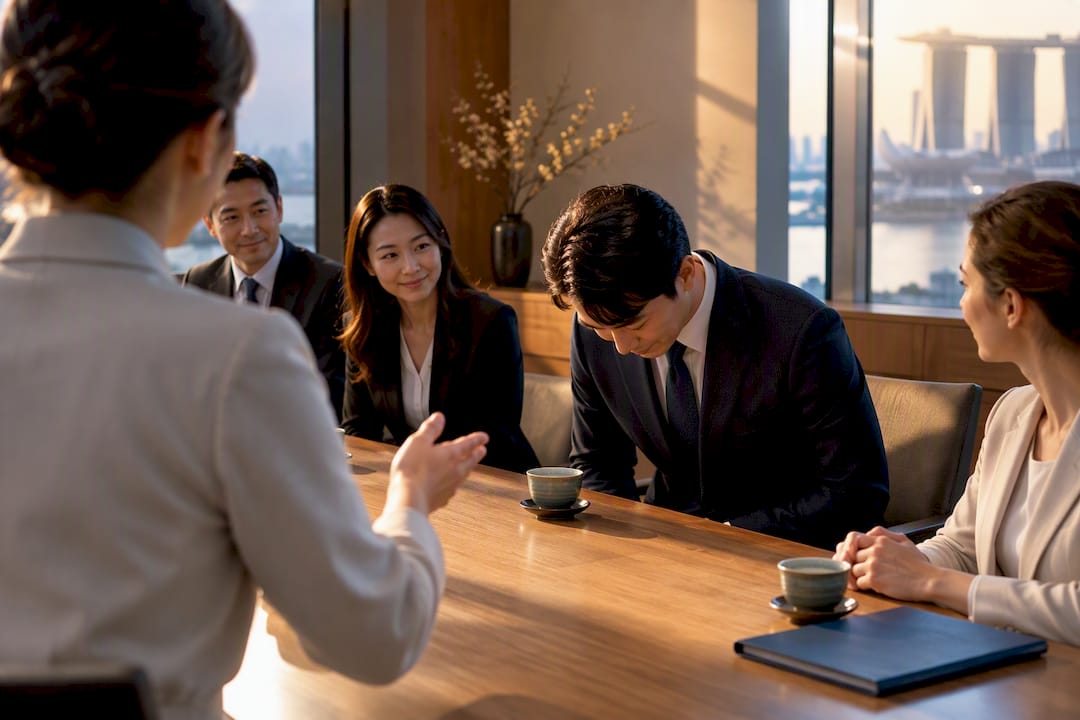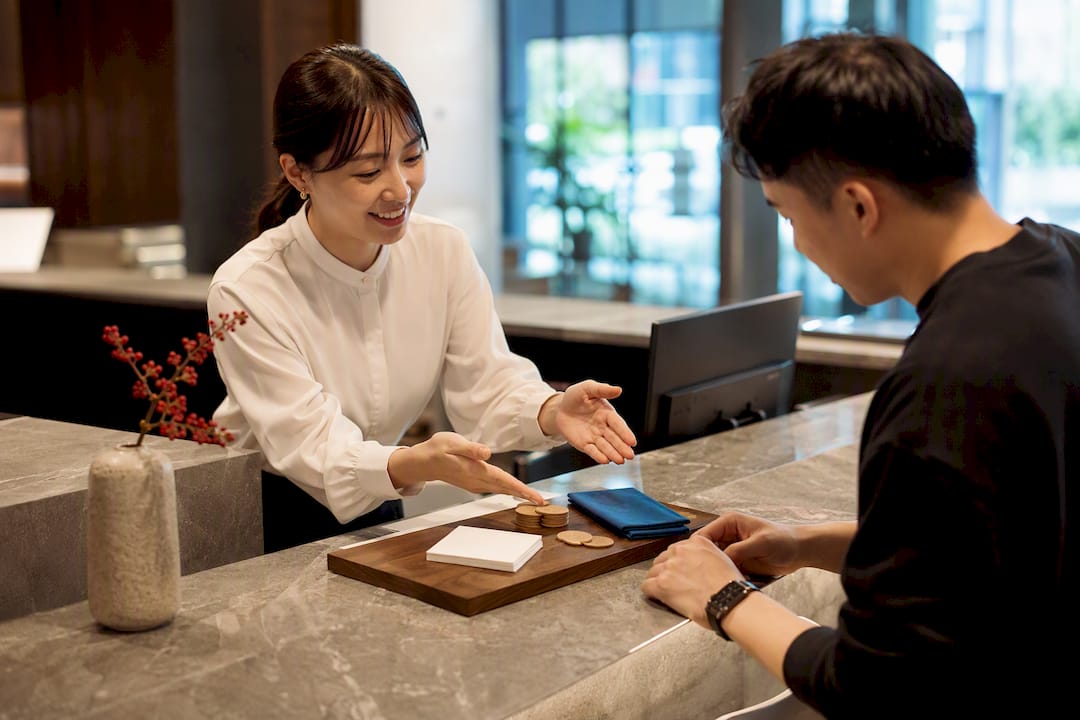
Keigo is the honorific system that governs polite Japanese, built from three layers: polite (teineigo), respectful (sonkeigo), and humble (kenjougo). The rule of thumb for business is simple: default to polite desu/masu speech in every interaction, then raise your language to full keigo when you address someone senior, external, or in a sensitive situation like an apology. What follows covers the phrases, email templates, and mistakes to avoid so that decision becomes automatic.
TL;DR:
- Mastering when to switch between polite, respectful, and humble keigo is vital, especially in formal emails and calls with clients or seniors.
- Using the correct greeting phrases and deferential language depending on the relationship and situation prevents sounding either too casual or overly stiff.
- Avoid common mistakes like stacking honorifics or misusing humble forms for others’ actions to maintain professionalism and clarity.
- Adjust your keigo level based on the audience, relationship duration, and topic sensitivity, rather than memorizing fixed rules alone.
- Practice real-time judgment through role-play and live correction, as timing and tone are more crucial than vocabulary memorization.
Table of Contents
- What Is Polite Speech in Japanese? The Three Types of Keigo
- Essential Business Greetings and Everyday Office Phrases
- How to Write a Polite Japanese Business Email
- Meeting, Phone, and Zoom Etiquette in Japanese
- Common Keigo Mistakes and How to Fix Them
- A Simple Decision Flow for Choosing Your Politeness Level
- Why Structured Practice Beats Memorizing Rules
- The Real Skill Isn’t Vocabulary, It’s Timing
- Ready to Put This Into Practice?
- Sources
- FAQ
What Is Polite Speech in Japanese? The Three Types of Keigo
Keigo is not one register but three overlapping systems, and mixing them up is the single most common error learners make. Getting this framework right is what separates someone who sounds stiff from someone who sounds genuinely professional, because keigo divides into a structured system, rather than a single sliding scale of formality.
- Teineigo (polite language): the desu/masu forms you already know from textbooks. This is your neutral default with colleagues, clients, and strangers.
- Sonkeigo (respectful language): raises the status of the person you’re talking about, used for a boss’s, client’s, or senior’s actions. “To go” becomes irassharu instead of iku.
- Kenjougo (humble language): lowers your own status to elevate the listener, used for your own actions toward someone senior. “To do” becomes itasu instead of suru; “to say” becomes moushiageru.
The prefixes o- and go- are your visual cue: o-namae (your name, respectful) versus o-denwa itashimasu (I will call you, humble). Memorize the irregular verb pairs first, since they carry the heaviest workload: iku/kuru → irassharu (respectful) or mairu (humble); suru → nasaru (respectful) or itasu (humble); iu → ossharu (respectful) or moushiageru (humble).
None of this exists to enforce rigid hierarchy. Official cultural guidance actually frames modern keigo around mutual respect between speakers, adapted to the relationship at hand rather than locked to fixed rank. That reframing matters for how you should think about the phrases below: they’re tools for the situation, not a ladder you’re required to climb every time.
Essential Business Greetings and Everyday Office Phrases
A handful of set phrases carry most of the weight in daily office life, and knowing exactly when to deploy each one saves you from sounding either too casual or oddly formal. These aren’t interchangeable pleasantries; each one has a specific slot.
- おはようございます (ohayou gozaimasu): morning greeting, used until roughly 10 or 11 a.m., appropriate for anyone regardless of rank.
- お疲れさまです (otsukaresama desu): the office workhorse. Say it when arriving, leaving, passing a colleague in the hallway, or opening an internal message. It roughly means “thank you for your effort” and works at any time of day.
- いつもお世話になっております (itsumo osewa ni natte orimasu): “thank you for your continued support,” reserved for external parties like clients, vendors, or partners. Never use this with your own coworkers.
- よろしくお願いいたします (yoroshiku onegai itashimasu): an all-purpose closer meaning something close to “I appreciate your cooperation,” used at the end of requests, introductions, and emails alike.
Here’s a short exchange that shows the register shift in action. A vendor calls your office:
Vendor: いつもお世話になっております。田中と申します。
You: こちらこそ、お世話になっております。少々お待ちください。
Notice that “osewa ni natte orimasu” gets echoed back, not restated identically; that small variation signals you were listening, not reciting a script.
For requests, softeners do the real work. Instead of a flat “please send it,” professionals say ご送付いただけますでしょうか (could you possibly send it), stacking a humble-adjacent request form with a question that leaves room for the other person to decline gracefully. Apologies split cleanly by audience: すみません works between coworkers, but 申し訳ございません is the external-facing version you want in front of a client.
Pro Tip: Keigo lands better when it’s slower and slightly lower in pitch than casual speech. Rushing through polite phrases is what makes them sound memorized rather than sincere. Native speakers often pause half a beat before a request phrase like “yoroshii deshou ka,” and that pause is doing as much work as the words.
How to Write a Polite Japanese Business Email
Email keigo follows a more rigid pattern than spoken keigo because there’s no tone of voice to soften a misstep, and readers can reread and judge a phrase at leisure. Getting the opener right sets the register for everything that follows.
Choosing your opener:
- First contact with a new company: 突然のご連絡失礼いたします (apologies for the sudden contact), followed by your name and company.
- Ongoing external relationship: いつもお世話になっております, the standard external default.
- Internal message to a colleague or boss: お疲れさまです works fine; save the external opener for outside parties only.
Think of formality as three rough bands: Level A (external, senior, first contact) demands full keigo throughout; Level B (internal, senior, ongoing relationship) blends teineigo with selective sonkeigo/kenjougo; Level C (internal, peer, routine matters) can run mostly on teineigo alone. Applying different formality levels to internal versus external recipients is the single biggest structural decision in any email, made before you write a single sentence of content.
One easy rule that trips up learners constantly: 貴社 (kisha) is the written form for “your company,” used in emails and letters, while 御社 (onsha) is the spoken equivalent used in meetings and on the phone. Mixing them up is a small error, but a noticeable one. Close your email with your closer, then company name, department, and your name stacked in that order, never the reverse — see this farewell message to coworkers example for phrasing guidance.
Four templates worth keeping on hand:
- First contact: 突然のご連絡失礼いたします。[Company] の [Name] と申します。この度は〜の件でご連絡させていただきました。ご確認いただけますでしょうか。よろしくお願いいたします。
- Request: いつもお世話になっております。恐れ入りますが、〜についてご確認いただけますでしょうか。お手数をおかけしますが、よろしくお願いいたします。
- Apology: この度はご迷惑をおかけし、誠に申し訳ございません。今後このようなことがないよう努めてまいります。
- Follow-up: 先日はお時間をいただき、誠にありがとうございました。その後いかがでしょうか。
The phrase ご確認いただけますでしょうか (“could you please confirm”) shows up constantly because it’s a reliably correct, patterned way to make a request without overreaching into stacked formality. For more openers and closers by scenario, Japanese Explorer’s email etiquette overview walks through additional line-by-line examples.
Meeting, Phone, and Zoom Etiquette in Japanese
Live interaction adds a timing layer that email doesn’t require: knowing when to speak, when to yield the floor, and how to exit gracefully.
- Introductions follow a strict order: company, then name, then role. “[Company name] no [Your name] to moushimasu, [role] wo shite orimasu” covers all three in one breath.
- Taking the floor politely often starts with a cushion phrase like 恐れ入りますが (osoreirimasu ga, “I’m sorry to interrupt, but”), which softens the interruption before you say anything substantive.
- Disagreeing rarely happens head on. A common pattern is おっしゃる通りですが (you’re absolutely right, but), which validates the other person before introducing a different view.
- Phone calls open with your company and name before anything else, and you wait for the other party, especially a senior one, to hang up first.
- Zoom etiquette mirrors phone etiquette with one addition: entering the call a minute or two early and staying until the host or senior participant disconnects is treated the same as waiting on a phone line, and a slight nod toward the camera when greeting someone functions as a seated bow.
A vendor call and an internal Zoom huddle call for genuinely different scripts. With a client, every phrase in the exchange sits at the higher keigo band; with your own team, teineigo carries the whole conversation comfortably. Japanese Explorer’s meeting phrases guide breaks down more of these client-versus-internal contrasts if you want the fuller phrase set.
Common Keigo Mistakes and How to Fix Them
Most keigo errors fall into three repeatable categories, and all three are fixable once you know what to listen for.
- Double keigo (二重敬語): stacking two honorific markers on one verb, like ossharareru (a doubled respectful form of “to say”). The fix is osshaimasu, one clean respectful conjugation, not two.
- Wrong direction of humility: using kenjougo for someone else’s action, such as saying a client “itashimasu” (a self-humbling verb) when you mean the client is doing something. Humble forms describe your own actions only; the client’s action needs sonkeigo, like nasaimasu.
- Overuse and unnecessary stacking: piling polite prefixes onto every noun in a sentence until it sounds artificial. Simpler teineigo is often the better choice for routine, low-stakes exchanges.
Before you speak or hit send, run a three-step check: who is performing the action (you or them), does that verb match the correct humble or respectful direction, and have you accidentally doubled a conjugation.
Pro Tip: When you’re not sure whether a sentence has doubled up on keigo markers, say it slowly and count the honorific pieces. If a single verb carries two honorific elements, one of them almost always needs to go.
A Simple Decision Flow for Choosing Your Politeness Level
Rather than memorizing rules for every scenario, run through four questions in order:
- Internal or external? External conversations default to a higher keigo band from the first sentence.
- How long has the relationship existed? A new client gets more formality than a vendor you’ve worked with for years, even though both are external.
- How sensitive is the topic? Apologies, complaints, and requests for favors all pull the register upward regardless of who you’re addressing.
- Pick your level. Match Level A, B, or C from the email section above, or the spoken equivalent.
Two shortcuts help when you’re moving fast: mirror the other person’s register rather than guessing independently, and when genuinely unsure with an external party, round up rather than down. A first client meeting calls for full sonkeigo and kenjougo throughout. An urgent internal apology to your manager still warrants 申し訳ございません even though the rest of the message can stay in teineigo. A routine internal request to a peer needs nothing more than a polite です/ます sentence.
Why Structured Practice Beats Memorizing Rules
Reading a list of keigo verbs gets you halfway there; the other half is judgment built through repetition, which is mostly a matter of knowing when to elevate or simplify rather than reciting every honorific form on command. That judgment develops fastest through role-play and live correction, since a script alone won’t tell you that you’ve reversed a humble and respectful verb until someone catches it in real time.
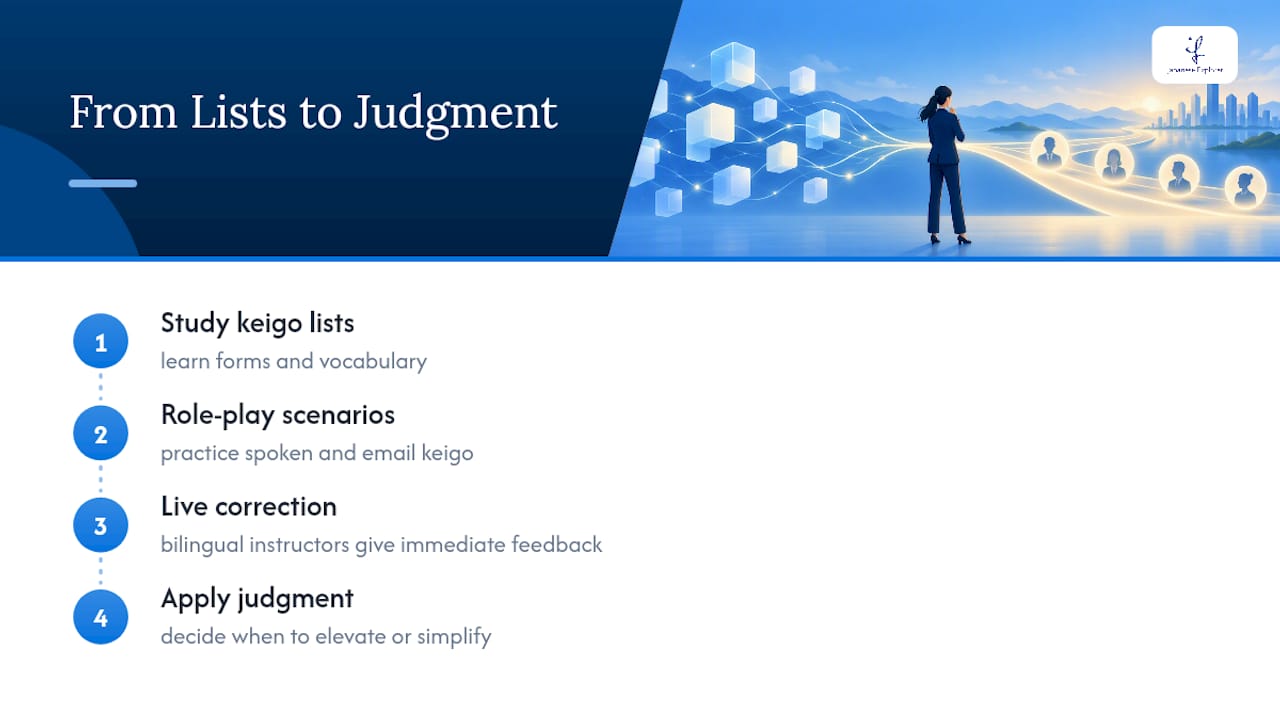
Some language schools structure their Business Japanese Courses around exactly that kind of practice, with bilingual instructors who model both spoken and email keigo in scenarios drawn from actual office situations. Courses may run in-person, online over Zoom, or as corporate training, fitting various professional settings. Repeated feedback on the specific double-keigo and wrong-direction mistakes covered above is what closes the gap between knowing the rule and applying it under pressure.
The Real Skill Isn’t Vocabulary, It’s Timing
Most guides to Japanese business etiquette treat keigo as a vocabulary problem: memorize enough respectful and humble verbs and you’re set. That’s backwards. The verbs themselves are a short list. What actually separates a fluent professional from an awkward one is timing, knowing exactly when to shift registers mid-conversation, not whether you can conjugate irassharu correctly on a flashcard.
The conventional advice oversells memorization and undersells judgment. You can know every keigo form in this article and still sound stiff if you apply full formality to a five-year vendor relationship that’s clearly settled into a warmer, more relaxed register. Native speakers adjust constantly, downward as often as upward, and the official guidance on mutual respect backs that flexibility rather than a fixed hierarchy.
If you take one thing from this guide, make it the TPO decision flow, not the phrase list. Phrases are replaceable; the four questions that tell you which phrase to reach for are not. Practice that decision under real conditions, with a real conversation partner correcting you, and the vocabulary will follow far faster than it will from a list alone.
— Paul
Ready to Put This Into Practice?
Reading about keigo and using it correctly under pressure, on a live call or in a client email, are two different skills. Japanese Explorer’s Business Japanese Course is built around that gap, pairing bilingual instructors with role-play scenarios so you get corrected on the double-keigo and wrong-direction mistakes covered above in real time, not after the email has already been sent.
Formats are flexible enough to match how you actually work: a private online or in-person course runs one-on-one so every session targets your specific weak points, a corporate training track brings the same structure to your whole team, and small group classes give you practice partners at a similar level. Registration for private lessons usually starts with a one-time fee per student, on top of the course fee itself. If you’re drafting emails for external clients or sitting in on your first Zoom meeting with Japanese partners, reach out through the Business Japanese Course page to request a syllabus or book a starting session at the Anson Road training centre in Singapore, right above Tanjong Pagar MRT.
Sources
- Cultural council report on keigo
- How to write a Japanese business email: Real-World Japanese
- Jepang
- How to Write Professional Japanese Business Emails: Etiquette, Phrases, and Zoom Rules – JLPT Samurai
FAQ
What Is Japanese Business Etiquette?
Japanese business etiquette centers on showing respect through language, timing, and small physical cues like bowing or entering a meeting early. It includes using the correct keigo register for your audience, following a strict order for introductions, and observing conventions like waiting for a senior colleague to leave a call first.
How Do You Properly Greet a Japanese Businessperson?
Introduce yourself with company name, then your name, then your role, paired with a slight bow or nod on camera. Follow with よろしくお願いいたします (yoroshiku onegai itashimasu) to close the introduction, since this closing phrase is standard across nearly every first meeting.
What Are Some Polite Words in Japanese?
Common polite phrases include お疲れさまです (otsukaresama desu) for office greetings, いつもお世話になっております (itsumo osewa ni natte orimasu) for external contacts, and 申し訳ございません (moushiwake gozaimasen) for formal apologies. Each one is scoped to a specific audience, internal versus external, so swapping them changes how appropriate the phrase sounds.
What Is the Business Language of Japan?
Japanese is the primary business language in Japan, and workplace communication runs on keigo, the honorific system covering polite, respectful, and humble speech. Professionals working with Japanese companies, even in English-speaking contexts like Singapore, often need working keigo for emails, calls, and meetings with Japanese clients or partners.
How Much Does a Business Japanese Course Cost?
Japanese Explorer’s Business Japanese Course starts from $350 for group formats, while private physical or online business courses run from 1,480 dollars. Current pricing and available start dates are listed on the Business Japanese Course page.