A well-structured beginner Japanese course starts with hiragana and pronunciation, moves into survival phrases and basic grammar, introduces a moderate range of kanji characters, and measures progress against Can-do goals tied to JF Standard A1 outcomes, the same level referenced by JLPT N5. Expect around 2 to 3 hours of class time weekly, plus 40 to 90 minutes of daily practice, to move through this sequence at a comfortable pace.
TL;DR:
- Most beginner courses follow a structured order starting with hiragana, then katakana and basic phrases, before gradually introducing vocabulary and kanji around month two.
- Courses are built around Can-do statements aligned with the JLPT N5 level, focusing on real communicative tasks rather than purely grammar rules.
- A typical 10 to 12 week syllabus includes weekly goals like greetings, shopping, daily routines, and early kanji, reinforced through classroom activities and homework.
- Regular assessment methods include kana quizzes, lesson tests, oral interviews, and progress checklists, all designed to ensure practical language use.
- Daily study routines of 40 to 90 minutes, combining spaced repetition, listening, shadowing, and writing practice, support steady progress alongside class lessons.
Table of Contents
- How the JF Standard shapes beginner course goals
- The building blocks and the order that actually works
- A sample 10 to 12 week beginner syllabus you can follow
- Class formats and how pacing changes your progress
- How progress gets measured along the way
- Building study habits that match the course pace
- How Japanese Explorer builds this structure into its beginner course
- Choosing the right path for your goals
- Which Japanese Explorer course fits this structure
- Sources
- FAQ
How the JF Standard shapes beginner course goals
Most quality beginner courses today are not built around grammar checklists. They are built around Can-dos, short statements of what a learner can actually do with the language at each stage. This comes from the JF Standard, a framework aligned with the CEFR scale that describes proficiency in six levels, from A1 through C2, using real communicative tasks rather than raw vocabulary counts.
For a beginner, that means the target level is A1, and the objectives read like things you would actually say or do, not grammar rules you would memorize. A Can-do for week one might be “I can introduce myself and say where I’m from.” A Can-do for week six might be “I can order food at a restaurant and ask for the bill.” This is also the approach behind Marugoto, the JF-produced course materials built specifically around A1 starter-level Can-dos.

This framing matters for two practical reasons. First, it keeps motivation high, because you’re working toward tasks you can picture using in real life rather than abstract categories like “particles” or “verb conjugation.” Second, it makes assessment far clearer: instead of asking “do you know te-form,” a Can-do–based check asks “can you describe your daily routine,” which is something you either can or cannot yet do.
A typical beginner module built this way defines its goals something like this:
- Introductions module: “I can greet someone and give basic personal information.”
- Shopping module: “I can ask the price of an item and complete a simple purchase.”
- Daily life module: “I can describe my typical day using simple time expressions.”
Each Can-do becomes the anchor for that module’s vocabulary, grammar points, and homework, so nothing gets taught without a clear reason tied to something you’ll actually use.
The building blocks and the order that actually works
Beginner Japanese has a fairly settled order, and it isn’t arbitrary. Practical learning-order guidance consistently recommends starting with hiragana, since it’s the phonetic base for nearly everything else you’ll read, including grammar particles and verb endings. Most learners who study daily pick up hiragana in about 1 to 2 weeks.
Katakana comes next, usually overlapping with the tail end of hiragana study rather than waiting for a clean break. Survival phrases and the earliest grammar patterns start around the same time, which keeps you speaking from roughly week 2 instead of spending a month buried in scripts before saying a single sentence.
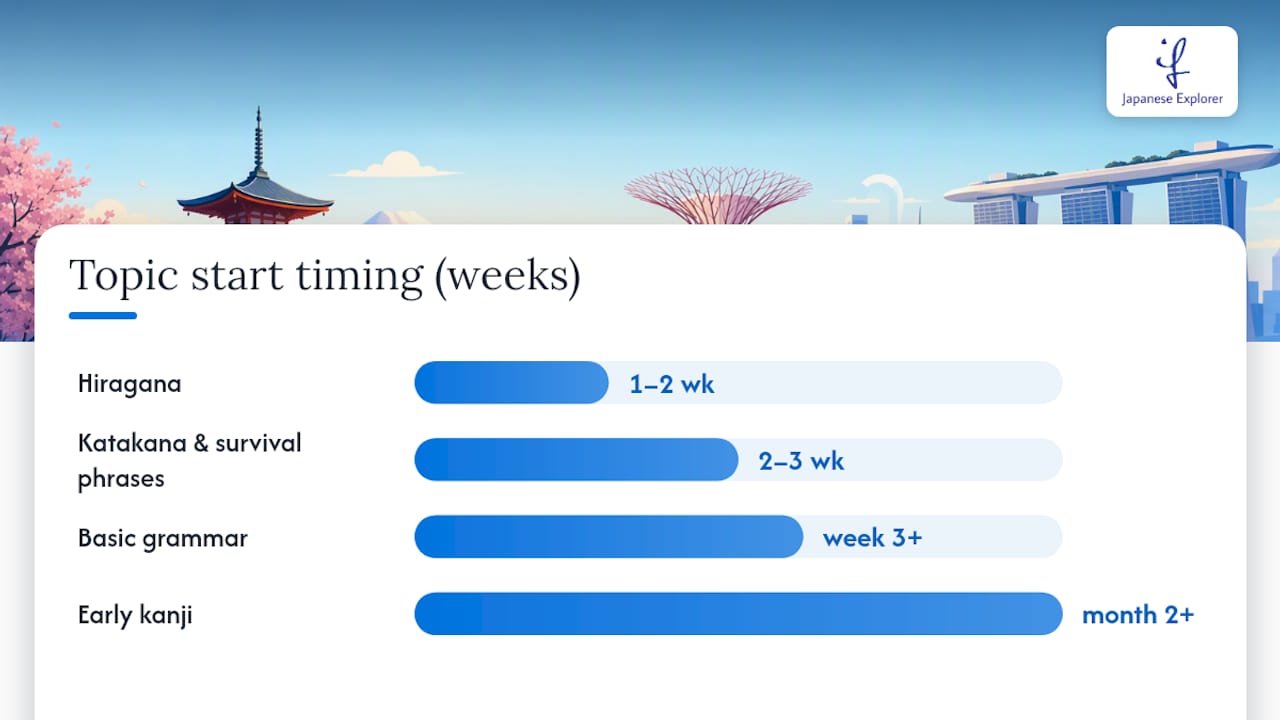
Kanji comes later, and for good reason: kanji only makes sense once you have vocabulary to attach it to. A sensible beginner course introduces kanji after you’ve built a small working vocabulary, often starting in the second month, with an initial target in the range of 30 to 80 characters. Some institutional syllabi land around 50 kanji for a first beginner course, which lines up with the MIT Japanese I syllabus, an early reference point still used to describe how university-level beginner courses sequence content.
A practical order looks like this:
- Hiragana (weeks 1 to 2): the phonetic foundation for reading and writing everything else.
- Katakana and survival phrases (weeks 2 to 3): learned in parallel so you’re speaking almost immediately.
- Basic grammar (week 3 onward): simple sentence patterns built directly on the vocabulary you already have.
- Early kanji (month 2 onward): introduced once words carry enough meaning for the characters to stick.
Pro Tip: Write new kanji next to the hiragana word you already know for it. Seeing 食べる next to たべる cements the connection faster than studying the character alone.
A sample 10 to 12 week beginner syllabus you can follow
A 10 to 12 week block is a practical unit for adult learners: long enough to reach a real set of Can-dos, short enough to stay motivating, and it fits neatly around regular quizzes and assessments. Here’s how a syllabus mapped to this structure typically breaks down, borrowing the FACT (explanation) and ACT (practice) session split described in the MIT syllabus.
| Week | Focus | In-class activity | Can-do outcome | Homework focus |
|---|---|---|---|---|
| 1-2 | Hiragana and greetings | FACT: script drills; ACT: greeting exchanges | I can greet someone and introduce myself | Kana writing practice, listening clips |
| 3 | Katakana and numbers | FACT: katakana rules; ACT: counting practice | I can state numbers and simple prices | Katakana quiz, number drills |
| 4 | Self-introduction depth | FACT: particles wa/mo; ACT: paired introductions | I can describe my job or study and nationality | Kana check, vocabulary review |
| 5 | Daily objects and existence | FACT: arimasu/imasu; ACT: describing a room | I can say what objects are present and where | Short listening quiz |
| 2 to 3 weeks | Shopping and prices | FACT: counters; ACT: mock shopping dialogue | I can buy an item and ask its price | Role-play recording |
| 40 to 90 | Time and routines | FACT: time expressions; ACT: describing a day | I can describe my daily schedule | Lesson test 1 |
| 8 | Food and ordering | FACT: verb forms; ACT: restaurant role-play | I can order food and ask for the bill | Vocabulary and kanji quiz |
| 10 to 12 | Early kanji introduction | FACT: 20 to 30 kanji; ACT: reading short signs | I can read common kanji in context | Kanji writing practice |
| 10 | Directions and travel | FACT: location grammar; ACT: asking directions | I can ask for and give simple directions | Speaking recording |
| 12 | Review and oral practice | ACT-heavy: mixed conversation drills | I can hold a short conversation on familiar topics | Mock oral interview |
| 12 | Final assessment | Oral interview and written final | I can demonstrate A1-level Can-dos across modules | Final exam |
If you’re moving faster, compress weeks 4 and 5 into one and add a second review week near the end. If you need a slower pace, split week 10 to 12’s kanji introduction across two weeks rather than rushing new characters alongside a review test. The beginner course structure page walks through a similar module breakdown if you want to see how this plays out in an actual classroom setting.
Class formats and how pacing changes your progress
Two session types drive most quality beginner courses. FACT sessions are teacher-led: this is where grammar gets explained, new vocabulary gets introduced, and questions get answered before you’re expected to produce anything. ACT sessions flip that entirely: they’re conducted in Japanese only, focused on using what you just learned in real exchanges rather than talking about it.
The pairing matters. A FACT session without a following ACT session leaves knowledge passive. An ACT session without prior FACT input leaves you guessing at structures you haven’t actually learned yet.
Format choice shapes how this plays out:
- Group classes suit steady, social learners who benefit from hearing classmates make (and correct) similar mistakes.
- Private lessons suit learners on a tighter timeline, especially those aiming at a JLPT N5 target date or a specific travel deadline.
- Live online classes suit learners who need scheduling flexibility but still want real-time FACT and ACT practice rather than pre-recorded content.
For steady beginner progress, aim for 2 to 3 hours of class time weekly split across FACT and ACT sessions, backed by daily homework rather than one long cram session before class.
How progress gets measured along the way
Quality beginner courses track progress constantly, not just at the end. A typical rhythm includes daily or weekly vocabulary and kana quizzes, periodic lesson tests after each module, a midterm and final exam, and oral interviews that check whether Can-dos actually hold up in spoken conversation.
- Kana checks: short quizzes in the first two to three weeks confirm hiragana and katakana are solid before grammar builds on top of them.
- Lesson tests: given after each module to confirm the Can-do for that unit has actually been met.
- Oral interviews: typically at the midpoint and end of a course, testing spontaneous use rather than memorized answers.
- Self-assessment checklists: learners rate their own confidence against each Can-do, which helps flag weak spots before a formal test does.
One consistent benchmark used across beginner Can-dos is alignment with JLPT N5, the entry-level proficiency test many learners use as an external checkpoint for their A1 progress. Reaching that benchmark doesn’t require passing the JLPT itself, but the Can-dos in a well-built beginner course map closely to what N5 expects.
Building study habits that match the course pace
Class time alone rarely gets anyone through a beginner Can-do on schedule. Most beginner programs assume 40 to 60 minutes of daily preparation outside class, and a slightly wider 40 to 90 minute range works well depending on how quickly new material sinks in for you.
A simple 60-minute daily routine could look like this:
- 15 minutes of spaced repetition using a tool like Anki to review vocabulary and kanji you’ve already met.
- 20 minutes of listening, using short native audio clips rather than long, dense podcasts that outpace your level.
- 15 minutes of shadowing, repeating short phrases aloud right after hearing them to build pronunciation and rhythm.
- 10 minutes of writing practice, drilling kana or new kanji by hand rather than typing them.
Pro Tip: Do your listening and shadowing practice before your vocabulary review, not after. Your ear warms up first, which makes new words easier to recall later in the session.
Tie this routine directly to whatever your class assigned that week. Reviewing kanji from a module you’ve already finished does less for you than reinforcing the Can-do you’re actively working toward.
How Japanese Explorer builds this structure into its beginner course
Japanese language schools typically offer courses for learners of various ages and proficiency levels, often with curricula designed to integrate grammar, speaking, and listening into every lesson rather than teaching them in isolation. Experienced instructors often teach in English and focus on interactive, real-world communication rather than lecture-style grammar drilling.
That structure maps closely to the syllabus outlined above:
- Flexible formats let you choose group classes, private lessons, or live online sessions depending on your pace and schedule.
- FACT and ACT balance shows up in how lessons pair grammar explanation with immediate speaking practice.
- Practical skill integration means kana, vocabulary, and early kanji are taught alongside speaking from the first weeks, not in isolation.
The beginner course page breaks down how these lessons are organized module by module, and the foundational guide to learning Japanese covers the early kana and study-order questions in more depth if you want to prepare before your first class.
Choosing the right path for your goals
The syllabus above works as a baseline, but where you should lean harder depends on what you’re actually trying to do with the language. If your goal is JLPT N5 within a fixed timeframe, front-load kanji and grammar earlier than week 10 to 12, and add weekly written drills alongside the FACT sessions rather than after them.
If your goal is conversation or travel readiness, do the opposite: push more of your weekly hours into ACT sessions and treat kanji as optional until your speaking Can-dos are solid. Homework should shift toward speaking recordings rather than written kanji practice, and assessment should weigh oral interviews overwritten tests.
A rough rule of thumb: JLPT-focused learners benefit from private lessons paced against exam dates, conversation-focused learners do well in group classes that force regular speaking practice, and travel-focused learners often get the most out of a short, intensive private block just before departure.
— Paul
Which Japanese Explorer course fits this structure
If the syllabus above matches what you’re after, Japanese Explorer runs beginner courses in the same three formats discussed here, so you can pick the one that fits your schedule rather than reshaping your week around a fixed class.

Group Japanese Classes run at 350 dollars one-off and suit learners who want steady weekly progress alongside classmates working through the same Can-dos. If you’re aiming for a JLPT deadline or simply prefer a pace built around your own schedule, the Private Physical or Online Conversational Japanese Course runs between 1,280 and 1,580 dollars one-off, with a one-time registration fee from 50 dollars per student. Learners who need flexibility without giving up live instruction can look at the Online Japanese Course, which delivers the same FACT and ACT structure over Zoom.
Not sure which format matches your pace? Book a placement test or a trial class through the beginner course page to see how the syllabus feels before committing.
Sources
- Minna no Kyozai – JF Standard (Can-do) overview
- MIT – Japanese I syllabus (FACT vs ACT; assessments)
- What should you learn first in Japanese? — JP YoKoSo
- Overview: JF Standard and practical Can-dos (2023 report)
FAQ
What is N1, N2, N3, N4, N5 in Japanese?
These are the five levels of the JLPT, Japan’s standardized proficiency test, with N5 as the entry level and N1 as the most advanced. A well-structured beginner course generally builds toward Can-dos that align with the N5 benchmark without requiring you to sit the exam itself.
What is the 80/20 rule in Japanese?
There’s no single official “80/20 rule” tied to a named source for Japanese study, so treat any specific ratio you see online with caution. The practical version most learners apply is prioritizing the highest-frequency vocabulary, grammar patterns, and kana first, since those show up constantly in beginner Can-dos like introductions and daily routines.
What is the best way for a beginner to learn Japanese?
Start with hiragana, move into katakana and survival phrases in parallel, then build basic grammar before introducing kanji once vocabulary gives it context. Pairing daily practice, such as spaced repetition and shadowing, with structured class time following FACT and ACT sessions tends to produce steadier progress than self-study alone.
How long does it take to learn beginner-level Japanese?
A typical beginner course runs 10 to 12 weeks, with hiragana taking about 1 to 2 weeks and early kanji study beginning around month two. Daily study of 40 to 90 minutes alongside 2 to 3 hours of weekly class time is a realistic pace for reaching A1-level Can-dos.
Does Japanese Explorer offer beginner Japanese courses?
Yes, Japanese Explorer offers beginner Japanese courses in group, private, and online formats, with a curriculum guided by the Association for Japanese-Language Teaching. Group classes are 350 dollars one-off, while private lessons range from 1,280 to 1,580 dollars one-off with a registration fee from 50 dollars per student.