TL;DR:
- Polite language in Japanese business relies on keigo, a structured honorific system divided into respectful, humble, and polite forms. Proper keigo application requires understanding who performs each action and avoiding common errors like double keigo and incorrect honorific usage, especially in emails and meetings. Mastery depends on judgment and practice, with structured training helping expatriates communicate effectively and respectfully.
Polite language in Japanese business is expressed through keigo, a structured system of honorific speech that governs how respect, humility, and formality are communicated in corporate settings. Keigo is not optional etiquette. It is the baseline expectation in every Japanese professional interaction, from email correspondence to boardroom introductions. For expatriates and business professionals working with Japanese companies, understanding keigo determines whether you are perceived as trustworthy and competent or inadvertently disrespectful. This guide breaks down the three core forms, the most common errors, and exactly how to apply polite language in Japanese business emails and meetings.
What is polite language in Japanese business?
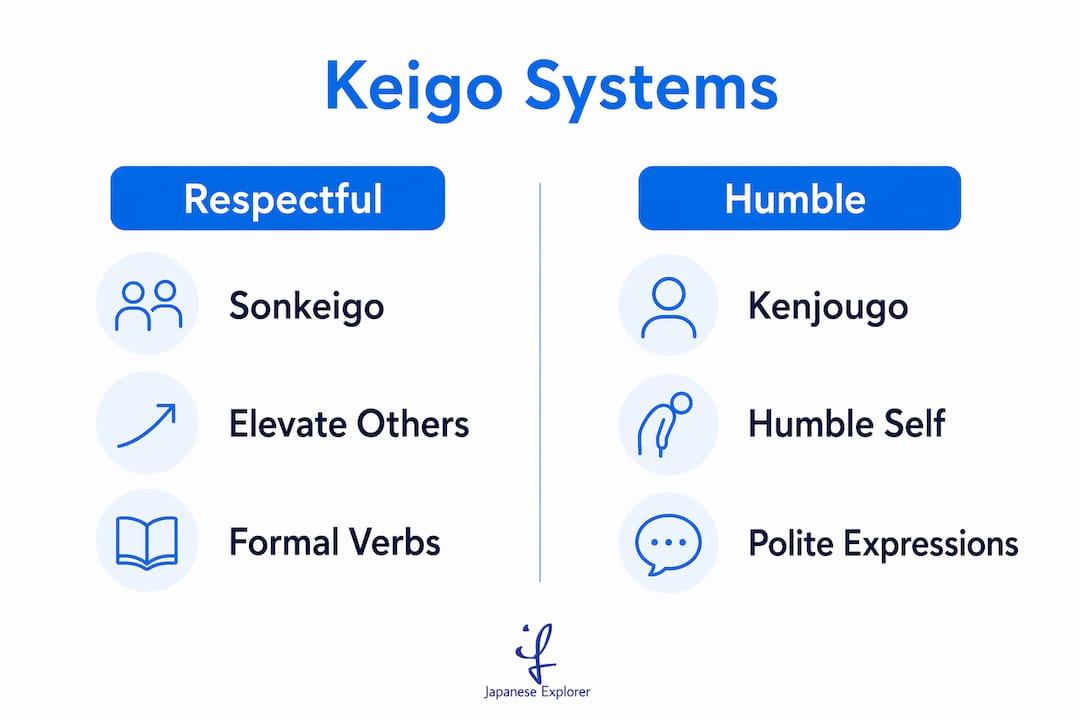
Keigo divides into three distinct systems, each serving a different communicative function. Knowing which system to use, and when, is the foundation of professional Japanese communication.
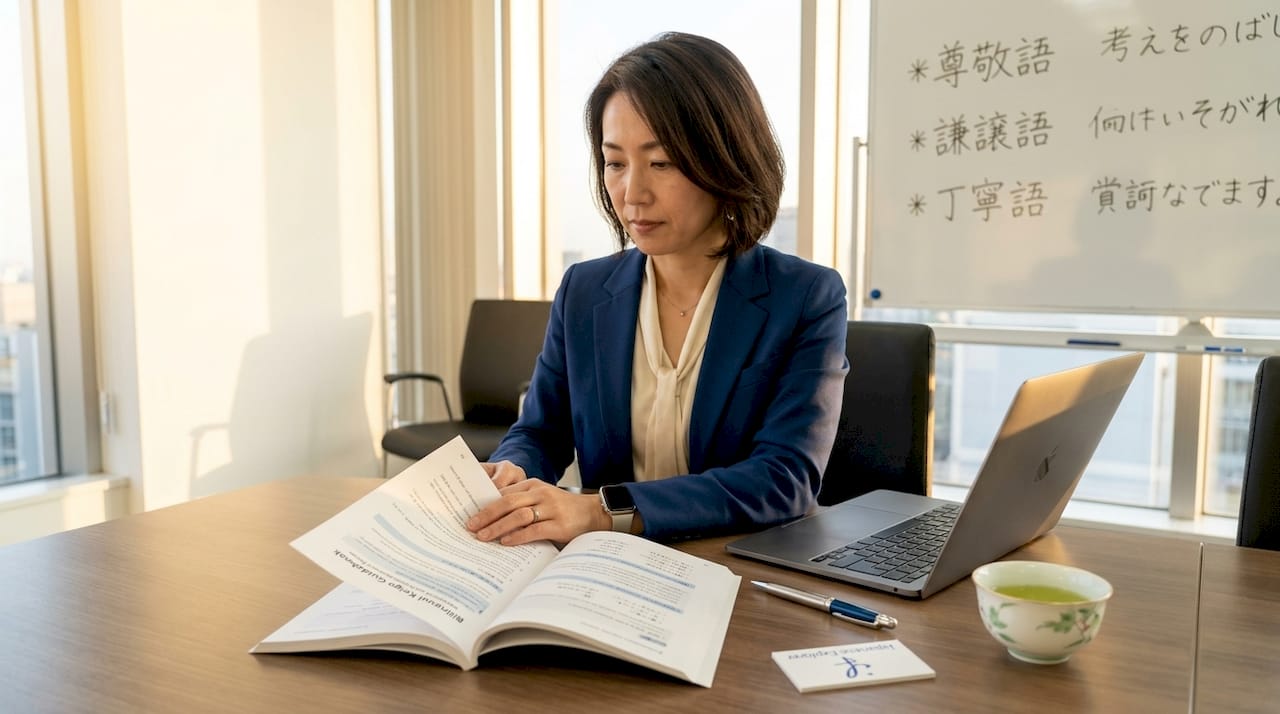
Sonkeigo (尊敬語) is respectful language. You use it to describe the actions or states of someone above you, such as a client, a senior colleague, or a business partner. The verb “to say,” for example, becomes ossharu (おっしゃる) when referring to what your client said.
Kenjougo (謙譲語) is humble language. You use it to describe your own actions or your company’s actions when speaking to or about someone of higher status. “To say” becomes mousu (申す) when you are the one speaking. The direction of the action determines which system applies, and this distinction is where most non-native speakers make errors.
Teineigo (丁寧語) is general polite language. It uses the desu and masu verb endings and applies across most formal situations regardless of hierarchy. For foreigners, consistent desu/masu use is the minimum standard in all professional correspondence.
The table below shows how the same verb shifts across all three forms:
| Plain form | Teineigo (polite) | Sonkeigo (respectful) | Kenjougo (humble) |
|---|---|---|---|
| 言う (to say) | 言います | おっしゃる | 申す / 申し上げる |
| 行く (to go) | 行きます | いらっしゃる | 参る |
| もらう (to receive) | もらいます | お受け取りになる | いただく |
| する (to do) | します | なさる | いたす |
Pro Tip: Before choosing a keigo form, ask yourself one question: whose action am I describing? If it is yours or your company’s, use kenjougo. If it belongs to the client or superior, use sonkeigo. This two-step decision process prevents the majority of honorific errors.
Common mistakes when using keigo in Japanese business
Even fluent Japanese speakers make keigo errors in professional settings. For expatriates, these mistakes carry real professional consequences because they signal either carelessness or a lack of cultural awareness.
Double keigo (二重敬語)
Double keigo, or nijuu keigo, occurs when you stack two honorific elements on the same verb unnecessarily. The phrase ossharareta (おっしゃられた) is a classic example. It combines the respectful verb ossharu with the additional honorific suffix rareru, creating redundancy. The correct form is simply osshatta (おっしゃった). Double keigo examples like this appear frequently in business speech and reduce your credibility rather than enhance it.
Using kenjougo for the recipient’s actions
This is the most structurally damaging error in business Japanese. A phrase like go-kakunin shite kudasai (ご確認してください) incorrectly applies a kenjougo pattern to an action the recipient is being asked to perform. The correct alternative is go-kakunin kudasai (ご確認ください) or the more polished go-kakunin itadakemasu deshou ka (ご確認いただけますでしょうか). The error signals that you have confused the direction of the honorific, which is a fundamental grammatical and social mistake.
Overusing honorifics
Psychologist Iota Tatsunari (五百田達成) states that excessive honorifics confuse rather than clarify in business exchanges. Over-polite language creates distance and can make simple requests sound bureaucratic or evasive. The goal of keigo is accurate and clear information transfer, not a performance of maximum formality. When every sentence is loaded with stacked honorifics, the actual content gets lost.
Here are the most common mistakes to watch for:
- Using ossharareta instead of osshatta (double keigo on a respectful verb)
- Applying go/o + verb + suru patterns to describe the recipient’s actions instead of your own
- Using itadaku when kudasaru is grammatically required because the recipient is giving, not you receiving
- Defaulting to teineigo in situations where sonkeigo is clearly expected, such as addressing a client directly
- Mixing plain form verbs into otherwise formal sentences, which breaks register consistency
Pro Tip: When reviewing a draft email or prepared speech, underline every verb and check who performs that action. If you find a mismatch between the subject and the honorific form, common speaking mistakes like these are exactly what to correct first.
How to write polite Japanese business emails
Business email is where keigo errors are most visible and most permanent. A spoken mistake can be recovered with context and tone. A written error sits in the recipient’s inbox indefinitely.
Foreigners should use desu/masu consistently throughout all professional correspondence as the non-negotiable baseline. From there, the structure of a polite Japanese business email follows a predictable pattern that you can learn and replicate.
- Opening salutation: Address the recipient with their company name, department, and surname followed by sama (様). For example: Tanaka-sama or ABC Corporation Tanaka-sama. Never use first names in formal correspondence.
- Self-introduction line: State your name and company. Use to moushimasu (と申します) rather than desu to apply appropriate humility from the start.
- Gratitude phrase: Open with itsumo osewa ni natte orimasu (いつもお世話になっております), which translates roughly as “Thank you for your continued support.” This phrase is standard in Japanese business emails and skipping it reads as abrupt.
- Main message: State your purpose clearly. Use kenjougo for your own actions and sonkeigo for the recipient’s. For requests, o-negai itashimasu (お願いいたします) is the standard closing phrase.
- Closing line: End with yoroshiku onegai itashimasu (よろしくお願いいたします) or a context-specific variation. This signals respect and invites a positive response.
The table below shows correct phrase choices for common email scenarios:
| Situation | Incorrect phrase | Correct phrase |
|---|---|---|
| Requesting confirmation | ご確認してください | ご確認いただけますでしょうか |
| Apologizing for delay | 遅れてすみません | ご連絡が遅くなり、大変申し訳ございません |
| Referring to your visit | 行きます | 参ります |
| Referring to client’s visit | 来ます | いらっしゃいます |
Honorific directionality is the core principle. Misuse of keigo most often comes from failing to distinguish whose action is being described when selecting sonkeigo or kenjougo. Map every verb to its subject before you write it, and your emails will read as genuinely professional rather than technically polite but structurally flawed.
How to use polite language in Japanese business meetings
Verbal keigo in meetings requires the same precision as written keigo, but with less time to think. The good news is that meetings follow predictable social scripts, and learning the right phrases for each stage gives you a reliable framework.
A survey of 438 HR respondents found that 40% of foreign employees struggled to interpret ambiguous Japanese expressions in the workplace. Indirect language is a feature of Japanese business communication, not a flaw. Recognizing phrases like muzukashii desu ne (難しいですね), which literally means “that’s difficult,” as a polite refusal is as important as knowing the correct honorific verb forms.
Here are the key phrases and conventions for each stage of a business meeting:
- Before the meeting: Greet with yoroshiku onegai itashimasu (よろしくお願いいたします) when being introduced. Use surnames with san (さん) for peers and sama (様) in more formal contexts. Never use first names unless explicitly invited to.
- Opening the meeting: Honjitsu wa ojama itashimasu (本日はお邪魔いたします) acknowledges that you are entering the other party’s space and time. It sets a respectful tone immediately.
- During discussion: Use ossharu toori desu (おっしゃる通りです) to agree with a superior’s point. Avoid blunt disagreement. Instead, use sukoshi chigau kangae mo gozaimasu ga (少し違う考えもございますが) to introduce an alternative view softly.
- Closing the meeting: Honjitsu wa arigatou gozaimashita (本日はありがとうございました) closes respectfully. Follow with hikitsuzuki yoroshiku onegai itashimasu (引き続きよろしくお願いいたします) to signal continued collaboration.
For more structured preparation, reviewing Japanese meeting phrases before client interactions gives you the vocabulary to handle hierarchy and formality with confidence. The cognitive load of real-time keigo selection is real, and preparation is the most effective way to manage it.
Key takeaways
Mastering polite language in Japanese business requires accurate keigo selection based on who performs each action, not simply using the most formal words available.
| Point | Details |
|---|---|
| Three keigo systems | Sonkeigo, kenjougo, and teineigo each serve distinct functions based on hierarchy and action direction. |
| Two-step verb check | Identify who performs the action, then apply sonkeigo for others and kenjougo for yourself. |
| Avoid double keigo | Stacking honorific elements on one verb reduces credibility; use single correct forms like osshatta. |
| Email structure matters | Follow the standard five-part email format and map every verb to its subject before writing. |
| Verbal keigo needs preparation | Learn meeting-stage phrases in advance to manage cognitive load and respond accurately in real time. |
Why keigo fluency is about judgment, not just grammar
I have worked with many expatriates who arrive in Japanese corporate environments having studied keigo from textbooks. They know the verb charts. They can recite the transformations. And yet, within weeks, they tell me the same thing: “I know the rules, but I freeze when I actually have to speak.”
The reason is that keigo is not purely a grammar system. It is a social judgment system. Every time you open your mouth in a Japanese business setting, you are making a real-time assessment of the relationship, the context, and the appropriate register. That takes practice that no chart can fully replace.
What I have found actually works is this: start with accuracy, then build toward fluency. Get the verb directions right first. Nail the email structure. Learn ten meeting phrases cold. Once those are automatic, the cognitive space opens up for you to read the room and adapt. Rigid, mechanical keigo without contextual adaptation can alienate colleagues just as much as incorrect keigo. The goal is not to sound like a compliance manual. It is to communicate clearly and respectfully, in a way that feels natural to your Japanese counterparts.
The expatriates who progress fastest are not the ones who memorize the most. They are the ones who practice in real conversations, make mistakes, get corrected, and adjust. That feedback loop is irreplaceable. If you are not yet in a Japanese-speaking work environment, structured classes with experienced instructors who can correct your keigo in context are the closest substitute.
— Paul
Take your business Japanese to the next level
If you are serious about using polite language effectively in Japanese corporate settings, structured learning makes the difference between knowing keigo and actually using it correctly under pressure.
Japanese Explorer offers business Japanese courses designed specifically for working professionals and expatriates in Singapore. Classes are taught by experienced bilingual instructors who focus on real-world communication, including keigo application, email writing, and meeting etiquette. Flexible group, private, and online options are available to fit your schedule. For organizations looking to build team-wide Japanese communication skills, Japanese Explorer also provides corporate Japanese training tailored to professional use. Classes are held at 10 Anson Road, Level 22, International Plaza, right above Tanjong Pagar MRT.
FAQ
What is keigo in Japanese business?
Keigo is the formal honorific speech system used in Japanese business communication. It includes three forms: sonkeigo (respectful), kenjougo (humble), and teineigo (polite), each applied based on hierarchy and the direction of the action being described.
What are examples of polite Japanese business greetings?
Common formal greetings include yoroshiku onegai itashimasu (よろしくお願いいたします) for introductions and requests, itsumo osewa ni natte orimasu (いつもお世話になっております) as a standard email opener, and honjitsu wa arigatou gozaimashita (本日はありがとうございました) to close a meeting respectfully.
How do sonkeigo and kenjougo differ?
Sonkeigo elevates the actions of the person you are speaking to or about, while kenjougo humbles your own actions. Using kenjougo to describe a client’s actions is a grammatical and social error that signals a misunderstanding of the honorific system.
Why is double keigo a problem in Japanese business?
Double keigo stacks two honorific elements on one verb, such as ossharareta instead of the correct osshatta. It signals a lack of keigo mastery and can undermine your professional credibility even when your intent is to be respectful.
How should foreigners approach keigo in business emails?
Foreigners should use desu/masu consistently as the baseline and apply the two-step verb check: identify who performs each action, then select sonkeigo or kenjougo accordingly. Following a standard five-part email structure and reviewing Japanese business fundamentals builds the confidence to write accurately and professionally.