TL;DR:
- Knowing the terms for classroom lessons, private lessons, and studying Japanese helps learners search for content and describe their studies accurately.
- Using structured resources like NHK Easy Japanese and Japan Foundation Minato supports immersion and beginner-level progress.
A Japanese lesson in Japanese is called 授業 (jugyō) in a classroom setting, レッスン (ressun) for a private or commercial lesson, and the act of learning Japanese is 日本語の勉強 (nihongo no benkyō). Knowing these three phrases lets you search for authentic Japanese-medium content, follow a teacher’s instructions, and describe your studies to a native speaker right away.
Here is one phrase to memorize today: 日本語の授業を受けています (nihongo no jugyō wo ukete imasu) — “I am taking a Japanese lesson.” Say it, write it, search it.
Start here: NHK WORLD-JAPAN Easy Japanese offers multiple bite-sized lessons with audio, scripts, and downloads — free and built for listening-first learners. For structured, CEFR-aligned courses taught mostly in Japanese, open Japan Foundation Minato next.
Table of Contents
- What do “lesson” and “learning Japanese” actually mean in Japanese?
- Where can you find lessons taught primarily in Japanese?
- How do you study effectively when lessons are delivered in Japanese?
- A short beginner mini-lesson in Japanese
- How do you choose a Japanese-medium course that fits your level?
- Why cultural context shapes what you hear in Japanese lessons
- How to use Japanese subtitles and transcripts to get more from every lesson
- Apps and platforms that offer immersive Japanese lessons with native audio
- How to track your progress when studying with Japanese-medium lessons
- Key Takeaways
- The case for leaning into discomfort early
- Guided Japanese lessons online, built for adult learners
- Useful sources
- FAQ
What do “lesson” and “learning Japanese” actually mean in Japanese?
The gap between these words is real, and mixing them up in a lesson context can confuse your teacher or fellow students. Here is a practical breakdown.
Core vocabulary table
| Japanese | Reading | Romanization | Typical context |
|---|---|---|---|
| 授業 | じゅぎょう | jugyō | Formal classroom lesson (school, university, structured class) |
| レッスン | レッスン | ressun | Private lesson, music/language tutoring, commercial class |
| 講座 | こうざ | kōza | A course or series of lessons (online course, lecture series) |
| 勉強 | べんきょう | benkyō | The act of studying; general self-study |
| 日本語の勉強 | にほんごのべんきょう | nihongo no benkyō | “Studying Japanese” — the most natural phrase for learners |
| 学校 | がっこう | gakkō | School — the institution itself |
| 練習 | れんしゅう | renshū | Practice (drilling a skill) |
The common word for school, 学校 (gakkō), comes up constantly in lesson materials, so recognizing it early saves confusion. Hiragana and katakana are worth learning before anything else — they unlock the pronunciation guides printed next to every kanji in beginner texts.
Classroom phrases you will hear in Japanese-medium lessons
Recognizing teacher cues is one of the fastest ways to follow a lesson delivered in Japanese. These phrases act as anchors — once you know them, the lesson structure clicks into place.
- もう一度 (mō ichido) — “One more time” — your teacher wants you to repeat or listen again.
- 聞いてください (kiite kudasai) — “Please listen” — pay attention, audio or teacher speech is coming.
- 練習しましょう (renshū shimashō) — “Let’s practice” — a drill or speaking exercise is starting.
- よくできました (yoku dekimashita) — “Well done” — positive feedback after a correct response.
- わかりましたか? (wakarimashita ka?) — “Did you understand?” — the teacher is checking comprehension.
- 読んでください (yonde kudasai) — “Please read” — you are being asked to read aloud.
A note on politeness
Japanese lessons use polite speech (teineigo) almost exclusively. The verb endings 〜ます (-masu) and 〜です (-desu) signal formal register. When a teacher addresses the class, expect these endings on nearly every sentence. If you hear plain-form speech (futsūkei), the teacher is likely modeling casual conversation for contrast — not being rude.
Where can you find lessons taught primarily in Japanese?
Four resources stand out for U.S.-based learners who want Japanese-medium instruction. Each fits a different level and learning style.
Resource comparison
| Resource | Best for | Format | Language of instruction | Cost | Weekly time |
|---|---|---|---|---|---|
| NHK WORLD-JAPAN Easy Japanese | Absolute beginner | Self-study, audio + script | Mostly Japanese, English support | Free | a short amount of time per lesson |
| Japan Foundation Minato / Marugoto | Early beginner (A1–A2) | Guided online course | Mostly Japanese (Katsudō track) | Free | a few hours each week |
| japanese-lesson.com | Beginner to intermediate | Self-study, grammar + vocab | English explanations, Japanese examples | Free | Flexible |
| Tofugu | Beginner to intermediate | Articles, WaniKani SRS | English-heavy, Japanese examples | Free / Paid (WaniKani) | Flexible |
NHK WORLD-JAPAN Easy Japanese is the most immersive starting point for absolute beginners. Its 48 lessons pair animated skits with downloadable scripts, so you can listen first and read second — exactly the sequence that builds listening comprehension fastest. Access it directly at nhk.or.jp/nhkworld from any U.S. device, no account needed.
Japan Foundation Minato / Marugoto suits learners who want a structured course with clear level markers. The Marugoto online course separates Katsudō (communication practice, mostly in Japanese) from Rikai (grammar explanation). Choosing the Katsudō track gives you a near-immersion experience at A1–A2 level. Courses are mapped to JF Standard levels — a CEFR-like framework — so you always know where you stand communicatively, not just how many vocabulary words you have memorized.
japanese-lesson.com works well as a reference companion. It covers grammar points and vocabulary with clear English explanations alongside Japanese examples, making it useful when a Japanese-medium lesson introduces a structure you cannot quite parse. Think of it as your safety net, not your primary source.
Tofugu is best known for its WaniKani kanji SRS platform and its long-form guides on learning Japanese. The site is English-heavy in its explanations but uses authentic Japanese examples throughout. WaniKani’s paid subscription accelerates kanji reading, which directly improves your ability to follow written lesson materials.
Pro Tip: Start NHK Easy Japanese at Lesson 1 even if you feel ready for something harder. The audio pacing and classroom phrases used in those early lessons train your ear for the exact cues you will hear in any Japanese-medium class.
How do you study effectively when lessons are delivered in Japanese?
Following a lesson taught mostly in Japanese is a skill in itself. This step-by-step routine turns passive listening into real progress.
Before the lesson
- Preview vocabulary. Skim the lesson title and any provided word list. Look up two or three key nouns so they do not stop you cold mid-lesson.
- Set a comprehension goal. Decide what you want to catch: the main topic, three new phrases, or one grammar pattern. A specific target beats vague “try to understand.”
During the lesson
- Listen for teacher cues first. When you hear mō ichido or renshū shimashō, you know what is expected of you even if you miss the surrounding words.
- Note timestamps, not translations. Mark the moments you did not understand rather than pausing to look up every word. Momentum matters more than 100% comprehension on the first pass.
After the lesson
- Review with the transcript. Read the script while replaying the audio at 0.75x speed. Match what you hear to what you see. This is where comprehension gaps close fastest.
- Add new items to an SRS deck. Spaced repetition significantly improves long-term retention for kanji and vocabulary when combined with short, regular sessions. Anki and WaniKani are the two most widely used tools for this.
- Shadow one sentence. Pick the sentence you found hardest to hear. Play it, pause, repeat it aloud three times. Recording yourself and comparing to the original is even better.
- Practice production. Write or say two sentences using vocabulary from the lesson. An AI conversation partner can give you low-stakes speaking practice, though you should validate critical corrections with a human tutor when accuracy matters.
Study frequency
Consistent daily practice of 15–30 minutes outperforms sporadic long sessions for long-term retention. A practical Japanese study plan built around this daily habit is more sustainable than marathon weekend sessions.

Pro Tip: Slow playback speed (0.75x or 0.85x) is not cheating. Native-speed audio is the goal, but training your ear at slightly reduced speed first means you catch more phonemes and build confidence faster.
A short beginner mini-lesson in Japanese
Here is what a Japanese-medium lesson actually looks like at the beginner level. Read each line, check the gloss, then try the exercise at the end.
Sample dialogue: これは何ですか? (Kore wa nan desu ka? — “What is this?”)
| Japanese | Romanization | English gloss |
|---|---|---|
| 先生:これは何ですか? | Sensei: Kore wa nan desu ka? | Teacher: What is this? |
| 生徒:それはペンです。 | Seito: Sore wa pen desu. | Student: That is a pen. |
| 先生:よくできました。もう一度。 | Sensei: Yoku dekimashita. Mō ichido. | Teacher: Well done. One more time. |
| 生徒:それはペンです。 | Seito: Sore wa pen desu. | Student: That is a pen. |
| 先生:聞いてください。これは本です。 | Sensei: Kiite kudasai. Kore wa hon desu. | Teacher: Please listen. This is a book. |
| 生徒:これは本ですか? | Seito: Kore wa hon desu ka? | Student: Is this a book? |
Quick comprehension exercise (2–3 minutes)
Answer these questions in Japanese using the dialogue above as a model:
- これは何ですか? (Point to something on your desk.)
- それは何ですか? (Point to something across the room.)
Notice the teacher’s pattern: question → student response → feedback (yoku dekimashita) → repetition prompt (mō ichido). This call-and-response loop appears in virtually every Japanese-medium lesson, from NHK Easy Japanese to live Zoom classes. Recognizing it means you spend less mental energy figuring out what is happening and more on the actual language.
How do you choose a Japanese-medium course that fits your level?
Not every course that claims to teach “in Japanese” is the right fit. Here is a practical checklist before you commit.
Decision checklist
- Level alignment. Does the course state a CEFR level (A1, A2, B1) or a JLPT equivalent (N5, N4, N3)? Courses built around the JF Standard / Marugoto framework give you communicative benchmarks, not just vocabulary counts.
- Teacher language use. Ask directly: “How much English will you use during lessons?” A good immersion-focused teacher uses English for safety explanations only, not for every grammar point.
- Transcripts and subtitles. Are lesson scripts provided? Without a transcript, reviewing a Japanese-medium lesson is significantly harder.
- Class size. Smaller groups (under eight students) give you more speaking time per session.
- Feedback channels. Can you ask questions between lessons? Asynchronous feedback via messaging or email matters for self-directed learners.
- Pacing. Does the course move at a fixed pace or let you replay and review? Self-paced suits busy schedules; cohort-based suits learners who need accountability.
- Cost and trial options. Many quality resources are free (NHK, Minato). For paid courses, a trial lesson is non-negotiable.
Questions to ask before enrolling
- “Do you provide lesson transcripts or written summaries?”
- “What is the expected weekly practice time outside of class?”
- “How do you handle students who fall behind?”
- “Can I sit in on a sample lesson before committing?”
Running a 2–3 lesson trial
Attend the first lesson with one goal: track how much you understand without pausing. If you catch 60–70% of the content, the level is right. Below 50%, the course may be too advanced for immersion to work efficiently. Above 85%, you are probably ready for the next level up. Use the tips for choosing the right language course to build your own evaluation rubric before you sit down for that trial.
Why cultural context shapes what you hear in Japanese lessons
Japanese classroom language carries cultural weight that pure vocabulary study misses. Understanding a few key norms makes lessons feel less foreign and more navigable.
Hierarchy and honorifics. Teachers in Japan hold a respected social position, and the language reflects this. Your teacher will use teineigo (polite speech) toward students, and students are expected to respond in kind. Dropping to casual speech (futsūkei) with a teacher is considered rude in most contexts, so stick to -masu and -desu endings until you are explicitly invited to use casual forms.
Silence as participation. In many Western classrooms, silence signals confusion. In Japanese lessons, a moment of quiet after a teacher’s question often signals that students are processing respectfully. Do not rush to fill the pause. Waiting a beat before answering is normal and polite.
Group repetition. Choral repetition (minna de itte kudasai — “everyone, please say it together”) is standard practice in Japanese-medium lessons. It reduces the anxiety of individual performance and trains pronunciation in a low-stakes way. Lean into it rather than staying quiet.
Bowing and greetings. Even in online Zoom lessons, many Japanese instructors open with a formal greeting sequence: kiritsu (stand), rei (bow), chakuseki (sit). You may not stand at your desk, but a small nod at the start and end of a lesson signals respect and fits naturally into the cultural frame of the class.
How to use Japanese subtitles and transcripts to get more from every lesson
Transcripts are not a crutch. They are one of the highest-leverage tools available for learners studying with Japanese-medium content, and most learners underuse them.
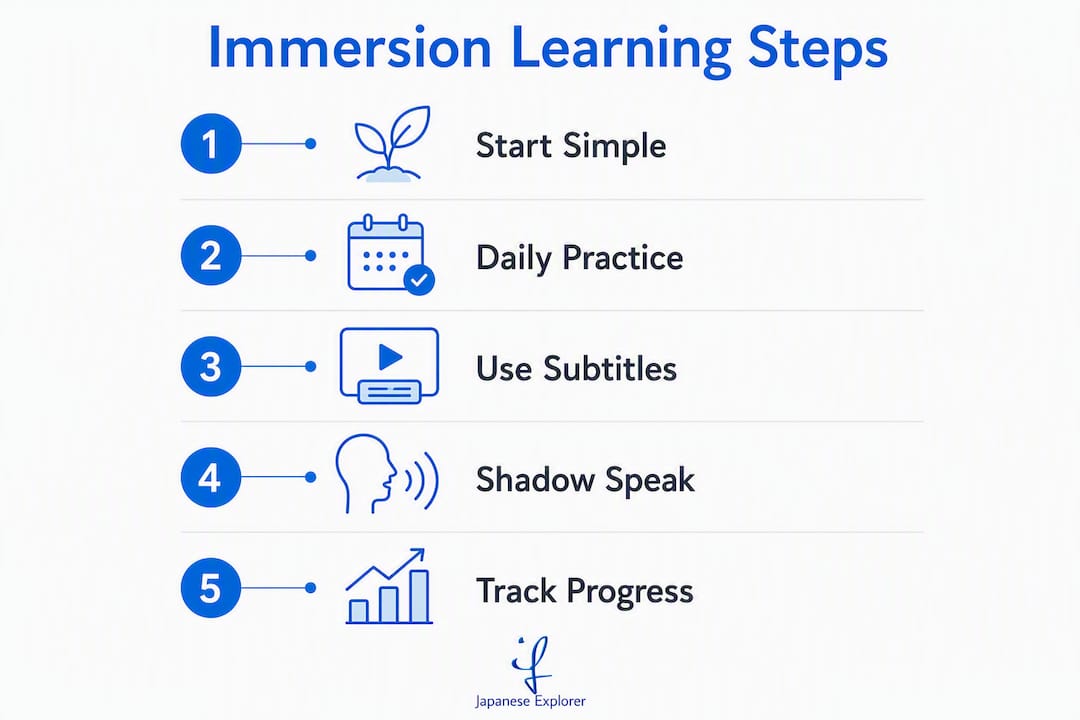
The most effective approach is a three-pass method. On the first pass, listen without any text. On the second pass, follow along with the Japanese transcript while the audio plays. On the third pass, read the transcript silently and mark any word or phrase you still cannot connect to what you heard. That third pass reveals your actual comprehension gaps, not just the words you do not know.
Graded readers, podcasts, and lesson transcripts are among the highest-impact supplements for building listening and reading fluency together. NHK Easy Japanese provides downloadable PDF scripts for every lesson — use them on pass two and three.
For Japanese subtitles specifically, set them as your primary subtitle track rather than English whenever the platform allows it. Your brain will default to reading English if it is available, which short-circuits the listening process. Japanese subtitles force you to connect audio to text in the target language, which is exactly the skill you are building.
Apps and platforms that offer immersive Japanese lessons with native audio
Beyond the four core resources covered earlier, several apps deliver native-speaker audio in a structured format that suits self-directed learners.

Anki remains the gold standard for SRS-based vocabulary and kanji review. It is free, highly customizable, and has a large library of community-made Japanese decks. Pair it with any Japanese-medium lesson to reinforce what you hear.
WaniKani (by Tofugu) takes a more guided approach to kanji, introducing radicals, kanji, and vocabulary in a fixed sequence. The paid subscription unlocks the full deck; the first three levels are free. It is particularly useful for learners who find that kanji blur together without a structured system.
NHK WORLD-JAPAN also offers its Learn Japanese portal beyond Easy Japanese, including conversation lessons and a level chart that maps programs to learner levels. All audio is native-speaker quality.
Japanese Compass provides an AI conversation partner specifically for Japanese practice. It is useful for building speaking confidence between lessons, though as noted, human feedback remains important when accuracy is critical.
For learners who want online Japanese classes with flexibility, live Zoom lessons with a bilingual instructor combine native audio with real-time correction — something no app currently replicates.
How to track your progress when studying with Japanese-medium lessons
Progress in immersion-based study is less visible than in grammar-drill courses, which makes tracking it deliberately more important.
Comprehension percentage per lesson. After each session, estimate what percentage of the lesson you understood without help. Log it. A steady upward trend over four to six weeks is the clearest signal that immersion is working. Flat or declining scores suggest the content level needs adjusting.
Production milestones. Set specific output goals: “I can introduce myself and describe my daily routine in Japanese without switching to English.” These are more meaningful than “I finished Unit 3.” The JF Standard / Marugoto framework frames progress exactly this way — by what you can do communicatively.
SRS retention rate. In Anki, your “mature card” retention rate (cards you have reviewed successfully over multiple sessions) should stay above 80–85%. If it drops, you are adding new items faster than your review schedule can handle.
Shadowing accuracy. Record yourself shadowing a sentence from a lesson. Compare it to the original. Over time, the gap between your pronunciation and the native model narrows in measurable ways — pitch, rhythm, and vowel length all improve with consistent practice.
Keep a simple log: date, resource, comprehension estimate, new items added to SRS. Reviewing it monthly shows you patterns you would otherwise miss. For a more structured approach, a practical Japanese study plan built around these metrics keeps progress visible and motivation steady.
Key Takeaways
Studying with lessons delivered primarily in Japanese works best when you combine listening-first resources, daily brief practice sessions, and targeted SRS review to close comprehension gaps.
| Point | Details |
|---|---|
| Core vocabulary | 授業 (jugyō) = classroom lesson; レッスン (ressun) = private lesson; 日本語の勉強 (nihongo no benkyō) = studying Japanese. |
| Daily study habit | 15–30 minutes of consistent daily practice outperforms sporadic long sessions for long-term retention. |
| Top free resources | NHK Easy Japanese (48 lessons, free) and Japan Foundation Minato/Marugoto (A1–A2, free) are the strongest starting points. |
| SRS and transcripts | Combine spaced repetition for kanji/vocab with transcript review to close comprehension gaps efficiently. |
| Japanese Explorer | Guided online Zoom lessons and business Japanese courses with bilingual instructors offer teacher-led immersion for adult learners. |
The case for leaning into discomfort early
There is a temptation, especially for beginners, to stay in the English-explanation lane as long as possible. Grammar tables in English, vocabulary lists in English, even lesson instructions in English. It feels safer. But that safety comes at a cost: your brain never learns to process Japanese as Japanese. It keeps routing everything through translation.
The learners who make the fastest progress are usually the ones who accept confusion as part of the process from day one. Not reckless confusion — you still need structure, level-appropriate content, and a way to check your understanding. But the willingness to sit with a sentence you do not fully understand, listen to it again, and let meaning emerge gradually is the core skill that immersion builds. No app or grammar book teaches it directly. You develop it by doing it.
What realistic progress looks like for most adult learners: after two to three months of daily brief practice sessions with Japanese-medium content, you will start catching teacher cues reliably, recognize common sentence patterns, and understand the gist of beginner-level audio without a transcript. That is not fluency, but it is the foundation everything else builds on. Measure comprehension percentage per lesson, not “how many lessons I finished,” and you will see the growth clearly.
Guided Japanese lessons online, built for adult learners
If you want teacher-led immersion rather than self-study, Japanese Explorer offers online Zoom lessons for conversational and business Japanese, with bilingual instructors who keep classroom instruction primarily in Japanese while providing targeted English support when you genuinely need it.
The curriculum follows the Association for Japanese-Language Teaching framework, so every lesson builds on the last in a structured sequence. Group classes keep costs manageable; private lessons move at your pace. Corporate training is also available for teams preparing for business communication with Japanese partners. Whether you are working toward JLPT proficiency or practical conversational confidence, the online Japanese course page shows current schedules and levels. Japanese Explorer’s training center is at 10 Anson Road, Level 22, International Plaza, Singapore 079903, right above Tanjong Pagar MRT, for learners who prefer in-person sessions. Browse all course levels and book a trial lesson to find the right fit.
Useful sources
A short annotated list of the resources referenced throughout this guide, organized by what you will find at each link.
- NHK WORLD-JAPAN Easy Japanese — 48 free lessons with native audio, animated skits, and downloadable scripts. Start here if you are an absolute beginner who wants listening-first content.
- NHK Learn Japanese Portal — Broader NHK resource hub with a level chart, conversation lessons, and classroom-ready video materials.
- Japan Foundation Minato — Free structured courses at A1–A2 level, mapped to the JF Standard. Choose the Katsudō track for maximum Japanese-medium instruction.
- Marugoto Online Course — The course platform behind Minato. Explains the Katsudō/Rikai split and lets you self-enroll in level-appropriate modules.
- Embassy of Japan — Learn Japanese — Concise guidance on study habits and beginner sequencing, including the 15–30 minute daily practice recommendation.
- Japanese Compass AI Conversation — AI-powered speaking practice for low-stakes production. Useful between lessons; supplement with human feedback for accuracy-critical tasks.
Reminder: Pair any immersive lesson resource with an SRS tool (Anki or WaniKani) and always use the provided transcript for your second and third listening passes. The combination of immersion plus targeted review closes comprehension gaps far faster than either approach alone.
FAQ
What is the Japanese word for “lesson”?
The most common word is 授業 (jugyō) for a formal classroom lesson, and レッスン (ressun) for a private or commercial lesson. The choice depends on the context: school-style instruction uses jugyō; tutoring or music/language lessons typically use ressun.
How do you say “learning Japanese” in Japanese?
The natural phrase is 日本語の勉強 (nihongo no benkyō), meaning “studying Japanese.” You can also say 日本語を勉強しています (nihongo wo benkyō shite imasu) — “I am studying Japanese” — which is the most common way to describe it in conversation.
What does gakkō (学校) mean?
学校 (gakkō) means “school” and refers to the educational institution itself, not a single lesson. It appears frequently in lesson materials and beginner texts, so recognizing it early helps you navigate written and spoken Japanese more confidently.
Why do Japanese people say “oi oi oi”?
おいおいおい (oi oi oi) is an informal exclamation expressing surprise, mild exasperation, or disbelief, roughly equivalent to “Hey, hey, hey!” or “Come on!” in American English. It is casual speech and would not appear in a formal lesson context.
How often should you study Japanese to make real progress?
Daily practice of 15–30 minutes consistently outperforms longer but irregular sessions for retention. Japanese Explorer’s online Zoom lessons are scheduled to fit adult schedules, making it easier to maintain that daily habit with teacher guidance.