
TL;DR:
- Alternative options to Coto Academy include Japanese Explorer for structured online courses and marketplace platforms like Italki and Preply for flexible, personalized lessons. Self-study tools such as WaniKani, Duolingo, Pimsleur, and JapanesePod101 provide additional practice, especially for beginners and daily habit building. Each platform offers different advantages depending on your specific language goals and preferred learning style.
Try a tutor marketplace for fast personalization, a structured kanji program for self-study, or Japanese Explorer for school-like online lessons. Those three paths cover most of what adult learners actually need when searching for cotoacademy.com alternatives. Here is the quick shortlist:
- Italki / Preply — best for flexible 1:1 lessons with native speakers; tutors typically start around $10–$25 per hour
- WaniKani — best for systematic kanji and vocabulary study; subscription starts around $9/month
- Pimsleur — best for audio-first listening and speaking practice; plans start around $14.95/month
- Duolingo / JapanesePod101 — best for daily app-based practice; free tiers available, premium from $6.99–$9.99/month
- Japanese Explorer — best school-style online option with certified bilingual instructors, structured JLPT-aligned paths, business Japanese, and corporate training via Zoom
Before you commit to any platform, look for these trust signals: a free trial lesson or money-back guarantee, verifiable teacher credentials, a JLPT-aligned curriculum, and transparent cancellation terms. Alternatives fall into clear categories — tutor marketplaces, structured school courses, kanji tools, audio programs, and app-based practice — and the right pick depends entirely on your goal.
Table of Contents
- How do these Coto Academy alternatives compare at a glance?
- What does each alternative actually offer you?
- How do you pick the right alternative to Coto Academy?
- What does each option typically cost, and how long will it take?
- What are learners saying about these platforms?
- How do the platforms hold up on usability and tech quality?
- Key Takeaways
- Why the “best alternative” question is harder than it looks
- Japanese Explorer: structured online Japanese for adult learners
- Useful sources
- FAQ
How do these Coto Academy alternatives compare at a glance?
The table below maps each platform across the seven dimensions that most affect your decision. “Best pick” badges are noted in the “Best for” column.
| Platform | Best for | Lesson format | Teacher type | Pricing model & typical range | Trial / refund | JLPT prep | US availability |
|---|---|---|---|---|---|---|---|
| Japanese Explorer ⭐ School-style pick | Structured online courses, business Japanese, corporate training | Group, private, online Zoom | Certified bilingual instructors | Per-course / per-lesson fees | Trial lesson available; contact school | Yes, JLPT-aligned curriculum | Zoom-friendly; any timezone |
| Italki ⭐ Best-value marketplace | Flexible 1:1 with native speakers | 1:1 tutoring | Marketplace tutors + professional teachers | Per-lesson; community tutors ~$10–$25/hr | No formal guarantee; trial lesson pricing varies by tutor | Depends on tutor | Global; US-friendly scheduling |
| Preply ⭐ Best marketplace for credentials | Personalized lessons with vetted tutors | 1:1 tutoring | Vetted marketplace tutors | Per-lesson; typically $15–$40/hr | First lesson money-back guarantee | Depends on tutor | Global; US-friendly scheduling |
| WaniKani ⭐ Best kanji tool | Systematic kanji and vocab self-study | Self-study (SRS flashcards) | No live teacher | Subscription; ~$9/month or $299 lifetime | Free for first 60 kanji | Kanji/vocab only; no speaking | Web-based; any timezone |
| Duolingo | Daily habit and beginner practice | App-based self-study | No live teacher | Free; Duolingo Plus ~$6.99/month | Free tier always available | Limited | iOS/Android; any timezone |
| Pimsleur ⭐ Best audio-first | Listening and speaking on the go | Audio lessons (self-study) | No live teacher | Subscription ~$14.95/month | 7-day free trial | Limited | App/web; any timezone |
| JapanesePod101 | Supplemental listening and grammar | Video/audio lessons (self-study) | No live teacher (add-on tutoring available) | Free tier; Premium ~$9.99/month | Free trial available | Moderate (structured levels) | Web/app; any timezone |
| Rosetta Stone | Immersive self-study for beginners | Self-study (immersive software) | No live teacher | Subscription ~$11.99/month | 30-day money-back guarantee | Limited | Web/app; any timezone |
How to read this table: If you want live instruction, focus on the top three rows. If you prefer self-study tools to supplement live lessons, the bottom five rows are your options. No single platform wins every column, so match the “Best for” column to your primary goal first.
What does each alternative actually offer you?

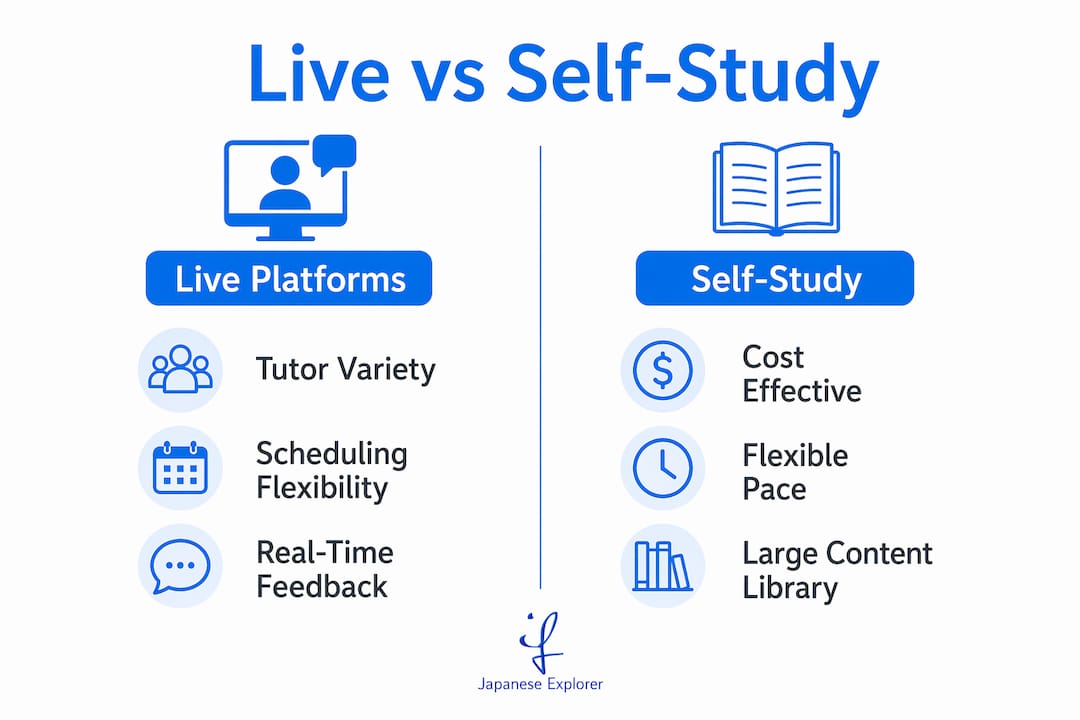
Alternatives break into two broad camps: platforms with live teachers and platforms built around self-study. Here is what each one genuinely delivers.
Japanese Explorer
Japanese Explorer is a school-style provider with certified bilingual instructors who teach structured, curriculum-driven courses from beginner through advanced and business Japanese. Lessons run via Zoom, which makes the school genuinely accessible to US-based learners regardless of timezone. The curriculum follows the Association for Japanese-Language Teaching framework, so grammar, speaking, and listening are integrated in every session rather than siloed. Corporate training is a distinct offering, making it a strong fit for professionals who need business Japanese for workplace use.
- Best for: Adult conversational learners, JLPT candidates, business professionals, corporate teams
- Format: Group classes, private lessons, online Zoom
- Pros: Certified instructors, structured JLPT-aligned paths, corporate training available, Zoom-flexible
- Trial: Trial lesson available on request
Italki
Italki is the largest tutor marketplace for language learning, connecting you directly with both professional teachers and community tutors. The range of tutors is wide, which means pricing varies considerably. Tutor marketplaces like Italki are consistently recommended when personalization and scheduling flexibility are the top priorities. The trade-off is that curriculum coherence depends entirely on the individual tutor you choose — there is no school-wide structure.
- Best for: Learners who want flexible scheduling and a specific tutor style
- Format: 1:1 live lessons
- Typical cost: Community tutors ~$10–$25/hr; professional teachers higher
- Trial: Trial lesson pricing set by each tutor; no platform-wide guarantee
Preply
Preply operates similarly to Italki but puts more emphasis on tutor vetting and offers a first-lesson money-back guarantee, which lowers the risk of a bad first experience. The platform’s interface is clean and the scheduling tools are reliable. Like Italki, the quality of JLPT preparation depends on the tutor you select rather than a platform-wide curriculum.
- Best for: Learners who want a vetted tutor and a safety net on the first lesson
- Typical cost: ~$15–$40/hr depending on tutor
- Trial: First lesson money-back guarantee
WaniKani
WaniKani uses a spaced repetition system (SRS) to teach kanji and vocabulary through mnemonics. It is one of the most focused kanji tools available and works well as a complement to live lessons. It does not teach grammar or speaking, so it should not be your only resource. The free tier covers the first 60 kanji before a subscription is required.
- Best for: Learners who want systematic kanji study alongside other learning
- Format: Self-study SRS flashcards
- Typical cost: ~$9/month or $299 lifetime
Duolingo
Duolingo is the most widely downloaded language app globally, and its Japanese course covers hiragana, katakana, and basic vocabulary. It is genuinely useful for building a daily habit and for absolute beginners, but it does not prepare you for JLPT N3 and above or for business conversation. The free tier is ad-supported; Duolingo Plus removes ads and adds offline access.
- Best for: Beginners building a daily practice habit
- Typical cost: Free; Plus ~$6.99/month
Pimsleur
Pimsleur’s audio-first method is built around spaced repetition in spoken form, making it ideal for commuters or anyone who learns best by listening and repeating. The Japanese course covers conversational phrases and pronunciation clearly. It does not teach reading or writing, so kanji study requires a separate tool.
- Best for: Learners who want to improve speaking and listening on the go
- Typical cost: ~$14.95/month; 7-day free trial available
JapanesePod101
JapanesePod101 offers a large library of audio and video lessons organized by level, from absolute beginner through advanced. The free tier gives access to a limited number of lessons; Premium unlocks the full library. Add-on 1:1 tutoring is available at extra cost. The structured level system makes it a reasonable supplement for JLPT preparation, though it works best alongside live instruction.
- Best for: Supplemental listening, grammar explanations, and vocabulary building
- Typical cost: Free tier; Premium ~$9.99/month
Rosetta Stone
Rosetta Stone uses an immersive, image-based method that avoids direct translation. It is well-suited to complete beginners who want a structured self-study path, and the 30-day money-back guarantee makes it low-risk to try. Its JLPT preparation support is limited, and advanced learners often find the immersive method less efficient than direct grammar instruction.
- Best for: Beginners who prefer immersive self-study
- Typical cost: ~$11.99/month; 30-day money-back guarantee
How do you pick the right alternative to Coto Academy?
The single most useful question to ask yourself before choosing is: What do I need to be able to do in Japanese, and by when? Matching format to goal — 1:1 tutors for rapid speaking gains, structured school courses for JLPT prep, dedicated kanji platforms for systematic kanji study — is the advice that appears across every serious comparison.
Decision checklist
- Define your goal first. JLPT preparation, business conversation, casual travel Japanese, and corporate training each call for a different format.
- Check teacher credentials. For structured learning, look for certified instructors with verifiable qualifications, not just native speakers. Knowing what to look for in a Japanese language school saves you time.
- Confirm timezone and scheduling. US-based learners on East or West Coast time need to verify that live lesson slots are actually available at reasonable hours.
- Ask about JLPT-aligned milestones. A good school or tutor can tell you which level you are working toward and roughly how many hours it will take.
- Read the cancellation policy before you pay. Non-refundable prepaid packages are a common pain point on review forums.
Questions to ask on a trial lesson
- What textbook or curriculum framework do you follow?
- How do you track my progress toward JLPT milestones?
- What is your cancellation and rescheduling policy?
- Do you have experience teaching business Japanese or corporate groups?
Price brackets
| Format | Typical price range | Notes |
|---|---|---|
| Private tutor (marketplace) | $10–$40/hr | Wide range; community tutors at the low end |
| Subscription self-study app | $6.99–$14.95/month | Duolingo, Pimsleur, Rosetta Stone |
| Structured kanji tool | ~$9/month or $299 lifetime | WaniKani |
| School-style online course | Varies by course length and level | Japanese Explorer; contact for current rates |
Red flags to watch for
- No trial lesson or money-back option
- Opaque or hidden pricing
- Non-refundable prepaid lesson bundles with no clear refund path
- No information about teacher qualifications
- Poor scheduling tools or no timezone support for US learners
What does each option typically cost, and how long will it take?
Cost and time commitment are the two questions most learners ask after the shortlist stage, so here is a realistic picture.
Tutor marketplaces (Italki, Preply) give you the most scheduling control. At two 1:1 lessons per week, you are looking at roughly $80–$320/month depending on tutor rate. Most adult learners notice meaningful conversational progress after three to four months at that pace.
Self-study apps (Duolingo, Pimsleur, Rosetta Stone) cost the least but require the most self-discipline. Duolingo’s free tier is genuinely useful for 15–20 minutes of daily practice, but reaching conversational fluency on apps alone takes considerably longer than with live instruction. Pimsleur’s 30-minute daily audio lessons are well-paced for commuters.
WaniKani is a long-term investment. Working through all 60 levels at a steady pace takes roughly 12–18 months of consistent daily review. The payoff is a solid kanji foundation that makes reading manga, news, and JLPT reading passages much less daunting.
School-style online courses (Japanese Explorer) bundle curriculum, teacher accountability, and structured progression into one package. For adult learners targeting JLPT N5 or N4, a structured course typically spans three to six months of weekly group or private lessons. Online Zoom classes offer flexibility that makes it practical even for learners in US time zones.
What are learners saying about these platforms?
Community feedback on Reddit’s r/LearnJapanese and app store reviews reveals a consistent pattern: marketplace reviews focus on individual teachers, while platform reviews focus on curriculum coherence and customer service. That distinction matters when you are deciding where to look for social proof.
Italki earns strong praise for tutor variety and scheduling flexibility. The most common complaint is inconsistency — a great tutor experience on one booking does not guarantee the same quality next time. Learners recommend reading individual tutor reviews carefully rather than relying on platform-level ratings.
WaniKani has a devoted community. Learners on Reddit frequently credit it with breaking through the kanji wall that stops many intermediate students. The main criticism is that the SRS pace can feel slow for learners who want to accelerate.
Pimsleur gets consistent positive feedback for pronunciation improvement and listening comprehension. Learners who use it as a commute supplement alongside a structured course report faster speaking confidence.
Duolingo reviews are mixed for Japanese specifically. Beginners appreciate the gamified approach; intermediate learners often find the app insufficient on its own and move to supplemental resources.
Coto Academy itself holds a reported Google rating of 4.8/5 with hundreds of reviews, with small class sizes and conversation focus cited as key strengths. Learners who seek an alternative typically want either more scheduling flexibility, a lower price point, or a more structured JLPT curriculum path.
How do the platforms hold up on usability and tech quality?
Platform reliability and interface quality affect your learning more than most comparison articles admit. A laggy video call or a confusing dashboard adds friction every single session.

Italki and Preply both use in-platform video calling. Preply’s interface is generally considered cleaner and more reliable; Italki’s is functional but some tutors prefer to move lessons to Zoom or Skype, which can complicate scheduling.
WaniKani is web-based and runs smoothly on any modern browser. The mobile experience is usable but the platform is primarily designed for desktop review sessions.
Duolingo is one of the most polished mobile apps in language learning. The iOS and Android apps are stable, fast, and well-maintained. The gamification layer (streaks, XP, leaderboards) is genuinely effective for habit formation.
Pimsleur delivers audio lessons through a clean app. Offline download support makes it practical for commutes without reliable data. The interface is minimal by design, which suits the audio-first method.
JapanesePod101 has a large content library but a somewhat dated interface. Navigation can feel cluttered when you are trying to find a specific lesson level. The audio quality of lessons is consistently good.
Rosetta Stone has invested heavily in its web and mobile interface over the past few years. The immersive design is polished, and the speech recognition feature for pronunciation practice works reasonably well, though it is not as precise as a live teacher’s feedback.
Japanese Explorer’s Zoom-delivered lessons put platform quality largely in Zoom’s hands, which means a stable, familiar experience for most US-based learners. The school’s structured curriculum means you are not dependent on a single tutor’s personal setup.
Key Takeaways
The best Coto Academy alternative is the one that matches your specific goal: a tutor marketplace for personalized speaking practice, a kanji tool for systematic self-study, or a school-style online course for structured JLPT and business Japanese progress.
| Point | Details |
|---|---|
| Match format to goal | Choose 1:1 tutors for speaking, structured courses for JLPT prep, and kanji tools for reading. |
| Check teacher credentials | Certified bilingual instructors deliver more consistent progress than unvetted community tutors. |
| Demand a trial or guarantee | Any reputable platform offers a trial lesson, free tier, or money-back policy before you commit. |
| Budget realistically | Tutor marketplaces run $10–$40/hr; self-study apps cost $6.99–$14.95/month; school courses vary by level. |
| Japanese Explorer for school-style online learning | Japanese Explorer offers certified instructors, JLPT-aligned courses, business Japanese, and Zoom delivery for US learners. |
Why the “best alternative” question is harder than it looks
Most comparison articles treat this as a simple ranking problem. Pick the highest-rated platform, done. But the learners who struggle most are the ones who chose a platform that was genuinely excellent for someone else’s goal.
A tutor marketplace is a fantastic tool if you already know what you want to work on and can direct your own sessions. If you are new to Japanese or targeting a specific JLPT level, showing up to a 1:1 lesson without a curriculum framework often means paying for conversation practice that does not compound into measurable progress. That is not the tutor’s fault — it is a format mismatch.
The platforms that deliver the most consistent results for adult learners are the ones that combine qualified instruction with a structured path. Self-study apps are genuinely useful as daily supplements, but the learners who reach conversational fluency fastest are almost always the ones with a live teacher holding them accountable to a curriculum. That is why school-style options like Japanese Explorer deserve serious consideration alongside the more heavily marketed marketplace platforms.
Japanese Explorer: structured online Japanese for adult learners
If you want the accountability of a real school without the commute, Japanese Explorer’s online Japanese courses deliver exactly that. Lessons run live on Zoom with certified bilingual instructors who follow a structured, JLPT-aligned curriculum — so every session builds on the last rather than covering whatever a tutor feels like that day.
Adult learners can choose from group classes, private lessons, business Japanese, and full corporate training programs for teams. The school’s curriculum is guided by the Association for Japanese-Language Teaching, and instructors are experienced, bilingual, and certified. For US-based learners, Zoom delivery means you can join from any timezone without rearranging your schedule.
Ready to try a lesson? Contact Japanese Explorer to book a trial session or request a corporate training quote.
Useful sources
The sources below are where you can read deeper comparisons, community feedback, and official course information on Coto Academy and its alternatives.
| Source | What it covers | Best for |
|---|---|---|
| BFF Tokyo — Top Online Japanese Lessons | Roundup of online Japanese lesson providers including Coto | Structured comparisons |
| SmallBizGenius — Coto Academy Alternatives | Category-based alternatives list with quick stats | Quick shortlisting |
| Japademy — Coto Academy Review | In-depth review of Coto Academy with ratings and pros/cons | Understanding what Coto offers |
| Lunoo — Coto Academy | Aggregated quality score and alternatives list | Trust signal comparison |
| AhrefsTop — Coto Academy Competitors | Traffic-based competitor and alternatives list | Market-level context |
| Semrush — cotoacademy.com Overview | Traffic analytics and audience overlap data | Market context |
| Reddit r/LearnJapanese | Community discussion on Coto Online vs other platforms | Real user reviews |
| Study in Japan | Official resource for Japanese language study programs | Authoritative program info |
| Japanese Explorer — About | School credentials, instructor profiles, curriculum framework | EEAT verification |
FAQ
How much does Coto Academy cost?
Coto Academy’s pricing is not publicly listed as a flat rate; costs vary by course type, class size, and lesson frequency. Comparable school-style online Japanese courses typically range from moderate monthly fees for group classes to higher rates for private lessons.
What is Coto Academy known for?
Coto Academy is a Tokyo-based school with over 20 years of history known for small-class conversational Japanese lessons and certified teachers, with a reported Google rating of 4.8/5.
Are there reviews of Coto Academy online?
Yes. Reviews appear on Japademy, Lunoo, Reddit’s r/LearnJapanese, and Google. Community feedback highlights small class sizes and teacher quality as strengths; some learners seek alternatives for more scheduling flexibility or lower pricing.
What level of Japanese does Coto teach?
Coto Academy offers courses from beginner through advanced levels, with a focus on conversational Japanese. Japanese Explorer similarly covers beginner through advanced and adds business Japanese and corporate training for adult professional learners.
How do I choose between a tutor marketplace and a school-style course?
Choose a tutor marketplace like Italki or Preply if you want maximum scheduling flexibility and a specific tutor style. Choose a school-style course like Japanese Explorer if you want a structured JLPT-aligned curriculum, certified instructors, and consistent progression tracked by a school rather than an individual tutor.