
TL;DR:
- Structured courses like JF Minato and WaniKani help learners build a solid foundation in Japanese through curriculum alignment and memorization techniques. Combining free tools such as NHK World, Yomichan, and Anki can efficiently support reading, listening, and vocabulary acquisition. Integrating live classes with self-study tools accelerates progress and enhances practical communication skills.
The clearest alternatives to learn-japanese-adventure.com break down by goal: JF Minato for structured, JLPT-aligned curriculum; WaniKani for kanji mastery through mnemonics and spaced repetition; Bunpro for grammar drilling; and Satori Reader or Yomichan for reading practice in authentic texts. If you want a single free starting point, Duolingo or NHK World gets you moving in under ten minutes. Here is the quick shortlist:
- Structured course (JLPT/curriculum): JF Minato (Marugoto)
- Kanji + vocabulary SRS: WaniKani
- Grammar reinforcement: Bunpro
- Reading support: Satori Reader + Yomichan
- Free beginner entry: Duolingo or NHK World
- Vocabulary recall: Anki or Memrise
- Advanced sentence practice: Clozemaster
Table of Contents
- How do these alternatives compare at a glance?
- What does each alternative actually offer?
- How do you choose the right tool for your goals?
- What do the best study stacks actually look like?
- What does the research say about kanji methods and structured courses?
- What should you try first, based on your goal?
- Key Takeaways
- What actually surprised me about how learners combine these tools
- Live online classes as a complement to your self-study stack
- Useful sources and further reading
- FAQ
How do these alternatives compare at a glance?
| Tool | Best for | Platform | Price model | Level suitability | Fits into stack |
|---|---|---|---|---|---|
| JF Minato | Structured curriculum, JLPT alignment | Web | Free / paid tutor options | Beginner–Intermediate (A1–B1+) | Backbone course |
| WaniKani | Kanji + vocabulary SRS | Web, iOS, Android | Freemium / subscription | Beginner–Advanced | Kanji layer |
| Bunpro | Grammar SRS | Web, iOS, Android | Freemium / subscription | Beginner–Advanced | Grammar layer |
| Anki | Custom flashcard SRS | Web, iOS, Android, desktop | Free (desktop) / paid iOS | All levels | Vocab + kanji recall |
| Satori Reader | Graded reading | Web, iOS, Android | Subscription | Intermediate–Advanced | Reading layer |
| Memrise | Vocabulary + listening | Web, iOS, Android | Freemium / subscription | Beginner–Intermediate | Vocab supplement |
| Clozemaster | Sentence-level vocab | Web, iOS, Android | Freemium / subscription | Intermediate–Advanced | Sentence fluency |
| Yomichan | In-browser reading lookup | Browser extension | Free | Intermediate–Advanced | Reading support |
| Duolingo | Casual beginner habit | Web, iOS, Android | Freemium / subscription | Beginner | Entry point |
| Japan Foundation Minato | Institutional course | Web | Free / paid | Beginner–Intermediate | Structured backbone |
What does each alternative actually offer?
JF Minato (Marugoto)
JF Minato is the Japan Foundation’s official e-learning platform, offering the Marugoto Japanese Online Course across A1 to B1+ levels. Two study paths exist: Katsudoo for practical speaking and listening, and Katsudoo+Rikai for deeper comprehension. It is curriculum-aligned, tutor-supported, and free to start.
- Pros: Institutional rigor, CEFR-like progression, free self-paced access
- Cons: Less gamified than commercial apps; tutor sessions cost extra
- Ideal user: Adult learners who want a reliable, structured backbone for JLPT prep or real-world communication
WaniKani
WaniKani uses radicals, mnemonics, and a spaced repetition system to teach 2,000 kanji and 6,000 vocabulary items. Motivated adult learners can reach that full scope in roughly 18 months. The first three levels are free; a subscription unlocks the rest.
- Pros: Highly efficient kanji sequencing, strong community, memorable mnemonics
- Cons: Locks you into its own order (you cannot skip ahead); subscription required beyond level 3
- Ideal user: Anyone whose kanji knowledge is the main bottleneck to reading or JLPT progress
Bunpro
Bunpro applies SRS logic to Japanese grammar points, drilling you through N5 to N1 sentence patterns with example sentences and hints. It integrates with popular textbooks like Genki and Minna no Nihongo, so it reinforces whatever course you are already using.
- Pros: Textbook-aligned, clear JLPT tagging, flexible review scheduling
- Cons: Requires a subscription after the trial; grammar explanations can feel thin without a companion textbook
- Ideal user: Learners who have a course or textbook but want daily grammar review to lock in patterns
Anki
Anki is the gold standard for custom spaced repetition. You build or download decks for any topic, kanji set, or vocabulary list, and the algorithm surfaces cards at exactly the right interval for long-term retention. The desktop version is free; the iOS app is a one-time purchase.
- Pros: Completely flexible, massive community deck library, offline capable
- Cons: Steep setup curve; no built-in curriculum or guidance
- Ideal user: Self-directed learners who already know what vocabulary or kanji they need to drill
Pro Tip: Pair Anki with a structured course like Marugoto or a textbook like Genki. Use the course to learn new material, then add those words and grammar patterns to Anki the same day for long-term retention.
Satori Reader
Satori Reader offers graded Japanese stories and articles with sentence-by-sentence audio, grammar notes, and integrated SRS. It bridges the gap between textbook Japanese and authentic native content, making it one of the best tools for intermediate learners who feel stuck.
- Pros: Authentic-feeling content, audio for every sentence, built-in SRS
- Cons: Subscription required; content library is smaller than some competitors
- Ideal user: Intermediate learners (N4–N3 range) ready to move beyond textbook sentences
Memrise
Memrise uses video clips of native speakers alongside spaced repetition to build vocabulary and listening recognition. Its Japanese courses cover hiragana through conversational phrases, and the free tier offers a solid amount of content.
- Pros: Native speaker video, engaging format, strong free tier
- Cons: Grammar coverage is shallow; community-created courses vary in quality
- Ideal user: Beginners who want vocabulary and listening exposure alongside a grammar-focused tool
Clozemaster
Clozemaster drills vocabulary through fill-in-the-blank sentences pulled from real corpora. It is designed for learners past the beginner stage who want to see words in context rather than isolated flashcards. A free tier covers a large portion of the content.
- Pros: Sentence-level context, massive sentence library, JLPT-tagged vocabulary
- Cons: Not suitable for absolute beginners; interface is utilitarian
- Ideal user: Intermediate to advanced learners building reading fluency and vocabulary breadth
Yomichan
Yomichan (now maintained as Yomitan) is a free browser extension that gives you instant dictionary lookups on any Japanese webpage. Hover over a word and a popup shows the reading, meaning, and pitch accent. Reddit’s Japanese learning communities consistently rank it as one of the most useful tools for immersion reading.
- Pros: Free, instant lookup, works on any website, exports to Anki
- Cons: Browser-only; requires intermediate reading ability to use effectively
- Ideal user: Intermediate learners doing immersion reading who want frictionless lookup without leaving the page
Duolingo
Duolingo covers hiragana, katakana, and basic vocabulary and grammar through short gamified lessons. It is the easiest entry point for absolute beginners and works well as a daily habit-builder. Its depth is limited, so most learners outgrow it by the N4 level.
- Pros: Free, habit-forming, available offline, no setup required
- Cons: Grammar explanations are minimal; not sufficient for JLPT N3 and above
- Ideal user: Complete beginners who want a low-pressure way to start before committing to a structured course
Japan Foundation Minato (additional apps)
Beyond Marugoto, JF Minato hosts several J-Learning apps covering hiragana, katakana, kanji, and listening. All are free and carry the Japan Foundation’s curriculum authority, making them reliable supplements for any study stack.
- Pros: Free, institutional quality, covers multiple skill areas
- Cons: Apps are supplementary rather than full courses
- Ideal user: Learners who want free, trustworthy practice tools to complement a main course
How do you choose the right tool for your goals?
Start with one question: What do you actually need Japanese for? Your answer shapes every other decision.
Map your goal to a primary tool using these criteria:
- JLPT prep: You need curriculum alignment and grammar SRS. Start with JF Minato or Bunpro.
- Kanji mastery: You need sequenced, mnemonic-driven SRS. WaniKani is the clearest choice.
- Conversational fluency: You need speaking practice and listening input. A live class or tutor-supported course beats any solo app.
- Reading in authentic texts: You need graded content plus a lookup tool. Satori Reader + Yomichan is the standard combination.
- Travel Japanese fast: Duolingo or NHK World get you functional phrases in days.
Red flags to watch for: auto-renewing subscriptions with no clear cancellation path, apps that promise fluency without grammar instruction, and platforms with no trial period. Always check whether a free trial exists before entering payment details. Subscription flexibility matters: WaniKani and Bunpro both offer trial access; Satori Reader offers a limited free tier. Anki’s desktop version costs nothing.
Pro Tip: Answer these four questions before choosing: (1) What is my JLPT target level or practical goal? (2) How many minutes per day can I realistically study? (3) Do I need offline access? (4) Am I willing to pay a monthly fee or do I need free tools? Your answers will eliminate at least half the options immediately.
What do the best study stacks actually look like?
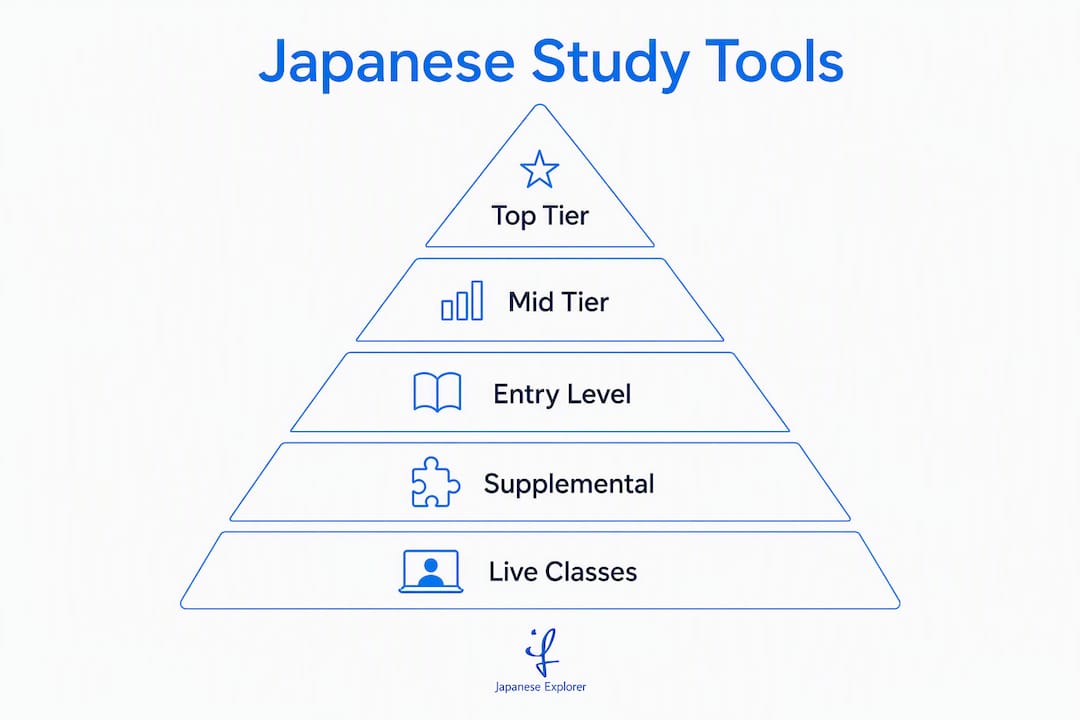
Mixing tools produces better results than relying on one app. Here are four stacks built around common adult learner goals, each with a sample weekly plan.

JLPT prep stack (N5–N3)
Core tools: JF Minato (Marugoto) + Bunpro + Anki
- Monday: 30 min Marugoto lesson (new grammar + dialogue)
- Tuesday: 20 min Bunpro grammar review + 15 min Anki vocab
- Wednesday: 30 min Marugoto listening + reading
- Thursday: 20 min Bunpro + 15 min Anki
- Friday: 30 min Marugoto new lesson
- Saturday: 45 min full review (Bunpro + Anki)
- Sunday: Rest or light listening
Weekly commitment: 4–5 hours. Track progress by completing one Marugoto unit per two weeks and hitting 90% Bunpro review accuracy.
Conversational fluency stack
Core tools: Live online class + Memrise + Anki
- Monday/Wednesday/Friday: 60 min live class (speaking + listening)
- Daily: 15 min Memrise vocabulary
- Daily: 10 min Anki review of class vocabulary
Weekly commitment: 3.5–4.5 hours. Measure progress by tracking new conversation topics you can handle without switching to English.
Kanji-first stack
Core tools: WaniKani + Bunpro
- Monday–Friday: 20 min WaniKani reviews (morning)
- Monday–Friday: 15 min Bunpro grammar
- Saturday: 30 min WaniKani lessons (new kanji batch)
- Sunday: Light review only
Weekly commitment: 3–4 hours. A useful milestone: reading a full NHK Easy News article without looking up kanji you have already studied.
Reading and immersion stack
Core tools: Satori Reader + Yomichan + Anki
- Daily: 20–30 min Satori Reader (one story episode)
- Daily: Export unknown words to Anki; review 15 min
- Weekend: 30–45 min free reading on a Japanese website using Yomichan
Weekly commitment: 3–4 hours. Progress check: track how many Yomichan lookups you need per page over four weeks. A steady drop means your reading fluency is building.
You can also explore interactive language platforms to see how gamified and music-based approaches fit alongside these stacks, particularly for listening and vocabulary exposure.
What does the research say about kanji methods and structured courses?
The evidence behind the most recommended tools is worth knowing, because it helps you trust the method, not just the marketing.
JF Minato’s Marugoto course follows a CEFR-like progression from A1 to B1+, with two study paths: Katsudoo for practical communication and Katsudoo+Rikai for comprehensive skills. This structure makes it one of the few free online options with genuine curriculum alignment for adult learners balancing study with work.
Statistic callout: WaniKani states that motivated adult learners can cover a comprehensive set of kanji and vocabulary in about a year and a half using its radicals-plus-mnemonics-plus-SRS method.
WaniKani’s approach works because it sequences kanji by usefulness and anchors each character to a memorable story, cutting recall time compared with rote stroke memorization. High-volume kanji programs that use mnemonic anchors consistently outperform naive frequency lists for adult learners.
NHK World offers free audio and video lessons for beginners, with no registration required. It is one of the most reliable free entry points available. Class Central’s roundup of the best Japanese courses notes workload estimates for top beginner courses, including a substantial workload for one leading free beginner course, which gives you a realistic benchmark for planning.

| Course type | Format | Cost | Estimated workload | Best for |
|---|---|---|---|---|
| JF Minato Marugoto | Self-paced + tutor option | Free / paid tutor | Varies by level | Structured JLPT/curriculum |
| NHK World lessons | Video + audio | Free | Flexible, beginner-focused | Free beginner entry |
| WaniKani | SRS web app | Freemium / subscription | ~18 months to full scope | Kanji + vocabulary mastery |
| Bunpro | SRS web app | Freemium / subscription | Ongoing, JLPT-paced | Grammar reinforcement |
Blending free institutional resources with one or two targeted paid tools tends to produce broader coverage than any single all-in-one app. A practical approach: use JF Minato or NHK for structure, WaniKani or Anki for retention, and Yomichan or Satori Reader for reading practice.
What should you try first, based on your goal?
- JLPT prep: Start with JF Minato’s free Marugoto course. Complete one unit, then add Bunpro for grammar review in week two.
- Kanji: Sign up for WaniKani’s free first three levels. Set a daily 20-minute review habit before adding anything else.
- Grammar: Try Bunpro’s free trial for two weeks alongside your current textbook.
- Reading: Install Yomichan (free, five minutes to set up) and read one NHK Easy News article today.
- Travel Japanese: Open Duolingo or NHK World right now and complete one lesson.
Three concrete next steps for any goal:
- Pick one primary tool from the list above that matches your goal and sign up for its free tier or trial today.
- Block 20–30 minutes in your calendar for the next seven days. Consistency in the first week matters more than the tool you choose.
- Set one measurable target for day 14: finish a Marugoto unit, reach WaniKani level 4, or read a full NHK Easy News article without help.
Pro Tip: Do not wait until you feel “ready” to start reading. Install Yomichan and open any Japanese webpage today. Even recognizing three words you already know builds momentum faster than another week of flashcards alone.
For a full adult learning roadmap that maps these tools to a longer progression, the 2026 adult learner guide at Japanese Explorer walks through each stage in detail.
Key Takeaways
The most effective approach to finding learn-japanese-adventure.com alternatives is matching each tool to a specific goal rather than searching for one app that does everything.
| Point | Details |
|---|---|
| Goal-first selection | Match your primary goal (JLPT, kanji, reading, conversation) to one core tool before adding supplements. |
| Kanji via SRS + mnemonics | WaniKani covers 2,000 kanji and 6,000 vocabulary items in roughly 18 months using radicals, mnemonics, and SRS. |
| Institutional backbone | JF Minato’s Marugoto course offers free, CEFR-aligned progression from A1 to B1+ for structured learners. |
| Free vs. paid balance | Mixing free tools (NHK, JF Minato, Yomichan, Anki desktop) with one paid SRS reduces cost without sacrificing progress. |
| Japanese Explorer | Live online and group classes complement self-study stacks for conversational and business Japanese goals. |
What actually surprised me about how learners combine these tools
Most learners assume the right app will do the heavy lifting. What actually moves the needle is the combination: a structured course for new input, an SRS tool for retention, and a reading tool for real-world exposure. The learners who progress fastest are not the ones using the most tools. They are the ones who use two or three tools consistently, every day, for at least a month before evaluating whether to switch.
The other thing that catches people off guard is how quickly reading becomes accessible once kanji recognition reaches a critical mass. Learners who commit to WaniKani for 60–90 days often report that Japanese text stops feeling like a blur and starts feeling like something they can actually parse. That shift in perception is what keeps motivation alive long-term. Pairing that kanji work with a live speaking session, even once a week, accelerates the whole process in a way that no solo app can replicate.
Live online classes as a complement to your self-study stack
Self-study tools cover a lot of ground, but they cannot replicate the feedback loop of a real conversation with a trained instructor. That is where Japanese Explorer’s online classes come in.
Japanese Explorer offers live Zoom-based group and private Japanese classes for adult learners, with curriculum aligned to practical communication and business outcomes. Classes are taught by certified bilingual instructors who give you real-time correction, something no app can do.
- Flexible scheduling for working adults
- Group and private class options to match your pace and budget
- Curriculum aligned with JLPT levels and business Japanese goals
- Corporate training available for teams and organizations
Ready to add a live class to your study stack? Browse Japanese Explorer’s group classes and book a trial session to see how instructor-led learning fits alongside the tools above.
Useful sources and further reading
- JF Japanese e-Learning Minato — Japan Foundation’s official platform; free Marugoto courses from A1 to B1+
- WaniKani — Kanji and vocabulary SRS using radicals and mnemonics; first three levels free
- NHK World Learn Japanese — Free audio and video lessons for beginners from Japan’s public broadcaster
- Class Central: Best Japanese Courses — Curated roundup of free and paid Japanese courses with workload estimates
- Marugoto Japanese Online Course — Detailed course information for the Katsudoo and Katsudoo+Rikai study paths
- Japanese Explorer: How to make the most of language resources — Practical tips on combining tools and maximizing study time
FAQ
What is the best free website to learn Japanese?
NHK World and JF Minato are the strongest free options: NHK offers audio and video lessons for beginners with no registration, while JF Minato provides structured Marugoto courses from A1 to B1+.
What is the best online program to learn Japanese?
For structured JLPT-aligned learning, JF Minato’s Marugoto course is the top free program; WaniKani leads for kanji mastery; and Bunpro is the strongest grammar SRS. Most adult learners benefit from combining one structured course with one SRS tool rather than relying on a single app.
What is the 80/20 rule in Japanese learning?
Focusing on the highest-frequency vocabulary and grammar patterns first means targeting roughly 2,000 common words and the N5–N4 grammar points, which cover the majority of everyday conversation and reading. Tools like WaniKani and Bunpro are sequenced around this idea, prioritizing the most useful items before rarer ones.
How do learn-japanese-adventure.com alternatives compare for JLPT prep?
JF Minato and Bunpro are the most directly JLPT-aligned alternatives: Minato maps to A1–B1+ with explicit curriculum structure, and Bunpro tags every grammar point to its JLPT level from N5 to N1. Combining both with Anki for vocabulary review gives you a complete JLPT prep stack.