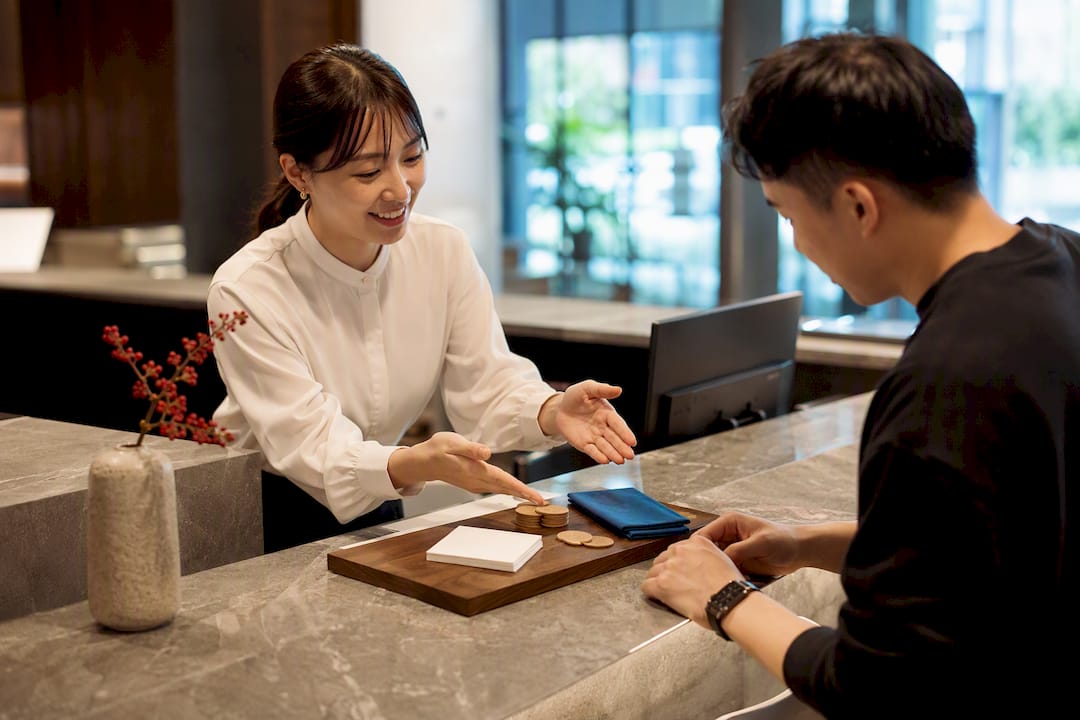
The fastest way to improve your Japanese language speaking is to prioritize daily spoken output from day one, pair it with early pronunciation work, and get regular feedback from native speakers or qualified instructors. Waiting until your grammar is “perfect” before opening your mouth is the single biggest mistake learners make. Speaking early, even imperfectly, trains your brain to retrieve language under real-time pressure, which is a completely different skill from reading or writing.
Start today with these three actions:
- Speak out loud for five minutes using phrases you already know, even if it’s just counting, greetings, or describing objects around you.
- Record yourself saying five sentences and play it back to notice where your vowels or rhythm sound off.
- Book one conversation session with a tutor or language exchange partner this week, even a 20-minute drop-in.
Pro Tip: Don’t wait to “know enough.” Every conversation you have now, however broken, builds the retrieval pathways that fluency depends on. Mistakes at this stage are data, not failures.
Table of Contents
- Evidence-backed strategies that actually move your speaking forward
- What to fix first in pronunciation and how to drill it
- How to practice speaking with real people: exchanges, tutors, and classes
- A realistic practice plan and timeline to conversational ability
- Recommended apps, courses, and channels for speaking practice
- Common mistakes that stall speaking progress and how to fix them
- Why a structured, teacher-led approach builds speaking skills faster
- Key Takeaways
- What actually works, from the classroom and beyond
- Ready to speak Japanese with confidence? Japanese Explorer can help
- Useful sources
- FAQ
Evidence-backed strategies that actually move your speaking forward
Speaking ability tends to lag behind listening and reading because production requires deliberate retrieval practice, not just passive exposure. The strategies below are ordered by impact.
-
Speak from day one. Use what you know immediately. Even a handful of phrases practiced aloud daily builds the habit of production. Learning to speak Japanese words early prevents the “I understand but can’t speak” plateau that stalls so many learners.
-
Shadow native audio daily. Pick a short clip (a drama scene, a podcast segment, an NHK lesson), listen once, then speak along with the audio in real time. Shadowing forces you to match rhythm, pitch, and speed simultaneously.
-
Drill core phrases with spaced repetition. Use an SRS tool like Anki to cycle through spoken sentence cards. Say the answer aloud before flipping the card. Vocabulary breadth is a primary engine of fluency; reaching roughly 10,000 words produces approximately 95% coverage of everyday Japanese, making natural conversation far more accessible.
-
Do roleplay scenarios. Pick a real-world situation (ordering food, introducing yourself at work, asking for directions) and rehearse it out loud. Roleplay forces you to produce language under mild pressure, which is closer to real conversation than drilling isolated words.
-
Pair listening with immediate output. Active listening drills like shadowing and transcribing short clips, followed by speaking the same content back, accelerate spoken accuracy faster than passive listening alone.
-
Keep sessions short and focused. Short, targeted output sessions repeated daily outperform long, unfocused study blocks. Consistency over volume is the rule here.
-
Track weekly speaking time. Aim for a reasonable amount of spoken output daily, split across two or three sessions if needed. Logging it keeps you honest.
Pro Tip: Build a “phrase bank” of 20–30 sentences you can say confidently right now. Expanding from a solid core is faster than trying to speak from scratch every session.
What to fix first in pronunciation and how to drill it
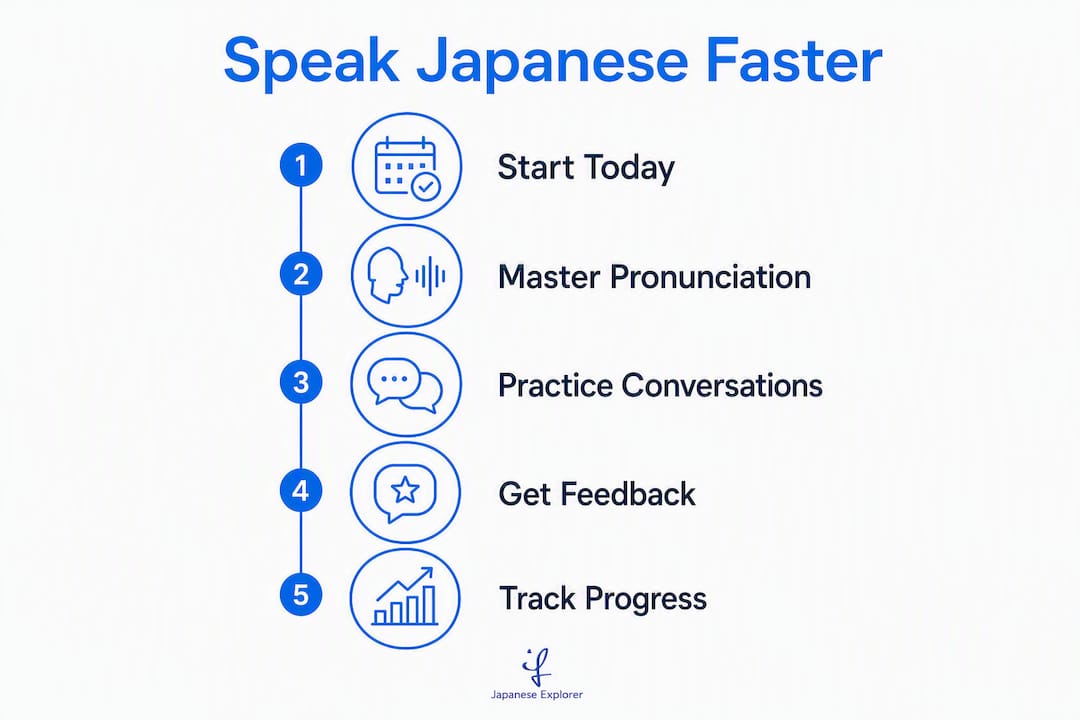
Mastering hiragana and basic phonetics early prevents fossilized errors that become very hard to unlearn later. Japanese pronunciation is often described as “simple” compared to tonal languages, but several features trip up English speakers consistently.
The four features to prioritize first:
- Vowel sounds. Japanese has five pure vowels (a, i, u, e, o) that never change quality. English speakers tend to diphthongize them. Drill each vowel in isolation, then in CV (consonant-vowel) pairs.
- Mora timing. Japanese is mora-timed, not stress-timed. Every mora (roughly one syllable unit) gets equal duration. “Sapporo” has four morae: sa-p-po-ro. Clapping one beat per mora while speaking is a simple drill that builds this instinct quickly.
- Long vowels and geminate consonants. Stretching a vowel (おかあさん, okaasan) or doubling a consonant (きって, kitte) changes meaning entirely. Minimal-pair practice, comparing short and long versions of the same word, is the most direct fix.
- Pitch accent basics. Tokyo Japanese uses pitch accent (high-low patterns) rather than stress. You don’t need to master every word’s pattern immediately, but learning the two main patterns (flat and downstep) prevents the monotone delivery that makes speech sound unnatural to native ears.
Practical drills:
- Record yourself reading a hiragana passage, then compare it to a native recording of the same text.
- Use Japanese Pronunciation Tips for English Speakers to identify your specific weak points.
- Run minimal-pair exercises daily: listen to two words, identify which is long and which is short, then produce both yourself.
- For web-based speech tools, use Chrome or Edge on desktop for the most reliable speech recognition support.
Pro Tip: Record a 60-second speaking sample every week and keep the files. Comparing week one to week eight is more motivating than any progress chart, and it shows exactly which sounds still need work.

How to practice speaking with real people: exchanges, tutors, and classes
Getting real conversation time is where most learners underinvest. Here are the main options, what each does well, and when to use them.

Language exchanges and free conversation platforms
Free live conversation platforms offer drop-in audio rooms organized by level, letting you listen before jumping in. The cost is zero, the exposure is high-frequency, and you can find a partner at almost any hour. The downside: you get no structured feedback, and bad habits can reinforce themselves if no one corrects you. Use these for volume and confidence, not for precision work.
Paid tutors
A tutor gives you corrective feedback in real time, which is something no app or exchange partner reliably provides. The best use of a tutor session is not free conversation; it’s structured roleplay with a debrief. Bring a scenario (a job interview, a phone call to a hotel, a business meeting opener) and ask your tutor to correct pronunciation and grammar as you go. One focused 30-minute session per week produces more measurable improvement than hours of unstructured chat.
Group classes vs. private lessons vs. drop-in rooms
| Format | Best for | Trade-off |
|---|---|---|
| Group classes | Building conversational habits, peer motivation | Less individual correction time |
| Private lessons | Targeted feedback, rapid progress on weak points | Higher cost per hour |
| Drop-in conversation rooms | High-frequency low-stakes exposure | No structured feedback |
Scenarios to bring to your next session:
- Introducing yourself and your job in Japanese
- Asking for and giving directions
- Handling a simple business email read-aloud
- Ordering at a restaurant and asking about ingredients
Recording yourself and reviewing with a checklist or teacher feedback is one of the highest-impact habits you can build alongside live practice.
Pro Tip: Tell your tutor or exchange partner at the start of each session: “Please correct my pronunciation every time, not just when it causes confusion.” Most partners default to letting errors slide to keep the conversation flowing.
A realistic practice plan and timeline to conversational ability
Reaching basic conversational ability typically requires a few hundred hours of study; comfortable conversation often demands 800–1,200 hours depending on consistency and efficiency. That sounds daunting, but daily 30-minute sessions add up faster than most learners expect.
Adult learners can reach JLPT N5 in 3–6 months at 30 minutes per day and conversational levels (N4–N3) in 12–24 months with consistent small daily efforts.
Milestone map:
| Goal | Approximate hours | Weekly schedule (30 min/day) |
|---|---|---|
| Tourist survival (greetings, numbers, basic requests) | a few hundred hours | Weeks 1–8 |
| Basic conversation (simple topics, present/past tense) | a few hundred hours | Months 3–10 |
| Comfortable conversation (N3 level, work topics) | 800–1,200 hours | Months 12–24 |
4-week starter plan (speaking-first):
- Week 1: Learn hiragana sounds + 20 core phrases. Speak each phrase aloud 10 times daily. Record one 60-second sample.
- Week 2: Add 20 new phrases. Begin 10-minute daily shadowing with NHK Easy Japanese clips. Book first tutor or exchange session.
- Week 3: Introduce roleplay scenarios. Practice one scenario per day. Review your week-one recording and note changes.
- Week 4: Combine shadowing + roleplay + one live conversation session. Log total speaking minutes for the week.
Recommended apps, courses, and channels for speaking practice
The tools below are organized by the specific role they play in building spoken Japanese.
Pronunciation trainers and listening-output tools
- NHK World’s Learn Japanese offers structured lessons with audio at natural speed, ideal for shadowing practice. The NHK World Learn Japanese portal is free and organized by level.
- Speak Japanese Naturally — (YouTube channel) focuses on natural, conversational Japanese as it’s actually spoken, not textbook-formal. Use it for shadowing and for hearing pitch accent patterns in context.
Conversation exchange and live practice
- Hilokal — provides free drop-in audio rooms by level, useful for daily low-stakes speaking exposure.
- The Japan Foundation’s Erin’s Challenge (erin.jpf.go.jp) is a free interactive video course built around real conversation scenarios, excellent for beginners who want structured spoken practice.
Structured courses with teacher feedback
- Japanese Explorer’s online classes — (via Zoom) give you bilingual instructor feedback in a structured conversational curriculum, which is the format that closes the gap between passive knowledge and active speaking fastest.
How to combine these in a study week:
Use NHK or Speak Japanese Naturally for daily shadowing (10–15 minutes), Hilokal or a tutor for live output (two to three sessions per week), and Busuu or a structured course for grammar and vocabulary review. The combination of input, output, and feedback is what produces measurable progress.
Common mistakes that stall speaking progress and how to fix them
Most learners hit the same walls. Here’s what they are and what to do about each.
-
Waiting until you’re “ready” to speak. There is no ready. Set a rule: you speak Japanese in every study session, starting today, even if it’s just reading sentences aloud. Overcoming the fear of speaking is a skill you build by doing, not by preparing.
-
Over-focusing on grammar before production. Grammar knowledge does not automatically transfer to spoken fluency. Spend at least 40% of your study time on spoken output, not grammar drills. If you can explain a grammar rule but can’t use it in a sentence under mild time pressure, it isn’t in your speaking vocabulary yet.
-
Ignoring pronunciation in the first few weeks. Errors in vowel length and mora timing that go uncorrected in month one tend to persist for years. Run a quick self-check: record yourself saying five words with long vowels and five with geminate consonants, then compare to a native recording.
-
Studying without feedback loops. Self-study without any external correction is the slowest path to fluency. Even one tutor session every two weeks, focused on reviewing recorded samples, produces faster progress than daily unreviewed practice.
-
Treating every session as “free conversation.” Unstructured chat is good for confidence but poor for precision. Alternate between structured drills (pronunciation, roleplay, phrase patterns) and free conversation so both accuracy and fluency develop together.
Pro Tip: Set a “no English” rule for the first 10 minutes of every study session. Even if you’re alone, describe what you see around you in Japanese. It forces retrieval under low pressure and builds the habit of thinking in Japanese.
Why a structured, teacher-led approach builds speaking skills faster
Unguided practice has real limits. Without structured feedback, learners often reinforce the same errors session after session, building confidence in incorrect patterns. Teacher-led classes with interactive speaking blocks reduce wasted practice time and increase productive feedback compared with unstructured exchanges.
Japanese Explorer’s approach is built around exactly this principle. Bilingual certified instructors lead every session with a focus on real-world communication, not just grammar drills. Each lesson integrates speaking, listening, and grammar so that production skills develop alongside comprehension, rather than lagging behind it.
Who benefits from which format:
- Group conversational classes suit learners who want peer interaction, regular speaking practice, and a structured syllabus at an accessible price point.
- Private lessons are the fastest route for learners with specific goals (a business trip, a job interview, JLPT preparation) who need targeted correction and a flexible schedule.
- Business Japanese modules serve professionals who need workplace vocabulary, formal register, and the confidence to hold meetings or write emails in Japanese.
The curriculum at Japanese Explorer follows the Association for Japanese-Language Teaching framework, which means every lesson builds systematically toward real communicative ability, not just test scores.
Key Takeaways
Speaking Japanese fluently requires daily spoken output, early pronunciation work, and regular feedback from qualified instructors or native speakers.
| Point | Details |
|---|---|
| Start speaking immediately | Produce spoken Japanese every study session from day one, even with limited vocabulary. |
| Fix pronunciation early | Drill mora timing, long vowels, and geminate consonants in the first weeks to prevent fossilized errors. |
| Combine input and output | Pair shadowing and active listening with immediate spoken production for faster accuracy gains. |
| Use feedback loops | Record weekly speaking samples and review them with a tutor or checklist to catch errors you can’t hear yourself. |
| Japanese Explorer classes | Structured group, private, and business Japanese courses with bilingual instructors accelerate speaking progress faster than self-study alone. |
What actually works, from the classroom and beyond
The gap between learners who improve quickly and those who stall for months almost always comes down to one thing: how much time they spend producing language versus consuming it. Watching dramas, reading grammar guides, and building Anki decks all have value, but none of them train the retrieval speed that real conversation demands.
What teachers see repeatedly in class is that the learners who improve fastest are not the ones with the most grammar knowledge. They’re the ones who speak in every session, accept correction without embarrassment, and then go home and practice the corrected version out loud five more times. That loop, speak, get corrected, repeat, is the whole mechanism.
One small change that produces outsized results: five-minute daily speaking sprints where you describe your day in Japanese, out loud, without stopping to look anything up. The constraint forces you to work with what you have, which is exactly the skill real conversation requires. Pair that with one structured class or tutor session per week, and progress becomes visible within a month.
The school’s bilingual instructors at Japanese Explorer see this pattern consistently. Learners who combine structured class time with daily self-practice outside the classroom reach conversational ability significantly faster than those who rely on class time alone.
Ready to speak Japanese with confidence? Japanese Explorer can help
If you’ve been studying Japanese on your own and feel like your speaking isn’t keeping up with your reading or grammar knowledge, you’re not alone. That gap is exactly what Japanese Explorer’s conversational and business Japanese courses are designed to close.

Japanese Explorer offers small-group conversational classes for adults at every level, from complete beginners to professionals preparing for workplace communication. Every session is led by a bilingual certified instructor who integrates speaking practice, pronunciation correction, and real-world scenarios into each lesson. Prefer to study from home? The online Japanese course via Zoom delivers the same structured, interactive experience with the flexibility of learning from anywhere. For professionals, the Business Japanese course covers workplace vocabulary, formal register, and the conversational confidence needed for meetings and presentations. Book a trial lesson or take the placement test to find the right starting point for you.
Useful sources
A curated list of resources to bookmark for ongoing speaking practice:
- NHK World Learn Japanese — Free, level-organized lessons with native audio. Use the Easy Japanese Conversation series for shadowing practice.
- Tofugu’s Learn Japanese Guide — Detailed roadmap covering hiragana, phonetics, and study sequencing. Start here for pronunciation foundations.
- Hilokal Free Japanese Speaking Practice — Drop-in live audio rooms by level. Use for daily low-stakes speaking exposure.
- Erin’s Challenge by The Japan Foundation — Interactive video course built around real conversation scenarios. Free and beginner-friendly.
- Japanese Explorer: The Role of Speaking Practice — Explains why speaking practice must be central to your study plan, with practical implementation tips.
- Japanese Explorer: Pronunciation Guide for Adult Learners — Targeted drills and explanations for the phonetic features English speakers find hardest.
- Japanese Explorer: Japanese Classes for Adults — Overview of group, private, and business course options to find the right fit for your goals.
FAQ
How can I start speaking Japanese as a beginner?
Start by learning hiragana sounds and 20–30 core phrases, then practice them aloud every day. Book one conversation session with a tutor or exchange partner within your first two weeks to build the habit of real spoken output early.
How do you say hello in Japanese?
The standard greeting is こんにちは (Konnichiwa), used during the day. おはようございます (Ohayou gozaimasu) is good morning, and こんばんは (Konbanwa) is good evening.
How do you count from 1 to 10 in Japanese?
The numbers 1–10 in Japanese are: ichi (1), ni (2), san (3), shi/yon (4), go (5), roku (6), shichi/nana (7), hachi (8), ku/kyuu (9), juu (10). Japanese has two counting systems; this is the Sino-Japanese set used for most everyday counting.
Why do Japanese speakers say “oi oi oi”?
Oi (おい) is an informal interjection used to get someone’s attention, similar to “hey” in English. Repeating it (“oi oi oi”) expresses surprise, mild protest, or exasperation, roughly equivalent to “come on!” or “hey, wait a minute!” in casual speech.
How long does it take to speak Japanese conversationally?
With consistent daily practice, adult learners can reach basic conversational ability (JLPT N4–N3 level) in a few hundred hours, usually over 12–24 months. Comfortable, flexible conversation typically requires 800–1,200 total hours of study, depending on how much of that time is spent on active spoken output.