
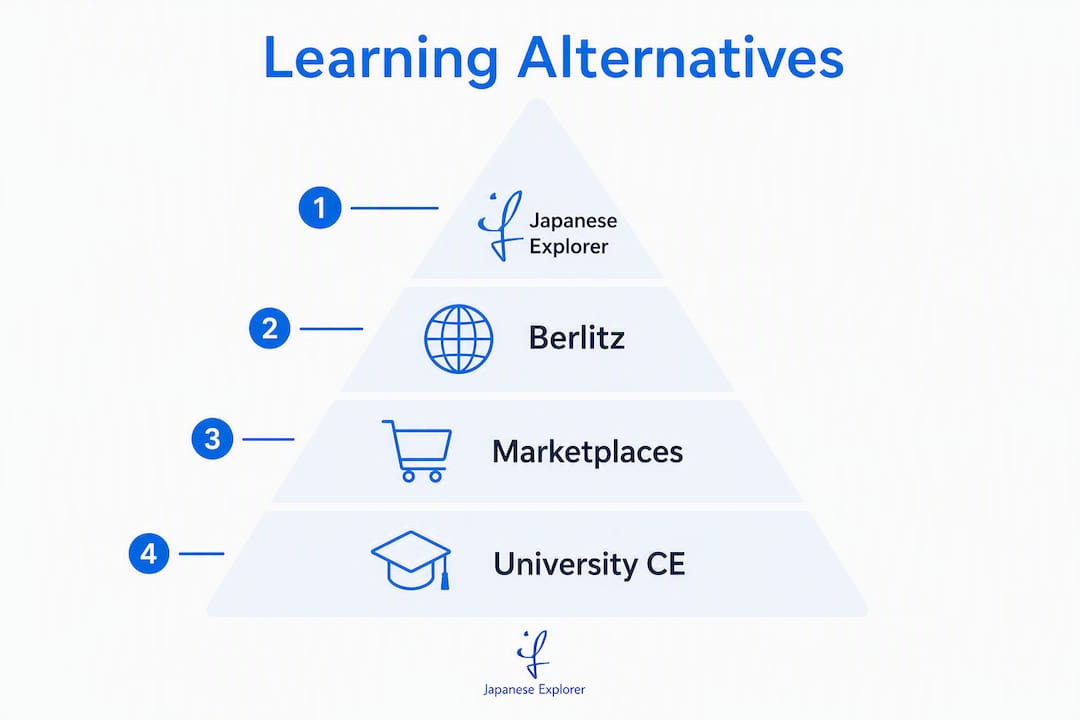
If you’re an adult learner in Singapore looking for fass.nus.edu.sg alternatives, here is your shortlist: Japanese Explorer (recommended), Berlitz, italki, Preply, and university continuing-education programs. For most working adults who want conversational or business Japanese, Japanese Explorer is the strongest starting point. It offers in-person classes at 10 Anson Road (Level 22, International Plaza), live Zoom lessons, corporate training, and bilingual certified instructors, all in one place.
Quick best-for summary:
- Japanese Explorer — conversational and business Japanese, online Zoom or in-person, corporate training; best for busy Singapore professionals
- Berlitz — standardized corporate language programs; best for multinationals needing a globally recognized curriculum
- italki — fully online tutor marketplace; best for self-directed learners who want maximum flexibility and budget control
- Preply — online tutor marketplace with lesson packages; best for learners who want some structure without full school enrollment
- University / continuing-education programs — semester-length, credentialed study; best for adult learners who need a formal transcript
Recommended first step: Contact Japanese Explorer for a level assessment and class placement before committing to any provider. Knowing your starting level saves weeks of misplaced effort.
Table of Contents
- How do these providers compare at a glance?
- Why Japanese Explorer is the recommended pick
- Is Berlitz a good option for Singapore adults?
- What does italki offer that schools don’t?
- How does Preply differ from other tutor marketplaces?
- Are university continuing-education programs worth it?
- How do you choose the right alternative to fass.nus.edu.sg?
- Why trust Japanese Explorer’s credentials?
- What support do you get after you enroll?
- Key Takeaways
- The provider that actually fits most adult learners
- Japanese Explorer is ready when you are
- FAQ
How do these providers compare at a glance?
| Dimension | Japanese Explorer | Berlitz | italki | Preply | University CE |
|---|---|---|---|---|---|
| Best for | Adult conversational, business & corporate | Multinational corporate training | Self-directed, budget-flexible learners | Structured packages, goal-specific tutoring | Credential-seekers, long-term study |
| Delivery mode | In-person + online Zoom | In-person + online | Fully online | Fully online | In-person / hybrid |
| Instructor type | Bilingual certified instructors | Trained franchise instructors | Independent tutors (varied) | Vetted tutors (varied) | University faculty / lecturers |
| Pricing model | Per course / corporate packages | Per hour / corporate packages | Per lesson (pay-as-you-go) | Per lesson or lesson packages | Per-course tuition / CE fees |
| Scheduling flexibility | Flexible; group + private + online | Moderate; structured intake | High; book any time | High; package-based | Low; semester schedule |
| Unique differentiator | Singapore-based, adult-focused, JLPT + business pathways | Global brand, standardized curriculum | Widest tutor selection, trial lessons | Filtered tutor discovery, packaged lessons | Formal transcript, academic rigor |
Why Japanese Explorer is the recommended pick
At a glance
Japanese Explorer runs small-group Japanese classes for adults at its city-centre location (10 Anson Road, Level 22, International Plaza, Singapore 079903, right above Tanjong Pagar MRT) and via live Zoom. Formats include small-group lessons, private one-to-one sessions, business Japanese courses, and corporate training packages.
Core features
- Bilingual certified instructors who teach grammar and conversation in a way that clicks for English-speaking adults
- Placement testing so you start at the right level, not too easy and not overwhelming
- Flexible scheduling across group, private, and online Zoom formats
- Business Japanese and corporate training pathways for professionals and HR buyers
- Curriculum guided by the Association for Japanese-Language Teaching, covering grammar, speaking, and listening in every lesson
Pros and cons
Pros: Singapore-based adult focus; bilingual instructors who understand local learner needs; clear pathways from conversational to JLPT to business Japanese; online Zoom option that matches in-person quality when class sizes stay small.
Cons: Group class schedules are fixed by intake, so if your calendar is unpredictable, a private lesson slot may suit you better. One-to-one availability depends on instructor scheduling.
Who it’s for
Busy professionals who need conversational Japanese for travel or work, corporate clients building team language skills, and adults targeting JLPT certification. The adult learner guide for 2026 walks through typical learner journeys and what to expect at each stage.
Pricing and enrollment
Pricing is structured per course for group classes and per package for private and corporate formats. Contact Japanese Explorer directly for a current schedule and fee breakdown. From first enquiry to first lesson typically takes one to two weeks for group classes, faster for private bookings.
Pro Tip: Book a placement test before your first lesson. Japanese Explorer’s course expectations page explains exactly what the assessment covers and what materials are included, so you arrive prepared.
Is Berlitz a good option for Singapore adults?
Berlitz is a globally recognized language school with a long track record in corporate training. Its structured curriculum and franchise network make it a familiar name for multinational companies that need standardized language programs across multiple offices.
Key features:
- In-person and online delivery through a global school network
- Corporate training packages with standardized curricula
- Structured intake and level progression
Pros: Strong brand recognition; corporate clients appreciate the consistency of a globally standardized program; useful when a company needs to train staff across multiple countries under one vendor.
Cons: Less local tailoring for Singapore-specific business contexts; pricing tends toward the premium end; the global standardization that helps multinationals can feel generic for individual adult learners with specific goals.
Who it’s for: Professionals at multinational firms where the employer is sponsoring training and needs a vendor with a global footprint. If you are self-funding and want a more personal learning experience, the cost-to-value ratio may not work in your favor.
Pricing shape: Berlitz typically charges per hour or through corporate packages. Exact rates are not publicly listed and vary by market; request a quote directly.
What does italki offer that schools don’t?
italki is a fully online tutor marketplace where you browse independent Japanese tutors, read their profiles, watch intro videos, and book lessons one at a time. There is no fixed curriculum unless your tutor builds one for you.
Key features:
- Pay-per-lesson model with no long-term commitment
- Wide range of tutors at different price points
- Trial lessons available to test fit before committing
- Conversational focus is easy to arrange; JLPT prep depends on tutor specialization
Pros: Extreme scheduling flexibility, you book when you want. Budget options exist at the lower end of the tutor price range. Trial lessons reduce the risk of a bad match.
Cons: Instructor quality varies significantly. Without a structured syllabus, progress can stall for learners who need external accountability. You may need to try two or three tutors before finding the right fit.

Who it’s for: Self-directed learners who already know what they want to practice, people with irregular schedules, and budget-conscious adults who want occasional conversation practice rather than a full course.
Pricing shape: Per-lesson rates vary by tutor. To estimate a monthly cost, multiply your planned weekly lesson frequency by the per-lesson rate and add any materials your tutor recommends. This simple model also helps you compare marketplace costs against a school’s per-term fee.
When comparing marketplace tutors against school-based options, look for transparent trial policies, tutor demo videos, and packaged lesson options. These signals reduce churn and help busy professionals make faster progress. A broader look at language school vs. marketplace tradeoffs is worth reading before you decide.
How does Preply differ from other tutor marketplaces?
Preply sits between a pure marketplace and a structured school. You still choose your own tutor, but the platform pushes you toward lesson packages and offers filtered search by goal (JLPT prep, business vocabulary, conversation).
Key features:
- Lesson packages that lock in a rate and encourage consistent study
- Filtered tutor discovery by goal, availability, and price
- Trial lesson policy with a replacement guarantee if the first tutor isn’t a fit
- Ratings and reviews visible before booking
Pros: Package pricing creates a mild accountability structure. The filtering tools make it faster to find a tutor who specializes in your specific goal. The trial replacement policy lowers the risk of wasted money.
Cons: Cost per lesson can vary widely depending on the tutor tier you choose. You may still need to try more than one tutor before finding the right pace and teaching style. There is no school-wide curriculum, so progress tracking depends on your tutor’s approach.
Who it’s for: Learners who want more structure than a pure pay-as-you-go marketplace but are not ready to commit to a full school enrollment. Also useful for adults targeting a specific outcome like JLPT N3 or business vocabulary within a defined timeframe.
Pricing shape: Packages are priced per lesson with a discount for larger bundles. Estimate your monthly spend the same way as italki: weekly frequency multiplied by per-lesson rate, then compare that against a school’s per-term cost.

Are university continuing-education programs worth it?
University and continuing-education (CE) programs offer something the other options on this list do not: a formal transcript. If your employer requires documented language training, or if you are building toward a longer qualification, a CE program gives you that paper trail.
Key features:
- Semester-length courses with structured assessment and grading
- Potential pathway credit toward longer qualifications
- Taught by university faculty or qualified language lecturers
Pros: Academic rigor and formal recognition. Structured curriculum with clear milestones. Useful for employer-sponsored development where proof of completion matters.
Cons: Semester schedules are fixed and inflexible. Time commitment is significantly higher than a private lesson or short course. Enrollment windows mean you may wait weeks or months before a class starts. Cost per credit hour can be higher than a private school course.
Who it’s for: Adult learners whose employers require a formal course record, or individuals planning a longer academic pathway. If your goal is conversational fluency for a business trip next quarter, a CE program’s timeline will not serve you.
Pricing shape: Tuition is charged per course or per credit. Enrollment windows typically follow semester calendars, meaning lead times of four to eight weeks from application to first class.
How do you choose the right alternative to fass.nus.edu.sg?
The right provider depends on three things: your goal, your schedule, and how you learn best. Here is a practical framework.
Step 1: Define your goal and time commitment
- Conversational fluency for travel or daily life → Japanese Explorer (group or online) or italki
- Business Japanese for meetings and presentations → Japanese Explorer’s business Japanese course or Berlitz corporate
- JLPT certification → Japanese Explorer (structured curriculum) or a Preply tutor with exam-prep experience
- Formal transcript or academic credit → university CE program
- Maximum flexibility, irregular schedule → italki or Preply
Step 2: Shortlist by delivery mode and price
Decide whether you need in-person, online, or hybrid. Then estimate monthly cost using the per-lesson or per-term model and compare across your shortlist.
Step 3: Take a trial lesson
Every provider on this list offers some form of trial or placement assessment. Use it. A trial lesson tells you more about instructor fit, pacing, and materials than any website description. Japanese Explorer’s placement test process is a good benchmark for what a thorough intake looks like.
Step 4: Confirm schedule and payment terms
Before enrolling, ask: What is the cancellation policy? Are materials included? How is progress tracked? What happens if you miss a class?
Red flags to watch for:
- No placement test or level assessment offered
- Instructor bios are absent or vague
- Pricing is not disclosed until after you sign up
- No trial lesson or a trial with no replacement option
- Zero student reviews or ratings visible
For a deeper look at how to match your learning style to the right format, the guide on how to choose a Japanese conversation class in Singapore covers the key questions to ask at each stage.
Why trust Japanese Explorer’s credentials?
Japanese Explorer’s curriculum follows the Association for Japanese-Language Teaching framework, which integrates grammar, speaking, and listening in every lesson rather than treating them as separate modules. Classes run at 10 Anson Road, Level 22, International Plaza, Singapore 079903, one floor above Tanjong Pagar MRT, and online via Zoom.
Course offerings for adult learners:
- Small-group Japanese classes (beginner to advanced)
- Online Japanese course via Zoom
- Private one-to-one lessons
- Business Japanese course
Instructors are bilingual and certified, which matters more than it might seem. A bilingual teacher can explain why a grammar point works the way it does in English terms, not just demonstrate it in Japanese. That clarity speeds up comprehension for adult learners who are building on existing language intuition. Read more about what this means in practice on the bilingual instructors page.
Trust signal: Japanese Explorer publishes instructor profiles with qualifications and teaching backgrounds, offers placement testing at enrollment, and provides transparent course descriptions with syllabus outlines. These are the three signals adult learners consistently cite as most important when choosing a provider.
What support do you get after you enroll?
Enrolling is only the beginning. The quality of after-enrollment support often determines whether a learner sticks with a course or drops out after a few weeks.
Japanese Explorer assigns you to a class level based on your placement test, so you are not repeating material you already know. Instructors track progress within each cohort, and you can switch between group and private formats if your schedule changes. Corporate clients receive structured reporting on team progress, which HR buyers need for internal sign-off.
Berlitz provides account management for corporate clients and structured level progression for individual learners, though the depth of personal support varies by location.
italki and Preply rely on the individual tutor for after-lesson support. The best tutors on both platforms send recap notes, assign homework, and check in between sessions. The worst do not. Reading recent reviews before booking is the fastest way to filter for tutors who stay engaged between lessons.
University CE programs offer academic advising and formal assessment feedback, but the support model is designed for semester-long cohorts, not the flexible check-ins a working adult might need mid-module.
For corporate training specifically, requesting a short pilot package of four to six sessions tied to measurable outcomes (presentation vocabulary, meeting phrases) before committing to a full contract is a practical way to evaluate fit. Japanese Explorer’s corporate training page outlines how its packages are structured for business clients.
Key Takeaways
Japanese Explorer is the strongest fass.nus.edu.sg alternative for most Singapore adult learners, offering in-person and Zoom classes, bilingual certified instructors, and clear pathways for conversational, business, and corporate Japanese.
| Point | Details |
|---|---|
| Best overall pick | Japanese Explorer covers conversational, business, and corporate Japanese in-person and online. |
| Marketplace options | italki and Preply suit self-directed learners who need flexible scheduling and per-lesson pricing. |
| Corporate training | Japanese Explorer and Berlitz both offer corporate packages; request a pilot before signing a full contract. |
| Formal credentials | University CE programs are the only option if you need a transcript or academic credit. |
| Japanese Explorer next step | Book a placement test at japaneseexplorer.com.sg to confirm your level before your first class. |
The provider that actually fits most adult learners
Most people searching for top fass alternatives are not looking for a semester-long academic commitment. They want to speak Japanese with more confidence at work, pass a JLPT level, or prepare for a business trip to Tokyo. For that profile, a structured school with bilingual instructors and a clear curriculum beats a marketplace tutor every time.
That said, marketplace options like italki and Preply are genuinely useful when your schedule is chaotic or you only need occasional conversation practice. And if your employer requires a formal transcript, a university CE program is the only path that delivers one.
The practical tip I’d give anyone at this decision point: take the trial lesson seriously. Use it to test whether the instructor explains grammar in a way that makes sense to you, whether the pace feels right, and whether the materials look current. Thirty minutes of a real lesson tells you more than hours of reading provider websites.
Japanese Explorer is ready when you are
If you want structured, adult-focused Japanese lessons taught by bilingual certified instructors, Japanese Explorer is a natural next step. Classes run in-person at 10 Anson Road, Level 22, International Plaza, Singapore 079903 (above Tanjong Pagar MRT) and online via Zoom, so your location or schedule is not a barrier.
Whether you are starting from zero, preparing for JLPT, or building business Japanese skills for your team, there is a format that fits. Explore small-group classes, online Zoom lessons, or corporate training packages, then contact the team to confirm your level and reserve your spot.
FAQ
What are the best fass.nus.edu.sg alternatives for adult learners?
Japanese Explorer, Berlitz, italki, Preply, and university continuing-education programs are the main options. Japanese Explorer is the recommended pick for most Singapore adults seeking conversational or business Japanese.
Does Japanese Explorer offer online Japanese classes?
Yes. Japanese Explorer runs live Zoom lessons for adult learners with the same bilingual certified instructors who teach in-person classes at 10 Anson Road, Level 22, International Plaza.
How long does it take to start lessons after enrolling?
For group classes at a school like Japanese Explorer, expect one to two weeks from enquiry to first lesson. Marketplace tutors on italki or Preply can typically be booked within a day or two.
Is Berlitz or Japanese Explorer better for corporate training?
Both offer corporate packages, but Japanese Explorer’s Singapore-based instructors provide more local context for business communication. For multinationals needing a globally standardized program across multiple offices, Berlitz has the wider network.
What should I check before booking a Japanese course?
Confirm that the provider offers a placement test, publishes instructor qualifications, and allows a trial lesson. These three signals, outlined on Japanese Explorer’s course expectations page, are the clearest indicators of a provider worth your time and money.