
For adult learners in Singapore ready to move beyond tomo-japanese.com, Japanese Explorer is the strongest local alternative: in-person and online Zoom classes, bilingual instructors, business Japanese, and corporate training all under one roof. If you want to cast a wider net, here are the main provider types worth comparing:
- Japanese Explorer (local school, Singapore) — structured group and private lessons, online Zoom, business Japanese, corporate training; trial lesson available
- Small boutique school — personalized in-person or small-group online classes; community feel; variable scheduling
- Tutor marketplace (e.g., italki-style platforms) — 1:1 lessons, pay-per-lesson, high flexibility; best for conversational practice
- Subscription tutoring platform (e.g., Preply-style) — recurring lesson plans, in-app scheduling, trial lessons common
- Podcast/subscription platform (e.g., JapanesePod101-style) — on-demand audio and video lessons; great for self-study and listening
Try a trial lesson first, then compare price-per-hour and class size before committing to any provider.
Table of Contents
- How do these tomo-japanese.com alternatives compare at a glance?
- Why Japanese Explorer stands out among local alternatives
- What a small boutique school typically offers
- How a tutor marketplace works for Japanese learners
- What subscription tutoring platforms offer
- What podcast and subscription platforms bring to self-study
- How to pick the right alternative for your goals
- Does the 80/20 rule actually apply to learning Japanese?
- Does customer support quality matter when choosing a provider?
- How do you evaluate curriculum quality and certification?
- What technology and tools do providers use?
- Key Takeaways
- What actually matters when you are choosing a Japanese school in Singapore
- Japanese Explorer is your local alternative worth trying first
- Further reading
- FAQ
How do these tomo-japanese.com alternatives compare at a glance?
| Provider | Format | Pricing model | Best for | Class size | Trial/sample |
|---|---|---|---|---|---|
| Japanese Explorer | In-person + online Zoom | Group, private, corporate | Beginners to advanced, business, JLPT, corporate | Small group or 1:1 | Trial lesson available |
| Boutique local school | In-person + small-group online | Per lesson or term | Conversational, community learners | Small group | Varies by school |
| Tutor marketplace | Online 1:1 | Pay-per-lesson or package | Flexible speaking practice, pronunciation | 1:1 | Trial lesson standard |
| Subscription tutor platform | Online 1:1 | Subscription or hourly | Committed self-directed learners | 1:1 | Trial lesson common |
| Podcast/subscription platform | On-demand audio/video | Monthly subscription | Self-study, listening, grammar | Self-study | Free trial common |
The sharpest dividing line is format vs. goal. Learners focused on business Japanese or corporate training need a structured school with certified instructors. Learners who want maximum scheduling flexibility and targeted speaking practice lean toward tutor marketplaces. Podcast platforms fill the gaps between live lessons but rarely replace them for speaking confidence.
According to curated reviews of online Japanese lessons, the most effective learners tend to match their provider type to their primary goal rather than choosing by brand recognition alone.
Why Japanese Explorer stands out among local alternatives
Japanese Explorer is a Singapore-based Japanese language school located at 10 Anson Road, Level 22, International Plaza, right above Tanjong Pagar MRT. Its curriculum follows the Association for Japanese-Language Teaching guidelines, which means lessons integrate grammar, speaking, and listening in every session rather than treating them as separate modules.
At a glance:
- Formats: In-person group classes, private lessons, online Zoom classes, corporate training
- Class size: Small groups and 1:1 private options
- Pricing model: Group, private, and corporate packages
- Instructors: Certified bilingual Japanese teachers
- Trial: Trial lesson available
Core features adult learners care about:
- Business Japanese courses and corporate training programs for professionals and HR teams
- Flexible scheduling including online Zoom lessons for remote learners
- Structured progression from beginner through advanced levels
- JLPT-focused pathways for learners targeting N5 through N2
Pros:
- Local Singapore support with in-person access above Tanjong Pagar MRT
- Bilingual instructors who understand the challenges English speakers face with Japanese grammar and pitch accent
- Corporate training option sets it apart from most online-only providers
- Curriculum tied to recognized teaching guidelines rather than ad hoc lesson plans
Cons:
- Primarily Singapore-based, so in-person access suits local learners more than overseas ones
- Group class schedules may not suit every working professional’s timetable
Best for: Working professionals, corporate clients, and adult learners who want structured progression with a local school they can walk into or join via Zoom.
Pro Tip: On your trial lesson, ask the instructor to walk you through the first three lesson objectives and how they connect to your specific goal (conversational fluency, JLPT prep, or business Japanese). A clear answer signals a structured curriculum; a vague one signals improvised teaching.
What a small boutique school typically offers
Small independent language schools represent the closest structural match to tomo-japanese.com for learners who value in-person community and personalized attention. Think of them as neighborhood studios: fewer students per class, a familiar teaching team, and often a more relaxed pace than larger institutions.
At a glance:
- Formats: Local in-person classes, small-group online sessions
- Pricing: Per-lesson or per-term fees; some schools, like those profiled on BFF Tokyo’s Japan Switch review, highlight no enrollment fees and straightforward per-lesson pricing
- Trial policy: Varies; some offer a free first lesson, others a paid trial
Core features:
- Small class sizes that allow more speaking time per student
- Weekend and morning schedules common, which suits working adults
- Community atmosphere that can keep motivation high over months of study
Pros:
- Personalized attention and direct teacher feedback
- Easier to build rapport with instructors and classmates
- Often more affordable than large institutions for group lessons
Cons:
- Teacher pools can be small, so if your preferred instructor leaves, continuity suffers
- Scheduling options may be limited compared to larger schools or online platforms
- Curriculum quality varies widely; not all boutique schools follow a recognized syllabus
Best for: Local learners who thrive in face-to-face settings, want conversational Japanese in a small group, and prefer a community feel over a corporate classroom environment.
On a trial, ask to see the curriculum outline for the first month and confirm the refund policy in writing before paying any deposit.
How a tutor marketplace works for Japanese learners
Tutor marketplaces connect you directly with freelance Japanese instructors for one-on-one lessons. Platforms in this category let you filter by native speaker, bilingual teacher, JLPT specialization, or business Japanese focus, then book a trial lesson before committing.
At a glance:
- Format: Online 1:1 lessons
- Pricing: Pay-per-lesson or lesson packages; trial lessons typically available at a reduced rate
- Scheduling: High flexibility; you book around your calendar
Core features:
- Tutor profiles with ratings, reviews, and sample video introductions
- Native vs. bilingual teacher filters so you can match your learning style
- Trial lesson policies that let you test chemistry before buying a package
Pros:
- Maximum scheduling flexibility, including evenings and weekends across time zones
- Excellent for targeted speaking practice, pronunciation work, or interview preparation
- You can switch tutors if the fit is not right
Cons:
- No structured curriculum unless the tutor builds one for you; progression can stall without a clear syllabus
- Teacher quality varies significantly even within the same platform
- Less suitable for learners who need accountability or group interaction
Best for: Learners who already have some foundation and want focused 1:1 conversational practice, or professionals preparing for a specific situation like a job interview or business trip to Japan.
Team Japanese’s review of Japanese lesson formats notes that tutor marketplaces excel for speaking practice but work best when paired with a structured course or self-study resource for grammar and vocabulary.
What subscription tutoring platforms offer
Subscription tutoring platforms operate similarly to tutor marketplaces but add a layer of structure through recurring lesson plans, in-app scheduling tools, and built-in lesson materials. Platforms like Preply represent this model: you pick a tutor, set a weekly lesson cadence, and the platform handles billing and reminders.
At a glance:
- Format: Online 1:1 lessons on a recurring schedule
- Pricing: Subscription (weekly or monthly) or hourly packages; trial lessons widely available
- Scheduling: In-app calendar with automated reminders
Core features:
- Recurring lesson plans that create a study routine
- Built-in lesson tools (shared whiteboards, vocabulary trackers, homework features on some platforms)
- Refund or trial lesson policies that reduce commitment risk
Pros:
- Predictable weekly study routine helps learners stay consistent
- Subscription pricing can lower the effective per-lesson cost for committed learners
- Trial lessons let you assess tutor fit before subscribing
Cons:
- Over-reliance on a single tutor’s approach can limit exposure to different teaching styles
- Subscription models can feel wasteful during busy weeks when lessons get skipped
- Less community interaction than a group class setting
Best for: Self-directed adult learners who want a fixed weekly 1:1 lesson routine and prefer the convenience of an all-in-one platform over coordinating with a school directly.
What podcast and subscription platforms bring to self-study
Content-driven platforms like JapanesePod101 deliver graded audio and video lessons on demand. You subscribe, work through lesson libraries at your own pace, and supplement with downloadable PDFs, vocabulary lists, and optional tutor add-ons.
At a glance:
- Format: On-demand audio/video lessons, downloadable resources
- Pricing: Monthly or annual subscription; free tiers often available with limited access
- Interactivity: Low to moderate; forums and optional tutoring add-ons vary by platform
Core features:
- Graded lesson libraries from absolute beginner through advanced
- Structured grammar and vocabulary exposure with spaced repetition system (SRS) integrations on some platforms
- Podcast-style audio lessons ideal for commuters
Pros:
- Affordable entry point compared to live instruction
- Great for building listening comprehension and grammar awareness on your own schedule
- Free trials or free tiers let you sample content before paying
Cons:
- Limited live speaking practice; you can listen for months without improving your spoken output
- Self-discipline required; without a teacher or classmate, motivation can drop
- Mnemonics and audio drills alone rarely build the conversational confidence you get from live feedback
Best for: Motivated self-learners and commuters who want structured grammar and listening practice between live lessons. Works best as a supplement to a live class rather than a standalone path to fluency.
Team Japanese’s resource list recommends blending a subscription platform for daily self-study with at least one weekly live lesson for speaking practice.
How to pick the right alternative for your goals
The right provider depends on three things: your learning goal, your schedule, and how much structure you need. Here is a practical checklist to work through before you pay anything.
Immediate steps:
- Define your primary goal: conversational fluency, JLPT preparation, business Japanese, or corporate training.
- Book a trial lesson with your top two shortlisted providers before committing.
- Compare price-per-hour across formats (group vs. private vs. subscription).
- Confirm the refund or cancellation policy in writing.
- Check whether the provider offers JLPT-focused pathways if that is your target.
Decision criteria to weigh:
- Teacher quality: Are instructors certified and bilingual, or native speakers without formal teaching credentials? Both have value, but for structured progression, certification matters.
- Class size: Smaller groups mean more speaking time per student. A group capped at four learners gives you meaningfully more practice than a class of twelve.
- Curriculum clarity: Can the school show you a syllabus for the first month? A structured, graded curriculum like Marugoto (Japan Foundation) sets a useful benchmark for what organized progression looks like.
- Schedule fit: Does the provider offer evening or weekend slots that match your working hours in Singapore?
- Corporate training options: If your company is paying, does the provider offer invoicing, group enrollment, and customized business Japanese content?
Sample questions to ask on a trial or inquiry:
- What level will you place me at, and how is that assessed?
- What does a typical lesson look like from start to finish?
- How many students are in the group class?
- Do you follow a recognized curriculum or syllabus?
- What is your JLPT pass rate or preparation pathway?
- Can I see the lesson plan for the first four weeks?
- What happens if I need to reschedule a lesson?
- Do you offer corporate invoicing or group enrollment for companies?
- How do you handle it if I am not progressing as expected?
- What is your refund policy if I am not satisfied after the trial?
Red flags to watch for:
- Pricing that is unclear or changes after inquiry
- No sample lesson or trial option
- Slow or evasive responses to basic questions about curriculum
- No visible teacher bios or credentials
- Claims of JLPT preparation with no structured pathway to back it up
For a deeper checklist tailored to Singapore adult learners, the Japanese conversation class guide walks through exactly what to ask and what to look for.
Does the 80/20 rule actually apply to learning Japanese?
Yes, and it changes how you should evaluate any course you try. The Pareto Principle applied to language learning suggests that roughly 20% of vocabulary and grammar patterns account for the vast majority of everyday conversation. For Japanese, that means prioritizing high-frequency words, core sentence patterns, and practical listening before drilling obscure kanji or low-frequency grammar.
What to prioritize in early lessons:
- High-frequency vocabulary (the words that appear constantly in daily conversation)
- Core conversational templates (greetings, requests, questions, responses)
- Listening practice with natural speech, not just textbook recordings
- Task-based speaking: ordering food, asking directions, introducing yourself in a business context
Pro Tip: During a trial lesson, ask the instructor which vocabulary set the course covers in the first month and why those words were chosen. A teacher who can explain the frequency rationale is using 80/20-aligned materials. One who says “we follow the textbook” without further explanation may be teaching low-frequency content first.
A note on group size and speaking time: Online group classes capped at around four learners typically give each student significantly more speaking time per session than larger groups, which matters a lot when you are trying to build spoken fluency fast.
For a step-by-step adult learning roadmap that applies these principles, the 2026 adult Japanese roadmap is a practical starting point.
Does customer support quality matter when choosing a provider?
More than most learners expect. The responsiveness of a school or platform before you enroll is usually a reliable signal of how they will treat you after. A provider that takes three days to answer a basic pricing question, or gives vague answers about refund policies, tends to handle mid-course issues the same way.
For live schools and tutoring platforms, test support before committing: send an inquiry with a specific question (class size, JLPT pathway, corporate invoicing) and note how quickly and completely they respond. Platforms with in-app messaging tend to respond faster than schools relying on email alone. For corporate clients, confirm whether a dedicated account contact is available, since coordinating group enrollment across a team requires more than a generic contact form.
How do you evaluate curriculum quality and certification?
A well-structured curriculum has three visible markers: a clear syllabus you can read before enrolling, a defined progression from one level to the next, and assessments that tell you when you are ready to advance. The Marugoto online course from the Japan Foundation is a useful benchmark: it organizes content by communicative task and CEFR level, so you always know where you stand.
For certification, the JLPT (Japanese Language Proficiency Test) is the globally recognized standard. Any provider claiming JLPT preparation should be able to show you which grammar points and vocabulary sets each level covers and how their lessons map to those targets. Teacher credentials matter too: look for instructors certified by the Association for Japanese-Language Teaching or equivalent bodies, not just native speakers without formal pedagogy training. Tailored adult language courses that align content to your specific level and goal tend to produce faster, more measurable progress than generic group syllabi.
What technology and tools do providers use?
The platform a school or tutor uses affects your learning experience more than it might seem. For online lessons, Zoom remains the most common delivery tool for live instruction in Singapore, and its screen-sharing and annotation features work well for grammar explanations and writing practice. Some providers supplement Zoom with shared Google Docs or Notion boards for lesson notes and homework.
Tutor marketplaces and subscription platforms typically offer proprietary in-app tools: shared whiteboards, flashcard decks, vocabulary trackers, and lesson recording. These built-in features can be convenient, but they also lock your study history into the platform. If you ever switch providers, you may lose access to your notes and progress data.
For self-study, apps built around a spaced repetition system (SRS) like Anki are widely used alongside live lessons to reinforce vocabulary. Pronunciation tools that address pitch accent, a feature of Japanese that many learners overlook, are less common but worth seeking out. If you are also working on English pronunciation alongside Japanese, resources like accent training for Japanese speakers can help you manage cross-linguistic transfer between the two languages.
Key Takeaways
Matching your provider type to your specific learning goal is the single most important decision you will make when comparing alternatives to tomo-japanese.com.
| Point | Details |
|---|---|
| Try before you commit | Book a trial lesson with your top two providers and compare price-per-hour and class size before paying. |
| Match format to goal | Business or JLPT learners need a structured school; conversational learners can thrive with a tutor marketplace. |
| Apply the 80/20 rule | Prioritize high-frequency vocabulary and conversational templates in early lessons for the fastest spoken gains. |
| Check curriculum clarity | Ask for a written syllabus and confirm teacher credentials before enrolling in any course. |
| Japanese Explorer for Singapore | Japanese Explorer offers in-person, online Zoom, business Japanese, and corporate training with bilingual instructors above Tanjong Pagar MRT. |
What actually matters when you are choosing a Japanese school in Singapore
Most comparison articles focus on brand names and star ratings. The more useful question is: does this provider’s format match the way you actually learn, and can they show you a curriculum before you pay?
The 80/20 principle is not just a productivity cliché. It is a genuine filter for evaluating course quality. If a school cannot tell you which vocabulary set the first month covers and why those words were chosen, that is a meaningful gap. Structured progression, small class sizes, and bilingual instructors who understand the specific challenges English speakers face with Japanese grammar are not premium extras. They are the baseline for effective adult learning.
For Singapore-based learners, the in-person option still carries real advantages: accountability, real-time pronunciation feedback, and the kind of rapport with a teacher that keeps you showing up when motivation dips. Online Zoom lessons close most of that gap for remote or busy professionals, but only when the class is small enough for genuine interaction.
Improving communicative fluency takes consistent, structured practice over months. The provider you choose should make that consistency easier, not harder.
Japanese Explorer is your local alternative worth trying first
If you have been searching for tomo-japanese.com alternatives and want a Singapore school that covers every format you might need, Japanese Explorer delivers exactly that. In-person classes above Tanjong Pagar MRT, online Zoom lessons for busy weeks, business Japanese courses for professionals, and corporate training programs for teams. Bilingual instructors follow a curriculum aligned with the Association for Japanese-Language Teaching, so every lesson builds on the last rather than covering random topics.
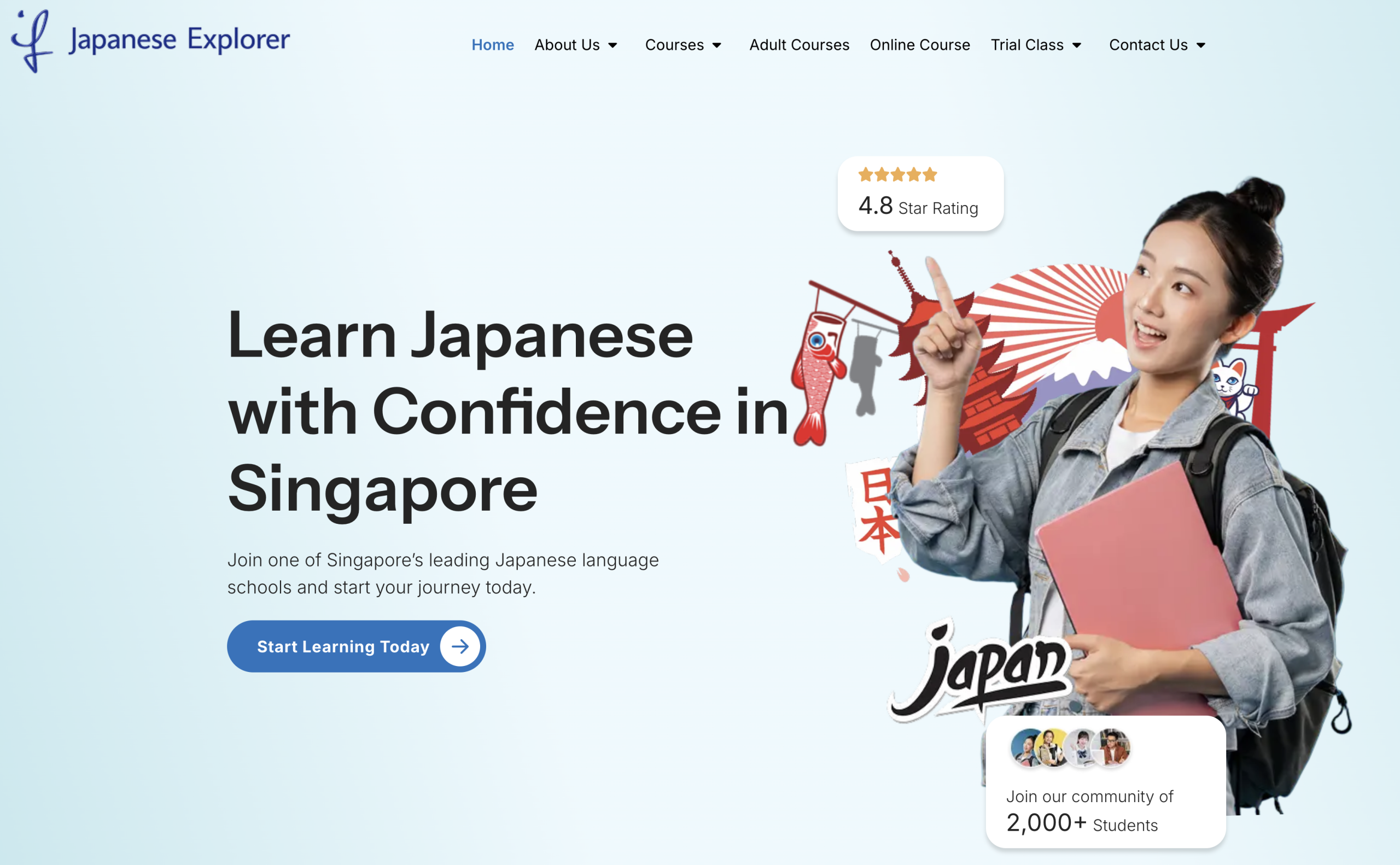
The trial lesson is the best way to see whether the teaching style and class format suit you. Come with your specific goal (conversational fluency, JLPT prep, or business Japanese) and ask the instructor to walk you through the first month’s plan. Explore the full range of Japanese language courses or go straight to the small group classes page to check current schedules and book your trial.
Further reading
- Top 10 Online Japanese Lessons (BFF Tokyo) — Curated overview of common online Japanese lesson formats and provider types.
- Marugoto Japanese Online Course (Japan Foundation) — Structured, graded online Japanese curriculum organized by communicative task and CEFR level; a useful benchmark for curriculum quality.
- The Ultimate List of Japanese Learning Resources (Team Japanese) — Comprehensive resource list grouping apps, courses, and platforms by learning goal; useful for building a blended study plan.
- Pareto Principle and Language Learning (WordBrewery) — Evidence-based case for prioritizing high-frequency vocabulary and grammar in early study.
FAQ
What does “tomo” mean in Japanese?
“Tomo” (友) means “friend” in Japanese. It is a common word used in everyday conversation and appears in many compound words and names.
What is the best online Japanese tutoring for adult learners?
The best option depends on your goal: a structured local school like Japanese Explorer suits business and JLPT learners, while tutor marketplaces work well for flexible 1:1 conversational practice. Pairing a live weekly lesson with a self-study subscription platform tends to produce the fastest speaking gains.
What is the 80/20 rule in Japanese learning?
The 80/20 rule suggests that roughly 20% of Japanese vocabulary and grammar covers the vast majority of daily conversation. Focusing on high-frequency words and core sentence patterns in early lessons accelerates spoken fluency faster than studying low-frequency content first.
How do I choose between a group class and a private tutor?
Group classes offer structured progression, peer interaction, and lower cost per lesson; private tutoring gives you faster feedback and a fully customized lesson plan. For most adult learners in Singapore, a small group class (four or fewer students) combined with occasional private sessions for targeted work is the most efficient combination.
Is JapanesePod101 enough on its own to reach conversational fluency?
Podcast and subscription platforms like JapanesePod101 build strong listening comprehension and grammar awareness, but they rarely develop spoken fluency on their own. Most learners need at least one live lesson per week with a qualified instructor to convert passive knowledge into confident speaking.