TL;DR:
- Japanese has three speech levels: casual, polite, and honorific, each with distinct grammar and social meaning. Using the wrong level can harm relationships and credibility, making it essential to choose correctly based on context. Beginners should primarily master polite speech first, gradually learning keigo for formal situations and responding to social cues.
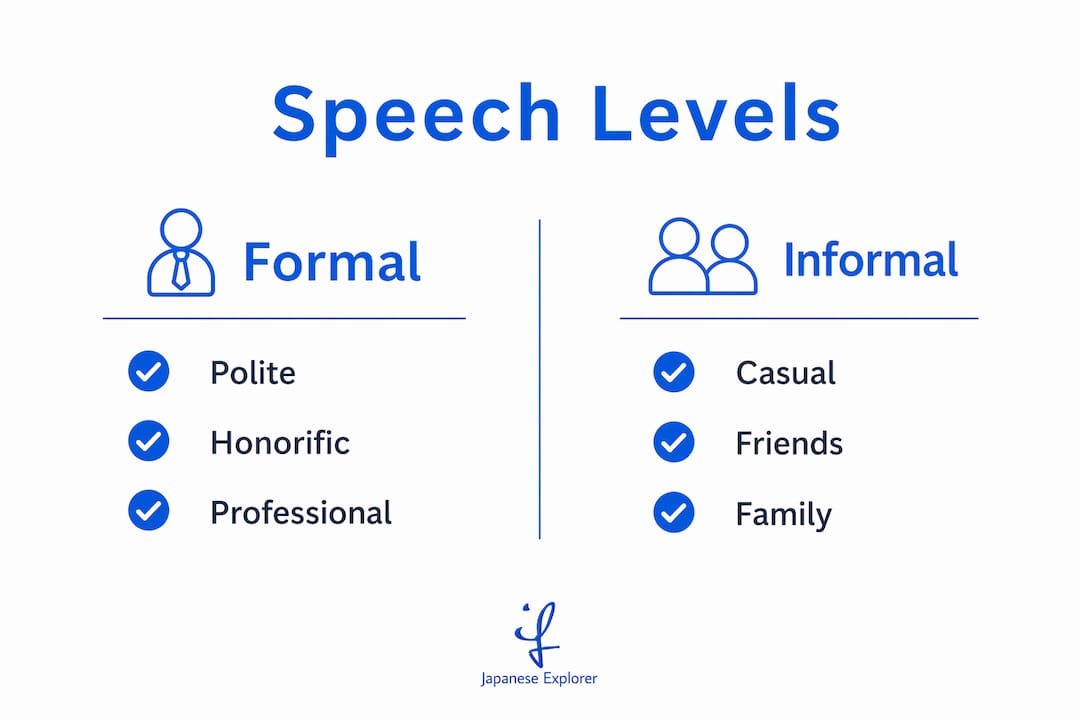
Japanese has three main speech levels: casual (tameguchi), polite (teineigo), and honorific (keigo). Each level carries distinct grammar, vocabulary, and social meaning. Choosing the wrong level in the wrong setting does not just sound awkward. It can damage relationships and professional credibility. This guide covers formal vs informal Japanese explained clearly for adult learners, so you know exactly which level to use, when to use it, and how to avoid the most common mistakes. Whether you are learning Japanese for travel, work, or daily life, getting speech levels right is one of the most practical skills you can build.
What are the main differences between formal and informal Japanese?
Japanese speech divides into three levels: casual (tameguchi), polite (teineigo), and honorific (keigo). Each level changes how verbs are conjugated, which vocabulary you choose, and how much respect you signal to the listener. Think of them as three different registers of the same language, each suited to a different social situation.
Casual speech (tameguchi)
Casual speech uses plain verb forms with no polite endings. You drop the formality markers and speak directly. For example, the verb “to go” becomes iku in casual speech. You use this register with close friends, family members, and people your own age who have invited you to speak casually. Using tameguchi with someone you have just met is a serious social misstep in Japanese culture.
Polite speech (teineigo)
Polite speech adds -masu or -desu endings to verbs and adjectives. “To go” becomes ikimasu. This register is the standard for most adult interactions: strangers, coworkers, shop staff, and anyone you do not know well. Teineigo is warm and respectful without being stiff. Most learners should master this level first because it works in almost every everyday situation.
Honorific speech (keigo)
Keigo is the formal register used in professional and ceremonial contexts. It divides into two main types: sonkeigo (respectful speech) and kenjougo (humble speech). Sonkeigo elevates the actions of the person you are speaking to. Kenjougo lowers your own actions to show deference. Misusing these directions is a serious social mistake that even native speakers sometimes make.
The table below shows how the same verb changes across all three levels.
| Speech Level | Japanese Term | Verb “to go” | Verb “to eat” |
|---|---|---|---|
| Casual | Tameguchi | iku | taberu |
| Polite | Teineigo | ikimasu | tabemasu |
| Respectful (keigo) | Sonkeigo | irassharu | meshiagaru |
| Humble (keigo) | Kenjougo | mairu | itadaku |
The vocabulary shifts are not just stylistic. They signal your awareness of social hierarchy and your respect for the other person.
When and how to use casual and polite Japanese
Knowing the difference between speech levels is only half the skill. Knowing when to switch is the other half. Getting this wrong is one of the most common mistakes Japanese learners make, and it happens more often than you might expect.
Here are the clearest guidelines for choosing the right register:
- Use casual speech with close friends and family. Once someone explicitly invites you to drop the formality, tameguchi is natural and expected. Staying overly polite with a close friend can actually feel cold or distant.
- Use polite speech as your default in all other situations. Strangers, coworkers, service staff, teachers, and anyone older than you all fall into this category. Polite form is the safe default for beginners and is appropriate in most unfamiliar social situations.
- Use keigo in professional and formal settings. Job interviews, client meetings, formal emails, and interactions with senior colleagues all call for honorific speech. This is where teineigo alone is not enough.
- Wait for an invitation before going casual. In Japanese social culture, the shift from polite to casual is usually initiated by the more senior or older person. Do not assume that a friendly conversation means you can drop the formality.
- Match the register of the person speaking to you. If someone addresses you in polite speech, respond in kind. If they shift to casual, you can follow their lead.
Pro Tip: Always start with polite speech when meeting someone new. It is far easier to relax your register later than to repair a first impression damaged by unexpected casualness.
The transition from polite to casual is gradual in Japanese relationships. You might spend weeks or months speaking politely with someone before they suggest you both drop the formality. Patience here is not just politeness. It is cultural literacy.
How to navigate honorific Japanese (keigo) safely as a learner
Keigo is the part of Japanese that intimidates most learners. The grammar is more complex, the vocabulary is entirely different, and the social stakes feel higher. The good news is that you do not need to master keigo before you can communicate effectively. You need to understand its logic and know when to use it.
The single most important rule in keigo is this: identify the subject of the action. If the subject is the other person, use sonkeigo. If the subject is yourself, use kenjougo. Mixing these directions is the most common keigo error, and it signals a lack of cultural understanding rather than just a grammar slip.
Here are the key points every learner should know about keigo:
- Sonkeigo raises the other person’s actions. The pattern is often o + verb stem + ni naru. For example, o-yomi ni naru means “you read” in respectful speech.
- Kenjougo lowers your own actions. The pattern is often o + verb stem + suru. For example, o-okuri suru means “I will send” in humble speech.
- Double keigo is a mistake. Stacking multiple honorific markers on one verb sounds unnatural and can confuse listeners.
- Mixing sonkeigo and kenjougo directions is a serious error. Using humble forms for the other person’s actions, or respectful forms for your own, reverses the intended meaning.
- Overly complex keigo without confidence can confuse listeners. Stick to polite teineigo forms if you are unsure, rather than attempting keigo incorrectly.
For learners who want to go deeper into professional contexts, understanding keigo in business communication is a natural next step after mastering teineigo.
Pro Tip: Incorrect keigo is usually better than no keigo in formal situations. Native speakers understand that learners are trying, and the effort itself communicates respect.
A practical strategy for beginners is to memorize a small set of high-frequency keigo phrases rather than trying to learn the full system at once. Phrases like itadakimasu (humble form of “to receive”) and irasshaimase (respectful greeting) appear constantly in daily Japanese life and are worth learning early.
How speech level shapes perceptions and relationships
Speech level choice encodes respect, social distance, and hierarchy in Japanese in a way that has no direct equivalent in English. English speakers can adjust tone and word choice, but Japanese speakers change the entire grammatical structure of a sentence to signal their relationship with the listener. This is not a surface feature of the language. It is built into the core of how Japanese communication works.
Using informal speech in a formal setting does real damage. A job candidate who uses casual verb forms in an interview signals either ignorance or disrespect. A client who receives casual emails from a vendor may feel undervalued. The social consequences are concrete and lasting.
The table below maps common social contexts to the recommended speech level.
| Social Context | Recommended Level | Notes |
|---|---|---|
| Close friends and family | Casual (tameguchi) | Only after relationship is established |
| Strangers and new acquaintances | Polite (teineigo) | Always start here |
| Workplace peers | Polite (teineigo) | Neutral-polite is the safe choice |
| Clients and senior colleagues | Keigo | Sonkeigo for their actions, kenjougo for yours |
| Formal events and ceremonies | Keigo | Full honorific register expected |
Digital communication follows the same rules. In chat apps and email, formality depends on relationship, not platform. Sending a casual message to your manager over a messaging app is just as inappropriate as saying the same thing face to face. Many learners assume that digital contexts are more relaxed, but Japanese professional culture does not make that distinction.
Polite speech also makes social interactions smoother for learners. When you default to teineigo, you signal cultural awareness and good faith. Native speakers are generally patient and encouraging with learners who make the effort to use the right register, even imperfectly. You can read more about casual vs formal social contexts to build a clearer picture of how these registers play out in real life.
Key takeaways
Mastering Japanese speech levels means defaulting to polite teineigo, learning keigo logic before vocabulary, and always letting the social context guide your register choice.
| Point | Details |
|---|---|
| Three distinct speech levels | Japanese uses casual, polite, and honorific registers, each with different grammar and vocabulary. |
| Polite form is the safe default | Use teineigo (-masu/-desu) with anyone you do not know well until the relationship deepens. |
| Keigo follows a subject rule | Use sonkeigo for others’ actions and kenjougo for your own to avoid serious social errors. |
| Context drives register choice | Workplace, formal events, and client interactions require keigo; casual speech is reserved for close relationships. |
| Digital formality mirrors real life | Speech level in messages and emails should match the social relationship, not the platform. |
What I have learned from watching learners tackle speech levels
The most common pattern I see is learners who rush past teineigo because they want to sound “natural.” They hear casual Japanese in anime or music and assume that is how people actually talk day to day. It is not. Casual speech in media is written for entertainment, not as a model for real social interaction.
The learners who progress fastest are the ones who get comfortable with polite speech first and treat it as a foundation, not a stepping stone to skip. They build confidence in teineigo, then layer in keigo vocabulary gradually as they encounter real professional situations. That sequence works because it mirrors how Japanese people themselves learn to use the language in different contexts.
Keigo intimidates almost everyone at first. I have seen fluent learners freeze up in a business meeting because they were not sure whether to use sonkeigo or kenjougo for a particular verb. My honest advice is to prepare a small set of reliable keigo phrases for the situations you actually face, whether that is a job interview, a client call, or a formal introduction. You do not need to know every pattern. You need to know the right ones for your context.
The fear of sounding unnatural is real, but it is also overblown. Japanese speakers are genuinely appreciative when a non-native learner makes the effort to use the right register. A small mistake in keigo, delivered with confidence and good intent, lands far better than avoiding formal speech altogether. Embrace the learning curve. Every awkward moment in a real conversation teaches you something a textbook cannot.
— Paul
Build your speech level skills with Japanese Explorer
Getting speech levels right takes structured practice with real feedback, not just self-study. Japanese Explorer offers small group Japanese classes in Singapore that cover conversational and business Japanese, including practical training in polite and honorific speech. Classes are taught by experienced bilingual instructors who give you real-world scenarios to practice in, not just grammar drills. If you prefer flexibility, the online Japanese course covers all levels via Zoom, so you can build your skills from anywhere. For professionals who need keigo for client work or corporate settings, the business Japanese course goes deep into formal register training. Japanese Explorer is located at 10 Anson Road, Level 22, International Plaza, Singapore 079903, right above Tanjong Pagar MRT.
FAQ
What is the difference between formal and informal Japanese?
Formal Japanese uses polite (-masu/-desu) or honorific (keigo) verb forms, while informal Japanese uses plain verb forms without polite endings. The choice depends on your relationship with the listener and the social context.
Which speech level should a beginner learn first?
Beginners should learn polite teineigo first. It uses -masu and -desu endings and is appropriate in almost every everyday situation, making it the most practical starting point.
What is keigo and when do you use it?
Keigo is the honorific speech register used in formal and professional contexts. It divides into sonkeigo, which elevates the other person’s actions, and kenjougo, which lowers your own actions to show respect.
Can you use casual Japanese in digital messages?
Casual Japanese in digital messages is only appropriate when your relationship with the recipient already allows it. Sending casual messages to a manager or client is considered disrespectful regardless of the platform.
How do you avoid mistakes when using keigo?
Identify the subject of the action before choosing a keigo form. Use sonkeigo when the other person is the subject, and kenjougo when you are the subject. When in doubt, polite teineigo is always safer than incorrect keigo.