TL;DR:
- Understanding Japanese consensus and hierarchy is essential for building trust and securing business deals effectively. Fluency in Japanese language and knowledge of cultural negotiation nuances significantly strengthen long-term relationships with Japanese partners. Patience, respect for hierarchy, and early engagement with key stakeholders are crucial for success in Japanese business environments.
Japanese culture and language are foundational assets in business, directly shaping how trust is built, decisions are made, and partnerships last. The role of Japanese in business goes far beyond translation. It encompasses consensus-driven decision-making, hierarchical respect, and a communication style that rewards patience and cultural fluency. For business professionals and entrepreneurs working with Japanese partners, clients, or markets, understanding these dynamics is not optional. It is the difference between a deal that closes and one that quietly stalls.
How consensus and nemawashi shape Japanese corporate decision-making
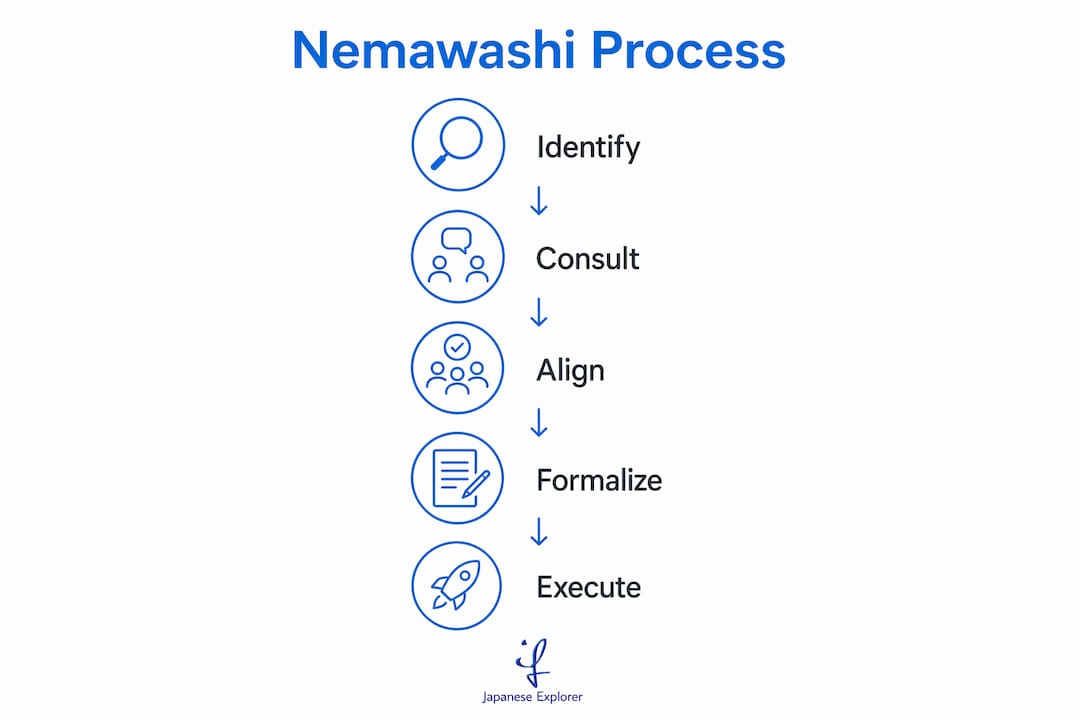
Nemawashi is the informal stakeholder consultation process that precedes every formal decision in Japanese organizations. The word literally means “going around the roots,” and that image captures the process well. Before any proposal reaches a meeting room, a Japanese manager will have already spoken privately with every key stakeholder to gauge their position and address concerns.
Nemawashi typically takes 2–6 weeks of behind-the-scenes alignment before a formal decision is made. That timeline surprises many Western professionals who expect meetings to be the place where decisions happen. In Japanese corporate culture, formal meetings confirm consensus that was already reached through private conversations. Walking into a meeting with a new proposal is a breach of protocol, not a sign of initiative.
The ringi system works alongside nemawashi. A written proposal circulates through the organization for approval stamps from each relevant manager. This process reinforces accountability and ensures no one is blindsided. The result is slower front-end decision-making but faster execution once approval is granted, because everyone is already aligned.
For entrepreneurs engaging Japanese partners, the practical implication is clear. Build relationships with middle managers early. They are the gatekeepers of the nemawashi process, and their quiet support determines whether your proposal moves forward or quietly disappears.
- Identify the key stakeholders before any formal pitch.
- Request informal one-on-one meetings to share your proposal early.
- Listen more than you speak in these sessions. The goal is alignment, not persuasion.
- Allow 2–6 weeks for the process to run its course without pushing for a faster answer.
- Treat the formal meeting as a confirmation, not a negotiation.
Pro Tip: If a Japanese counterpart says they “need more time to consider,” that is not a delay. It is the nemawashi process working exactly as intended. Respect the timeline and follow up gently after two weeks.
How does hierarchy shape Japanese business communication?
Hierarchy and seniority govern nearly every interaction in a Japanese business setting. The senpai-kohai relationship, where senior members guide and junior members defer, structures not just rank but also who speaks first, who receives a business card with two hands, and whose opinion carries weight in a room.
Bypassing a superior, even unintentionally, damages your credibility immediately. Japanese professionals notice when a foreign partner addresses a junior employee directly on a matter that should go through the senior manager. That misstep signals a lack of cultural awareness, and it can quietly close doors that were just beginning to open.
Indirect communication adds another layer of complexity. Japanese professionals often signal refusal through phrases like “that would be difficult” or “we will need to study this further.” These are polite rejections, not invitations to negotiate harder. Understanding honne (true feelings) versus tatemae (public position) is the skill that separates professionals who read the room from those who leave meetings thinking everything went well when it did not.
Key communication practices to follow in Japanese business settings:
- Address people by their title and family name until invited to use first names.
- Exchange business cards (meishi) with both hands and a slight bow. Study the card before putting it away.
- Avoid direct disagreement in group settings. Raise concerns privately before or after the meeting.
- Silence is not awkward. It signals that the other person is thinking carefully. Do not fill it.
- Learn a few Japanese meeting phrases to show respect and cultural awareness.
Pro Tip: Before your first meeting with a Japanese company, research the seniority of every attendee. Greet the most senior person first, and never hand your business card to a junior employee before addressing their superior.
Does Japanese language fluency give you a real business advantage?
Language fluency is trust capital in the Japanese market. Major Japanese trading houses invest heavily in multilingual training for their staff, prioritizing human communication over machine translation. That investment reflects a clear belief: relationships built through shared language are more durable than those mediated by interpreters.

Machine translation handles vocabulary. It does not handle nuance, tone, or the cultural weight behind a phrase. When you speak even basic business Japanese, you signal respect, commitment, and a willingness to meet your partner on their terms. That signal carries more weight than any polished presentation deck.
The impact of Japanese language skills on business relationships shows up in concrete ways:
- You catch indirect cues that an interpreter might smooth over or miss entirely.
- You can participate in informal conversations before and after meetings, where real trust is built.
- You demonstrate long-term commitment to the relationship, not just the transaction.
- You reduce dependence on intermediaries who may not fully represent your position.
| Language skill level | Business impact |
|---|---|
| Basic greetings and etiquette phrases | Shows respect; opens initial conversations |
| Conversational Japanese | Builds rapport in informal settings; reduces reliance on interpreters |
| Business Japanese (keigo) | Enables direct negotiation; signals deep cultural commitment |
| Advanced fluency | Full participation in nemawashi; access to candid stakeholder views |
Despite advances in AI translation, Japanese firms continue to prioritize human multilingual communication for its trust-building power. That preference is not nostalgia. It reflects the reality that business in Japan runs on relationships, and relationships run on genuine human connection.
Japanese Explorer’s business Japanese courses are structured around the Association for Japanese-Language Teaching framework, integrating keigo (formal speech), business vocabulary, and real-world communication practice. The curriculum is designed for adult professionals who need practical skills, not just textbook grammar.
What is Japan’s influence on global business today?
Japan’s footprint in global business is larger than most professionals realize. Japan’s outbound M&A activity reached $158 billion in 2025, with $110 billion directed to North America and $9 billion to India. That scale of investment places Japanese firms at the center of global capital flows, supply chains, and industry partnerships.
Japanese enterprises operate over 25,000 overseas subsidiaries, with more than 10,832 in manufacturing alone. That network makes Japan a supply chain gatekeeper in advanced industries including automotive, electronics, and precision engineering. Entrepreneurs who want to enter these supply chains need more than a competitive product. They need cultural credibility.
Japan also holds effective veto power in several advanced industries globally, particularly in components and materials that have no near-term substitutes. That position means Japanese partners are not just vendors or clients. They are often structural partners whose cooperation determines whether a product can be built at all.
| Japan’s global business metric | Scale |
|---|---|
| Outbound M&A activity (2025) | $158 billion total |
| Investment directed to North America | $110 billion |
| Investment directed to India | $9 billion |
| Overseas subsidiaries | 25,034 total |
| Manufacturing subsidiaries | 10,832 |
Japanese corporate strategies prioritize consensus, long-term reputation, and risk minimization over speed. That approach creates stable, loyal partnerships when managed well. It also creates friction for entrepreneurs who expect fast decisions and direct communication. The professionals who succeed in Japanese markets are those who adapt their pace and communication style to match their partner’s expectations, not those who try to accelerate the process.
Understanding the structure of Japanese business communication is a practical starting point for any entrepreneur preparing to engage Japanese partners for the first time.
Key Takeaways
Japanese business success depends on cultural fluency, language investment, and patience with consensus-driven processes that prioritize long-term trust over short-term speed.
| Point | Details |
|---|---|
| Nemawashi drives decisions | Allow 2–6 weeks for informal stakeholder alignment before expecting any formal answer. |
| Hierarchy shapes every interaction | Address senior members first and engage middle managers early as key allies. |
| Indirect communication requires skill | Phrases like “that would be difficult” signal refusal. Learn to read honne versus tatemae. |
| Language fluency builds trust capital | Business Japanese signals commitment and gives you access to candid, unfiltered conversations. |
| Japan’s global footprint is vast | With $158B in outbound M&A and 25,000+ overseas subsidiaries, Japan is a central player in global supply chains. |
Why cultural fluency matters more than most professionals admit
I have watched talented professionals lose Japanese partnerships not because their product was wrong, but because they misread a meeting. They walked in with a new proposal, expecting debate. They got polite nods. They left thinking they had agreement. Three weeks later, the deal was quietly shelved.
The mistake is almost always the same. Western professionals treat Japanese meetings as decision points. Japanese professionals treat them as confirmation rituals. Once you internalize that difference, everything else about Japanese business culture starts to make sense. The long timelines, the indirect language, the emphasis on relationship over transaction. These are not obstacles. They are a system designed to minimize risk and protect long-term reputation.
Language learning accelerates that understanding in ways that no cultural briefing document can replicate. When you study business Japanese, you do not just learn vocabulary. You learn how the language encodes respect, hierarchy, and social distance into every sentence. That knowledge changes how you listen, how you respond, and how you show up in a room.
My honest advice: start with the language before you need it. Professionals who begin studying Japanese before their first major partnership are far better positioned than those who scramble for an interpreter at the last minute. The investment pays off not just in communication but in the credibility it signals to every Japanese counterpart you meet.
— Paul
Build the skills that open Japanese business doors
Knowing the cultural rules is a strong start. Speaking the language is what makes Japanese partners trust you enough to bring you inside the process.

Japanese Explorer offers business Japanese courses and corporate training programs designed specifically for adult professionals in Singapore. Courses cover keigo, business vocabulary, meeting etiquette, and real-world communication scenarios. Classes are available in small groups, private sessions, and online via Zoom, so you can fit learning around a full work schedule. The school is located at 10 Anson Road, Level 22, International Plaza, right above Tanjong Pagar MRT. Whether you are preparing for a first partnership or deepening an existing relationship, Japanese Explorer gives you the language skills and cultural confidence to engage Japanese business partners on their terms.
FAQ
What is nemawashi in Japanese business?
Nemawashi is the informal process of consulting key stakeholders privately before any formal decision is made. It typically takes 2–6 weeks and determines whether a proposal succeeds or fails before it ever reaches a meeting.
Why does Japanese business communication seem indirect?
Japanese professionals use honne (true feelings) and tatemae (public position) to maintain harmony and avoid direct confrontation. Phrases like “that would be difficult” are polite refusals, not requests for more information.
How does learning Japanese improve business relationships?
Language fluency signals long-term commitment and cultural respect to Japanese partners. It also gives you direct access to informal conversations and subtle communication cues that interpreters often miss.
How significant is Japan’s role in global business?
Japan’s outbound M&A activity reached $158 billion in 2025, and Japanese firms operate over 25,000 overseas subsidiaries. Japan holds effective veto power in several advanced manufacturing industries worldwide.
What is the best way to prepare for working with Japanese companies?
Study business Japanese, learn the basics of nemawashi and hierarchy, and engage middle managers early in any partnership. Cultural preparation combined with language skills gives you a measurable advantage over competitors who rely solely on interpreters.