
TL;DR:
- The JLPT is a five-level Japanese proficiency test ranging from beginner N5 to near-native N1. It assesses vocabulary, grammar, reading, and listening without requiring speaking or writing skills and offers lifelong certification. Proper level selection and balanced skill development are key to successful preparation and real proficiency.
The Japanese Language Proficiency Test (JLPT) is defined as a standardized certification exam that measures Japanese language ability across five levels, from N5 (beginner) to N1 (advanced near-native proficiency). With JLPT levels explained clearly, you can choose the right starting point, set realistic study goals, and understand exactly what each certificate means to employers and universities. The test covers vocabulary, grammar, reading, and listening, and certificates never expire, making your achievement permanent. Whether you are brand new to Japanese or already reading newspapers in the language, this guide maps out every level so you can move forward with confidence.
What does each JLPT level represent?
The five JLPT levels span a wide range of ability, from recognizing basic hiragana and katakana at N5 to processing complex, abstract Japanese at N1. Each level builds directly on the one below it in terms of vocabulary, kanji, and grammar complexity.

N5 and N4: building the foundation
N5 is the entry point. At this level, you need roughly 800 vocabulary words and 100 kanji. You can understand simple greetings, classroom phrases, and very short written sentences. Think of it as the Japanese you would use to order food, introduce yourself, or follow basic directions.
N4 expands that foundation to around 1,500 vocabulary words and 300 kanji. You can handle everyday conversations on familiar topics, read short passages, and follow slow, clear speech. Most learners reach N4 after completing a structured beginner course.
N3: the bridge level
N3 sits between beginner and intermediate. It requires a working vocabulary of roughly 3,750 words and 650 kanji. At this level, you can understand the main point of conversations on everyday topics and read simple articles. The grammar becomes noticeably more complex, and abstract expressions start to appear. Many learners find N3 the first real test of whether their study habits are strong enough to keep pace.
N2 and N1: advanced proficiency
N2 demands around 6,000 vocabulary words and 1,000 kanji. You can read newspapers, follow natural-speed conversations, and handle most professional situations in Japanese. N2 is the minimum standard most Japanese companies and universities require from non-native speakers.
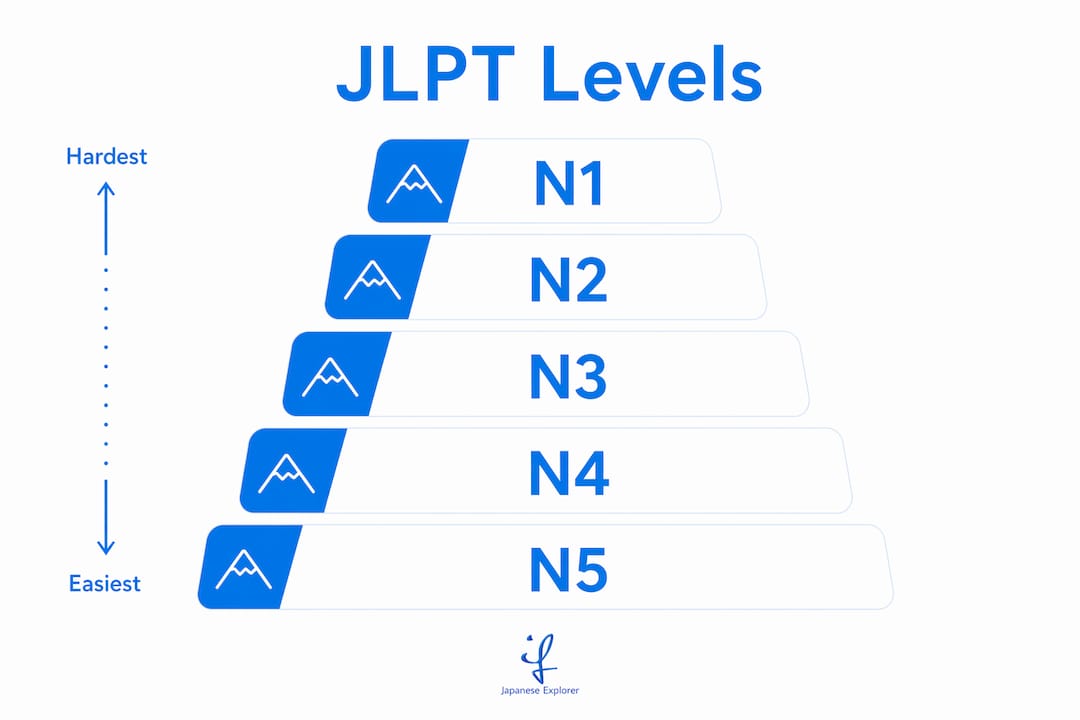
N1 is the top tier. It requires over 10,000 vocabulary words and approximately 2,000 kanji. That vocabulary count is roughly equivalent to what an educated native speaker uses in daily life. Passing N1 signals near-native reading and listening comprehension across complex, abstract, and technical topics.
| Level | Vocabulary | Kanji | Ability Summary |
|---|---|---|---|
| N5 | ~800 words | ~100 | Basic greetings, simple sentences |
| N4 | ~1,500 words | ~300 | Everyday familiar conversations |
| N3 | ~3,750 words | ~650 | Everyday situations, simple articles |
| N2 | ~6,000 words | ~1,000 | Newspapers, professional contexts |
| N1 | 10,000+ words | ~2,000 | Complex, abstract, near-native |
Pro Tip: If you can read a Japanese children’s book with ease but struggle with newspaper headlines, you are likely at the N3 to N4 range. Use that as your calibration point before registering.
How is the JLPT exam structured and scored?
The JLPT tests three core skill areas: Language Knowledge (vocabulary and grammar), Reading, and Listening. No speaking or writing sections exist on any level of the exam. That distinction matters because passing the JLPT does not automatically mean you can hold a conversation in Japanese.
Exam format by level
N1, N2, and N3 each have three separate scored sections: Language Knowledge, Reading, and Listening. N4 and N5 combine Language Knowledge and Reading into a single section, then test Listening separately. The total exam time ranges from 90 minutes at N5 to 165 minutes at N1. That 75-minute difference reflects the much greater volume of text and audio at the advanced levels.
Scoring and passing thresholds
The total possible score across all sections is 180 points. Passing requires meeting minimum scores in every individual section, not just hitting the overall total. This rule catches many test-takers off guard. You can score well on vocabulary and grammar but still fail the exam if your Listening score falls below the section minimum.
Here is a summary of the scoring structure:
- Total score range: 0–180 points across all sections
- Overall passing score: 100 points for N1, N2, and N3; 80 points for N4 and N5
- Section minimums: Each section has its own floor score that you must clear
- Failing one section: Fails the entire exam, regardless of your total score
- Certificates: Do not expire and are valid indefinitely worldwide
The JLPT is highly valued in Japanese academia and industry precisely because its section-based scoring proves balanced competence, not just strength in one area. Employers know a passing certificate reflects genuine, well-rounded ability.
What should you know before choosing your level and preparing?
Candidates can register for any level without completing a lower level first. You do not need an N5 certificate to sit N3. This flexibility is useful if you have studied Japanese through other means and want to enter at the level that matches your actual ability.
Realistic study timelines
Study time varies significantly by level. N5 typically takes 3–6 months of consistent study for a learner starting from zero. N1 can take 3–5 years or more, depending on your study intensity and immersion. The jump from N3 to N2 is where many learners stall. The vocabulary load nearly doubles, abstract grammar patterns multiply, and reading passages become far longer and denser.
The N3 plateau is real. Learners who coasted through N4 on classroom Japanese often hit a wall at N3 because the content shifts toward native-level material. This is where study methods like spaced repetition systems (SRS) for kanji and vocabulary become necessary, not optional. Tools like Anki, which uses SRS, help you retain the large vocabulary sets that N2 and N1 demand.
Choosing the right level
The most common mistake is choosing a test level based on ambition rather than current ability. Sitting N2 when you are genuinely at N3 level wastes your registration fee and your study time. A placement test gives you an honest baseline before you commit to a level.
Here is a practical approach to level selection:
- Take a placement test. Assess your current vocabulary, grammar, and reading comprehension before deciding on a level. Japanese Explorer offers a Japanese placement test for exactly this purpose.
- Review sample questions. The Japan Foundation publishes official sample questions for each level. If you can answer 60–70% correctly, that level is a realistic target.
- Factor in your timeline. The JLPT is offered twice yearly, in july and december. If you have four months to prepare, N5 or N4 is achievable. N2 in four months is not realistic for most learners.
- Set a skill goal, not just a certificate goal. Ask yourself what you want to do with Japanese. Working in Japan or with Japanese companies typically requires N2 at minimum. Traveling and casual conversation may only need N4.
- Plan your exam day strategy. There is no penalty for wrong answers, so answer every question. If you are stuck, make your best guess and move on. Leaving blanks guarantees zero points.
Pro Tip: Pair your JLPT preparation with real listening practice. Watch Japanese variety shows or news programs at your target level. The Listening section rewards learners who have heard natural Japanese, not just studied it from textbooks. For learners also working on spoken output, resources like accent and pronunciation guides can sharpen your ear for phonetic patterns.
For a deeper look at the full exam format and preparation strategies, the JLPT study and format guide at Japanese Explorer covers everything from registration to test-day logistics.
Key takeaways
The most effective approach to JLPT preparation is choosing a level that matches your current ability, then building balanced skills across vocabulary, reading, and listening before exam day.
| Point | Details |
|---|---|
| Five distinct levels | N5 is the easiest and N1 is the hardest, each with specific vocabulary and kanji requirements. |
| Section scores matter | Failing any one section fails the entire exam, regardless of your total score. |
| No speaking or writing | The JLPT tests only vocabulary, grammar, reading, and listening. |
| Realistic timelines | N5 takes 3–6 months; N1 can take 3–5 years or more of consistent study. |
| No level prerequisites | You can register for any level without holding a lower certificate first. |
Why the N3 plateau is the most important level to get right
The JLPT numbering trips up a lot of learners. N5 sounds advanced because five is a big number, but it is actually the easiest level. I have seen this confusion lead people to skip N5 out of pride and then struggle badly at N4. The reversed scale is genuinely counterintuitive, and it is worth pausing on it before you register.
The level I pay the most attention to when advising learners is N3. Not because it is the hardest, but because it is the level where study habits either solidify or collapse. Up to N4, you can get by on classroom exposure and a good textbook. At N3, the content starts pulling from real Japanese media, abstract grammar, and vocabulary that no beginner course covers fully. Learners who rely on passive review at this stage plateau for months or even years.
My honest view is that the language learning milestones between N3 and N2 are the most rewarding in the entire JLPT progression, but only if you treat them seriously. Use SRS for vocabulary, read graded readers at your level, and listen to Japanese every day. Chasing N1 without genuinely mastering N2 content is a shortcut that shows up clearly on exam day.
The certificate is valuable. N2 and N1 open real doors in Japanese business and academia. But the goal should be actual proficiency, not just a passing score. The JLPT measures comprehension well, and if you build real skills, the score follows naturally.
— Paul
Prepare for your JLPT with Japanese Explorer
Japanese Explorer offers structured JLPT preparation courses in Singapore designed for adult learners at every level, from N5 beginners to N2 and N1 candidates. Classes are taught by experienced bilingual instructors who integrate grammar, vocabulary, and listening practice in every session.

Flexible options include small group classes, private lessons, and online Japanese courses via Zoom, so you can prepare around your schedule. For professionals targeting N2 or N1, Japanese Explorer also offers business Japanese courses that align exam preparation with real workplace communication skills. Not sure which level to target? Take a placement test first and get a clear picture of where you stand.
FAQ
What is the JLPT and how many levels does it have?
The JLPT is a standardized Japanese proficiency test with five levels, N5 through N1. N5 is the easiest and N1 is the most advanced.
Can I skip levels and go straight to N2 or N1?
Yes. There are no prerequisites, and you can register for any level regardless of prior certifications. Choose based on your actual ability, not your target credential.
Does the JLPT test speaking or writing?
No. The JLPT tests only vocabulary, grammar, reading, and listening. Passing the exam does not certify conversational fluency.
How long does it take to prepare for each JLPT level?
N5 typically requires 3–6 months of study. N1 can take 3–5 years or more, depending on study intensity and daily exposure to Japanese.
Do JLPT certificates expire?
No. JLPT certificates are valid for life and do not require renewal. They are recognized internationally by employers and academic institutions.