TL;DR:
- Learning Japanese is easier than many expect because it is a phonetic language with consistent sounds. Mastering five vowel sounds and polite endings like です and ます builds a solid foundation for conversation. Practicing pronunciation through listening and shadowing accelerates fluency, while correct mora timing ensures speech sounds natural and understandable.
Learning how to speak Japanese words is more straightforward than most people expect. Japanese is a phonetic language, meaning every character maps to a fixed sound. Master the five core vowel sounds and the two polite sentence endings, です (desu) and ます (masu), and you have the foundation for real conversation. Tools like NHK WORLD RADIO JAPAN and the Japan Foundation’s IRODORI materials make structured practice accessible from day one. This guide gives you the pronunciation rules, polite speech patterns, and practice methods you need to start speaking with confidence.
What are the basic pronunciation rules for speaking Japanese words?
Japanese pronunciation is phonetic, which means what you see is what you say. Unlike English, there are no silent letters and no irregular vowel sounds. That consistency is your biggest advantage as a beginner.
The entire system builds on five vowel sounds:
- あ (a) sounds like the “a” in “father”
- い (i) sounds like the “ee” in “feet”
- う (u) sounds like a short, unrounded “oo”
- え (e) sounds like the “e” in “bed”
- お (o) sounds like the “o” in “go”
Every Japanese syllable uses one of these five vowels as its core. Practice each one individually before combining them into words. Words like “sake” (さけ), “umi” (うみ, meaning sea), and “eki” (えき, meaning station) are good starting points because they are short and use clear vowel sounds.
Beyond vowels, mora timing shapes how Japanese sounds. Each mora, or sound unit, receives equal length. There is no stress accent the way English has it. “Tokyo” in Japanese is not “TOH-kyo” with a heavy first beat. Each sound unit gets the same weight.

Two timing rules trip up most beginners:
| Sound | What It Does | Example |
|---|---|---|
| Long vowel (oo, uu) | Doubles the vowel length | おかあさん (okaasan, mother) |
| Small っ | Creates a brief pause before the next consonant | きって (kitte, stamp) |
Getting these timing units right matters more than having a perfect accent. Improper timing makes speech sound unnatural even when individual vowels are correct.
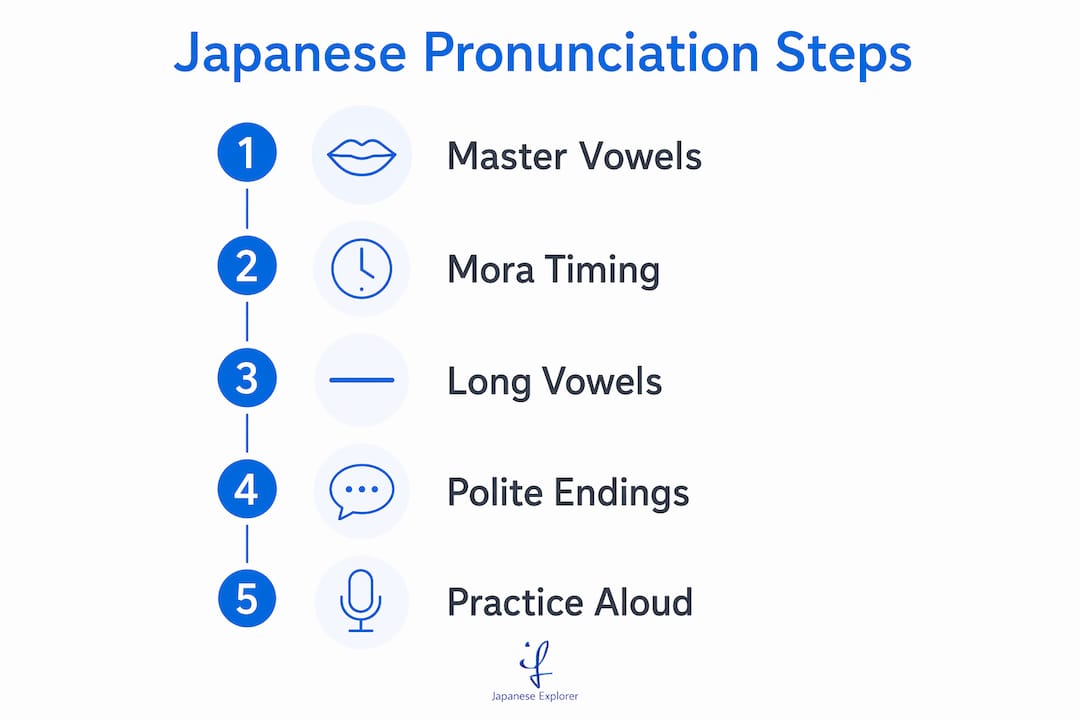
Pro Tip: Record yourself saying a five-syllable word like “tabemasu” (I eat) and count whether each sound takes the same amount of time. If one syllable sounds longer or louder, you are applying English stress patterns.
How do polite sentence endings work in spoken Japanese?
The two most important endings in spoken Japanese are です (desu) and ます (masu). Using them correctly is a communication strategy, not just a grammar rule. Polite speech signals respect and makes interactions smoother, especially with people you have just met.
The rule is clear. Use です after nouns and adjectives. Use ます after action verbs. They are not interchangeable.
- 私は学生です。(Watashi wa gakusei desu.) “I am a student.” (noun + です)
- 日本語を話します。(Nihongo wo hanashimasu.) “I speak Japanese.” (verb + ます)
- これは本です。(Kore wa hon desu.) “This is a book.” (noun + です)
- 毎日勉強します。(Mainichi benkyou shimasu.) “I study every day.” (verb + ます)
A common beginner mistake is attaching ます to a noun or です to a verb stem. Both produce grammatically incorrect sentences that confuse native speakers. Memorize the pattern: noun or adjective gets です, action verb gets ます.
One pronunciation detail makes a big difference. In natural speech, the う in です is devoiced and nearly silent. “Desu” sounds more like “dess.” Pronouncing the full “u” sounds stiff and unnatural. The same devoicing applies to the す in ます at the end of a sentence.
Pro Tip: Listen to native speakers on NHK WORLD RADIO JAPAN and pay attention to how they end sentences. You will hear “dess” and “mass” rather than full vowel sounds. Copying that pattern immediately makes your speech sound more natural.
Mastering these two endings also gives you a polite speech foundation you can build on. Start with polite forms, then expand into casual or more nuanced speech as your skills grow.
What are practical ways to practice speaking Japanese words?
Listening before speaking is the most effective sequence for building pronunciation. The Japan Foundation’s IRODORI materials use separate kiku (listen) and hanasu (speak) components so you internalize a sound before you produce it. That approach prevents bad habits from forming early.
Here is a step-by-step practice routine that works for beginners:
- Listen to a word or phrase once without trying to repeat it. Focus only on the sounds.
- Listen again and shadow the speaker, matching their rhythm and vowel length as closely as possible.
- Repeat the phrase three times on your own, recording yourself on the second and third attempt.
- Compare your recording to the original audio. Identify one specific difference to fix.
- Move to the next phrase only after your timing feels consistent.
This method works because interactive practice with immediate feedback builds stronger retention than passive reading or translation exercises.
Useful resources for Japanese vocabulary practice include:
- NHK WORLD RADIO JAPAN Easy Japanese: Each quiz presents three questions where you listen and choose the correct meaning. The immediate feedback reinforces both listening and speaking.
- Japan Foundation IRODORI: Structured beginner lessons with audio for both listening and speaking practice, organized by real-life situations.
- Practice Japanese (practice-japanese.com): Clear pronunciation guides with audio examples for each vowel and consonant combination.
Practice speaking before you focus on writing. Reading hiragana and katakana is useful, but consistent vowel sounds and correct timing are what make you understood in conversation. Writing can follow once your ear is trained.
For tips on improving your listening skills, pairing audio drills with focused listening sessions accelerates your progress significantly.
What common mistakes should beginners avoid when speaking Japanese?
The most damaging mistake beginners make is confusing long and short vowels. Vowel length changes meaning entirely. The classic example: おばさん (obasan) means “aunt,” but おばあさん (obaasan) means “grandmother.” One extra vowel length unit creates a completely different word.
Other frequent mistakes include:
- Applying English stress patterns. Saying “TAbe-masu” with a heavy first beat instead of equal mora timing makes the word harder to understand.
- Mixing up です and ます. Saying “gakusei masu” instead of “gakusei desu” signals a grammar gap immediately.
- Pronouncing the full う in です. Saying “de-su” with a clear “u” sounds unnatural. Native speakers say “dess.”
- Rushing through long vowels. Cutting a long vowel short changes the word. Take the extra beat.
- Ignoring the small っ pause. Skipping the pause in words like きって (kitte) makes the word sound like きて (kite), which means “come here,” not “stamp.”
“Focus on timing and clarity first. Accent perfection comes later, but correct vowel length and mora timing make you understood from day one.”
The fix for most of these mistakes is the same. Slow down, count your mora units, and record yourself. You cannot hear your own errors in real time. A recording lets you catch the moment your timing breaks down. Developing good speaking habits early prevents these errors from becoming permanent.
Pro Tip: Write out the mora units of a word before you say it. “Tokyo” has four units: to-u-kyo-u. Tapping your finger for each unit while speaking trains your timing faster than any other drill.
How can you keep improving your Japanese speaking skills?
Building on the basics requires consistent exposure and a structured path forward. Vocabulary practice is the next layer. Once you can produce the five vowels cleanly and use です and ます correctly, expand your word bank by topic: greetings, numbers, directions, food, and transportation cover most travel situations.
Effective habits for continued improvement include:
- Practice with native speakers or language partners. Real conversation exposes you to natural rhythm, devoicing, and connected speech that audio drills cannot fully replicate.
- Use spaced repetition. Apps that use spaced repetition systems, such as Anki, help you retain common Japanese words without cramming.
- Focus on phrases, not isolated words. Learning “sumimasen” (excuse me) as a complete phrase is more useful than memorizing individual sounds.
- Immerse yourself in audio. Japanese podcasts, NHK WORLD RADIO JAPAN broadcasts, and drama clips train your ear to the natural pace of speech.
- Join a structured course. A beginner Japanese course gives you a curriculum that sequences grammar, speaking, and listening in the right order.
Structured classes matter because self-study often stalls at the point where grammar becomes complex. A teacher corrects your timing and pronunciation in real time, which no app can fully replace. For learners with professional goals, a business Japanese course adds the formal register and polite vocabulary that workplace communication requires. The 4 learning tips that experienced learners rely on consistently point back to rhythm, repetition, and real conversation as the three pillars of progress.
Key Takeaways
Mastering Japanese speaking starts with five vowel sounds and two polite endings, then grows through consistent listen-and-repeat practice and structured feedback.
| Point | Details |
|---|---|
| Five vowels are the foundation | Train あ, い, う, え, お individually before combining them into words. |
| Mora timing beats stress accent | Give each sound unit equal length to sound natural and be understood. |
| です vs. ます is non-negotiable | Use です after nouns and adjectives, ます after action verbs, never reversed. |
| Devoice the う in です | Say “dess” not “de-su” to match natural spoken Japanese immediately. |
| Listen before you speak | Use IRODORI and NHK WORLD RADIO JAPAN audio drills before attempting production. |
Why I think most beginners practice Japanese the wrong way
Most learners spend their first weeks memorizing vocabulary lists and writing hiragana. Both are useful, but neither builds speaking confidence. The real bottleneck is not vocabulary. It is timing.
I have seen learners with 500 words in their heads who cannot hold a basic conversation because their mora timing is off. Native speakers struggle to follow them, not because of vocabulary gaps, but because the rhythm feels wrong. Japanese ears are tuned to equal-length sound units. When that rhythm breaks, comprehension breaks with it.
The fix is simple but uncomfortable. You have to speak out loud from day one, even when it feels awkward. Record yourself, compare to native audio, and fix one thing at a time. Polite endings like です and ます are your best friends early on. They give you a safe, respectful default for every sentence while your grammar catches up.
The learners who progress fastest are not the ones who study the most. They are the ones who speak the most, make mistakes in front of others, and treat every correction as useful data. Clarity and rhythm first. Accent perfection is a long-term project.
— Paul
Japanese Explorer: structured speaking practice for adult learners
Japanese Explorer offers adult learners in Singapore a direct path from beginner pronunciation to confident conversation.

The school’s small group Japanese classes put you in a live speaking environment where certified bilingual instructors correct your timing and pronunciation in real time. Every lesson integrates grammar, listening, and speaking so skills build together rather than in isolation. For learners who prefer flexibility, the online Japanese course delivers the same structured curriculum via Zoom, making it easy to fit practice into a busy schedule. Classes run from beginner conversational through business Japanese, with a curriculum guided by the Association for Japanese-Language Teaching. The school is located at 10 Anson Road, Level 22, International Plaza, Singapore 079903, right above Tanjong Pagar MRT.
FAQ
What are the five Japanese vowel sounds?
The five vowels are あ (a), い (i), う (u), え (e), and お (o). Every Japanese syllable is built on one of these sounds, making pronunciation consistent once you learn them.
What is the difference between です and ます?
Use です after nouns and adjectives to mean “is” or “am.” Use ます after action verb stems to indicate a polite action. They serve different grammatical roles and are not interchangeable.
How do I pronounce です correctly?
In natural speech, the う in です is devoiced and nearly silent. Say “dess” rather than “de-su” to match how native speakers actually sound in conversation.
Why does vowel length matter so much in Japanese?
Vowel length changes word meaning entirely. おばさん (obasan) means “aunt” while おばあさん (obaasan) means “grandmother.” Getting the length wrong produces a different word, not just an accent variation.
How long does it take to speak basic Japanese phrases?
With consistent daily practice using audio drills and listen-and-repeat methods, most adult learners can produce clear basic Japanese phrases within a few weeks. Structured classes accelerate this timeline significantly.