TL;DR:
- Japanese curriculum standards set mandatory educational content and assessment methods across all schools in Japan. They emphasize a three-dimensional evaluation model, prioritize language arts, and are undergoing revisions to integrate AI literacy by 2030. Schools have flexibility in delivery but must adhere to MEXT-approved textbooks and content guidelines.
Japanese curriculum standards are the officially mandated educational frameworks that define required learning content, goals, and evaluation methods across all Japanese schools. Known formally as the Gakushū Shidō Yōryō, or Course of Study, these standards are set by Japan’s Ministry of Education, Culture, Sports, Science and Technology (MEXT) and apply to every public and private school nationwide. For educators and curriculum developers building Japanese language programs, understanding this framework is not optional. It determines what gets taught, how learning is assessed, and where the Japanese education framework is heading next.
What are japanese curriculum standards and how are they governed?
Japanese curriculum standards follow a nationally unified structure built on 9 years of compulsory education, organized as 6 years of elementary school followed by 3 years of junior high. This 6-3 structure is the backbone of the national curriculum Japan enforces across all regions.
MEXT holds authority over content standards, while local Boards of Education manage staffing and school operations. Local schools have operational autonomy but must comply strictly with MEXT curriculum standards and textbook protocols to maintain nationwide educational consistency. That balance between local flexibility and central control is what makes the Japanese education framework both adaptable and reliable.
The governing document is the Gakushū Shidō Yōryō. MEXT revises it on a roughly 10-year cycle, though technology-related guidelines may be updated more frequently to align with textbook cycles. The most recent major revision took effect in 2020 for elementary schools, introducing significant changes to evaluation methods and subject emphasis.
Key structural features of the national curriculum Japan uses:
- Gakushū Shidō Yōryō sets mandatory content for every subject at every grade level
- MEXT-approved textbooks are required across all schools, preserving standardization regardless of local delivery choices
- Local Boards of Education handle school administration but cannot override MEXT content mandates
- Revision cycles run approximately every 10 years, with faster updates possible for technology subjects
- High school follows the compulsory phase and operates under a separate but connected set of MEXT standards
How does the japanese education framework define language learning?
Japanese language education holds the highest instructional weight of any subject in the elementary curriculum. Grade 1 students receive 306 instructional hours per year in Japanese language arts, with that figure decreasing to around 175 hours by Grade 6. That front-loaded emphasis reflects how foundational language competency is to every other subject.
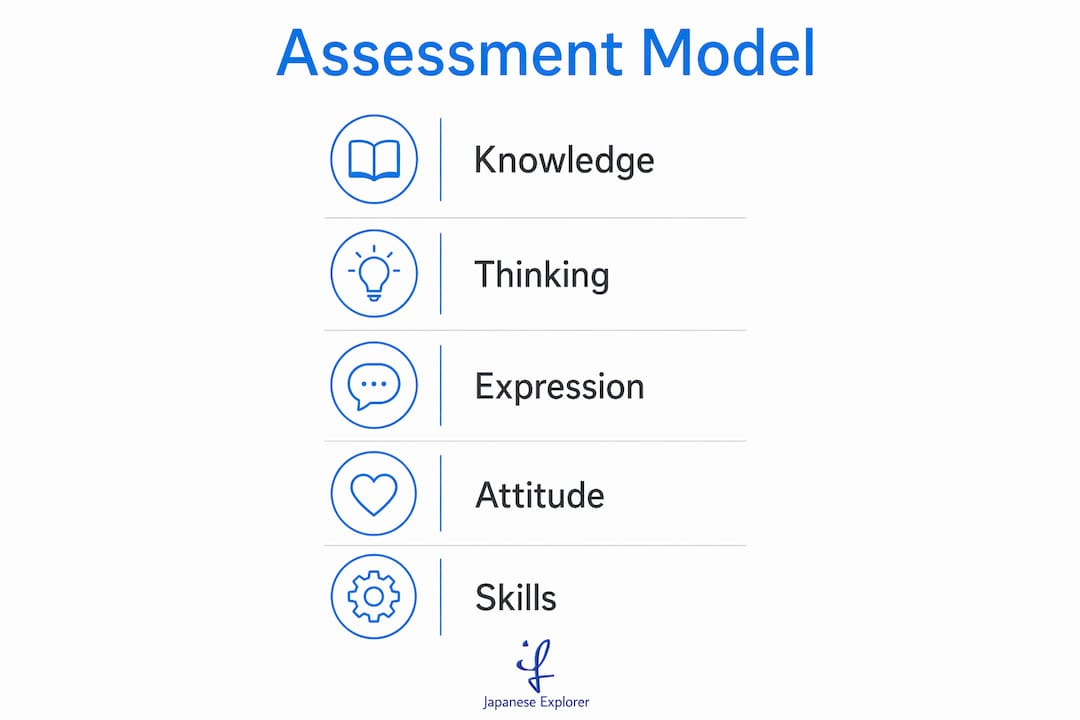
The evaluation model that governs Japanese language education is three-dimensional. Single numerical marking has been non-compliant since the 2020 revisions of the Gakushū Shidō Yōryō. Teachers must now assess students across three distinct dimensions:
- Knowledge and Skills — Does the student understand and can apply language rules, vocabulary, and grammar?
- Thinking, Judgment, and Expression — Can the student read critically, construct arguments, and communicate ideas clearly?
- Attitude toward Learning — Does the student engage actively, reflect on their progress, and show motivation to improve?
This shift away from single scores toward multi-dimensional assessment reflects MEXT’s broader goal of developing learners who think, not just memorize. For curriculum developers, this means your program design needs to address all three dimensions explicitly, not just test vocabulary recall.
The 2020 reforms also placed new emphasis on critical reading and high-order expression skills. High-order language capabilities are now positioned to support information literacy and inquiry-based learning in the AI era. Japanese language arts is no longer just about reading and writing. It is the subject that teaches students how to evaluate sources, construct reasoned arguments, and communicate with precision.
Pro Tip: If you are designing a Japanese language program for adults, map your learning outcomes directly to these three evaluation dimensions. Programs that address knowledge, critical thinking, and learner attitude tend to produce more confident, capable speakers than those focused on grammar drills alone.
What changes are coming to japan’s curriculum standards by 2030?
The next major revision of Japan’s curriculum standards is already in motion. The notification is scheduled for 2027, with phased implementation beginning in elementary schools in 2030, junior high in 2031, and high schools by 2032. This is the most technology-focused revision in the history of the Gakushū Shidō Yōryō.

The centerpiece of the upcoming reform is a new subject called “Information & Technology,” planned for junior high. This subject will formalize digital literacy instruction that currently sits scattered across existing subjects. The 2030 curriculum emphasizes high-order language capabilities including AI awareness and digital information literacy across all subjects, not just the new technology course.
Here is a summary of the key changes and their timelines:
| Reform Area | Detail | Implementation |
|---|---|---|
| New “Information & Technology” subject | Standalone digital literacy course for junior high | From 2031 |
| AI awareness integration | Embedded across multiple subjects including language arts | From 2030 |
| Expanded integrated studies | Elementary schools get broader inquiry-based learning blocks | From 2030 |
| High-order language skills | Critical reading and expression strengthened in Japanese language arts | From 2030 |
| Curriculum simplification | Structured reduction of content load to reduce teacher burden | Across all phases |
MEXT’s stated priority for this revision is high quality, deep learning with a simplified and structured curriculum that reduces teacher burden while maintaining academic rigor. That is a deliberate departure from the tendency to add more content with each revision cycle. The goal is depth over breadth.
For educators building Japanese language programs now, this revision signals something important. AI literacy and digital information evaluation are becoming core language competencies, not add-ons. Programs that already teach critical reading and source evaluation are ahead of the curve. Those that focus only on conversational fluency will need to adapt.
Pro Tip: Start incorporating digital literacy for educators into your professional development now. The 2030 curriculum will expect teachers to model AI-aware thinking, not just teach it as a separate topic.
How do japanese teaching standards balance flexibility and consistency?
One of the most misunderstood aspects of curriculum development in Japan is the relationship between national mandates and local delivery. MEXT sets what must be taught. Schools decide how to teach it. That distinction matters enormously for curriculum developers.
MEXT requires nationally approved textbooks across all schools, which preserves content standardization even when delivery methods vary. A school in rural Hokkaido and a school in central Tokyo cover the same content, assessed by the same three-dimensional framework, using MEXT-approved materials. The teacher’s method, pacing, and supplementary resources can differ, but the content floor does not.
The upcoming revision also addresses inclusion and diverse learner needs directly. MEXT’s reform directions acknowledge school attendance challenges and the need to support students who learn differently. Curriculum reform aims to balance reducing teacher workload with maintaining deep, high-quality learning. That is not just a policy statement. It reflects real pressure on Japanese schools, where teacher burnout has become a documented concern.
For curriculum developers outside Japan building programs aligned with Japanese teaching standards, this flexibility-within-consistency model offers a useful design principle. You can adapt delivery methods, pacing, and supplementary content to your learners’ context. What you should not compromise is the content framework and the three-dimensional assessment approach. Those are the elements that make a program genuinely aligned with educational standards in Japan.
Practical ways to apply this model in your own program:
- Use MEXT’s subject content lists as your content floor, not your ceiling
- Design assessments that capture all three evaluation dimensions, not just test scores
- Build in flexibility for learner pace and context while keeping learning objectives fixed
- Reference learning strategies that complement MEXT’s simplification goals
Key takeaways
Japanese curriculum standards, governed by MEXT through the Gakushū Shidō Yōryō, define a three-dimensional assessment model, a 6-3 school structure, and a 2030 revision that makes AI literacy a core language competency.
| Point | Details |
|---|---|
| Governing document | The Gakushū Shidō Yōryō sets all mandatory content and is revised roughly every 10 years. |
| Three-dimensional assessment | Programs must address Knowledge/Skills, Thinking/Expression, and Attitude, not just test scores. |
| Language arts priority | Japanese language receives the most instructional hours in elementary grades, reflecting its foundational role. |
| 2030 revision focus | AI literacy and digital information skills will be embedded across subjects, starting with elementary schools. |
| Flexibility within standards | Schools control delivery methods, but MEXT-approved textbooks and content mandates are non-negotiable. |
Why alignment with evolving standards is the real competitive advantage
I have spent years working with educators who treat curriculum standards as a compliance checkbox. That is the wrong frame entirely. The Gakushū Shidō Yōryō is not a ceiling. It is a floor, and the most effective programs use it as a foundation to build something genuinely better.
The three-dimensional evaluation model is the clearest example. Most programs I have seen still default to vocabulary tests and grammar drills as their primary measure of progress. The 2020 revisions made that approach officially non-compliant in Japan, and for good reason. A learner who can pass a grammar test but cannot construct a reasoned argument in Japanese is not fluent. They are just trained.
The upcoming 2030 revision reinforces this. AI and digital literacy are not replacing language skills. They are being built on top of them. MEXT’s position is that AI complements foundational language skills, not replaces them. That means the educators who invest in critical reading, source evaluation, and high-order expression now will have programs that are already aligned when the new standards arrive.
My advice is straightforward. Map your program outcomes to the three evaluation dimensions today. Build in inquiry-based tasks that develop thinking and judgment, not just knowledge. And pay close attention to the 2027 notification from MEXT. The phased rollout gives you a window to adapt before full implementation hits in 2030. Use it.
— Paul
How japanese explorer supports curriculum-aligned japanese learning
If you are an educator or curriculum developer looking to build programs that reflect Japan’s educational standards, the quality of instruction matters as much as the content framework.

Japanese Explorer, Singapore’s leading Japanese language school located at 10 Anson Road, Level 22, International Plaza, above Tanjong Pagar MRT, offers small group Japanese classes and online Japanese courses taught by certified bilingual instructors. The curriculum follows the Association for Japanese-Language Teaching framework, integrating grammar, speaking, and listening in every lesson. Whether you are building a corporate training program or developing your own Japanese language skills to better serve your learners, Japanese Explorer provides a structured, practical path forward. Reach out to the team to explore group, private, and online options that fit your professional goals.
FAQ
What is the gakushū shidō yōryō?
The Gakushū Shidō Yōryō is Japan’s official Course of Study document, issued by MEXT, that mandates all subject content, learning objectives, and evaluation methods for Japanese schools. It is revised approximately every 10 years.
How does MEXT evaluate japanese language learning?
MEXT requires a three-dimensional evaluation covering Knowledge and Skills, Thinking and Expression, and Attitude toward Learning. Single numerical scores have been non-compliant since the 2020 revisions.
When will the next japanese curriculum revision take effect?
MEXT is scheduled to notify schools of the new standards in 2027, with elementary schools implementing changes in 2030, junior high in 2031, and high schools by 2032.
What role does AI play in the upcoming curriculum changes?
The 2030 revision embeds AI awareness and digital information literacy across multiple subjects, including Japanese language arts, positioning critical reading and source evaluation as core competencies for the AI era.
Can schools in japan adapt the curriculum to local needs?
Schools control delivery methods, pacing, and supplementary resources, but must use MEXT-approved textbooks and follow the content mandates set by the Gakushū Shidō Yōryō without exception.