
TL;DR:
- Effective kanji memorization relies on breaking characters into radicals, creating vivid mnemonics, and anchoring each to real vocabulary through spaced repetition. Learning radicals and stories helps transform complex shapes into meaningful units, while vocabulary context reinforces readings and pronunciation naturally. Consistent review with spaced repetition systems like Anki ensures long-term retention and fluent reading ability.
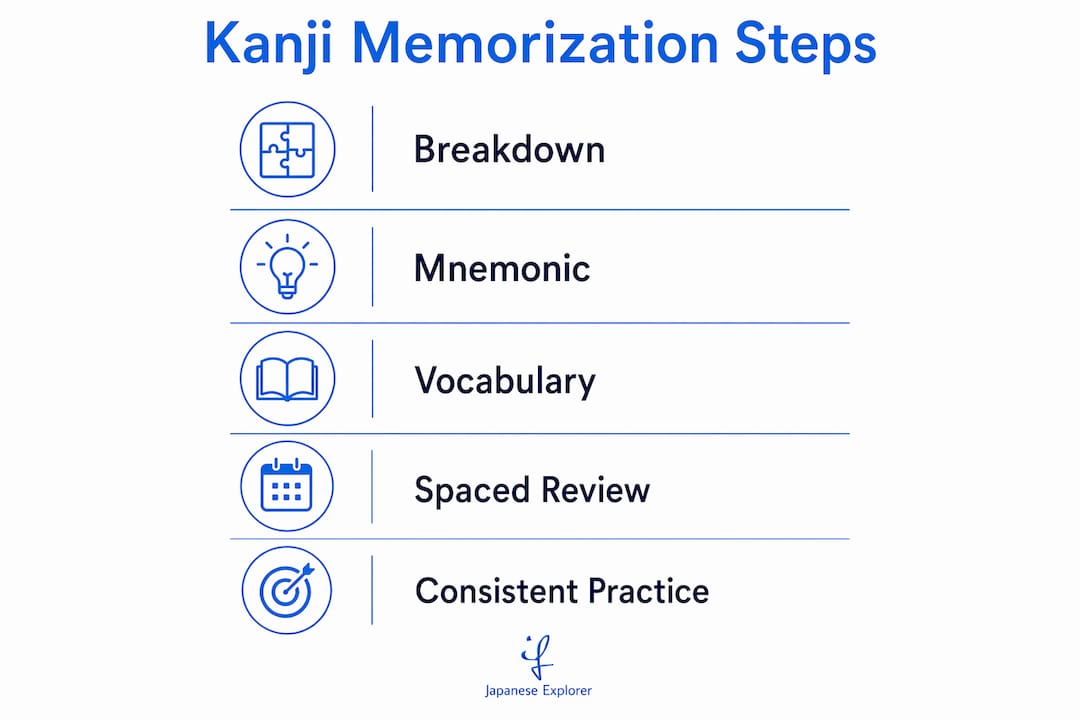
Memorizing kanji is best achieved by combining three core methods: breaking characters into radicals, building mnemonic stories around those parts, and anchoring every kanji to real vocabulary through spaced repetition. Rote copying of characters alone fails most learners because it treats kanji as abstract shapes rather than structured, meaningful units. The good news is that the Japanese writing system has an internal logic you can exploit. Whether you are studying for JLPT N5 or aiming for business-level fluency, the techniques in this guide will help you retain kanji faster and forget them far less often.
How to memorize kanji using radicals and mnemonics
Radicals are the building blocks of kanji. Every character is composed of smaller visual units, and recognizing those units turns an intimidating wall of strokes into a manageable puzzle. The Kangxi radical system organizes 214 radicals by stroke count and forms the backbone of most Japanese dictionaries. You do not need to memorize all 214, but learning the 50 to 80 most common ones gives you a key that unlocks hundreds of kanji at once.
The two-step mnemonic method works like this: first, identify the radicals inside a kanji and assign each one a vivid image or nickname. Second, write a short story of two to three sentences that connects those images to the kanji’s meaning. For example, the kanji 明 (bright) combines 日 (sun) and 月 (moon). Your story might be: “The sun and the moon shine together in the sky, making everything brilliantly bright.” That tiny narrative sticks in memory far better than staring at the character for ten minutes.
Mnemonics reduce cognitive load by transforming complex shapes into meaningful smaller chunks. This aligns with both Dual Coding Theory and Cognitive Load Theory, which confirm that picture-based mnemonics enhance recognition and recall by linking visual and verbal memory pathways simultaneously.
Here is a practical workflow for building your mnemonic system:
- Identify every radical or component in the kanji, even if a part is not a standard Kangxi radical.
- Assign a stable image or nickname to each component. Keep these consistent across all your kanji so the same radical always triggers the same mental image.
- Write a two to three sentence story linking the images to the kanji’s core meaning.
- Say the story aloud once, then write the kanji while recalling the story. This multimodal encoding strengthens the memory trace.
Note that mnemonic radicals used for learning are optimized for memory utility, not strict dictionary taxonomy. Flexibility in how you label a component is fine as long as it makes your story more memorable.
Pro Tip: If a component does not match any standard radical, invent your own nickname for it. Calling an unfamiliar squiggle “a broken umbrella” is completely valid if that image helps the story click. Personal associations are almost always stronger than borrowed ones.
Why learning kanji in vocabulary context beats isolated memorization
Learning kanji as isolated characters is like memorizing phone numbers with no names attached. You can recall the digits briefly, but the connection fades fast. The more effective approach is to learn kanji through vocabulary by pairing every new character with at least one real word that uses it.
Japanese kanji carry two types of readings: on’yomi (the Chinese-derived reading) and kun’yomi (the native Japanese reading). Trying to memorize both reading lists in isolation is one of the most common mistakes beginners make. Instead, anchor readings to actual words rather than abstract pronunciation lists. The kanji 水 (water) has the on’yomi “sui” and the kun’yomi “mizu.” Rather than drilling those two sounds separately, learn 水 through words like 水曜日 (suiyoubi, Wednesday) and お水 (omizu, water to drink). The readings attach naturally through repeated word exposure.
Learning kanji through vocabulary also gives you reading practice, pronunciation reinforcement, and grammar context all at once. Here is what that approach delivers:
- Faster reading comprehension because you recognize kanji in the words you already know.
- Correct pronunciation habits built from real usage rather than abstract rules.
- Multiple readings absorbed naturally as you encounter the same kanji in different words.
- Stronger retention because meaning, sound, and context form a single memory unit rather than three separate facts.
The structured path recommended by most experienced learners is to master hiragana and katakana first, then move into JLPT N5 kanji through vocabulary study. For practical tips on expanding your word bank alongside kanji, the Japanese vocabulary expansion guide at Japanese Explorer is a solid starting point.
How to use spaced repetition systems to retain kanji long-term
Spaced repetition is the single most evidence-backed method for long-term kanji retention. The concept is straightforward: review a kanji just before you are about to forget it, and the memory strengthens each time. The optimal review schedule runs at one day, three days, seven days, and fourteen days after initial learning. Each successful review pushes the next interval further out, so you spend less time on kanji you know well and more time on the ones that keep slipping.

Anki is the most widely used spaced repetition tool among Japanese learners, and the card format matters as much as the schedule. The most effective Anki cards are built around vocabulary rather than isolated kanji. A strong card shows a Japanese word on the front, with the reading, meaning, and an example sentence on the back. This format reinforces the vocabulary context approach from the previous section and prevents you from recognizing a kanji in isolation while failing to read it inside a real word.
The FSRS scheduler is a newer algorithm available in Anki that personalizes review intervals by targeting a specific recall probability for each card. It outperforms the older SM-2 algorithm for most learners because it adapts to your actual forgetting patterns rather than applying a fixed formula. Setting up FSRS takes about ten minutes and is worth doing before you build a large deck.
The most common reason learners quit Anki is review backlog. Capping new cards at 10 to 20 per day prevents the backlog from growing faster than you can clear it. One learner’s documented experience shows that adding 50 or more cards daily caused a review pile so large that they quit entirely around day fifteen. Sustainable pacing beats ambitious starts every time.
| Review method | Best for | Key advantage |
|---|---|---|
| Fixed interval (1, 3, 7, 14 days) | Beginners building a new habit | Simple to follow without any app |
| Anki with SM-2 algorithm | Learners with an established deck | Automatic scheduling based on self-rating |
| Anki with FSRS algorithm | Intermediate to advanced learners | Personalized intervals targeting recall probability |
| Paper flashcards with self-review | Learners who prefer analog study | Handwriting reinforces stroke memory |
Pro Tip: Never skip your Anki review session, even if you only have five minutes. Clearing due cards daily is more important than adding new ones. A short session beats a missed session every time.
For a full walkthrough of setting up your review system, the SRS setup guide at Japanese Explorer covers recommended intervals and deck organization in detail.
What tools and resources support effective kanji study?
The right tools make your mnemonic and spaced repetition system far easier to maintain. Anki is the foundation for most serious learners because it is free, highly customizable, and available across all devices. Pre-built decks like Core 2000 and Core 6000 give you frequency-ranked vocabulary with kanji already embedded in context, so you do not have to build your deck from scratch.
For mnemonic support, Kanji Damage is a free online resource that provides pre-written mnemonic stories for over 1,700 kanji, organized by radical groups. It is opinionated and occasionally irreverent, which actually helps with memorability. If you prefer building your own stories, the 4 proven methods for writing Japanese characters guide offers a structured approach to combining stroke practice with mnemonic recall.
For pronunciation and pitch accent, Forvo provides native speaker audio for thousands of Japanese words, and it is free to use. Google Translate’s text-to-speech is a quick fallback for words not yet on Forvo, though it occasionally misses pitch accent nuances. Jisho.org is the go-to online dictionary for kanji lookup, radical search, and JLPT level filtering, all in one clean interface.
Here is a quick reference for the most useful tools:
- Anki with FSRS: spaced repetition flashcards with personalized scheduling.
- Kanji Damage: free mnemonic stories and radical breakdowns for 1,700+ kanji.
- Core 2000 / Core 6000 decks: frequency-ranked vocabulary with kanji in context.
- Jisho.org: kanji lookup by radical, stroke count, or JLPT level.
- Forvo: native speaker audio for accurate pronunciation practice.
Key takeaways
Memorizing kanji efficiently requires radicals and mnemonics for initial encoding, vocabulary context for reading retention, and spaced repetition for long-term recall.
| Point | Details |
|---|---|
| Use radicals as building blocks | Break every kanji into components and assign each a stable image before writing your story. |
| Build mnemonic stories | Write two to three sentence narratives linking radical images to the kanji’s meaning for stronger initial recall. |
| Learn kanji through vocabulary | Anchor on’yomi and kun’yomi readings to real words rather than isolated pronunciation lists. |
| Cap daily new cards at 10 to 20 | Limiting new Anki cards prevents review backlog and keeps your study habit sustainable long-term. |
| Transition from stories to fluency | Mnemonic stories scaffold early learning; spaced reviews build the automatic recall you need for real reading. |
Why mnemonics are a starting point, not a destination
I have seen learners fall into a trap that I call “mnemonic dependency.” They get so attached to their stories that they cannot read a kanji without mentally running through the whole narrative first. That is a sign the spaced repetition is not doing its job yet, and the fix is simply more reviews, not better stories.
Mnemonic stories serve as scaffolding for the first few exposures. After four or five spaced reviews, most learners find the story fades into the background and the meaning just appears. That transition from deliberate recall to automatic recognition is the real goal, and it only happens through consistent review sessions over weeks, not days.
The other mistake I see constantly is treating kanji study as separate from everything else. The learners who progress fastest are the ones reading native content, even simple graded readers, alongside their Anki reviews. Every time you spot a studied kanji in a real sentence, that encounter counts as a bonus review. Authentic exposure accelerates the shift from scaffolded memory to fluent knowledge in a way that flashcards alone cannot replicate.
My honest advice: start with 15 new kanji per day, build solid mnemonic stories for each, and never miss a review session. Within three months of that routine, you will have a working knowledge of JLPT N5 and N4 kanji and the confidence to read real Japanese text without every character blurring into the next.
— Paul
Take your kanji learning further with Japanese Explorer
If you want structured guidance that puts these techniques into a proven curriculum, Japanese Explorer is worth exploring. The school’s small group Japanese classes in Singapore integrate kanji study with grammar, speaking, and listening from day one, so your character knowledge builds alongside real communication skills. For learners with busy schedules, the online Japanese course delivers the same quality instruction via Zoom, giving you flexibility without sacrificing depth.
Japanese Explorer’s certified bilingual instructors guide you through JLPT-aligned content at your own pace, whether you are a complete beginner or preparing for business-level Japanese. Classes are held at 10 Anson Road, Level 22, International Plaza, Singapore 079903, right above Tanjong Pagar MRT. Reach out today and find the course that fits your goals.
FAQ
What is the fastest way to memorize kanji?
The fastest method combines radical-based mnemonics with spaced repetition in Anki. Breaking kanji into components and building short vivid stories accelerates initial encoding, while daily reviews lock the characters into long-term memory.
How many kanji should I study per day?
Capping new kanji at 10 to 20 per day is the recommended limit for sustainable study. Adding more creates a review backlog that most learners cannot clear, which leads to burnout and quitting.
Should I learn kanji readings in isolation?
No. Binding readings to actual vocabulary words is more effective than memorizing on’yomi and kun’yomi lists separately. Learning words like 水曜日 and お水 teaches both readings of 水 through natural context.
What is spaced repetition and why does it work for kanji?
Spaced repetition schedules reviews just before you forget a character, strengthening the memory each time. The optimal intervals run at one, three, seven, and fourteen days, with each successful review pushing the next session further out.
Do I need to learn all 214 Kangxi radicals?
No. Focusing on the 50 to 80 most common radicals gives you the building blocks for the majority of kanji you will encounter at JLPT N5 through N2 levels. Full mastery of all 214 is not necessary for practical fluency.