
TL;DR:
- Practical Japanese communication involves understanding high-context cues, indirect expressions, and cultural practices like kuuki wo yomu and nemawashi. Mastery of these concepts helps expats and professionals navigate Japan’s social and business settings effectively, often within three to six months of consistent practice. Developing cultural awareness, patience, and active listening skills is essential for meaningful and respectful Japanese interactions.
Practical Japanese communication is defined as the ability to convey and interpret meaning through language, social cues, silence, and cultural context in ways that align with Japanese norms of harmony and indirectness. It goes far beyond grammar and vocabulary. Researchers like Edward T. Hall, who developed high-context communication theory, identified Japanese as one of the world’s most high-context cultures, where shared social understanding carries as much weight as spoken words. For business professionals and expats, mastering this skill set is the difference between functional Japanese and genuinely effective Japanese conversation. With consistent daily practice, basic conversational fluency is achievable within three to six months.
What is practical Japanese communication and why does it matter?
Practical Japanese communication is the applied skill of understanding and responding to both explicit language and the unspoken social signals that govern Japanese interaction. The recognized framework for this comes from high-context communication theory, which describes cultures where meaning is embedded in context, relationships, and tone rather than stated outright.
Three concepts sit at the core of this framework. The first is kuuki wo yomu, which translates literally as “reading the air.” The second is honne and tatemae, the distinction between true feelings and public expression. The third is nemawashi, the practice of building consensus informally before any formal decision is made. Together, these concepts explain why Japanese workplace communication relies so heavily on tone, timing, and situation rather than explicit words.
For expats arriving in Japan or professionals working with Japanese colleagues in Singapore, the gap between textbook Japanese and real-world communication can feel significant. You may say all the right words and still miss the meaning entirely. That gap is exactly what practical Japanese language skills are designed to close.
What are the key cultural concepts underlying Japanese communication?
Kuuki wo yomu: reading the air
Kuuki wo yomu is not a metaphor. It is a three-part conceptualization studied in academic organizational research, covering perception, attitude, and behavior. Perception means noticing what is happening in the room without being told. Attitude involves consideration for others and a willingness to conform to group expectations. Behavior means responding with flexibility, cooperation, and proactivity.
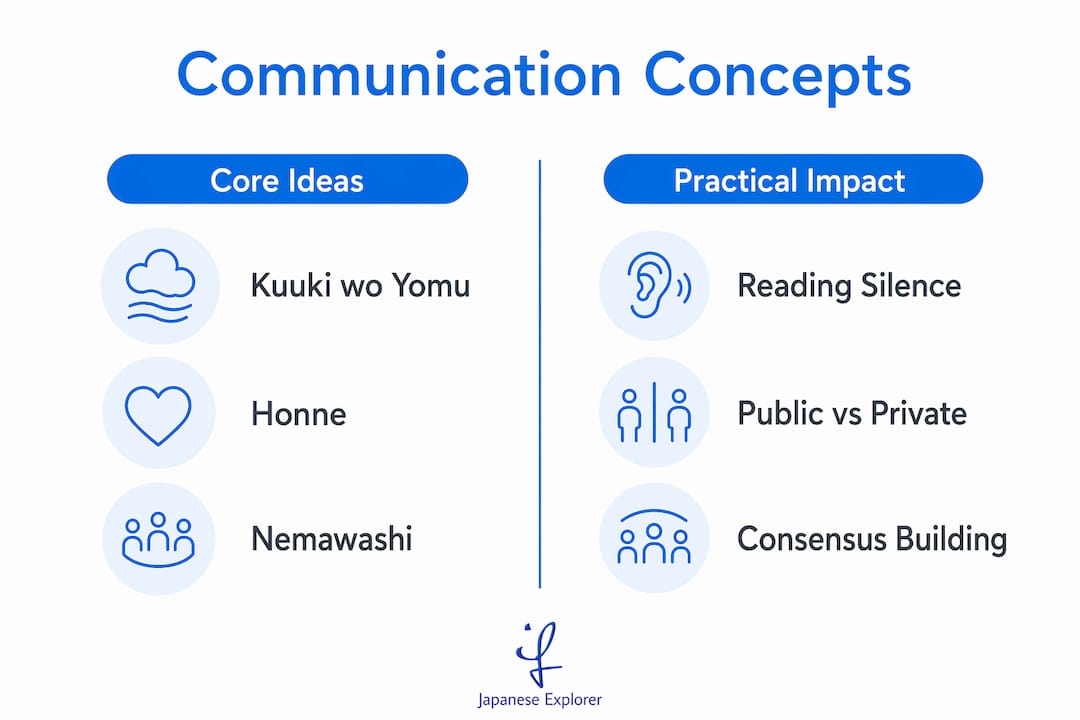
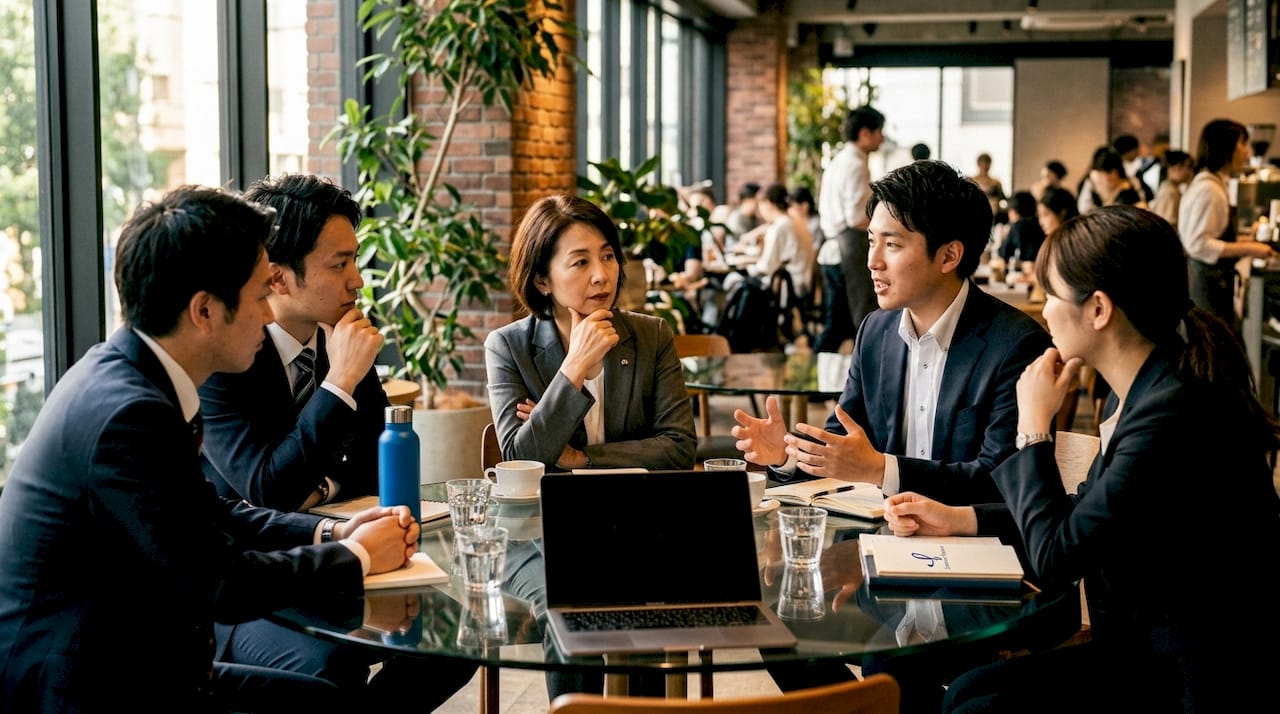
In practice, this means you read a meeting not just by what is said, but by who speaks, who stays silent, and how long pauses last. A colleague who says nothing during a proposal may be signaling discomfort more clearly than someone who objects out loud.
Honne and tatemae: the public and private self
Honne refers to a person’s genuine feelings and desires. Tatemae is the public position they maintain to preserve social harmony. Academic research frames honne and tatemae not as deception but as culturally patterned communication choreography. Both parties in a conversation often understand the gap between the two, and navigating it gracefully is a sign of social intelligence.
A phrase like “That might be a little difficult” (chotto muzukashii desu ne) is a classic tatemae expression. It almost never means the task is genuinely hard. It means no, and both speakers are expected to understand that without the refusal being stated directly.
Nemawashi: consensus before the meeting
Nemawashi is the informal process of consulting stakeholders individually before a formal meeting, so that agreement is already in place when the group convenes. Nemawashi prevents surprises and allows everyone to save face. In Japanese corporate culture, a proposal that has not gone through nemawashi is unlikely to succeed, regardless of its merit.
Pro Tip: Before any important meeting with Japanese colleagues, schedule brief one-on-one conversations with key decision-makers. Ask for their input, not their approval. This mirrors nemawashi and signals cultural awareness.
| Concept | What it means in practice |
|---|---|
| Kuuki wo yomu | Read silence, pauses, and body language as part of the message |
| Honne | The speaker’s real opinion, rarely stated directly in formal settings |
| Tatemae | The polite public position that maintains group harmony |
| Nemawashi | Pre-meeting consensus building through private consultation |
How does practical Japanese communication differ from Western styles?
The clearest way to understand Japanese communication practices is to place them alongside Western communication norms. Edward T. Hall’s model distinguishes high-context cultures, where meaning is implied, from low-context cultures, where meaning is explicit. Most Western communication styles, particularly American and Northern European, are low-context. Japanese communication is among the highest-context in the world.
| Behavior | Western (low-context) | Japanese (high-context) |
|---|---|---|
| Disagreement | Stated directly | Implied through hesitation or silence |
| Silence | Signals discomfort or confusion | Signals thinking or respect |
| Eye contact | Shows confidence and engagement | Prolonged contact can feel aggressive |
| Refusal | “No, that won’t work” | “That might be difficult” |
| Feedback | Direct and specific | Indirect, framed as suggestion |
| Decision-making | In the meeting | Before the meeting, via nemawashi |
Pushing for direct answers in Japanese conversations causes discomfort and can damage trust. This is one of the most common mistakes expats make. The instinct to fill silence or demand clarity is natural in low-context cultures, but it reads as impatient or aggressive in Japanese settings.
Non-verbal cues carry significant weight. Strong eye contact may be interpreted as confrontational rather than confident. Nodding (aizuchi) signals that you are listening, not necessarily that you agree. Silence allows the other person to think and signals that you respect the process. Learning to sit comfortably with pauses is one of the most underrated Japanese communication skills you can develop.
What practical steps build effective Japanese communication skills?
Building real conversational ability in Japanese requires a shift in how you practice. Text-heavy study builds reading comprehension, but it does not build the instincts you need for live conversation. The Kaiwa method, documented in the Kaiwa Blog’s 2026 guide, recommends prioritizing speaking and listening from day one, with 20 to 30 minutes of daily practice over passive study.
Here is a structured approach that works for adult learners and professionals:
- Start with polite speech forms. The masu form covers 90% of common communication and is the correct register for most professional and social situations. Casual forms come later, once you understand when they are appropriate.
- Practice shadowing daily. Shadowing means listening to native Japanese audio and repeating it simultaneously, matching rhythm, pitch, and intonation. This builds natural speech patterns faster than drilling grammar rules.
- Use self-talk in Japanese. Narrate your daily routine in Japanese. This builds vocabulary in context and trains you to think in the language rather than translating from English.
- Study indirect phrases explicitly. Learn the standard tatemae expressions and their implied meanings. “I will consider it” often means no. “It may be challenging” almost always means no. Knowing this vocabulary is part of improving communicative fluency.
- Practice listening for what is not said. After conversations, reflect on silences, hesitations, and topic changes. These are data points, not gaps.
- Build your kuuki wo yomu awareness gradually. Start by observing group dynamics in Japanese media, films, or dramas. Notice how characters signal disagreement without stating it.
Pro Tip: Pair your speaking practice with focused listening skill development. Comprehension and production improve together, not separately.
With daily practice, most adult learners reach basic conversational Japanese within three to six months. Business-level fluency, including the ability to navigate nemawashi and interpret tatemae reliably, typically takes longer and benefits significantly from structured instruction.
How to navigate business communication challenges in Japanese
Japanese business communication operates on a set of conventions that differ sharply from most Western corporate environments. Understanding Japanese social cues in professional settings is not optional for expats or international professionals. It is the foundation of effective working relationships.
The most important habits to build include:
- Conduct nemawashi before formal proposals. Decisions in corporate Japan are expected to be aligned off-stage before meetings. A proposal that arrives cold in a formal setting will receive polite stalls, not engagement.
- Interpret positive phrases carefully. Phrases like “We will look into this further” or “That is very interesting” can signal a stalled decision. Concrete follow-up actions are the real signal of progress, not enthusiastic-sounding responses.
- Avoid direct criticism in writing or speech. Email feedback in Japanese business contexts is framed as questions or suggestions, not corrections. “Would it be possible to consider…” is the standard structure.
- Respect hierarchy in communication order. Addressing the most senior person first and waiting for them to set the conversational tone is expected behavior in meetings.
- Use silence as a tool. After making a proposal, stop speaking. Allow the other party time to process. Filling the silence with additional justification signals anxiety and weakens your position.
- Follow up with specifics. After any meeting, send a written summary of agreed actions. This is how you distinguish genuine agreement from polite acknowledgment.
For professionals preparing for Japanese meetings specifically, the guide on communicating in Japanese meetings covers the etiquette and structure in detail.
Key takeaways
Practical Japanese communication requires mastering high-context cues, indirect expression, and cultural frameworks like kuuki wo yomu and nemawashi alongside spoken language skills.
| Point | Details |
|---|---|
| High-context communication | Meaning in Japanese is carried by tone, silence, and context as much as by words. |
| Kuuki wo yomu | Reading the air involves perception, attitude, and behavioral flexibility in social situations. |
| Honne and tatemae | Polite expressions often mask true intentions; learning standard indirect phrases is non-negotiable. |
| Nemawashi in business | Build consensus privately before formal meetings to avoid polite stalls and delays. |
| Learning timeline | Daily speaking and listening practice produces basic conversational fluency within three to six months. |
Why reading the air changed how I think about language learning
I spent years watching learners arrive with strong grammar and solid vocabulary, only to struggle in real Japanese conversations. The pattern was consistent. They understood the words but missed the message. A colleague’s hesitation was read as uncertainty rather than refusal. A long pause was filled with more talking instead of patience.
The shift that made the biggest difference was not more grammar study. It was learning to treat silence as information. Once you stop fearing pauses and start reading them, Japanese conversation opens up in a completely different way. You start noticing that a lot of what Japanese speakers communicate never gets said out loud at all.
My honest view is that most learners underinvest in cultural communication skills and overinvest in vocabulary lists. You do not need to become Japanese to communicate well in Japanese. You need to understand the rules of the game well enough to play it respectfully. That means learning the standard indirect phrases, practicing nemawashi instincts in your professional life, and giving yourself permission to be wrong and adjust.
Patience is not a soft skill here. It is the core competency. The learners who progress fastest are the ones who stay curious about what they are missing, not frustrated by it.
— Paul
Build your practical Japanese communication skills with Japanese Explorer
If this article has shown you how much depth sits beneath the surface of Japanese conversation, the next step is structured practice with instructors who understand both the language and the culture.

Japanese Explorer offers adult conversational and business Japanese courses designed specifically around practical communication, including how to handle indirect speech, navigate professional settings, and build the cultural instincts that textbooks rarely teach. Classes are available as small groups, private sessions, and online Japanese courses via Zoom, so you can learn at a pace and format that fits your schedule. Corporate training programs are also available for teams working with Japanese partners or clients. Visit Japanese Explorer to find the right course and take a trial class.
FAQ
What is practical Japanese communication?
Practical Japanese communication is the ability to interact effectively in Japanese by combining spoken language with cultural skills like reading indirect cues, interpreting silence, and understanding social frameworks such as kuuki wo yomu and nemawashi.
How long does it take to reach conversational Japanese?
With 20 to 30 minutes of daily speaking and listening practice, most adult learners reach basic conversational fluency within three to six months. Business-level communication skills typically require additional structured study.
What does kuuki wo yomu mean in communication?
Kuuki wo yomu means “reading the air” and refers to perceiving unspoken social cues in a conversation or group setting. It involves noticing tone, silence, and group dynamics to understand what is not being said directly.
How do honne and tatemae affect business communication?
Tatemae expressions like “that might be difficult” or “we will consider it” often signal refusal or stalled decisions rather than genuine uncertainty. Recognizing these phrases is critical for interpreting Japanese business communication accurately.
Is nemawashi still relevant in modern Japanese workplaces?
Nemawashi remains a core practice in Japanese corporate culture. While digital tools are increasingly used for pre-meeting consultation, face-to-face conversations are still preferred for sensitive decisions where reading the air is necessary.