
TL;DR:
- Kanji are logographic characters derived from Chinese, used in Japanese to directly convey meaning through visual form. Mastering kanji involves understanding their multiple readings, learning them within vocabulary, and studying radicals and context; targeted practice accelerates recognition and retention. Starting with basic sets like JLPT N5 ensures gradual progress, and integrating reading, writing, and real-world texts makes learning efficient and rewarding.
Kanji is defined as a set of logographic characters adapted from Chinese writing and used as one of the three core scripts in the Japanese writing system. Unlike hiragana or katakana, which represent sounds, kanji carry meaning directly through their visual form. A single character can represent a word, concept, or idea. If you are starting to learn Japanese or simply curious about how the language works on the page, understanding kanji is the single most important step toward reading real Japanese text. This guide covers what kanji are, how they function, how they compare to other scripts, and how you can start learning them effectively.
What is kanji and how does it work in Japanese writing?
Japanese writing mixes three scripts in nearly every sentence: kanji, hiragana, and katakana. Each script plays a distinct role, and none of them works in isolation. Kanji typically carry the core meaning of a sentence, while hiragana and katakana handle grammar, pronunciation markers, and foreign words.
Here is how the three scripts divide their responsibilities in a typical sentence:
- Kanji conveys the main semantic content. The character 食 means “eat,” and 水 means “water.”
- Hiragana handles grammatical elements like verb endings, particles, and conjunctions. It fills the spaces between kanji.
- Katakana is used for foreign loanwords, brand names, and words the writer wants to emphasize.
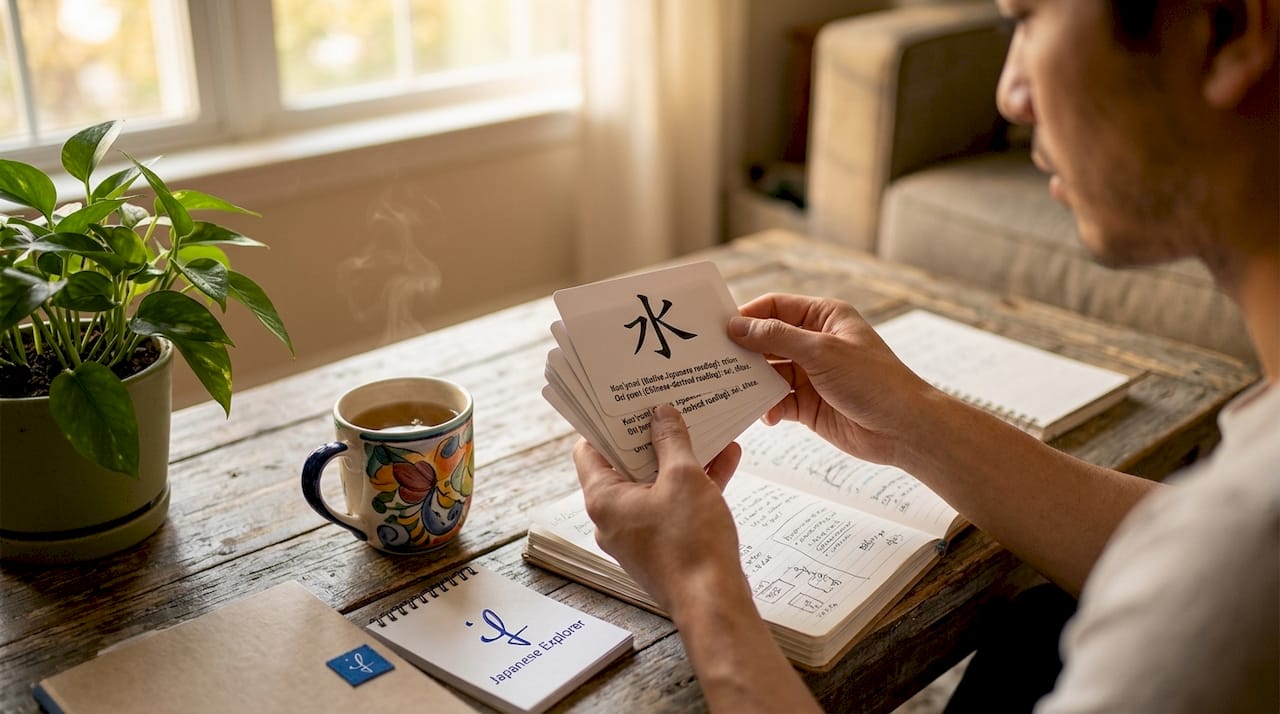
Every kanji also carries at least two types of readings. The kun’yomi is the native Japanese reading, used when a kanji stands alone or combines with hiragana. The on’yomi is the Chinese-derived reading, typically used when two or more kanji appear together as a compound word. For example, the kanji 山 (mountain) is read yama in kun’yomi and san in on’yomi. You see both readings in everyday Japanese. The mixture of kanji and kana is what gives written Japanese its distinctive layered appearance, and it is also what makes reading such a rewarding skill to develop.
What challenges do learners face with kanji readings?
The biggest misconception new learners bring to kanji is treating it like an alphabet. An alphabet assigns one sound to each symbol. Kanji assigns meaning, and the pronunciation changes depending on how and where the character is used. That shift in thinking is the first real hurdle.
Most kanji have multiple readings, and some have four or more. The character 生, for instance, can be read as sei, shō, i, u, nama, or ki depending on the word it appears in. Context determines which reading applies. This is not a flaw in the system. It reflects the depth of meaning each character carries.
Common challenges learners face include:
- Multiple on’yomi readings for a single kanji, especially in older or literary vocabulary
- Context-dependent pronunciation that cannot be guessed from the character alone
- Compound kanji words where the reading shifts entirely from the standalone form
- Kanji that look visually similar but carry completely different meanings
Pro Tip: Learn kanji inside real words from day one. Studying the character 食 in isolation is far less effective than learning it as part of 食べる (taberu, “to eat”) or 食事 (shokuji, “a meal”). Context locks in both the reading and the meaning at the same time.
The kun’yomi and on’yomi distinction is not just a grammar rule. It reflects the history of how Chinese characters were absorbed into Japanese over centuries, layering Chinese pronunciation on top of existing Japanese words. Understanding that history makes the complexity feel less arbitrary and more logical.
What kanji sets should learners focus on?
Knowing which kanji to study first is one of the most practical decisions you will make as a learner. The jōyō kanji list contains 2,136 characters and represents the official standard for general literacy in Japan. These are the characters used in newspapers, government documents, and school education. Reaching full jōyō literacy is a long-term goal, but it gives you a clear ceiling to work toward.
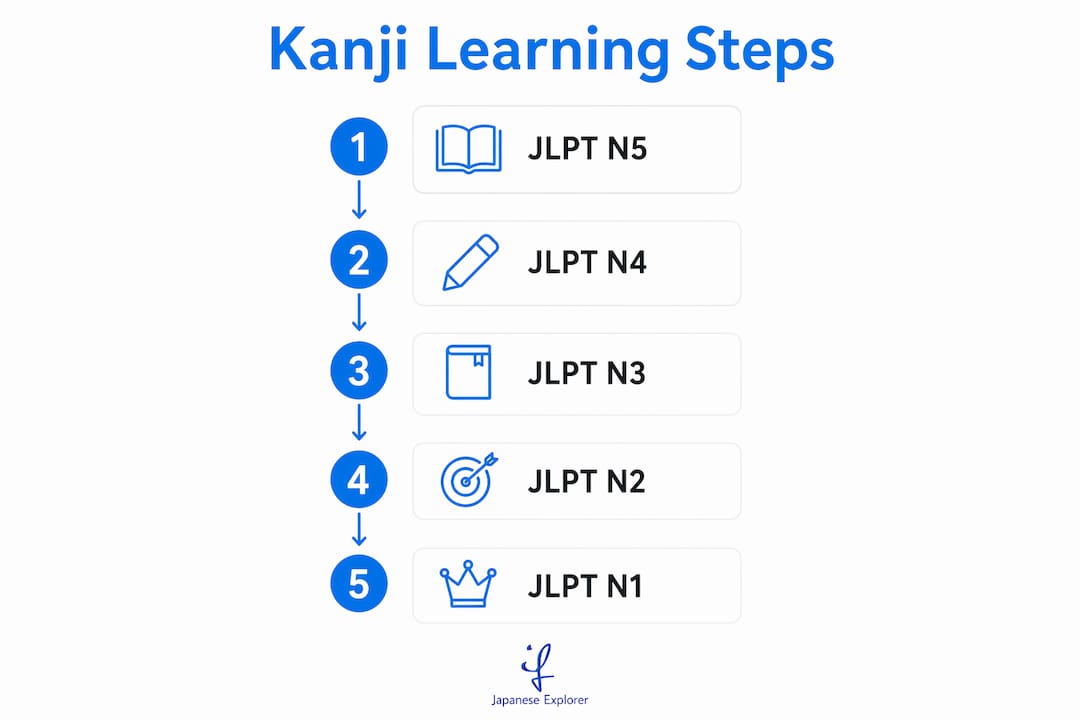
For most adult learners, the Japanese Language Proficiency Test (JLPT) levels offer a more structured path. The JLPT N5 level requires recognition of roughly 100 to 110 kanji, covering the most basic and frequently used characters. Each level adds more, with N1 covering the full jōyō set and beyond.
| Learner level | Approximate kanji count | Focus area |
|---|---|---|
| JLPT N5 (beginner) | ~100–110 | Basic characters: numbers, days, common nouns |
| JLPT N4 | ~300–400 | Everyday vocabulary and simple sentences |
| JLPT N3 | ~650–700 | Intermediate reading and compound words |
| JLPT N2 | ~1,000–1,200 | Newspaper-level reading |
| JLPT N1 (advanced) | ~2,000+ | Full jōyō set and literary vocabulary |
Targeting JLPT-aligned kanji sets prevents the overwhelm that comes from staring at thousands of characters with no clear starting point. It also ties your kanji progress to a recognized qualification, which matters if you are learning Japanese for professional or academic reasons.
Kanji vs hiragana vs katakana: what is the difference?
The three Japanese scripts are not interchangeable. They serve different functions, and the complexity of the writing system comes precisely from how they work together. Understanding each script’s role removes a lot of confusion for new learners.
| Script | Type | Primary use | Character count |
|---|---|---|---|
| Kanji | Logographic (meaning-based) | Core vocabulary, nouns, verb stems | 2,136 (jōyō set) |
| Hiragana | Phonetic syllabary | Grammar particles, verb endings, native words | 46 base characters |
| Katakana | Phonetic syllabary | Foreign loanwords, emphasis, brand names | 46 base characters |
Hiragana and katakana are both phonetic scripts, meaning each character represents a sound rather than a meaning. A child learning Japanese masters hiragana and katakana first, typically within the first year of school. Kanji study continues through all twelve years of formal education in Japan and beyond.
For you as an adult learner, this means hiragana and katakana are achievable in weeks of focused study. Kanji is a years-long project, but one that pays off at every stage. Even knowing 100 kanji transforms your ability to read signs, menus, and basic text. You can explore the full picture of Japanese writing scripts to see how all three scripts fit together visually and functionally.
How to learn kanji effectively: strategies that actually work
Learning kanji effectively comes down to method, not just effort. Spending hours copying characters without a system produces slow results. The following approaches are grounded in how memory and language acquisition actually work.
-
Study radicals first. Breaking kanji into radicals gives you a visual vocabulary for recognizing and remembering characters. A radical is a component part of a kanji that often hints at meaning. The radical 氵(water) appears in 海 (sea), 泳 (swim), and 池 (pond). Recognizing it instantly groups those characters in your memory.
-
Learn kanji inside vocabulary. Learning through context rather than isolated memorization is the most effective approach for long-term retention. When you learn 電 (electricity) as part of 電話 (denwa, “telephone”) and 電車 (densha, “train”), you absorb the reading and the meaning simultaneously.
-
Use spaced repetition. Apps like Anki apply spaced repetition system (SRS) logic to kanji flashcards, showing you characters just before you would forget them. This dramatically reduces the time needed to move kanji into long-term memory.
-
Write by hand, at least at first. Writing a kanji forces you to notice its stroke order and structure in a way that passive recognition does not. It also slows you down enough to actually look at the character. You do not need to maintain a handwriting practice forever, but it builds a strong foundation.
-
Align your study with JLPT levels. Working through a targeted kanji set tied to your proficiency goal keeps your study focused and measurable. It also means every kanji you learn has immediate practical value at your current level.
-
Read real Japanese text early. Even simple manga, children’s news sites like NHK Web Easy, or graded readers expose you to kanji in natural sentences. Passive recognition in context accelerates active recall.
Pro Tip: Combine your kanji study with listening practice. When you hear a word you have studied as a kanji compound, your brain reinforces the connection between sound, meaning, and written form. This cross-modal reinforcement is one of the fastest ways to make kanji stick. You can also explore proven writing methods that Japanese Explorer’s instructors recommend for building solid character recognition from the start.
Key takeaways
Kanji are logographic characters that carry meaning rather than sound, and mastering them requires learning readings in context, targeting structured sets like the jōyō list or JLPT levels, and using methods like radical study and spaced repetition.
| Point | Details |
|---|---|
| Kanji carries meaning, not just sound | Each character represents a concept or word, unlike phonetic hiragana or katakana. |
| Multiple readings are the norm | Most kanji have both kun’yomi and on’yomi readings that change based on context. |
| Start with JLPT N5 kanji | Roughly 100 to 110 characters give you a practical, measurable starting point. |
| Radicals speed up recognition | Learning component parts of kanji helps you decode unfamiliar characters faster. |
| Context beats isolation | Learning kanji inside real vocabulary and sentences produces stronger, longer-lasting recall. |
Why kanji is worth every bit of effort you put in
I have watched learners arrive at their first Japanese class convinced that kanji is the impossible part. They have heard the stories: thousands of characters, multiple readings, years of study. And yes, all of that is true. But here is what those stories leave out.
Kanji is not a wall you have to climb before Japanese starts making sense. It is the thing that makes Japanese richer as you go. The moment you recognize 山 on a hiking trail sign or 食 on a restaurant menu, the language stops being abstract. It becomes real and personal. That feeling compounds with every new character you learn.
The learners who struggle most are the ones who try to memorize kanji in bulk, divorced from meaning or context. The ones who progress fastest treat each kanji as a small story. They learn why 明 (bright) combines the characters for sun and moon. They notice that 森 (forest) is literally three trees stacked together. That kind of curiosity is not a luxury. It is the most efficient learning strategy there is.
My honest advice: do not wait until you feel ready to tackle kanji. Start with the 100 characters at JLPT N5, learn them inside real words, and let the system reveal itself gradually. The effort you invest in kanji pays dividends across every other part of your Japanese study, from reading to vocabulary to understanding how the language thinks.
— Paul
Start learning kanji with the right support
Understanding kanji is one thing. Building real reading and writing ability takes structured practice with people who know how to teach it.

Japanese Explorer offers adult Japanese courses in Singapore and online, designed to take you from complete beginner to confident reader and speaker. Classes are kept small so instructors can give you direct feedback on your kanji recognition and writing. Every lesson integrates grammar, vocabulary, and character study so your progress across all areas reinforces itself. Whether you prefer group sessions, private lessons, or online Zoom classes, there is a format that fits your schedule and goals. Explore Japanese language courses and find the right starting point for your level, or check out the online Japanese course if you prefer to study from home.
FAQ
What is kanji in simple terms?
Kanji are logographic characters adapted from Chinese writing and used in Japanese to represent words, ideas, and concepts. Unlike hiragana or katakana, each kanji carries meaning rather than just a sound.
How many kanji do I need to learn to read Japanese?
The jōyō kanji list sets 2,136 characters as the standard for general literacy in Japan. Beginners targeting JLPT N5 can start with roughly 100 to 110 of the most common characters.
What is the difference between kanji and hiragana?
Kanji are meaning-based logograms imported from Chinese, while hiragana is a phonetic syllabary representing sounds. Hiragana handles grammar and native Japanese words; kanji carries core vocabulary and semantic content.
How long does it take to learn kanji?
Reaching JLPT N5 kanji recognition takes most adult learners a few months of consistent study. Full jōyō literacy, covering 2,136 characters, typically requires several years of dedicated practice.
Can I learn kanji without a teacher?
Apps like Anki and resources like KanjiAlive support self-study effectively, but structured classes accelerate progress by providing feedback, context, and a clear curriculum. Combining both approaches produces the fastest results.