
TL;DR:
- Japanese pronunciation relies on five pure vowels, predictable syllable patterns, and pitch accents that influence meaning. Mastery of mora timing and consonant sounds like the tapped R and bilabial “fu” is essential for sounding natural and clear. Daily shadowing of native audio, along with learning hiragana early, accelerates pronunciation accuracy and fluency.
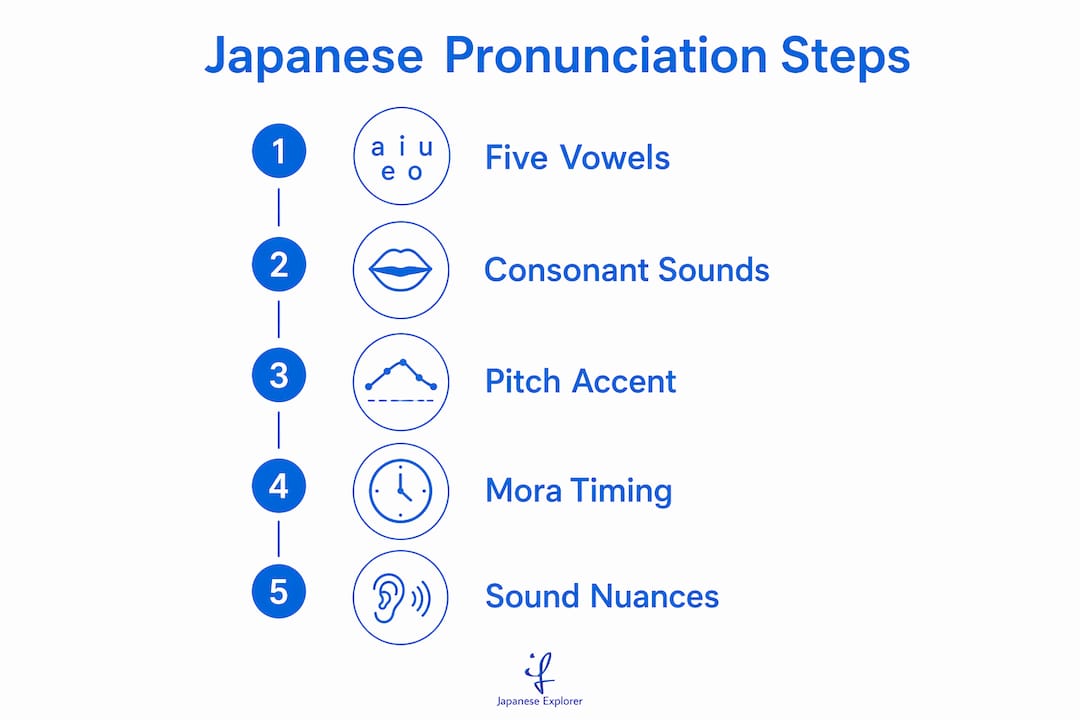
Japanese pronunciation is defined by five pure vowels, predictable syllable patterns, and a pitch accent system that shapes meaning in ways most English speakers never expect. This japanese pronunciation guide covers every layer of the sound system, from basic vowels to mora timing, so you can speak with clarity and confidence. Whether you are preparing for a business conversation or building conversational fluency, getting the sounds right from the start saves you from habits that are hard to break later. The phonetic consistency of Japanese makes it genuinely approachable. You just need to know where to focus.
What are the five core Japanese vowels and how do you pronounce them?
Japanese pronunciation features only five stable vowel sounds, which is far fewer than the 15-plus vowels in English. That simplicity is a real advantage. Once you lock in these five sounds, every syllable in the language becomes predictable.

Each vowel is pure. Japanese vowels do not glide into another sound the way English vowels do. The English word “no” ends with a slight “oo” glide. The Japanese vowel “o” stays flat and clean throughout.
| Vowel | Sound | English Approximation | Common Mistake |
|---|---|---|---|
| あ (a) | “ah” | “father” | Saying “ay” as in “cat” |
| い (i) | “ee” | “feet” | Saying “ih” as in “bit” |
| う (u) | Unrounded “oo” | Between “oo” and “uh” | Rounding the lips like English “oo” |
| え (e) | “eh” | “bed” | Saying “ay” as in “say” |
| お (o) | “oh” | “go” (without glide) | Adding an “oo” glide at the end |
The trickiest vowel for English speakers is “u.” Japanese “u” is produced with the lips relaxed and spread, not rounded. Think of the sound in “uh” but pushed slightly forward. Rounding your lips gives you an English “oo” that sounds foreign to Japanese ears.
Pro Tip: Record yourself saying each vowel in isolation, then compare it to a native speaker. Your ear will catch the difference faster than any written description.
How do Japanese consonants work and which ones challenge English speakers most?
Japanese consonants follow a consonant-vowel structure in kana. Almost every syllable is a consonant paired with one of the five vowels. That regularity makes reading pronunciation straightforward once you learn the kana syllabary, hiragana and katakana.
A few consonants require special attention:
- The Japanese R. The Japanese R is a light alveolar tap, not the English “r” or “l.” Your tongue briefly taps the ridge behind your upper teeth, similar to the “d” in the American English word “butter” said quickly. Practicing words like “ramen” with a tap rather than a curl helps build the muscle memory.
- The sound “fu” (ふ). This is a soft bilabial fricative. Air passes between both lips, not between the lower lip and upper teeth as in English “f.” It sounds closer to blowing out a candle gently.
- The nasal “n” (ん). This consonant shifts its sound based on the following consonant. Before “b,” “p,” or “m,” it sounds like “m.” Before “k” or “g,” it sounds like “ng.” Before a vowel, it stays as a pure nasal “n.” Treating it as always sounding like English “n” is one of the most common learner errors.
- The sounds “shi” (し), “chi” (ち), and “tsu” (つ). These do not follow the standard consonant-vowel pattern. “Shi” sounds like “she,” “chi” sounds like “chee,” and “tsu” sounds like the end of “cats” followed by “oo.”
Pro Tip: For the tapped R, say the American English phrase “butter” quickly and feel where your tongue taps. That exact spot and motion is what you need for Japanese R. Practice “ra, ri, ru, re, ro” slowly, then speed up.
Check out this guide on common speaking mistakes to see how these consonant errors show up in real conversation and how to fix them.
What role do pitch accent and mora timing play in sounding natural?
Pitch accent and mora timing are the two features that separate a learner who sounds “textbook correct” from one who sounds natural. Most pronunciation guides cover vowels and consonants well but underexplain these two elements.
Pitch accent means each syllable in a word is spoken at either a high or low tone. Japanese is not a tonal language like Mandarin, where tone changes the root meaning of a word. But pitch patterns do distinguish between words that are otherwise identical. The word “hashi” can mean “bridge,” “chopsticks,” or “edge” depending on which syllable carries the high pitch. Getting this wrong does not always cause confusion, but native speakers are more lenient with pitch accent errors than with timing errors.
Mora timing is the feature that affects understanding most. Each mora, which is a single sound unit in Japanese, gets equal time. Japanese rhythm is mora-based, not stress-based like English. Ignoring mora timing creates a choppy, unnatural rhythm that makes it harder for native speakers to follow you.
Practical ways to build pitch and timing skills:
- Shadowing. Repeating after native audio in real time is the most effective method for internalizing rhythm and pitch. Use TV shows, podcasts, or movie clips with natural speech.
- Listening in chunks. Focus on short phrases rather than individual words. Phrases reveal pitch patterns in context.
- Counting morae. Practice clapping once per mora as you speak. This makes the equal-timing rule physical and easier to internalize.
For a deeper look at how pitch accent changes meaning, the resource on pitch accent minimal pairs at Japanese Explorer breaks down real word pairs with clear audio examples.
How do long vowels, double consonants, and devoicing affect meaning?
These three features are where learners most often make errors that change the meaning of what they say, sometimes in embarrassing ways.
Long vowels are held for exactly twice the length of a short vowel. Long vowels change word meanings entirely. The classic example: “obasan” means “aunt,” while “obaasan” means “grandmother.” Rushing through the long vowel collapses two different words into one.
Double consonants, marked by a small “tsu” (っ), create a brief pause or glottal stop before the following consonant. The small っ affects word meaning directly. “Saka” means “hill,” while “sakka” means “writer.” The pause lasts exactly one mora in length.
| Word Pair | Meaning Difference | Feature |
|---|---|---|
| おばさん / おばあさん | Aunt / Grandmother | Long vowel |
| さか / さっか | Hill / Writer | Double consonant |
| です / (full pronunciation) | Sounds like “dess” | Vowel devoicing |
Vowel devoicing is the third nuance. Final vowels “i” and “u” are frequently devoiced between voiceless consonants or at the end of a phrase. “Desu” sounds like “dess.” “Suki” sounds like “ski.” This is not sloppy speech. It is standard, natural Japanese. Pronouncing every vowel fully makes you sound overly formal and robotic.
Pro Tip: When you learn a new word, check whether it contains a long vowel or double consonant. Mark it clearly in your notes. These features are invisible in romaji but obvious in hiragana, which is another strong reason to learn the kana writing system early.
What are effective methods to improve your Japanese pronunciation?
Building good pronunciation habits requires a structured routine, not random practice. The following plan works for adult learners at any level.
Step-by-step practice plan:
- Master the five vowels first. Spend one week drilling each vowel in isolation, then in simple syllables. Record yourself daily.
- Learn hiragana. Reading hiragana removes the distortion of romaji and shows you exactly how each syllable is structured. This is the single best reading tool for pronunciation accuracy.
- Add consonant drills. Focus on the tapped R, the bilabial “fu,” and the nasal “n” in different contexts. Use minimal pairs to train your ear.
- Introduce shadowing. Choose a short audio clip of 20–30 seconds. Listen once, then repeat in real time with the speaker. Do this daily for 10 minutes.
- Practice pitch and timing. Clap or tap once per mora as you speak phrases. Use a pitch accent dictionary to check words you use often.
Common mistakes to self-correct:
- Stressing syllables the English way instead of keeping mora timing even
- Skipping the pause for double consonants
- Pronouncing devoiced vowels fully
- Using English “r” or “l” instead of the Japanese tap
Shadowing native audio is the most consistent method for improving accent and rhythm together. Combine it with regular recording sessions so you can hear your own progress objectively. The foundational steps for learning Japanese at Japanese Explorer also outline how to build pronunciation into a broader study plan from day one.
Key Takeaways
Mastering Japanese pronunciation requires consistent attention to five pure vowels, mora timing, and pitch accent, because these three elements determine whether you sound natural or robotic.
| Point | Details |
|---|---|
| Five stable vowels | Learn each vowel’s pure sound first; they never glide or shift like English vowels. |
| Consonant accuracy | The tapped R, bilabial “fu,” and context-shifting “n” require specific muscle memory to produce correctly. |
| Mora timing over stress | Japanese rhythm is mora-based; equal timing across syllables matters more than stress placement. |
| Long vowels and double consonants | These features change word meanings entirely and must be held for the correct duration. |
| Shadowing builds fluency | Daily shadowing of native audio internalizes pitch and rhythm faster than rule study alone. |
What I’ve learned from watching learners get pronunciation wrong
Paul here. After years of observing adult learners work through Japanese phonetics, one pattern stands out clearly. Most learners spend too much time on vocabulary and grammar and too little time on the sound system in the first few weeks. By the time they realize their pronunciation is off, the habits are already set.
The biggest surprise for most learners is not the consonants. It is mora timing. English speakers are so conditioned to stress-based rhythm that they naturally emphasize certain syllables and rush through others. Japanese does not work that way. Every mora gets equal weight. When you ignore this, native speakers have to work harder to understand you, even if every individual sound is correct.
Pitch accent gets a lot of attention online, and it matters. But I have seen learners obsess over pitch patterns before they have stable vowels or consistent mora timing. That is the wrong order. Get the vowels clean. Get the rhythm even. Then layer in pitch accent awareness. Native speakers are genuinely patient with pitch errors from learners. They are less patient when the rhythm is so off that they cannot parse where one word ends and another begins.
My honest advice: shadow for 10 minutes every single day before you study anything else. It trains your ear and your mouth at the same time. Pair that with learning hiragana in your first week, and you will have a foundation that makes every other part of the language easier to absorb.
— Paul
Structured learning makes pronunciation stick
Good pronunciation does not come from reading guides alone. It comes from guided practice with feedback, real conversation, and a structured curriculum that builds each skill in the right order.

Japanese Explorer offers small group Japanese classes in Singapore designed for adult learners who want to speak clearly and confidently. Classes are held at 10 Anson Road, Level 22, International Plaza, right above Tanjong Pagar MRT, with flexible scheduling to fit working adults. For learners outside Singapore or those who prefer flexibility, online Japanese courses via live Zoom sessions cover the same pronunciation-focused curriculum with certified bilingual instructors. Corporate learners can also access specialized business Japanese training that targets professional communication and pronunciation for workplace settings.
FAQ
What makes Japanese pronunciation easier than other languages?
Japanese has only five stable vowel sounds and a consistent consonant-vowel syllable structure. Every kana character maps to a fixed sound, so pronunciation is predictable once you learn the system.
How does pitch accent affect communication in Japanese?
Pitch accent distinguishes between words that are otherwise identical in spelling and sound. Native speakers tolerate pitch errors from learners, but consistent pitch awareness improves clarity and sounds more natural.
What is mora timing and why does it matter?
Mora timing means every sound unit in Japanese gets equal length. Japanese rhythm is mora-based, not stress-based like English. Poor timing creates more comprehension problems than incorrect pitch accent.
Why do some Japanese vowels sound silent or whispered?
Vowels “i” and “u” are frequently devoiced between voiceless consonants or at the end of phrases. This is standard speech, not lazy pronunciation. “Desu” sounds like “dess” in natural conversation.
What is the fastest way to improve Japanese pronunciation?
Shadowing native audio daily for 10 minutes is the most effective method. It trains pitch, rhythm, and individual sounds simultaneously, which no rule-based study method can replicate as efficiently.