
TL;DR:
- Pitch accent is crucial in Japanese language learning because mispronouncing it hampers intelligibility more than some grammar errors. It functions to distinguish homophones, signal tense and conjugation, aid syntax parsing, and reflect regional identity, influencing overall comprehension. Mastering pitch accent speeds recognition, enhances fluency, and is embedded into effective instruction at Japanese Explorer from the beginning.
Pitch accent is the single most overlooked feature in Japanese language learning, and getting it wrong does more damage to your intelligibility than almost any grammar mistake. Japanese pitch accent (高低アクセント) is a prosodic system where the high or low tone assigned to each mora determines word meaning, grammatical form, and how natural your speech sounds to a native listener. Research published in Speech Prosody 2024 confirms that pitch accent mispronunciation interferes with lexical access more significantly than mispronouncing a consonant or vowel. That finding alone should reframe how seriously you take it.
What pitch accent actually does in Japanese communication
Pitch accent is not decoration. It carries real linguistic weight across four distinct functions:
- Distinguishes homophones: The word hashi means “bridge” with a low-high pitch pattern (LH) and “chopsticks” with a high-low pattern (HL). Say the wrong one at the dinner table and you will get a confused look.
- Signals verb tense and conjugation: Taberu (LHL) means “to eat,” while tabeta (HLL) means “ate.” The pitch shift is part of the grammar, not just the sound.
- Aids syntax parsing: A single phrase like kuru made mato o changes meaning entirely depending on where the pitch falls, shifting between “let’s wait at the car” and “let’s wait until he comes.”
- Marks regional and generational identity: Speakers from Osaka or Kyoto use pitch patterns that can be the reverse of Tokyo dialect norms, and younger speakers across Japan increasingly flatten sentential pitch.
- Predicts perceived foreign accent: A 2024 acoustic study found that tone patterns in pitch accent robustly predict how foreign a learner sounds, outperforming segmental errors as a predictor across both English and Mandarin L1 speakers.
Understanding these functions changes how you approach learning Japanese pronunciation. Pitch accent is not a bonus topic for advanced learners. It is woven into the fabric of spoken Japanese from the very first conversation.
How accent affects Japanese comprehension and fluency
Correct pitch accent speeds up how quickly a native listener can identify what you said. A study on spoken word recognition found that reaction times in shadowing tasks were shorter for words with correct pitch than for those with incorrect pitch, even in clean audio conditions. Under noisy conditions, the gap widens further because pitch information is more resistant to background noise than phonetic detail.

The neurological picture is equally clear. Event-related potential research shows that incorrectly accented words produce greater N400 amplitudes, meaning the brain works harder to process them. Semantic access, indicated by gamma-band activity, occurs only after correctly accented words, not after mispronounced ones without supporting context.
Advanced learners and native instructors consistently rate pitch accuracy as a higher priority than beginners do. In formal or business settings, where context clues are fewer and impressions matter more, a strong foreign pitch pattern can trigger social barriers even when the vocabulary and grammar are correct. That is not a minor inconvenience. For professionals using Japanese in the workplace, it can affect how credible and fluent you appear.
Prosody training produces measurable gains quickly. Research on Japanese prosody instruction found significant improvements in both intelligibility and comprehensibility within a short training period, using embodied and computer-assisted techniques.
Effective strategies to master Japanese pitch accent
The most reliable path to natural pitch accent is extensive listening to native speech. Native speakers acquire pitch through osmosis rather than conscious rule memorization, and learners who immerse themselves in authentic content develop pitch intuition far faster than those who rely on rule charts alone.
That said, a few structured strategies accelerate the process considerably:
- Use minimal pairs actively: Pairs like hashi (bridge vs. chopsticks) or kami (god vs. hair) make pitch differences concrete and memorable. Drilling these pitch accent minimal pairs trains your ear before your mouth.
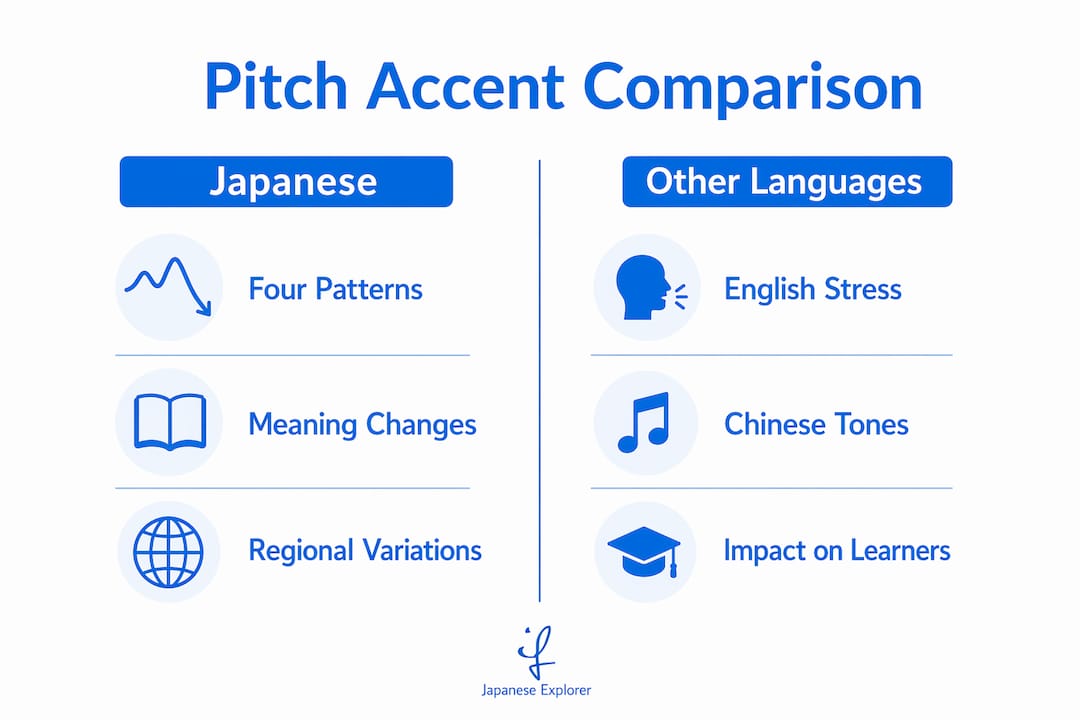
- Learn the four core patterns: Japanese has four main pitch accent patterns. Mastering these four covers most spoken words, making your speech sound natural about 90% of the time, even if you occasionally choose the wrong pattern.
- Apply the 平板 (heiban) default: The flat heiban pattern occurs in many of the most frequently used Japanese words. When unsure, defaulting to heiban gives you the best odds.
- Integrate pitch into grammar study: Verb conjugations shift pitch patterns. Learning taberu and tabeta together as pitch-grammar pairs, not just vocabulary, builds the right mental model from the start.
- Get explicit feedback early: Awareness-raising in the early stages of learning, especially through instructor feedback, significantly increases the likelihood that exposure will actually improve your pitch acquisition.
- Copy one dialect consistently: Mixing Tokyo and Kansai pitch patterns in the same speech sounds inconsistent to native ears. Stick to standard Tokyo dialect patterns until your ear is well trained.
Pro Tip: Don’t just listen passively. Shadow native speakers sentence by sentence, paying deliberate attention to where pitch rises and falls. Shadowing with pitch awareness trains both perception and production at the same time, which research confirms is the most effective combination.
How Japanese Explorer’s approach supports pitch accent mastery
Japanese Explorer’s curriculum is guided by the Association for Japanese-Language Teaching, which means pitch accent is not treated as an afterthought. It is embedded into speaking, listening, and grammar lessons from the beginning, so you build accurate patterns alongside vocabulary rather than trying to correct bad habits later.
The school’s bilingual, certified instructors provide the kind of explicit pronunciation feedback that research identifies as the most effective tool for early-stage learners. You hear the correct pattern, you produce it, and you get corrected in real time. That feedback loop is what separates structured classroom learning from self-study.
Flexible formats, including group classes, private sessions, and live online Zoom courses, mean you can find the pace and setting that suits your schedule. Whether you are learning Japanese for personal enrichment or preparing for a business context, Japanese Explorer’s adult Japanese courses build pitch accuracy alongside real-world communication skills.
How Japanese pitch accent compares to accent in other languages
Japanese pitch accent works differently from the stress accent system in English. In English, stressed syllables are louder, longer, and higher in pitch simultaneously. In Japanese, only pitch changes. Duration stays consistent across morae, which is why English speakers often impose stress where none belongs, creating an unnatural rhythm that native listeners immediately notice.
Mandarin Chinese is tonal, meaning pitch determines meaning at the syllable level with four distinct tones. Japanese pitch accent operates at the word level with patterns across morae, not individual syllables. Chinese learners of Japanese tend to over-apply tonal variation within single words, which sounds equally unnatural. Korean has its own pitch accent system in some dialects, making Korean learners somewhat more attuned to pitch distinctions, though the patterns differ enough to cause transfer errors.
The practical takeaway: your first language shapes exactly which pitch errors you are likely to make. American English speakers tend to impose stress-based patterns on Japanese words, defaulting to a mid-high accent on the second mora that does not match the most common Japanese pattern.
Common challenges learners face and how to get past them
The most common mistake is focusing on timing and stress rather than pitch. Many learners spend energy on speaking slowly and clearly without ever addressing whether their pitch contour is correct. The result is speech that sounds deliberate but still foreign.
A second challenge is inconsistency across dialects. You may learn a word’s pitch pattern from one source, then hear a native speaker use a different pattern, and assume you learned it wrong. Often, both are correct in different regional varieties. Anchoring your study to the Tokyo dialect standard gives you a consistent reference point and the widest comprehension across Japan.
Learners also underestimate how much pitch shifts with grammar. Verb endings, compound words, and particles all affect the pitch of surrounding morae. Treating pitch as a fixed property of isolated words, rather than a dynamic feature of connected speech, leads to errors that persist even at advanced levels. Studying common speaking mistakes alongside pitch patterns helps you catch these issues early.
Finally, many learners simply lack awareness that pitch accent exists. Raising that awareness, even briefly, in the early stages of study dramatically increases how much pitch information you absorb from natural exposure afterward.
Key Takeaways
Japanese pitch accent is a core feature of the language that directly affects intelligibility, grammar, and how natural you sound to native speakers.
| Point | Details |
|---|---|
| Pitch accent affects meaning | Words like hashi change meaning entirely based on pitch pattern, not just sound. |
| Mispronunciation slows comprehension | Incorrect pitch produces stronger brain processing effort and delays semantic access. |
| Four patterns cover most words | Japanese has four main pitch accent patterns. Mastering these four covers the vast majority of spoken words and prevents the most unnatural-sounding errors. |
| Heiban is the most common pattern | The flat heiban pattern appears in many of the most frequently used Japanese words. |
| Explicit feedback accelerates learning | Instructor-led awareness and correction in early stages significantly improves pitch acquisition speed. |
FAQ
What is pitch accent in Japanese?
Pitch accent is a prosodic feature of Japanese where the high or low tone assigned to each mora distinguishes word meaning, verb tense, and grammatical structure. It differs from English stress accent, which combines pitch, duration, and loudness.
Does pitch accent really affect whether people understand you?
Yes. Research shows that pitch mispronunciation delays lexical processing and reduces intelligibility, especially under noisy conditions. Context can sometimes compensate, but correct pitch reduces the cognitive effort required from the listener.
How many pitch accent patterns does Japanese have?
Japanese has four main pitch accent patterns. Mastering these four patterns covers the vast majority of spoken words and prevents the most unnatural-sounding errors.
Do all regions of Japan use the same pitch accent?
No. Regional dialects like Kansai (spoken in Osaka, Kyoto, and Kobe) use pitch patterns that can be the reverse of Tokyo dialect norms. For learners, focusing on the Tokyo dialect standard provides the most consistent and widely understood foundation.
Is pitch accent worth studying as a beginner?
Raising awareness of pitch accent early, even without mastering it, significantly improves how much pitch information you absorb from listening practice. Japanese Explorer’s online Japanese courses integrate pitch accent from the start so you build accurate habits from day one.