
TL;DR:
- Advanced Japanese proficiency corresponds to JLPT N1 and CEFR C1 levels, requiring mastery of vocabulary, complex grammar, and all four language skills. Many learners excel in reading and listening but lack productive skills and cultural competence needed for real-world communication. Building speaking, writing, and pragmatic abilities through deliberate practice accelerates reaching full fluency beyond passing the exam.
Advanced Japanese proficiency is defined as near-native mastery of complex vocabulary, grammar, and cultural nuance, corresponding to JLPT N1 and CEFR C1 standards. Defining advanced Japanese proficiency matters because learners who misread these benchmarks often plateau at an intermediate level and never close the gap to true fluency. The JLPT N1, introduced in its current five-level format in 2010, stands as the highest official benchmark for Japanese language skills. Understanding what that level actually demands, across reading, listening, speaking, and writing, gives you a realistic map for getting there.
What linguistic skills define advanced Japanese proficiency?
Advanced Japanese proficiency requires mastery of roughly 10,000 vocabulary words and 2,000 kanji, placing it at CEFR C1 level. That vocabulary range is not just about memorizing words. It means recognizing those words in dense academic prose, formal speeches, and literary texts where context shifts meaning significantly.
The grammar demands at this level go well beyond standard textbook patterns. Advanced grammar involves complex and classical forms that convey subtle emotional nuances and refined logical reasoning. These patterns appear in newspaper editorials, legal documents, and formal presentations, and they require you to read between the lines, not just decode surface meaning.
Four skill areas define full proficiency at this level:
- Reading: Comprehending academic papers, editorials, and novels, including implied meaning and abstract arguments
- Listening: Following fast-paced native speech, regional accents, and formal presentations without repetition
- Speaking: Producing grammatically accurate, contextually appropriate speech across formal and informal registers
- Writing: Composing structured arguments, formal correspondence, and nuanced written analysis
The critical gap most learners miss is that JLPT assessment only includes reading and listening. Speaking and writing are entirely absent from the exam. This means passing N1 confirms strong receptive skills but says nothing about your productive ability to hold a business negotiation or write a professional report.
Cultural and pragmatic competence also belongs in this list. Knowing when to use keigo (formal honorific speech), how to soften a refusal, or how to read the emotional tone of a conversation are skills that vocabulary alone cannot teach. True advanced Japanese skills include this layer of social intelligence.

Pro Tip: Track your progress across all four skills separately. Many learners are strong readers but weak speakers. Identifying your specific gap early saves months of unfocused study.
How does JLPT N1 relate to CEFR levels?
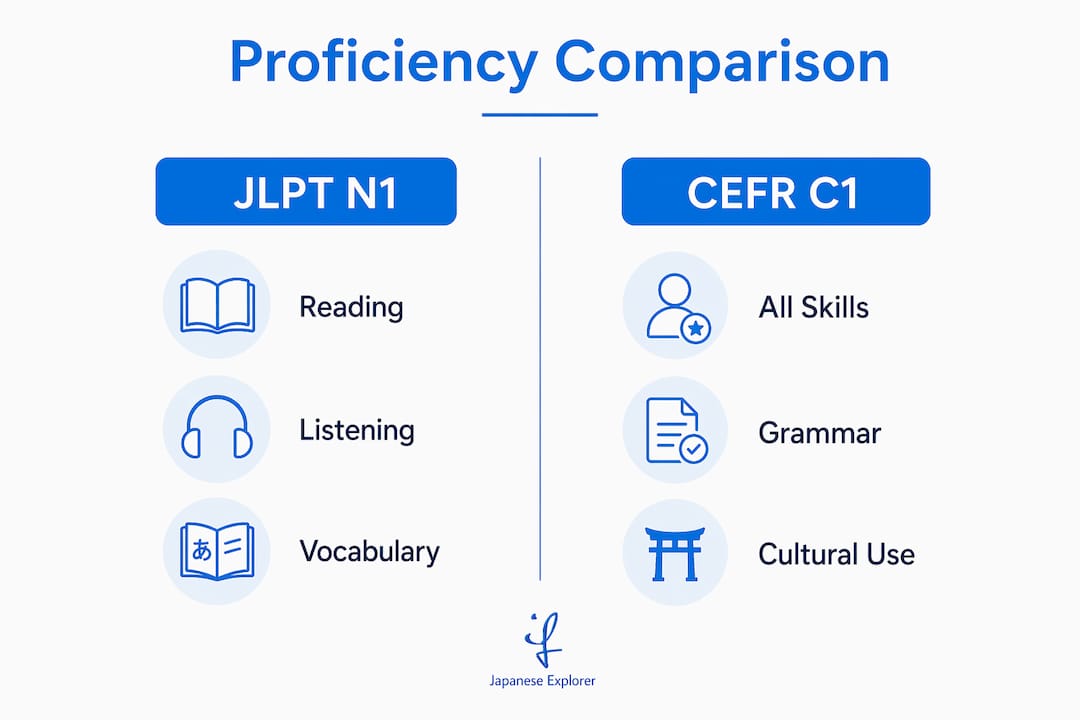
The official mapping between JLPT and CEFR took effect in december 2025, giving learners a clearer international reference point. N1 now officially corresponds to CEFR C1, and N2 corresponds to CEFR B2. This matters because CEFR is the global standard used by universities, employers, and immigration bodies worldwide.
The practical implication is significant. N2 is the minimum for office employment in Japan, while N1 is required for specialized roles in law, medicine, and technical fields. N1 also grants maximum points in Japan’s immigration scoring system and is recognized by academic institutions as proof of advanced literacy.
| Feature | JLPT N1 | CEFR C1 |
|---|---|---|
| Skills tested | Reading, listening only | All four skills |
| Vocabulary requirement | ~10,000 words | ~8,000–10,000 words |
| Grammar scope | Classical and advanced patterns | Complex and nuanced structures |
| Speaking assessment | Not included | Included |
| Writing assessment | Not included | Included |
| Professional recognition | Japan-specific | International |
The table above shows the core difference: JLPT N1 and CEFR C1 overlap in vocabulary and grammar scope, but CEFR C1 demands demonstrated ability in speaking and writing. This is why many N1 passers lack equivalent productive skills and still struggle in real professional environments. Passing N1 is a strong credential, but it is not the finish line for full communicative fluency.
Setting realistic goals means treating N1 as one benchmark within a broader proficiency picture. Learners who also build speaking and writing skills alongside exam preparation reach genuine CEFR C1 competence faster than those who focus on test prep alone.
What cultural and pragmatic abilities matter at the advanced level?
Advanced Japanese fluency requires more than grammar and vocabulary. It requires reading the room. Advanced learners struggle with emotional grammar that conveys subtle speaker nuances, and contextual learning through literature and speeches is the most effective way to build this skill.
Emotional grammar refers to patterns that signal the speaker’s attitude, certainty, or emotional state. A phrase that looks like a simple statement can carry frustration, reluctance, or irony depending on the grammatical ending used. Native speakers process these cues automatically. Advanced learners need deliberate exposure to natural, unscripted Japanese to internalize them.
Practical situations where cultural and pragmatic skills are non-negotiable include:
- Business negotiations: Knowing when silence signals agreement versus discomfort
- Formal presentations: Structuring arguments in a way that respects Japanese rhetorical conventions
- Social refusals: Using indirect language to decline without causing offense
- Reading editorials and literature: Interpreting the author’s stance from word choice and sentence structure alone
N1 holders can comprehend academic papers, business documents, editorials, and novels, handling abstract topics and implied meaning with confidence. That reading ability is the foundation for pragmatic competence, because exposure to high-quality written Japanese trains your ear and eye for how native speakers think.
Keigo, the formal honorific register, is a separate system within Japanese that advanced learners must control actively. Using the wrong register in a business meeting signals inexperience immediately, regardless of how accurate your grammar is otherwise.
Pro Tip: Read one Japanese newspaper editorial per week without a dictionary. Focus on identifying the author’s stance from grammar patterns and word choice, not just vocabulary. This builds the pragmatic reading skill that no textbook exercise replicates.
How can you practically develop and measure advanced Japanese skills?
Reaching advanced proficiency requires a structured approach that combines test preparation with real communication practice. Supplementary professional training focused on communication and documentation measurably improves overall competence beyond what exam study alone achieves.
Here is a practical framework for building and measuring your proficiency:
- Audit your four skills separately. Take a Japanese placement test to identify where you are strongest and where you have gaps. Most learners overestimate their speaking level relative to their reading level.
- Apply spaced repetition to vocabulary and kanji. High-achieving learners use SRS with context and prioritize vocabulary and grammar patterns by frequency in advanced usage. Apps like Anki work well when you add example sentences from real texts rather than isolated words.
- Focus on the 80/20 rule for grammar. Approximately 25% of grammar and vocabulary patterns cover 80% of advanced real-world usage. Prioritizing high-frequency advanced patterns gives you faster returns than studying every rare classical form equally.
- Add speaking and writing practice deliberately. Join a conversation course or business Japanese program that requires you to produce language, not just recognize it. This directly addresses the productive skill gap that JLPT does not measure.
- Track progress with CEFR can-do statements. These describe what you can actually do at each level, such as “I can write a formal business proposal” or “I can follow a native-speed news broadcast.” They give you concrete milestones beyond a test score.
| Study method | Skill targeted | Recommended frequency |
|---|---|---|
| SRS vocabulary review | Reading, vocabulary | Daily, 20–30 minutes |
| Newspaper editorial reading | Reading, pragmatics | 3–4 times per week |
| Speaking practice with instructor | Speaking, fluency | 2–3 times per week |
| Formal writing exercises | Writing, grammar | Weekly |
| Listening to native podcasts | Listening | Daily, 15–20 minutes |
The JLPT preparation course at Japanese Explorer integrates grammar, speaking, and listening in every lesson, which directly addresses the gap between receptive test skills and productive real-world communication. Learners who combine structured course work with independent SRS practice consistently reach N1 faster than those using either method alone.
Key Takeaways
Advanced Japanese proficiency requires mastery of JLPT N1 and CEFR C1 standards across vocabulary, grammar, and all four language skills, with cultural competence as the non-negotiable final layer.
| Point | Details |
|---|---|
| JLPT N1 equals CEFR C1 | Official mapping from december 2025 confirms N1 corresponds to CEFR C1 level. |
| Receptive skills are not enough | JLPT tests only reading and listening; speaking and writing require separate, deliberate practice. |
| 10,000 words and 2,000 kanji | This vocabulary and kanji range is the minimum knowledge base for advanced proficiency. |
| Cultural competence is required | Keigo, emotional grammar, and pragmatic cues are non-negotiable at the advanced level. |
| SRS plus context accelerates learning | Prioritizing high-frequency patterns with spaced repetition is the most efficient path to N1. |
The gap between passing N1 and actually being fluent
I have worked with many learners who passed JLPT N1 and still froze in their first real business meeting in Japanese. That experience taught me something the test score does not show: test-taking proficiency is genuinely different from holistic communicative competence. Recognizing a grammar pattern in a multiple-choice question is not the same as producing it under pressure in a live conversation.
The learners who close that gap fastest are the ones who treat speaking and writing as core study, not optional extras. They read editorials, write formal emails, and put themselves in situations where Japanese is the only option. Textbooks get you to the starting line. Real-world use gets you across it.
The other mistake I see constantly is neglecting keigo until it becomes urgent. Formal honorific speech is not a polish-up-later skill. It is a foundational professional tool, and waiting until you are job-hunting in Japan to learn it puts you at a serious disadvantage. Build it into your practice from the moment you hit intermediate level.
My honest recommendation: use your language learning milestones as checkpoints for all four skills, not just the ones the exam tests. That is the only way to know you are building real fluency and not just a test score.
— Paul
Advanced Japanese courses at Japanese Explorer
Japanese Explorer offers small group Japanese classes and flexible online Japanese courses designed specifically for adult learners targeting advanced and business-level proficiency. Every lesson integrates grammar, speaking, and listening, which directly addresses the productive skill gap that exam-only study leaves open.

For professionals, Japanese Explorer’s business Japanese courses cover keigo, formal writing, and workplace communication skills that N1 preparation alone does not teach. Corporate training programs are also available for teams working with Japanese clients or partners. Start with a placement test to find the right course level, and build toward genuine fluency with instructors who focus on real-world communication from day one.
FAQ
What level is advanced Japanese proficiency?
Advanced Japanese proficiency corresponds to JLPT N1 and CEFR C1. This level requires mastery of roughly 10,000 vocabulary words, 2,000 kanji, and complex grammar structures.
Does passing JLPT N1 mean you are fluent in Japanese?
Passing N1 confirms strong reading and listening skills, but JLPT does not test speaking or writing. Many N1 passers need additional practice to reach full professional fluency.
How many study hours does JLPT N1 require?
Reaching N1 typically requires 900–2,000+ study hours, depending on your starting level and study methods. Learners who combine structured courses with daily independent practice reach this benchmark faster.
What is the difference between JLPT N1 and N2 for professional use?
N2 is the minimum standard for general office employment in Japan, while N1 is required for specialized roles in law, medicine, and technical fields, and grants maximum points in Japan’s immigration scoring system.
How do I measure my Japanese proficiency beyond a test score?
Use CEFR can-do statements to assess what you can actually do in Japanese, such as writing a formal proposal or following a native-speed broadcast. A Japanese language placement test also gives you a structured benchmark across skill areas.