TL;DR:
- Workplace Japanese proficiency requires effective communication across professional contexts.
- Reaching JLPT N2 level, requiring 3–5 years of effort, is the industry standard for full-time roles.
Workplace Japanese proficiency is defined as the ability to communicate accurately and appropriately in Japanese across professional contexts, from emails and meetings to client calls and internal negotiations. The standard benchmark for effective office use is JLPT N2, which represents the minimum level most employers expect for full-time roles requiring Japanese. Reaching that level typically takes 3–5 years of consistent effort. Knowing how to enhance workplace Japanese proficiency means more than memorizing vocabulary. It means building the right habits, targeting business-specific language, and weaving practice into your daily work life.
How to enhance workplace Japanese proficiency: prerequisites and tools
The first decision you need to make is where you currently stand on the JLPT scale. JLPT N3 is functional for independent workplace participation, meaning you can follow conversations and handle basic tasks. JLPT N2 is the widely accepted minimum for full-time office work in Japan, where you are expected to read reports, write emails, and contribute in meetings without constant support.
Beyond test levels, you need to understand keigo, the system of honorific and polite speech that governs Japanese business communication. Keigo is not optional. Using the wrong register with a senior colleague or a client signals disrespect, even when your grammar is correct. Learning polite business registers early prevents habits that are hard to unlearn later.
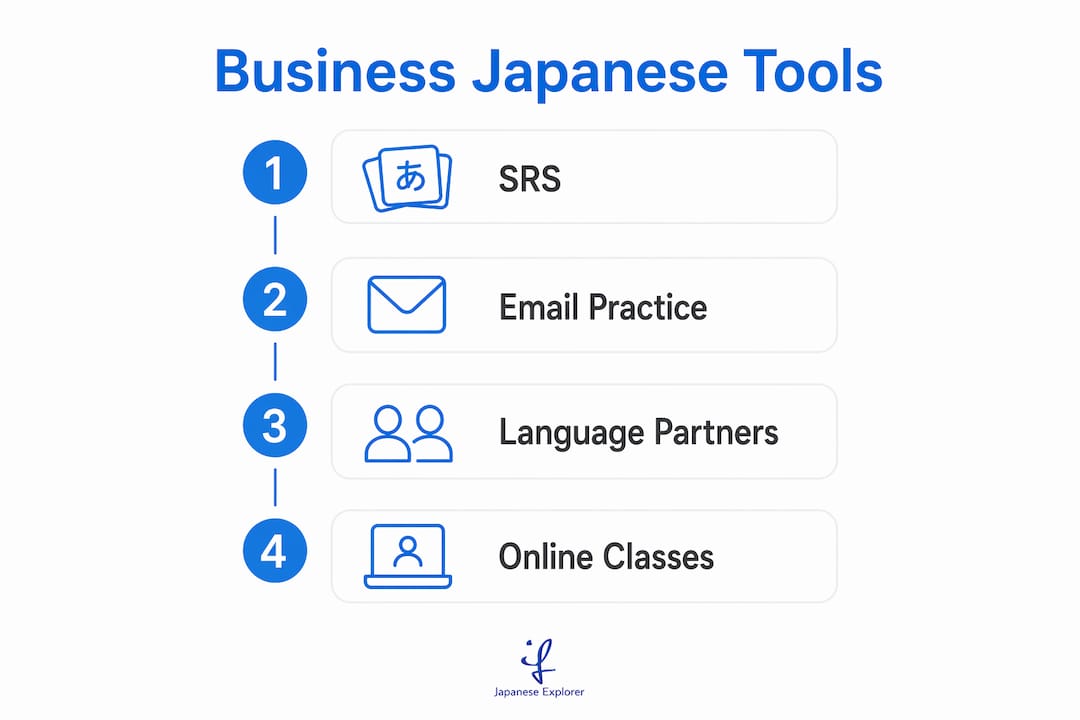
For tools, a spaced repetition system (SRS) like Anki helps you retain vocabulary efficiently by showing you words at the exact moment you are about to forget them. Pair that with industry-specific reading materials, such as business news in Japanese or internal documents from your company. A language app alone will not get you to N2. You need structured input, deliberate output practice, and materials that reflect your actual work context.
Pro Tip: Build a personal word list from your own workplace documents. Every new term you encounter in a real email or meeting is worth ten words from a generic textbook.
Here is a quick comparison of common study tools and their best use cases:
| Tool | Best use |
|---|---|
| Spaced repetition system (e.g., Anki) | Long-term vocabulary retention |
| Business Japanese textbooks | Grammar and keigo structure |
| Industry-specific reading materials | Role-relevant vocabulary in context |
| Online business Japanese classes | Speaking practice and feedback |
| Listening to recorded meetings | Comprehension and natural phrasing |
How can professionals structure daily practice for steady progress?
Consistent daily study of around 30 minutes produces better long-term retention than irregular longer sessions. That finding matters practically. A 30-minute daily habit is easier to protect than a two-hour weekend block that gets canceled when work gets busy.

The most effective structure for working professionals is habit stacking. This means attaching Japanese practice to activities you already do. Listen to a Japanese business podcast during your commute. Review key phrases during your lunch break. Read one short Japanese article before you open your inbox in the morning. Habit stacking keeps exposure consistent without requiring extra time you do not have.
Your weekly plan should also balance input and output. A 70/30 split works well early in your learning. Spend 70% of your study time on input, meaning listening and reading, and 30% on output, meaning speaking and writing. This ratio builds a strong comprehension base before you are asked to produce language under pressure in a real meeting.
A practical weekly structure looks like this:
- Monday: Listen to a Japanese business podcast episode during your commute (15 minutes each way).
- Tuesday: Review 20 new vocabulary cards using your spaced repetition system during a break.
- Wednesday: Read one short Japanese email or document from work and look up unfamiliar terms.
- Thursday: Practice speaking by shadowing a recorded business conversation for 10 minutes.
- Friday: Write a short summary in Japanese of something that happened at work that week.
- Weekend: Do one longer review session of the week’s vocabulary, plus one online class or conversation practice.
Pro Tip: Use your actual workplace emails as reading practice. Swap out one email per day for the Japanese version if your company operates bilingually. Real context beats textbook examples every time.
What core business Japanese skills matter most for the workplace?
Business Japanese effectiveness depends more on selecting the right speech register and using polished set phrases than on perfect grammar. Appropriate register matters more than flawless conjugation. A grammatically perfect sentence in the wrong register sounds worse than a simple sentence delivered correctly.
Keigo breaks into two main registers you need to master. The first is sonkeigo, which elevates the actions of the person you are speaking to. The second is kenjougo, which lowers your own actions to show humility. Both are used constantly in client meetings, phone calls, and formal emails. Mastering honorific forms for the eight to ten most common verbs covers the vast majority of situations you will face.
Prioritize passive input first. Successful learners spend 60–70% of early study time on reading and listening, mastering basic polite forms before advancing to complex keigo. Jumping into keigo before you are comfortable with the standard polite form (the masu form) produces unnatural speech that confuses native speakers.
Focus on these high-priority language areas:
- Meeting language: Phrases for agreeing, disagreeing politely, asking for clarification, and summarizing decisions.
- Email openings and closings: Set phrases that signal professionalism immediately.
- Telephone etiquette: Specific scripts for answering, transferring, and ending calls.
- Reporting language: Phrases for presenting updates to a manager or team.
- Safe responses under pressure: Short, polished phrases you can use when you need time to think.
The distinction between active and passive vocabulary also shapes how you study. For IT professionals, active speaking and writing vocabulary is roughly 50–60% of passive recognition vocabulary. That means you need to produce far fewer terms than you need to understand. Knowing which technical words require active production versus passive recognition lets you focus your energy where it counts most.
How to use technology and community to build Japanese skills on the job
Technology and community resources accelerate progress when used with a clear purpose. Recording and reviewing your own meetings is one of the most underused strategies. Listening back to a meeting you attended lets you catch phrases you missed in real time and study how native speakers structure their responses.
Language exchange partners give you speaking practice with a native speaker at no cost. Many professionals in Japan want to practice English, making a mutual exchange genuinely useful for both sides. Aim for at least one 30-minute exchange session per week, focused on workplace topics rather than casual conversation.
Online business Japanese classes tailored for working professionals provide structured feedback that self-study cannot replicate. A qualified instructor catches register errors and pronunciation issues before they become habits. Japanese Explorer offers business Japanese courses designed specifically for adults in professional roles, covering keigo, meeting communication, and business writing in a format that fits a working schedule.
Role-specific reading materials sharpen your vocabulary faster than general study. If you work in finance, read Japanese financial news. If you work in logistics, find Japanese industry newsletters. Connecting language practice to your actual professional tasks makes the language a tool rather than a separate subject.
What challenges do learners face when improving business Japanese?
The most common mistake is attempting complex keigo too early. Learners who skip the masu form foundation and jump straight into honorific speech produce sentences that sound stilted or even rude. Master the basics first. Keigo built on a shaky foundation creates more problems than it solves.
Motivation is the second major challenge. Work demands fluctuate, and language study is the first thing dropped when deadlines pile up. Tying your Japanese practice directly to work tasks solves this. Professionals who integrate Japanese study into their work routine progress faster and stay more motivated than those who treat it as a separate activity.
Self-assessment keeps you honest about your progress. Set a specific goal every month, such as passing a mock JLPT section or successfully handling a client call in Japanese without switching to English. Track what you can do, not just what you have studied.
“Language learning is not a project with a finish line. It is a professional skill that compounds over time. The professionals who treat Japanese as part of their job, not extra work, are the ones who reach fluency.”
Pro Tip: Find one Japanese-speaking colleague and commit to using Japanese with them for five minutes every day. Real conversation pressure accelerates progress faster than any app.
Soft skills matter alongside language skills. Emotional intelligence and diplomatic communication are critical for workplace success in Japanese contexts, even though they are rarely tested in JLPT. Reading the room, knowing when to stay quiet, and expressing disagreement without causing offense are skills that take time to develop but pay off enormously.
Key Takeaways
Improving Japanese skills at work requires consistent daily practice, targeted keigo mastery, and direct integration of language learning into your professional tasks.
| Point | Details |
|---|---|
| Target JLPT N2 as your benchmark | N2 is the minimum level for effective full-time office work in Japanese. |
| Study 30 minutes daily | Short daily sessions outperform irregular long blocks for long-term retention. |
| Master keigo in stages | Build masu-form fluency before advancing to honorific speech to avoid unnatural output. |
| Use a 70/30 input-output split | Prioritize listening and reading early; add speaking and writing as confidence grows. |
| Tie practice to real work tasks | Using workplace emails and meetings as study material keeps learning relevant and sustainable. |
What I have learned about learning Japanese while working full-time
The professionals I see progress fastest are not the ones who study the most hours. They are the ones who make Japanese unavoidable in their daily routine. They switch their phone to Japanese. They read the Japanese version of every document they receive. They ask their Japanese colleagues to correct them, even when it is uncomfortable.
The biggest trap is treating language learning as preparation for real use. You will never feel fully ready. The meeting where you stumble through a sentence in Japanese teaches you more than three hours of textbook study. Mistakes in a real professional context stick in a way that practice drills simply do not.
Soft skills deserve as much attention as grammar. I have watched professionals with near-perfect Japanese grammar lose client trust because they did not know how to read silence or soften a refusal. Japanese business culture rewards patience, indirectness, and attentiveness. Those are learnable skills, and they compound with your language ability.
The honest truth about improving Japanese skills at work is that the language itself is only part of the picture. Cultural fluency, professional judgment, and the willingness to be imperfect in front of colleagues are what separate functional speakers from genuinely effective communicators. Start before you are ready. Improve while you work.
— Paul
Japanese Explorer’s business Japanese courses for working professionals
Working professionals need a learning format that fits around their schedule, not the other way around. Japanese Explorer offers business Japanese courses built specifically for adults in professional and corporate roles, covering keigo, meeting language, and business writing with certified bilingual instructors.

Flexible online Japanese classes via Zoom make it easy to study from anywhere, whether you are based in Singapore or working remotely. For companies looking to train entire teams, Japanese Explorer’s corporate training program delivers customized instruction aligned to your industry and communication needs. Book a trial class to experience the approach firsthand and see how structured learning accelerates real workplace progress.
FAQ
What is the minimum JLPT level for office work in Japanese?
JLPT N2 is the widely accepted minimum for full-time office work in Japan. N3 supports independent participation but is generally not sufficient for roles requiring regular written and verbal communication.
How long does it take to reach business Japanese fluency?
Conversational fluency in Japanese generally requires 3–5 years of consistent effort. Daily study of around 30 minutes accelerates progress and is more effective than irregular longer sessions.
What is keigo and why does it matter at work?
Keigo is the Japanese system of honorific and polite speech used in professional settings. Using the correct register signals respect and professionalism. Errors in keigo can damage working relationships even when your grammar is otherwise correct.
How can I practice business Japanese without leaving my job?
Use your workplace documents, emails, and meetings as study material. Professionals who tie Japanese practice directly to their work tasks progress faster and stay more motivated than those who study separately.
Do I need perfect grammar to communicate effectively in Japanese at work?
No. Business Japanese effectiveness depends more on choosing the right speech register and using polished set phrases than on grammatical perfection. Appropriate register and safe, practiced expressions carry more weight in professional contexts.