
TL;DR:
- JALT is a nonprofit organization that promotes Japanese language teaching through conferences, publications, and interest groups. It serves around 2,800 members globally, supporting educators and researchers with professional development and community building. Many Japanese teachers are volunteers, highlighting the importance of accessible digital resources to sustain the field’s growth.
The Japan Association for Language Teaching, widely known as JALT, is a nonprofit organization committed to improving Japanese language teaching and learning in Japan and internationally. If you are an educator, language learner, or researcher asking what is association for Japanese-language teaching, JALT is the most recognized professional body in this field. Founded in 1975, JALT serves approximately 2,800 members through conferences, publications, and specialized interest groups. Japanese Explorer’s curriculum is guided by JALT’s frameworks, which means the structured approach you experience in class reflects the same standards that shape professional Japanese language education worldwide.
What Is the Association for Japanese-Language Teaching and What Does JALT Do?
JALT is defined as a nonprofit professional organization that advances Japanese language education through research, events, and community building. Its membership spans educators, researchers, and language learners across Japan and beyond. The organization operates on the principle that quality teaching improves when practitioners share knowledge, test new methods, and stay connected to current research.

JALT’s core activities fall into three categories: conferences, publications, and specialized interest groups (SIGs). Each one serves a distinct purpose for members.
Annual conferences and workshops are JALT’s most visible activity. Conferences and workshops give educators a dedicated space to present research, attend sessions on pedagogy, and network with peers from across Japan and internationally. These events cover topics ranging from grammar instruction to technology integration in the classroom.
Publications give members access to current research between events. JALT publishes a bimonthly magazine and semiannual research journals, keeping members updated on teaching methods, classroom studies, and language acquisition findings. This is one of the clearest benefits of teaching Japanese within a professional network: you gain access to peer-reviewed resources that most independent teachers never see.
Specialized Interest Groups let members go deeper on specific themes. SIGs focus on areas such as teacher education, learner development, and technology-assisted language learning. Joining a SIG connects you with a smaller, focused community of educators who share your specific interests.
Pro Tip: If you are new to JALT, joining a SIG before attending a full conference is a lower-pressure way to build connections and understand the community’s culture.
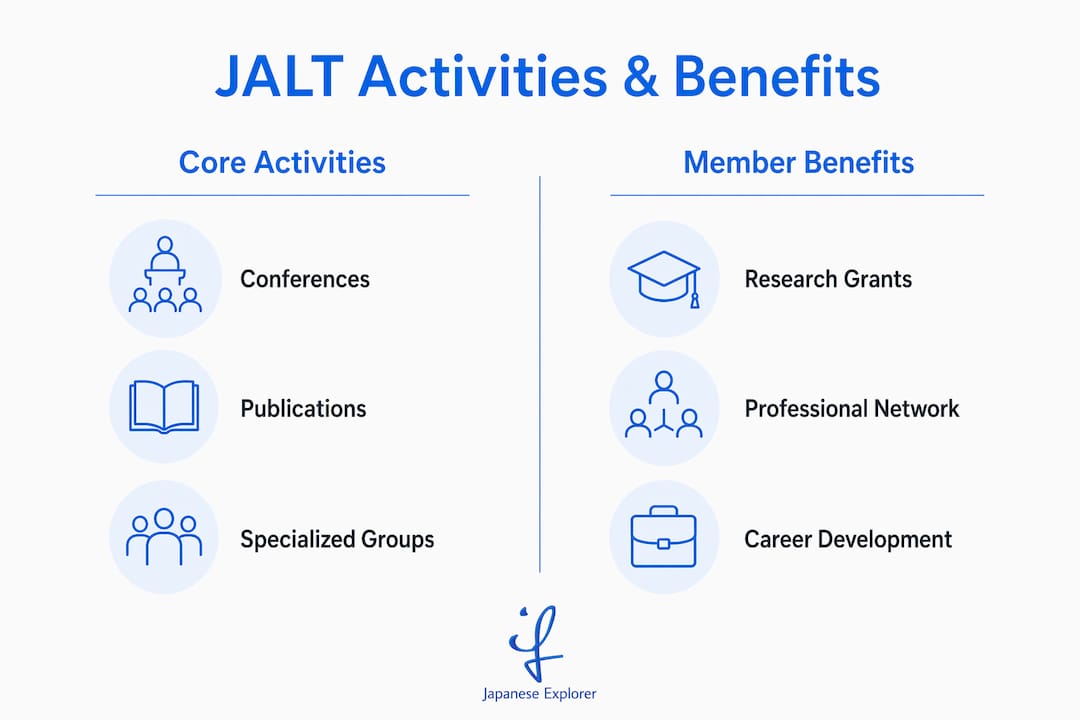
Additional member benefits include grant opportunities for research projects, access to a professional network for collaboration, and pathways to present your own classroom findings at regional and national events.
How does JALT compare to other Japanese language teaching associations?
The term “association for Japanese-language teaching” covers a wide range of organizations, from large professional bodies to small regional networks and volunteer groups. Understanding the differences helps you choose the right membership for your goals.
JALT operates at a national and international level, with a focus on professional development, research publication, and career-oriented networking. Regional associations serve a narrower geographic audience with more community-focused goals. The Association of Florida Teachers of Japanese is one example of a regional body. It uses tiered membership dues structured at $5 for students, $10 for supporters, $25 for professors, and $40 for dual members. That pricing reflects a community-engagement model rather than a career-development infrastructure.
Many Japanese language teaching associations also categorize memberships to serve K-16 teachers, university faculty, and students separately. This tiered approach lets each group access resources that match their professional stage. JALT follows a similar logic, with membership options suited to different career levels.
The table below summarizes the key differences between major association types.
| Feature | JALT (National/International) | Regional associations |
|---|---|---|
| Membership scope | Japan and international | Local or state-level |
| Primary focus | Research, career development, publications | Community engagement, local networking |
| Publications | Bimonthly magazine, semiannual journals | Newsletters or limited publications |
| Events | Annual national conference, workshops | Local meetups, regional workshops |
| Membership tiers | Multiple levels for educators and researchers | Student, supporter, faculty tiers |
| Best suited for | Career educators, researchers, language professionals | Community teachers, local advocates |
Pro Tip: If your goal is career advancement or publishing research, JALT’s infrastructure offers more than a regional association. If you want local community connections, a regional body may be the better starting point.
Professional associations that offer career-focused workshops and research opportunities consistently deliver more long-term value than those focused only on social networking. This is worth weighing before you commit membership fees and time.
What practical roles does JALT play for educators and learners?
JALT serves educators and learners in concrete, practical ways that go beyond simply holding a membership card.
-
Access to certification pathways and training. JALT connects educators with workshops and training programs that support professional certification. For teachers asking how to teach Japanese language at a higher level, these resources provide structured pathways to improve pedagogy and meet recognized standards.
-
Research resources and grant funding. JALT members can apply for research grants that fund classroom studies and language acquisition projects. This is particularly valuable for university faculty and independent researchers who need financial support to conduct and publish original work.
-
Networking and career development. Professional networking through JALT opens doors to job referrals, collaborative projects, and mentorship from experienced educators. The annual conference is one of the most concentrated networking opportunities in Japanese language education.
-
Connecting learners with educators. Language learners benefit indirectly from JALT because the organization raises the quality of teaching across the field. When teachers attend JALT events and apply new methods, learners in their classes experience better instruction. Language support programs that connect foreign residents with trained instructors and university students with real-world practice demonstrate exactly this kind of community benefit.
-
Sustaining quality amid rising demand. The number of foreigners studying Japanese in Japan has reached record levels. JALT’s role in training and connecting educators helps the field keep pace with that growing demand without sacrificing instructional quality.
What does a Japanese language teacher do within this ecosystem? They attend JALT events to stay current, publish findings in JALT journals, and apply evidence-based methods in their classrooms. JALT gives those individual efforts a professional framework and a wider audience.
What challenges and trends shape Japanese language teaching associations today?
Japanese language teaching associations operate in a field that is changing faster than most educators expected even five years ago.
The volunteer-versus-professional divide is the most significant structural challenge. 51.1% of Japanese language teachers in Japan teach as volunteers, while only 13.6% hold full-time professional positions. That gap creates real tension for associations like JALT, which are built around professional development. Volunteer teachers often lack the time or institutional support to engage deeply with conferences and journals.
Current trends reshaping the field include:
- Digital and hybrid teaching formats. Teaching increasingly blends online and in-person delivery, requiring educators to develop new technical skills alongside their language expertise. Associations that offer digital resources and online events reach a broader, more geographically dispersed membership.
- International student growth. Record numbers of international learners in Japan are putting pressure on the existing teacher pool. Associations play a direct role in training new educators and retaining experienced ones through professional recognition and community.
- Demographic shifts in membership. Younger educators expect digital-first resources, flexible event formats, and online community spaces. Associations that rely solely on in-person annual conferences risk losing this generation of members.
- Integration of technology in instruction. Tools like spaced repetition systems and pitch accent training apps are now standard in many classrooms. Associations that address these tools in their SIGs and workshops stay relevant to practicing teachers.
The multicultural student experience that comes with teaching Japanese is one of the most rewarding aspects of the profession. Associations that highlight this dimension attract educators motivated by more than salary, which matters enormously given the high proportion of volunteer teachers in the field.
Key Takeaways
JALT is the most established Japanese language teaching association, offering research, events, and professional development that directly improve teaching quality and career outcomes for educators worldwide.
| Point | Details |
|---|---|
| JALT’s core mission | JALT advances Japanese language education through conferences, publications, and specialized interest groups. |
| Membership scale | JALT serves approximately 2,800 members in Japan and internationally since its founding in 1975. |
| Volunteer vs. professional split | 51.1% of Japanese language teachers in Japan are volunteers; only 13.6% hold full-time roles. |
| Regional vs. national associations | Regional bodies focus on community engagement; JALT focuses on career development and research. |
| Practical value for educators | JALT provides grant funding, certification pathways, networking, and peer-reviewed publications. |
Why professional associations like JALT matter more than most educators realize
I have watched educators treat professional association membership as a box to check rather than a resource to use. That approach wastes real opportunity. JALT is not just a conference organizer. It is one of the few structures in Japanese language education that connects classroom teachers with researchers, gives independent educators access to peer-reviewed work, and creates a shared professional identity across a field that is otherwise fragmented between volunteers and full-time staff.
The 51.1% volunteer figure is the number that stays with me. More than half of Japanese language teachers in Japan are giving their time without professional compensation. That is a remarkable level of dedication, and it also means those teachers rarely have institutional backing for professional development. JALT fills that gap, but only if associations evolve to meet volunteer teachers where they are: online, time-constrained, and motivated by passion rather than career ladders.
The future of Japanese language teaching associations depends on one thing: making professional development accessible to the people who need it most, not just the ones who can afford conference travel. Associations that move toward digital-first resources, flexible SIG participation, and online mentorship will grow. Those that do not will shrink as their most engaged members age out.
If you are an educator or learner connected to Japanese Explorer, you are already working within a curriculum shaped by JALT’s standards. That is not a small thing. It means the structure behind your lessons reflects the same research and professional consensus that JALT has been building since 1975.
— Paul
Japanese Explorer: quality Japanese courses built on professional standards
Japanese Explorer’s courses are built on the same professional frameworks that JALT promotes across the field. Whether you are learning conversational Japanese for personal growth or preparing for business communication, the curriculum integrates grammar, speaking, and listening in every lesson.

Japanese Explorer offers small group Japanese classes in Singapore as well as fully online Japanese courses for learners who need flexibility. Classes run from beginner to advanced levels, with dedicated business Japanese options for professionals. The school is located at 10 Anson Road, Level 22, International Plaza, Singapore 079903, right above Tanjong Pagar MRT. Experienced bilingual instructors lead every session, keeping lessons practical, interactive, and grounded in real communication.
FAQ
What is JALT and when was it founded?
JALT, the Japan Association for Language Teaching, is a nonprofit organization founded in 1975. It serves approximately 2,800 members through conferences, publications, and specialized interest groups focused on Japanese language education.
How does JALT differ from regional Japanese language teaching associations?
JALT operates nationally and internationally with a focus on research and career development, while regional associations like the Association of Florida Teachers of Japanese focus on local community engagement with modest tiered membership fees.
What are the benefits of joining a Japanese language teaching association?
Members gain access to peer-reviewed journals, annual conferences, research grants, specialized interest groups, and professional networking opportunities that support both career growth and classroom improvement.
What does a Japanese language teacher do within JALT?
A Japanese language teacher in JALT attends conferences, publishes classroom research in JALT journals, joins SIGs aligned with their specialty, and applies evidence-based methods learned through the organization’s professional development programs.
Why are so many Japanese language teachers volunteers?
51.1% of Japanese language teachers in Japan teach as volunteers, with only 13.6% holding full-time professional roles. This reflects the community-driven nature of much Japanese language instruction, particularly for foreign residents and informal learners.