
TL;DR:
- Building Japanese fluency for teams requires a structured, phased approach that starts with mastery of kana and progresses through vocabulary, grammar, and active communication. The most effective path aligns with JLPT levels, targeting N3 for workplace proficiency, and emphasizes daily practice, realistic timelines, and relevant content. Using proper tools, cultural training, and specialized instruction accelerates learning and ensures rapid, sustainable progress.
Building Japanese fluency as a team is absolutely achievable when you follow a structured, progressive approach. The most effective path moves through five clear phases: kana mastery, core vocabulary and grammar at JLPT N5, intermediate expansion toward N3, active speaking and listening production, and finally immersive workplace practice. Here is what that looks like in practice for your team:
- Start with hiragana and katakana. Both scripts typically require a few weeks of daily practice to read fluently.
- Build vocabulary and grammar aligned with JLPT N5, targeting around 800 words and 80 core grammar patterns.
- Progress to N4 and N3 by adding workplace terminology, keigo (formal speech), and listening comprehension.
- Practice speaking and listening through role-plays, shadowing, and team conversations tied to real job scenarios.
- Embed Japanese into daily workflows through micro-learning, peer coaching, and regular JLPT benchmark assessments.
The key insight: skipping foundational stages creates structural gaps that stall progress after early gains. Sequence matters more than speed.
Table of Contents
- How JLPT proficiency levels guide your team’s learning path
- A step-by-step structured Japanese learning plan for teams
- Strategies and tools that accelerate team-based Japanese learning
- Managing realistic timelines and expectations for team fluency
- Why workplace-aligned Japanese training produces better results
- How to assess your team’s starting point and set group goals
- Evaluation and feedback mechanisms that keep teams on track
- Cultural competency training makes language skills actually land
- Technology and apps that work well for team language learning
- Japanese Explorer offers structured corporate Japanese training
- FAQ
- Key Takeaways
How JLPT proficiency levels guide your team’s learning path
The Japanese Language Proficiency Test (JLPT) gives teams a clear, internationally recognized framework for measuring progress. It runs from N5 through N1, with each level representing a meaningful jump in real-world capability:
- N5: Absolute beginner. Basic greetings, simple sentences, around 800 vocabulary words.
- N4: Simple conversation. Everyday situations, around 1,500 words, basic kanji.
- N3: Functional workplace fluency. The threshold where Japanese becomes genuinely usable at work.
- N2: Professional readiness. Full keigo, complex reading, business communication.
- N1: Near-native fluency. Nuanced expression, 10,000+ vocabulary words, deep cultural literacy.
For most corporate teams, N3 is the primary target. At N3, team members can handle meetings, reports, and client interactions without constant support. Setting N3 as a shared milestone gives everyone a concrete goal and keeps the group moving at a compatible pace. Pairing this with JLPT preparation courses helps teams stay on track with structured exam-aligned content.
A step-by-step structured Japanese learning plan for teams
A phased roadmap prevents the most common team learning failure: everyone moving at different speeds with no shared reference point.
Phase 1: Kana foundation (weeks 1–3). Every team member learns all 46 hiragana and 46 katakana characters. Reading kana fluently is the prerequisite every Japanese learning tool assumes. Teams that rush this phase pay for it later.

Phase 2: N5 vocabulary and grammar (months 1–3). Target 500–800 words and around 80 grammar patterns using spaced repetition. Group study sessions two to three times per week, with daily individual review using flashcard apps like Anki.
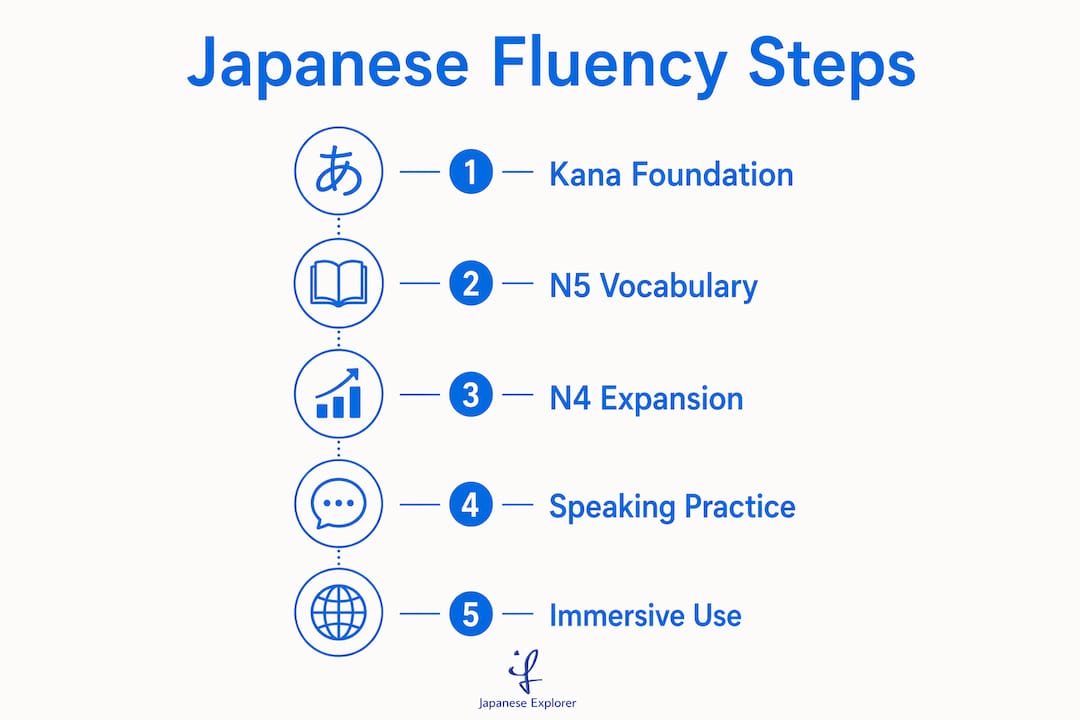
Phase 3: N4 expansion and workplace vocabulary (months 4–8). Add N4 vocabulary, introduce workplace-specific terminology, and begin reading simple Japanese texts. This is also when listening practice becomes non-negotiable. Teams that start daily listening at this stage develop an ear that makes every future level easier.
Phase 4: Speaking, listening, and production (months 9–16). Role-play workplace scenarios: meetings, status updates, client calls. Shadowing native audio builds rhythm and pronunciation. Assign team members rotating “Japanese-only” communication slots during internal check-ins.
Phase 5: Immersive practice and cultural depth (months 17 onward). Integrate Japanese into actual work communications where possible. Pursue N3 certification as a team milestone. Native media, podcasts, and cross-cultural training deepen both language and professional relationships.
Pro Tip: Assign a “language lead” within the team each week. That person sets the vocabulary focus, runs a five-minute warm-up at the start of meetings, and tracks the group’s shared flashcard deck.
Strategies and tools that accelerate team-based Japanese learning
The right tools make daily consistency far easier to maintain across a group.
Spaced repetition systems like Anki surface vocabulary at the exact moment each learner is about to forget it, which is why about 10 new words per day can lead to steady retention at a sustainable pace. For teams, shared Anki decks built from real workplace messages and meeting transcripts keep vocabulary directly relevant to the job.
Adaptive micro-training delivers 5–12 minute lessons integrated into daily tools, with contextual prompts, scenario-based assessments, and manager dashboards. One Tokyo-based product team using this approach saw client mail response time improved and internal satisfaction rose after a 12-week micro-training program.
Peer coaching rounds out the toolkit. Pairs or small groups within the team practice together, correct each other’s output, and share progress. This kind of collaborative practice improves motivation and accelerates acquisition in ways that solo study cannot replicate. You can also explore educational itinerary frameworks to structure immersive group learning experiences that go beyond the classroom.
Managing realistic timelines and expectations for team fluency
Reaching JLPT N3 functional fluency requires extensive study hours, which may take multiple years of daily study, with faster progress possible with more intensive study. The US Foreign Service Institute classifies Japanese as a very challenging language, estimating a high number of contact hours for professional working proficiency.
The most common team challenges are early speaking anxiety, uneven skill levels across members, and sustaining daily practice after the initial enthusiasm fades. Address these directly:
- Speaking anxiety: Normalize mistakes from day one. Create low-stakes practice spaces where errors are expected and celebrated as learning.
- Uneven skill levels: Group members by current proficiency for skill-building sessions, then bring the full team together for shared workplace scenarios.
- Sustaining practice: Short daily sessions consistently outperform long weekend cramming. Thirty minutes every day beats five hours on Saturday.
Periodic JLPT mock tests every three to four months give the team a shared checkpoint and a motivational boost when progress is visible. Review Japanese language learning milestones to set expectations that are honest and achievable.
Why workplace-aligned Japanese training produces better results
Generic language courses teach Japanese. Workplace-aligned training teaches the Japanese your team actually uses. That distinction drives both retention and organizational return on investment.
Curriculum tied to job-specific tasks such as client communication, progress reporting, and internal coordination increases learning retention and speeds the point at which language skills translate into real business value. Training built around actual workplace scenarios supports internal coordination, client relationship management, and cross-cultural collaboration simultaneously.
Modules worth prioritizing for most corporate teams include: meeting language and keigo, written reporting and email etiquette, client reception and hospitality phrases, and negotiation vocabulary. Aligning these modules with team KPIs gives leadership a clear way to measure training ROI. Explore how corporate Japanese training connects directly to business performance outcomes.
How to assess your team’s starting point and set group goals
Before any training begins, map where each team member currently stands. A short diagnostic assessment covering listening comprehension, reading, and basic speaking gives you a baseline. Many structured programs offer placement tests aligned with JLPT levels.
From there, set two types of goals: individual proficiency targets (each person’s next JLPT level) and shared team goals (a common vocabulary set, a workplace scenario the whole team can handle). Shared goals create accountability and give the group something to celebrate together. Keep goals specific: “pass JLPT N4 by December” is actionable; “get better at Japanese” is not.
Evaluation and feedback mechanisms that keep teams on track
Progress tracking works best when it combines formal assessments with informal feedback loops. Schedule JLPT mock tests every quarter. Between tests, use short scenario-based checks tied to real work tasks: can the team member handle a client inquiry in Japanese? Can they write a status update without switching to English?
Linking learning outcomes to team KPIs and real-world scenarios keeps training grounded in business needs. Manager dashboards in adaptive platforms let team leads see who needs support before a quarterly review surfaces the gap. Peer feedback sessions, where team members review each other’s written or spoken Japanese, add a layer of accountability that formal tests alone cannot provide.
Cultural competency training makes language skills actually land
Language without cultural context creates misunderstandings even when the grammar is perfect. Japanese professional culture carries specific expectations around hierarchy, indirect communication, and group harmony that directly affect how language is used.
Teams benefit from learning keigo (formal and humble speech registers) alongside grammar, not as an afterthought. Understanding when to use polite versus casual forms, how to decline a request without causing offense, and how silence functions in Japanese meetings changes the quality of every interaction. Cultural training modules covering these norms pair naturally with practical Japanese communication skills for professionals working with Japanese partners or clients.
Technology and apps that work well for team language learning
The most effective tech stack for team Japanese learning combines a spaced repetition app, a structured grammar resource, and a speaking practice tool.
For vocabulary, Anki with shared team decks built from workplace content keeps everyone reviewing the same words. For grammar, Tae Kim’s free guide at guidetojapanese.org covers every core pattern from beginner to advanced without paywalls. For speaking, shadowing apps that use native audio and automatic pronunciation grading build the muscle memory that reading-only study never develops.
At the team management level, platforms with manager dashboards and scenario-based micro-assessments let you track group progress without adding administrative overhead. The goal is a system where daily practice takes 15–30 minutes per person and feeds directly into shared team metrics.
Japanese Explorer offers structured corporate Japanese training
Japanese Explorer gives corporate teams in Singapore a clear, supported path to Japanese fluency, with curriculum guided by the Association for Japanese-Language Teaching and instruction from experienced bilingual certified instructors.

Whether your team is starting from zero or pushing toward N3 workplace fluency, Japanese Explorer’s corporate Japanese courses are built around real business communication scenarios: meetings, reporting, client interaction, and internal coordination. Flexible formats include small group classes, online Zoom sessions, and private instruction, so training fits around your team’s schedule rather than the other way around. Small group classes keep sessions interactive and give every team member speaking time in every lesson.
Contact Japanese Explorer at their city-centre training centre at 10 Anson Road, Level 22, International Plaza, Singapore 079903 (right above Tanjong Pagar MRT), or inquire online to find the right program for your team.
FAQ
What is the best way to learn Japanese fluently?
Consistent daily practice using spaced repetition for vocabulary, structured grammar study, and regular speaking output is the most reliable path. Reaching around 10,000 words gives you roughly 95% comprehension of everyday Japanese, which is where fluency becomes self-sustaining.
What do the JLPT levels N1 through N5 mean?
N5 is absolute beginner, N4 covers simple conversation, N3 marks functional workplace fluency, N2 signals professional readiness, and N1 is near-native proficiency. Most corporate teams target N3 as their primary milestone.
How do you speak Japanese step by step?
Start with kana (hiragana and katakana), build 500–800 vocabulary words at N5 level, then practice speaking from short scripted phrases toward open conversation. Shadowing native audio and doing regular speaking sessions with a partner or tutor accelerates production skills significantly.
How long does it take a team to reach functional Japanese fluency?
Reaching JLPT N3 typically requires 1,000–1,200 study hours, or about three years at one hour of daily study. With increased daily study, teams can reduce this timeline accordingly.
Key Takeaways
A team that follows a phased, JLPT-aligned Japanese learning plan with daily spaced repetition and workplace-relevant content reaches functional fluency at N3 in 1.5–3 years, depending on study intensity.
| Point | Details |
|---|---|
| Start with kana | Hiragana and katakana mastery in 2–3 weeks is the non-negotiable first step. |
| JLPT N3 is the team target | N3 marks functional workplace fluency and takes roughly 1,000–1,200 study hours to reach. |
| Daily consistency beats intensity | 30 minutes every day produces better retention than long, infrequent sessions. |
| Workplace alignment speeds ROI | Curriculum tied to real job tasks increases retention and shortens time to business value. |
| Japanese Explorer for teams | Japanese Explorer’s corporate courses use certified instructors and Association for Japanese-Language Teaching curriculum for structured team progress. |