TL;DR:
- Effective communication in Japanese business meetings relies heavily on cultural principles like nemawashi and hourensou, emphasizing preparation and respectful information flow. Mastering indirect expressions, appropriate silence, and keigo enhances cultural fluency, leading to better understanding and trust. Prior groundwork and structured follow-up are crucial, as decisions are typically made before the formal meeting through informal consensus-building.
Effective communication in Japanese business meetings is defined by three interlocking principles: polite indirectness, consensus orientation, and a deep respect for process. If you walk into a Japanese corporate meeting expecting live debate and real-time decisions, you will almost certainly misread the room. The practices of nemawashi (pre-meeting consensus building) and hourensou (report, inform, consult) govern how decisions actually get made. Mastering how to communicate in Japanese meetings means understanding these cultural frameworks just as much as learning the right phrases. Language skills open the door. Cultural fluency keeps you in the room.
How to communicate in Japanese meetings: cultural styles and etiquette
Japanese business communication operates on a principle of tatemae (public face) and honne (true feelings). What is said aloud in a meeting is rarely the full picture. Politeness and indirectness are not obstacles to communication. They are the communication.
Aizuchi is one of the most misread behaviors in Japanese meetings. These are backchannel signals: frequent nods, “hai,” “sou desu ne,” and “naruhodo.” Foreigners consistently interpret these as agreement, but hai signals listening, not consent. This distinction alone prevents a significant number of post-meeting misunderstandings in multinational teams.
Silence carries meaning too. A long pause after you present a proposal is not confusion. It signals reflection, and sometimes polite reluctance. Pushing to fill that silence with more talking is seen as disrespectful. Let the pause breathe.
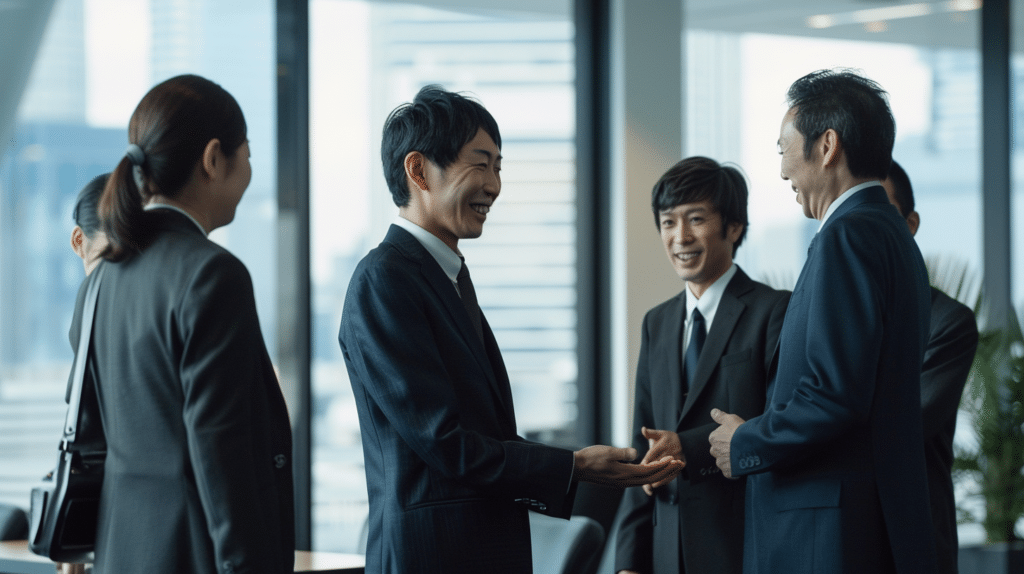
- Punctuality is non-negotiable. Arriving even two minutes late signals disrespect for the group.
- Bowing depth matters. A 15-degree bow is standard for colleagues. A 30-degree bow shows deeper respect to seniors.
- Self-introductions follow rank. The most senior person introduces themselves first. Follow the order of the room.
- Business cards (meishi) are presented and received with both hands. Read the card before setting it down carefully. Never write on it.
- Avoid direct disagreement. Phrases like “that is difficult” (muzukashii desu ne) signal a soft refusal. Learn to hear them.
Pro Tip: Before your first meeting with a Japanese team, research the seniority order of attendees. Addressing the most senior person first, even briefly, sets a respectful tone that the whole room notices.
How to prepare and participate effectively in Japanese business meetings
Preparation for a Japanese business meeting starts days or weeks before the meeting itself. The formal meeting is rarely where decisions are made. Nemawashi is the informal pre-meeting consultation process where you speak individually with key stakeholders, share your proposal, and build alignment before anyone sits down together. Formal meetings typically confirm decisions already reached through nemawashi, not debate them live.
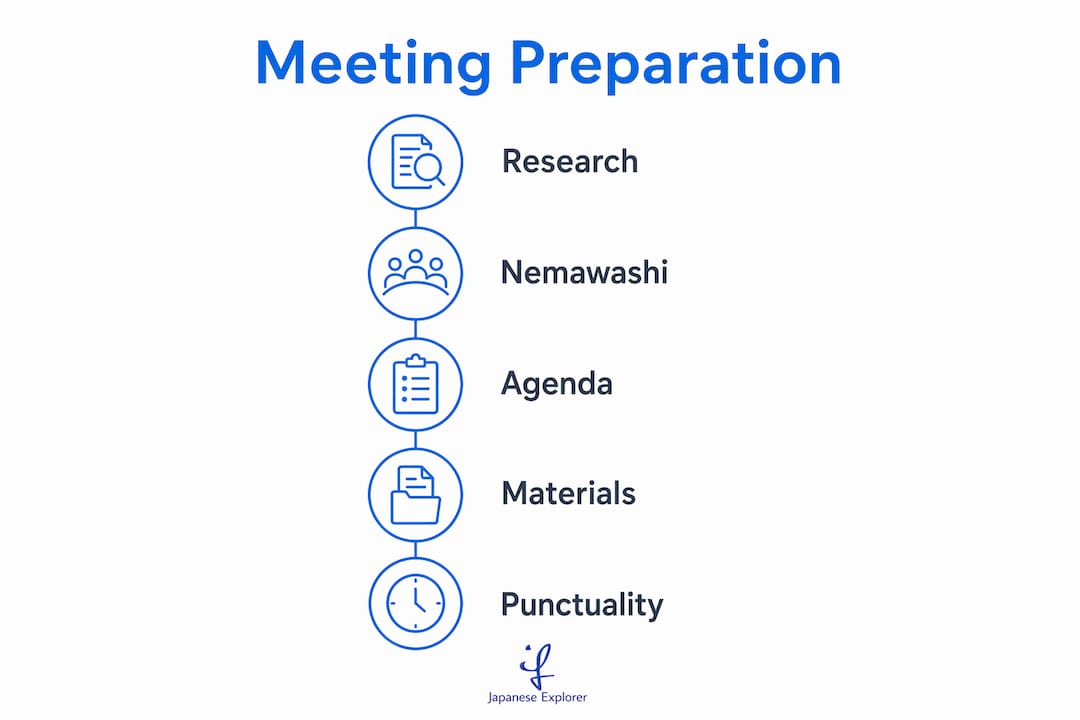
This has a direct implication for multinational professionals. Walking in without prior consultation produces polite, non-committal responses and stalled proposals. The meeting looks fine on the surface. Nothing moves forward. If you want a decision, do the groundwork first.
Here is a practical preparation sequence:
- Identify key stakeholders at least one week before the meeting. Know who has influence, not just who has the title.
- Share materials in advance. Send your agenda, data, and proposals at least two to three days early. Japanese teams need time for internal review and discussion before the formal session.
- Conduct one-on-one nemawashi conversations. Brief each key person informally. Ask for their input. This is not lobbying. It is relationship-building and process respect.
- Clarify the meeting’s purpose explicitly. Is this a decision meeting, a progress update, or an information-sharing session? Japanese meetings have distinct formats, and participants prepare differently for each.
- Apply hourensou principles throughout. Hourensou means you report progress to supervisors, inform relevant parties of updates, and consult before making independent decisions. Use this framework before, during, and after every meeting.
During the meeting itself, attentive listening is your most visible contribution. Nodding, maintaining appropriate eye contact, and using aizuchi signals show engagement. Speak in measured turns. Avoid interrupting, even to agree enthusiastically. Wait for a natural pause before contributing.
Pro Tip: If you are presenting a proposal that requires a decision, state clearly at the start: “We hope to reach a conclusion on this point today.” This sets an explicit expectation without being pushy, and gives the Japanese team a clear frame for the session.
Which business Japanese phrases are essential during meetings?
The right phrase at the right moment signals cultural fluency, not just language ability. These expressions cover the core situations you will encounter in any formal Japanese business meeting.
Greetings and opening:
- Yoroshiku onegai shimasu — “I look forward to working with you / please treat me well.” Said at introductions and the start of meetings.
- Honjitsu wa ojama shimasu — “Thank you for having me today.” Used when visiting a client’s office.
- Hajimemashite, [name] to moushimasu — “Nice to meet you, my name is [name].” Formal self-introduction.
Asking for opinions and input:
- Ikaga deshoo ka? — “What do you think?” A polite way to invite feedback.
- Go-iken wo ukagaemo yoroshii deshoo ka? — “May I ask for your opinion?” Extremely polite, appropriate for senior colleagues.
Expressing soft disagreement or hesitation:
- Sukoshi muzukashii desu ne — “That is a little difficult.” A polite signal of reluctance or refusal.
- Kentoo shite mimasu — “I will consider it.” Often means the answer is no. Confirm with a follow-up.
Confirming understanding and decisions:
- Kakunin shite mo yoroshii deshoo ka? — “May I confirm this?” Use this to verify decisions explicitly.
- Moo ichido oshiete itadakemasu ka? — “Could you explain that once more?” Polite way to ask for clarification.
The table below shows how the same intent shifts in formality depending on context:
| Situation | Casual / Internal | Formal / Client-facing |
|---|---|---|
| Asking for opinion | Doo omoimasu ka? | Go-iken wo ukagaemo yoroshii deshoo ka? |
| Expressing difficulty | Chotto muzukashii | Sukoshi muzukashii to zonjimasu |
| Confirming a point | Kakunin shimasu | Kakunin shite mo yoroshii deshoo ka? |
| Closing the meeting | Otsukare sama | Honjitsu wa arigatoo gozaimashita |
Keigo (honorific language) is not optional in client-facing or senior-level meetings. Japanese Explorer’s Japanese meeting phrases resource covers the full range of keigo expressions organized by meeting situation, which is worth bookmarking before your next session.
How to navigate common communication challenges in Japanese meetings
Cross-cultural misunderstandings in Japanese workplaces most often stem from process norms, not grammar errors. Research shows 52.3% of foreign employees cite time-sense expectations as a major challenge, and 40% find interpreting ambiguity difficult. These are not language problems. They are cultural process problems.
The most common pitfalls and how to address them:
- Misreading “hai” as agreement. Treat all aizuchi signals as acknowledgment only. After any key decision point, ask explicitly: “Kore de yoroshii deshoo ka?” (“Is this acceptable?”) to get genuine confirmation.
- Missing indirect refusals. Phrases like “kentoo shimasu” (I will consider it), “muzukashii desu ne” (that is difficult), or extended silence after your proposal are soft refusals. Do not push. Follow up privately after the meeting.
- Expecting live decisions. If your proposal has not gone through nemawashi, the formal meeting will not produce a decision. Recognize this as process, not obstruction.
- Ambiguity in task ownership. Japanese meetings do not always assign explicit owners or deadlines verbally. This is why written follow-up is critical.
“Teams rely on written records as communication tools to avoid omissions and misunderstandings.” — Tips for writing meeting minutes
Japanese meeting minutes follow a specific structure: decisions are listed separately from discussion points, each task has a named owner and a deadline, and the document is sent to all attendees for review. Sending clear minutes within 24 hours of a meeting is one of the most effective ways to prevent misalignment in multinational Japanese teams. It also demonstrates the kind of thoroughness that Japanese colleagues respect.
Understanding aizuchi and its role in Japanese communication is worth dedicated study. It changes how you interpret every meeting you attend.
Key takeaways
Effective communication in Japanese meetings requires cultural process knowledge, specifically nemawashi and hourensou, as much as it requires language skill.
| Point | Details |
|---|---|
| “Hai” means listening, not agreement | Always confirm decisions explicitly with a direct question after key discussion points. |
| Nemawashi precedes formal decisions | Build consensus through one-on-one consultations before the meeting, not during it. |
| Keigo signals respect | Use honorific language in client-facing and senior-level meetings to establish credibility. |
| Written minutes prevent ambiguity | Send structured minutes within 24 hours, listing decisions, owners, and deadlines clearly. |
| Cultural training matters as much as language | Process norms cause more misunderstandings than grammar errors in multinational Japanese teams. |
What I have learned from years of watching professionals navigate Japanese meetings
The single most common mistake I see from multinational professionals is treating Japanese meetings like Western ones with a language barrier. They prepare their slides, practice a few phrases, and walk in expecting the meeting to function the same way. It does not. The meeting is the ceremony. The real work happened before it.
I have watched well-prepared professionals lose deals not because their Japanese was poor, but because they skipped nemawashi. They presented a strong proposal in a formal meeting, received polite nods and “kentoo shimasu,” and left thinking it went well. It did not. The proposal was effectively dead because no one in the room had been consulted beforehand. The lesson is uncomfortable but clear: in Japanese corporate culture, the process is the product.
The other thing I would tell any professional preparing for these meetings is to invest in learning aizuchi properly. Not just knowing what it is, but training yourself to stop interpreting it as agreement. That rewiring takes practice. It also takes humility, because it means accepting that your instincts about what “yes” looks like are wrong in this context.
Language training helps enormously, but the professionals who communicate best in Japanese meetings are the ones who have also studied the cultural process. They understand why silence is respectful, why indirect refusals are considerate rather than evasive, and why a slow decision is often a careful one. That understanding changes your whole posture in the room.
— Paul
Build the skills to communicate confidently in Japanese business settings
If you are preparing for Japanese meetings and want to move beyond basic phrases into genuine fluency, Japanese Explorer offers business Japanese courses designed specifically for working professionals. The curriculum covers keigo, meeting communication, and the cultural frameworks that make Japanese business interactions work.

For teams in multinational companies, Japanese Explorer also provides corporate Japanese training tailored to your industry and communication goals. Classes are available in small groups, private sessions, and online via Zoom, so you can build skills around your schedule. The school is located at 10 Anson Road, Level 22, International Plaza, Singapore 079903, right above Tanjong Pagar MRT. Reach out to find the format that fits your team.
FAQ
What does “hai” actually mean in a Japanese meeting?
“Hai” functions as an aizuchi backchannel signal meaning “I am listening,” not “I agree.” Always confirm decisions with an explicit question like “Kore de yoroshii deshoo ka?” to get genuine approval.
What is nemawashi and why does it matter for meetings?
Nemawashi is the informal pre-meeting process of consulting key stakeholders individually to build consensus before a formal meeting. Formal meetings in Japanese companies typically ratify decisions already aligned through nemawashi, not make them live.
How should I follow up after a Japanese business meeting?
Send structured meeting minutes within 24 hours, clearly listing decisions made, tasks assigned, responsible persons, and deadlines. Clear written minutes reduce ambiguity and demonstrate the thoroughness that Japanese colleagues value.
What is hourensou and how does it apply to meetings?
Hourensou covers three communication habits: report progress to supervisors, inform relevant parties of updates, and consult before making independent decisions. Applying hourensou principles before, during, and after meetings keeps all stakeholders aligned and prevents omissions.
Do I need to use keigo in every Japanese business meeting?
Keigo (honorific language) is required in client-facing meetings and when speaking with senior colleagues. Internal team meetings may use a slightly less formal register, but defaulting to polite keigo forms is always the safer choice until you know the team’s preferred communication style well.