
TL;DR:
- Personalized language courses adapt content and assessment to learners’ goals and proficiency, yielding stronger vocabulary, fluency, and confidence gains. Continuous reassessment, real-world practice scenarios, and advanced technology such as AI and mobile tools enhance effectiveness and motivation. Genuine tailoring involves dynamic adjustments and curricular relevance, especially benefiting beginners and professionals striving for authentic communication skills.
Tailored language courses are defined as structured learning programs that adapt content, pacing, and practice to each learner’s specific goals, proficiency level, and real-world communication needs. The benefits of tailored language courses go far beyond simple convenience. Research from 2026 shows that personalized instruction produces measurably stronger outcomes in vocabulary, fluency, and writing accuracy compared to standard classroom formats. Whether you are learning Japanese for career advancement, travel, or personal growth, a customized approach means every lesson moves you forward rather than covering ground you have already mastered or skipping ahead before you are ready.
What measurable benefits do tailored language courses offer?
Tailored language courses outperform generic instruction across every major skill area, and the data is clear. A 2026 study on English-for-Specific-Purposes (ESP) digital corpus-based instruction found very large effect sizes with Cohen’s d exceeding 1.93. Students’ collocation awareness rose from 2.30 to 5.13, and professional writing accuracy improved from 7.83 to 10.10. That kind of gain in a single course cycle is not typical of standard instruction.

Anxiety reduction is another documented advantage. An Arizona State University case study using the IMMERSE adaptive speaking program found that foreign language anxiety dropped 39% over 16 weeks, while fluency measures improved by 21% among 199 students. Lower anxiety directly correlates with more willingness to speak, which accelerates real-world communication skills faster than any grammar drill.
A systematic review of AI-enabled personalized learning found medium-to-large effect sizes on cognitive outcomes, with Hedges’ g ranging from 0.50 to 0.70. These are not marginal improvements. They represent the difference between a learner who plateaus after six months and one who continues building fluency with confidence.
| Outcome Area | Research Finding |
|---|---|
| Professional writing accuracy | Improved from 7.83 to 10.10 in ESP corpus-based instruction study |
| Foreign language anxiety | Reduced by 39% in IMMERSE adaptive speaking program |
| Fluency measures | Improved by 21% over 16 weeks in ASU case study |
| Cognitive outcomes (AI personalization) | Effect sizes of g = 0.50 to 0.70 across reviewed studies |
| Academic achievement (gamified AI learning) | Significant positive effect with SMD = 1.01 in meta-analysis |
Pro Tip: When evaluating a language course, ask specifically how the program tracks your progress and adjusts difficulty. A course that reassesses you every few weeks is far more likely to deliver these kinds of results than one that follows a fixed syllabus from start to finish.
How do tailored courses address your individual learning needs?
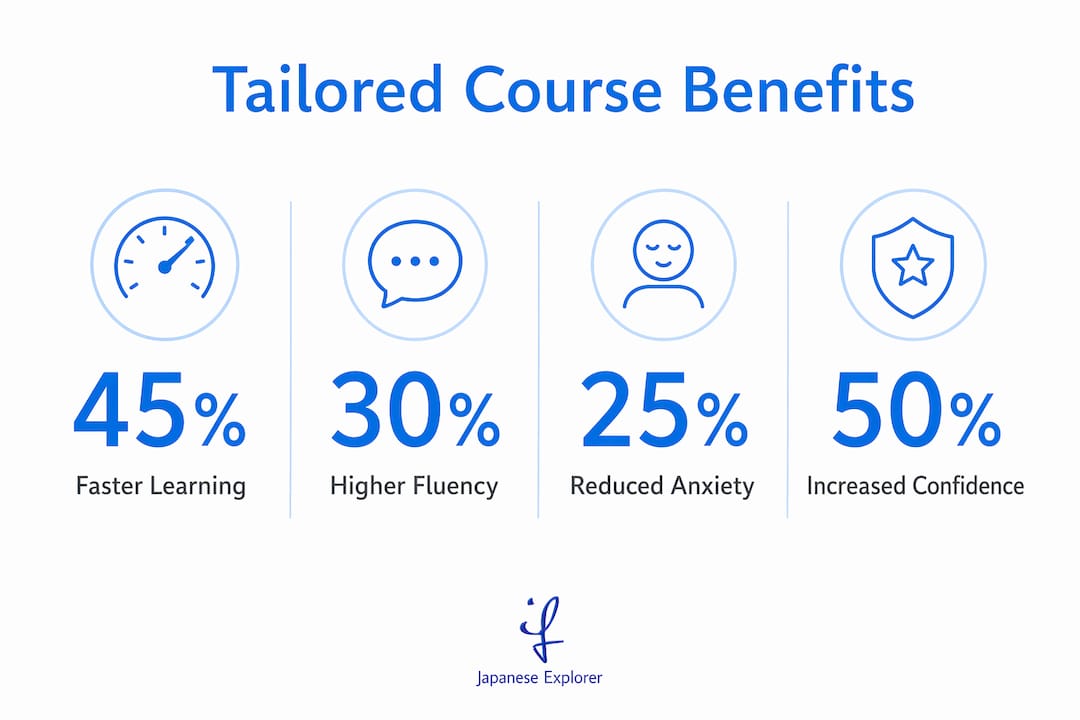
The advantages of personalized courses come from a deliberate cycle that starts before your first lesson. Effective tailored programs follow a four-stage loop: needs mapping, diagnostic assessment, targeted practice with feedback, and reassessment. This cycle is what separates genuine customization from a course that simply lets you choose your own textbook.
Here is how that cycle works in practice:
- Needs mapping. Your instructor identifies why you are learning the language. A professional preparing for business meetings in Tokyo has completely different vocabulary priorities than someone planning a two-week trip or studying for the JLPT in Singapore.
- Diagnostic placement. A proper placement assessment measures your current grammar, listening, and speaking ability so you start at the right level, not the default beginner level.
- Targeted practice with immediate feedback. Lessons focus on the specific structures and vocabulary you need. AI-mediated instruction delivers automated formative assessment and immediate feedback on writing, vocabulary, and grammar, which is far more efficient than waiting for weekly corrections.
- Reassessment and adjustment. Sustained progress depends on continuous assessment signals that guide dynamic difficulty adjustment. One-time customization at enrollment is not enough.
Contextualized scenarios are another mechanism that makes tailored courses work. The IMMERSE program used 3D workplace and social scenarios to give learners realistic, low-pressure practice environments. Practicing a job interview in Japanese feels very different from repeating textbook dialogues, and the confidence transfer to real situations is measurably stronger. Moving from textbooks to real-life interactions is one of the most consistent predictors of faster fluency.
Pro Tip: Before enrolling in any language program, ask whether the course uses a diagnostic placement test and whether your study plan gets updated as you progress. If the answer to either question is no, the course is not truly tailored.
What are the personal and professional advantages of personalized courses?
The benefits of custom language programs extend well beyond test scores. Language proficiency gained through a personalized approach translates directly into career opportunities. Research consistently links language skills to career growth, and professionals who can communicate in Japanese with clients, partners, or colleagues in Japan hold a clear competitive edge in Singapore’s business environment.
Motivation is another major advantage. Standardized one-size-fits-all instruction poorly serves diverse learner needs, which is why so many adult learners abandon generic language apps or evening classes after a few months. When lessons connect directly to your goals, whether that is passing the JLPT N3 or holding a business negotiation in Japanese, you have a concrete reason to keep showing up.
Customized language learning also builds soft skills that generic courses rarely address:
- Active listening. Scenario-based practice trains you to respond to what is actually being said, not just what you expected to hear.
- Cultural fluency. Tailored business Japanese courses include the social protocols and keigo (formal speech levels) that matter in professional settings.
- Adaptability. Learners who practice across varied, realistic contexts develop the flexibility to handle unexpected conversations rather than freezing when a native speaker goes off-script.
- Self-directed learning habits. Personalized feedback teaches you to recognize your own patterns and correct them, which builds long-term learning autonomy.
The connection between language mastery and communication skills is well documented. Adults who learn through tailored programs report stronger interpersonal confidence in professional settings, not just in the target language but in their overall communication style.
How do modern technologies power tailored language programs?
Technology is what makes large-scale personalization possible. Without it, truly tailored instruction would require one-on-one tutoring for every learner. Today, a combination of AI, mobile tools, and digital corpus platforms delivers customized learning at scale.
A 2026 meta-analysis found that AI-supported gamified learning environments produce a standardized mean difference of 1.01 on academic achievement. That is a large effect, and it reflects how gamification keeps learners engaged long enough for the personalization to work. Points, progress bars, and scenario unlocks are not just fun. They sustain the repetition that language acquisition requires.
Mobile-Assisted Language Learning (MALL) removes the access barrier entirely. The same 2026 ESP study found that mobile tools combined with corpus linguistics significantly enhanced lexical precision and professional writing skills, even in resource-limited settings. For adult learners in Singapore with demanding schedules, being able to practice on a commute or during a lunch break is not a minor convenience. It is often the difference between consistent practice and none at all.
| Technology | Primary Benefit | Example Application |
|---|---|---|
| AI adaptive platforms | Dynamic difficulty adjustment and instant feedback | Automated grammar and vocabulary correction |
| Digital corpus-based instruction | Authentic language data for professional writing | ESP collocation and writing accuracy training |
| Gamified learning environments | Sustained engagement and motivation | Progress tracking, scenario-based challenges |
| Mobile-Assisted Language Learning | Flexible access and consistent practice | Vocabulary review and listening practice on mobile |
| AI roleplay and 3D scenarios | Low-pressure speaking practice | Simulated workplace conversations |
The ideal course structure for adult learners combines these technologies with qualified instructors who can interpret the data and adjust the human elements of teaching that no algorithm fully replicates.
Key takeaways
Tailored language courses produce significantly better outcomes than generic instruction because they align every lesson with your specific goals, proficiency level, and real-world communication context.
| Point | Details |
|---|---|
| Measurable skill gains | ESP corpus-based tailored instruction shows effect sizes above Cohen’s d = 1.93 in 2026 research. |
| Anxiety and confidence | Adaptive speaking programs reduce foreign language anxiety by 39% and improve fluency by 21%. |
| Continuous adaptation | Effective personalization requires ongoing assessment loops, not just a one-time placement test. |
| Technology amplifies results | AI, gamification, and mobile tools make personalized instruction scalable and consistently effective. |
| Career and soft skills | Tailored programs build cultural fluency, active listening, and professional communication alongside language proficiency. |
Why I think most language learners underestimate what “tailored” actually means
When people hear “tailored language course,” they often picture a slightly smaller class or a teacher who remembers their name. That is not tailoring. Real tailoring means your lesson content changes based on what you got wrong last week, your practice scenarios reflect your actual job or social context, and your instructor is not waiting until the end of term to tell you that you have been misusing a grammar pattern for two months.
I have seen adult learners spend years in standard group classes without ever reaching conversational fluency, not because they lacked ability, but because the course was designed for an imaginary average student. The research backs this up. Implementation quality critically influences benefits. Labeling a course “personalized” without adaptive features and strong instructional design delivers none of the gains the research documents.
The other thing I would push back on is the idea that tailored courses are only for advanced learners or professionals. The anxiety reduction data from the IMMERSE program applies most powerfully to beginners, who are the most likely to go silent in class out of fear of making mistakes. A well-designed tailored course gives beginners a safe, low-stakes space to practice speaking from day one, which is exactly when that confidence foundation matters most.
If you are serious about reaching a real level of Japanese proficiency, whether for the JLPT, a career move, or simply to hold a genuine conversation, the course structure matters as much as the hours you put in. Seek out programs that show you their assessment process, not just their syllabus.
— Paul
Start learning Japanese your way with Japanese Explorer
If you are ready to experience the benefits of tailored language courses firsthand, Japanese Explorer offers exactly the kind of structured, personalized learning that the research supports.
Japanese Explorer’s small group Japanese classes keep class sizes small so your instructor can track your progress and adjust lessons to your pace. For professionals, the business Japanese courses are built around real workplace communication, covering keigo, business etiquette, and the vocabulary you actually need in professional settings. Prefer to learn from home? The online Japanese course delivers the same quality instruction via Zoom, giving you full flexibility without sacrificing the personalized attention that makes the difference. Japanese Explorer is located at 10 Anson Road, Level 22, International Plaza, Singapore 079903, right above Tanjong Pagar MRT.
FAQ
What are the main benefits of tailored language courses?
Tailored language courses improve vocabulary, writing accuracy, fluency, and speaking confidence by aligning instruction with your specific goals and proficiency level. Research shows effect sizes above Cohen’s d = 1.93 for tailored ESP instruction and a 39% reduction in foreign language anxiety through adaptive speaking programs.
How is a tailored language course different from a standard class?
A tailored course uses diagnostic placement, targeted practice, and continuous reassessment to adjust content as you progress, while a standard class follows a fixed syllabus designed for an average learner. The key difference is that your lessons change based on your actual performance, not a predetermined schedule.
Can customized language learning help with professional Japanese?
Yes. Tailored business Japanese programs focus on keigo, professional vocabulary, and workplace scenarios that generic courses rarely cover in depth. This targeted approach builds the cultural fluency and communication confidence that matter most in professional settings.
How does technology support personalized language courses?
AI platforms deliver adaptive feedback, gamified environments sustain motivation, and mobile tools enable consistent practice outside the classroom. A 2026 meta-analysis found that AI-supported gamified learning environments produce a standardized mean difference of 1.01 on academic achievement.
How do I know if a language course is truly tailored?
Look for a diagnostic placement test at enrollment, a study plan that updates based on your progress, and regular feedback that addresses your specific errors. A course without these features is not genuinely personalized, regardless of how it is marketed.
Recommended
- Revel In These Benefits When You Pick Up A New Language | Japanese Explorer
- Discipline: The Key Element In Online Language Learning | Japanese Explorer
- Is Age Just A Number When It Comes To Learning A Language? | Japanese Explorer
- Beneficial Reasons Why You Should Learn a New Language | Japanese Explorer