
TL;DR:
- The JLPT is a globally recognized, five-level Japanese proficiency exam that primarily tests recognition of vocabulary, grammar, reading, and listening skills. Its certificates do not expire, making them valuable long-term credentials for careers, studies, and visas, especially at the N2 level. Successful preparation requires consistent study over months, focusing on understanding rather than cramming, with practice in real-world communication.
The Japanese-Language Proficiency Test (JLPT) is a standardized, criterion-referenced exam that certifies Japanese language ability for non-native speakers across five proficiency levels, from beginner N5 to advanced N1. Administered jointly by the Japan Foundation and the Japan Educational Exchanges and Services (JEES), the JLPT is recognized by universities, employers, and immigration authorities worldwide. Whether you are learning Japanese for career advancement, academic study, or a move to Japan, understanding the JLPT structure is the first step toward setting a realistic and rewarding study goal.
What is JLPT and how does it work?
The JLPT is a standardized proficiency exam for non-native Japanese speakers, testing grammar, vocabulary, reading, and listening through multiple-choice questions only. There is no speaking or writing component. This design makes the test accessible and objectively scorable, but it also means the exam measures receptive language skills rather than your ability to hold a conversation or write a formal email in Japanese.

The test is held twice yearly internationally, on the first Sunday of July and December, in Japan and over 60 countries worldwide. In Singapore, the JLPT is a popular milestone for adult learners at every stage of their Japanese language journey. One practical advantage worth knowing: JLPT certificates never expire, so a certificate you earn this year remains valid indefinitely for job applications, visa submissions, or university admissions.
What are the five JLPT levels and their differences?
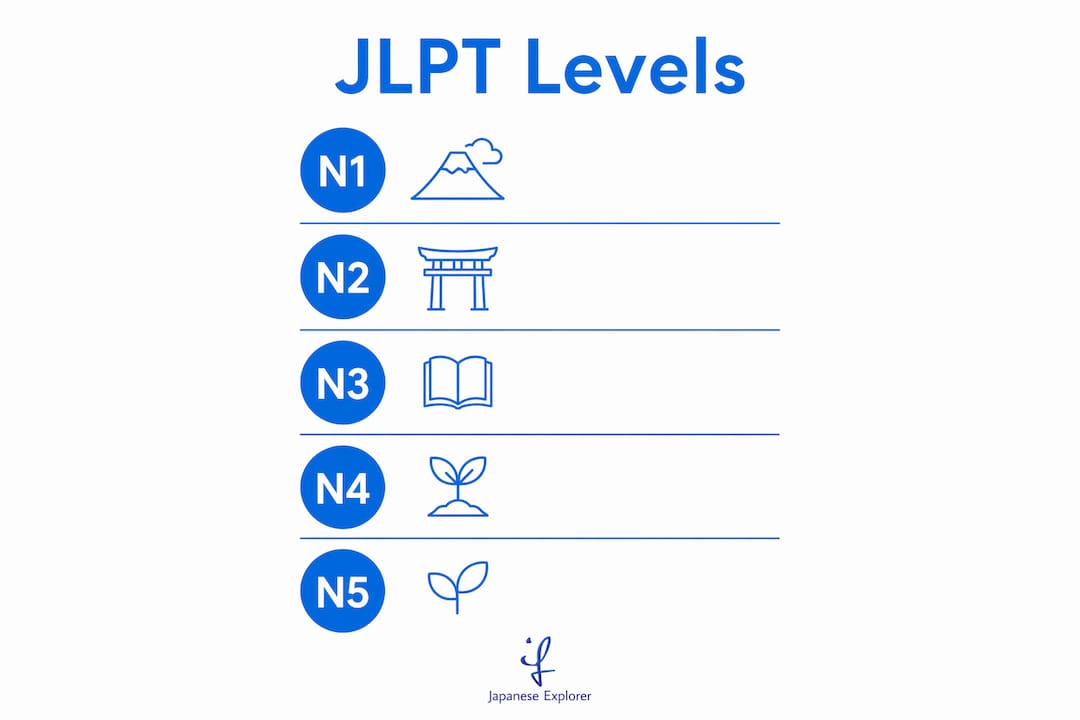
The JLPT levels span from N5 (the most beginner-friendly) to N1 (the most advanced), each representing a significant jump in vocabulary, kanji, and grammatical complexity. Here is a breakdown of what each level demands:
| Level | Vocabulary | Kanji | Grammar complexity | Estimated study hours | CEFR equivalent |
|---|---|---|---|---|---|
| N5 | ~800 words | ~100 kanji | Basic sentence patterns | 150–200 hours | A1 |
| N4 | ~1,500 words | ~300 kanji | Simple daily expressions | 300–400 hours | A2 |
| N3 | ~3,750 words | ~650 kanji | Intermediate structures | 450–600 hours | B1 |
| N2 | ~6,000 words | ~1,000 kanji | Complex grammar patterns | 600–900 hours | B2 |
| N1 | 10,000+ words | 2,000+ kanji | Advanced, nuanced texts | 900–1,200+ hours | C1 |
N2 and N1 carry the most professional weight. The Japan Foundation confirms that an N2 score of 112+ aligns with CEFR B2, while N1 scores above 141 align with C1, placing these levels on par with upper-intermediate and advanced proficiency in European language frameworks. For most learners in Singapore targeting work or study in Japan, N2 is the first serious milestone and N1 is the gold standard.
Pro Tip: If you are unsure which level to target, take a free online mock test for N4 and N3 first. Your score will tell you far more about your current level than self-assessment alone.
N5 and N4 are excellent confidence builders, but employers and universities rarely cite them as requirements. N3 signals genuine conversational ability. N2 opens professional doors. N1 signals near-native reading and listening comprehension, which is why N1 is recognized by Japanese universities and top employers as evidence of advanced Japanese ability.
How is the JLPT exam structured and what skills does it test?
The JLPT uses a multiple-choice format only, which means every answer is selected from given options rather than produced independently. The exam is divided into three scored sections:
- Language Knowledge (Vocabulary and Grammar): Tests your recognition of vocabulary, kanji readings, and grammatical structures in context.
- Reading: Assesses comprehension of written passages, ranging from short notices at N5 to dense editorial texts at N1.
- Listening: Plays audio recordings and asks you to select the correct answer based on what you hear.
The absence of speaking and writing assessment is the most misunderstood aspect of the JLPT. High-scoring candidates sometimes struggle in real-world communication because the exam never required them to produce language, only recognize it. This is not a flaw to fear. It is simply a design choice that reflects the test’s purpose: to certify comprehension ability at scale across 60+ countries.
Scoring works on a scaled system, not a raw percentage. Each level has a passing threshold across the three sections, and you must meet the minimum score in each section as well as the total. Failing one section means failing the level, even if your total score is high.
Pro Tip: Study the scoring breakdown for your target level before you begin. Knowing the minimum per-section score prevents the common mistake of over-preparing for reading while neglecting listening, which is a frequent reason candidates fail at N2 and N1.
The exam is held twice a year, so if you miss the July sitting, December is your next opportunity. Plan your study timeline backward from your target exam date to stay on track.
What study time and resources do you need for each JLPT level?
Realistic study hour estimates matter more than most learners realize. Underestimating the time commitment is the single most common reason people fail their first attempt. Based on established benchmarks, here is what to expect:
- N5: Approximately 150 to 200 study hours. Focus on hiragana, katakana, basic kanji, and everyday phrases. Resources like the Genki I textbook and the Anki flashcard app with an N5 vocabulary deck cover the core material well.
- N4: Around 300 to 400 hours. Genki II and the Tobira Gateway to Advanced Japanese series bridge this gap effectively.
- N3: Roughly 450 to 600 hours. This is where grammar complexity increases sharply. The Nihongo So-Matome N3 series and JLPT Sensei’s free grammar lists are widely used at this stage.
- N2: Between 600 and 900 hours, requiring mastery of approximately 6,000 vocabulary words and 1,000 kanji. The Kanzen Master N2 series is considered the benchmark prep resource for this level.
- N1: From 900 to 1,200+ hours, demanding 10,000+ vocabulary words and 2,000+ kanji. At this stage, reading native Japanese content such as news articles, novels, and business documents becomes a non-negotiable part of preparation.
A spaced repetition system (SRS) like Anki dramatically improves vocabulary retention at every level. The principle is simple: you review words just before you would naturally forget them, which makes long-term memorization far more efficient than rereading notes. Pairing SRS with a structured Japanese study plan gives you both the vocabulary foundation and the daily consistency the JLPT demands.
For N2 and N1 candidates, listening practice deserves dedicated daily time. Podcasts like Nihongo con Teppei and NHK Web Easy news recordings expose you to natural speech patterns that the exam’s audio tracks closely resemble. Do not leave listening practice until the final month of preparation.
How do JLPT certifications impact careers, academics, and visas?
The practical value of a JLPT certificate extends well beyond language bragging rights. Here is where certification makes a measurable difference:
- Employment in Japan: N2 is widely considered the minimum professional benchmark for working in Japan. Many job listings in sectors like IT, engineering, hospitality, and finance explicitly require N2 or above. N1 signals the ability to work in Japanese-language environments without language support.
- University admissions: Japanese universities accept JLPT N2 or N1 as proof of language proficiency for international applicants, often in place of a language interview.
- Visa and residency applications: N2 is frequently cited in student visa extension requirements and some skilled worker visa categories. Holding a valid certificate simplifies the documentation process significantly.
- Career advancement in Singapore: Multinational companies with Japanese operations, trading firms, and Japanese-owned businesses in Singapore regularly list JLPT N2 or N1 as a preferred qualification. It signals commitment and measurable ability to hiring managers.
One limitation worth understanding: because the JLPT does not test speaking or writing, a certificate alone does not prove you can communicate fluently in a workplace or academic setting. The most effective approach is to treat JLPT preparation as one part of a broader language practice that includes conversation, writing, and real-world listening. Pairing your JLPT study with a structured JLPT preparation course that integrates speaking practice gives you both the certification and the communication skills employers actually want.
The fact that JLPT certificates do not expire is a genuine long-term advantage. A certificate earned in 2026 remains fully valid for a job application in 2030 or a university application in 2028.
Key takeaways
The JLPT is the most widely recognized Japanese proficiency credential globally, and N2 is the practical minimum for professional and academic use in Japan.
| Point | Details |
|---|---|
| Five-level structure | Levels run from N5 (beginner) to N1 (advanced), each requiring significantly more vocabulary, kanji, and grammar mastery. |
| No speaking or writing | The exam tests only receptive skills through multiple-choice questions, so supplement study with active communication practice. |
| Study hours matter | N5 needs roughly 150 to 200 hours; N2 needs 600 to 900 hours; N1 requires 900 to 1,200+ hours of focused preparation. |
| N2 is the professional benchmark | Most employers and visa categories in Japan cite N2 as the minimum acceptable proficiency level. |
| Certificates never expire | Your JLPT certificate remains valid indefinitely, making it a lasting credential for career and academic use. |
Why the JLPT rewards consistency more than cramming
I have worked with hundreds of Japanese language learners at various stages of JLPT preparation, and the pattern is consistent. The candidates who pass are almost never the ones who studied the hardest in the final two weeks. They are the ones who studied steadily for six to twelve months and built genuine familiarity with the language.
The JLPT’s multiple-choice format can create a false sense of security. You might recognize a grammar pattern in a test question without truly understanding how to use it. That gap between recognition and production is where many learners get stuck, especially at N2 and N1. My honest advice: do not let the exam format limit your study habits. Practice writing sentences, speak with a language partner, and consume Japanese media regularly. The exam will feel easier, and your Japanese will actually be better.
One thing I tell every learner who asks how to prepare for JLPT: pick a realistic exam date, count backward, and divide your study hours across that timeline. If you have nine months before the July sitting and need 600 hours for N2, that works out to roughly 17 hours per week. That is manageable with two to three hours on weekdays and a longer session on weekends. Consistency beats intensity every time.
The beginner’s guide to Japanese is a great starting point if you are still deciding where to begin. For those already at intermediate level, the jump from N3 to N2 is steep but absolutely achievable with the right structure and support.
— Paul
Start your JLPT preparation with Japanese Explorer

Japanese Explorer offers structured small group Japanese classes in Singapore designed specifically for adult learners working toward JLPT certification. Classes are taught by experienced bilingual instructors who integrate grammar, vocabulary, and listening practice in every session, covering exactly the skills the exam tests. For learners who prefer flexibility, online Japanese courses via Zoom make it easy to prepare from anywhere in Singapore or abroad. Whether you are targeting N5 for the first time or pushing toward N2 for a career move, Japanese Explorer’s curriculum is structured to get you there. Visit Japanese Explorer at 10 Anson Road, Level 22, International Plaza, Singapore 079903, right above Tanjong Pagar MRT, or explore courses online today.
FAQ
What is JLPT and who is it for?
The JLPT is a standardized Japanese language proficiency test for non-native speakers, offered at five levels from N5 to N1. It is used by learners worldwide to certify their Japanese ability for employment, academic, and visa purposes.
What is the N2 JLPT level?
JLPT N2 is the fourth level of the exam, requiring approximately 6,000 vocabulary words and 1,000 kanji. It is widely recognized as the minimum professional benchmark for working or studying in Japan.
What is JLPT N1 and how hard is it?
JLPT N1 is the most advanced level, requiring mastery of 10,000+ vocabulary words and 2,000+ kanji, with 900 to 1,200+ hours of study typically needed. It is recognized by Japanese universities and employers as evidence of near-native reading and listening ability.
How often is the JLPT held?
The JLPT is held twice a year internationally, on the first Sunday of July and December, across Japan and over 60 countries including Singapore.
Does the JLPT test speaking or writing?
No. The JLPT is entirely multiple-choice and tests only vocabulary, grammar, reading, and listening. Candidates who want to demonstrate speaking or writing ability should supplement their JLPT study with active communication practice.