
TL;DR:
- Language is a key factor influencing trade efficiency and relationship durability between Japan and Singapore. Singapore’s English environment provides Japanese firms with a competitive advantage by speeding up legal, operational, and communication processes. Investing in structured multilingual training and careful language management reduces costly misunderstandings and enhances bilateral trade volumes.
Language is the single most consequential operational variable in Japan-Singapore trade, determining whether deals close cleanly, contracts hold up, and business relationships survive long-term. The role of language in Japan-Singapore trade goes well beyond translation. It shapes negotiation power, contract accuracy, and the speed at which Japanese firms can extract market intelligence from their Singapore operations. Singapore’s English-speaking environment gives Japanese businesses a structural commercial advantage that no other Southeast Asian market replicates at the same scale. For trade professionals and business analysts, understanding this dynamic is not optional. It is a prerequisite for competitive performance.
How does singapore’s english environment benefit japan-singapore trade?
Singapore’s use of English as its working language is a structural commercial advantage that directly accelerates Japan-Singapore trade operations. Legal documentation, regulatory filings, and contract negotiations all move faster when both parties share a common working language. Fewer errors enter the process, and fewer rounds of clarification slow it down.
The practical benefits show up across every operational layer:
- Legal and regulatory speed: English-language contracts and compliance documents require no intermediate translation step before submission to Singapore authorities, cutting turnaround time significantly.
- Marketing accuracy: Campaign briefs, product specifications, and brand guidelines travel from Japanese headquarters to Singapore teams without the distortion that translation layers introduce.
- Negotiation clarity: Terms like payment schedules, delivery conditions, and liability clauses land with precision when both sides work in the same language.
- Feedback quality: Singapore’s English interface allows Japanese headquarters to receive faster market feedback from their regional hub, which directly influences investment and contracting decisions.
This feedback loop is the most underappreciated advantage. When a Japanese firm’s Singapore team can report consumer behavior, regulatory shifts, or competitor moves in English without translation friction, headquarters acts faster and with better information. That speed compounds over time into a measurable trade advantage.
Pro Tip: If your firm is entering Southeast Asia, use Singapore as your language-aligned test market before expanding to markets where English is not the working language. The data you collect will be cleaner and your decisions will be sharper.

How do japanese trading houses build multilingual teams?
Japanese trading houses treat multilingual staffing as a governance mechanism, not a hiring preference. The distinction matters. A governance approach means language training is structured, funded, and tied to operational outcomes rather than left to individual initiative.
Mitsui & Co. is the clearest example. The firm runs formal language training programs that send employees abroad to acquire working proficiency in target languages, including Mandarin Chinese for Southeast Asian operations. The goal is not conversational fluency for its own sake. The goal is preserving the human quality of business relationships that machine translation cannot replicate.
Here is how leading Japanese trading houses structure their multilingual capability:
- Structured in-house language programs: Employees receive dedicated study time and resources, with language acquisition tied to career progression milestones.
- Overseas language immersion assignments: Staff are posted to target markets specifically to develop language skills alongside market knowledge, combining two forms of operational investment.
- Bilingual relationship managers: Key accounts are assigned staff who can communicate directly in the client’s language, reducing the risk of misinterpretation in high-stakes negotiations.
- Verification protocols: Human translators review all machine-translated documents before they enter formal trade processes, treating automated tools as a first draft rather than a final output.
The underlying logic is that multilingual capability preserves the human touch that trust-based business relationships require. In Japan-Singapore trade, where long-term partnerships drive significant contract value, that trust is a financial asset.
Pro Tip: When evaluating a trading partner’s communication capacity, ask directly whether they use human review on translated documents. The answer tells you how seriously they treat accuracy in bilateral trade communication.
What are the real costs of language barriers in trade?
Language barriers in business are not abstract risks. They produce concrete, measurable failures that show up in negotiation outcomes, contract disputes, and lost buyer relationships. Trade professionals who underestimate this cost tend to discover it at the worst possible moment.
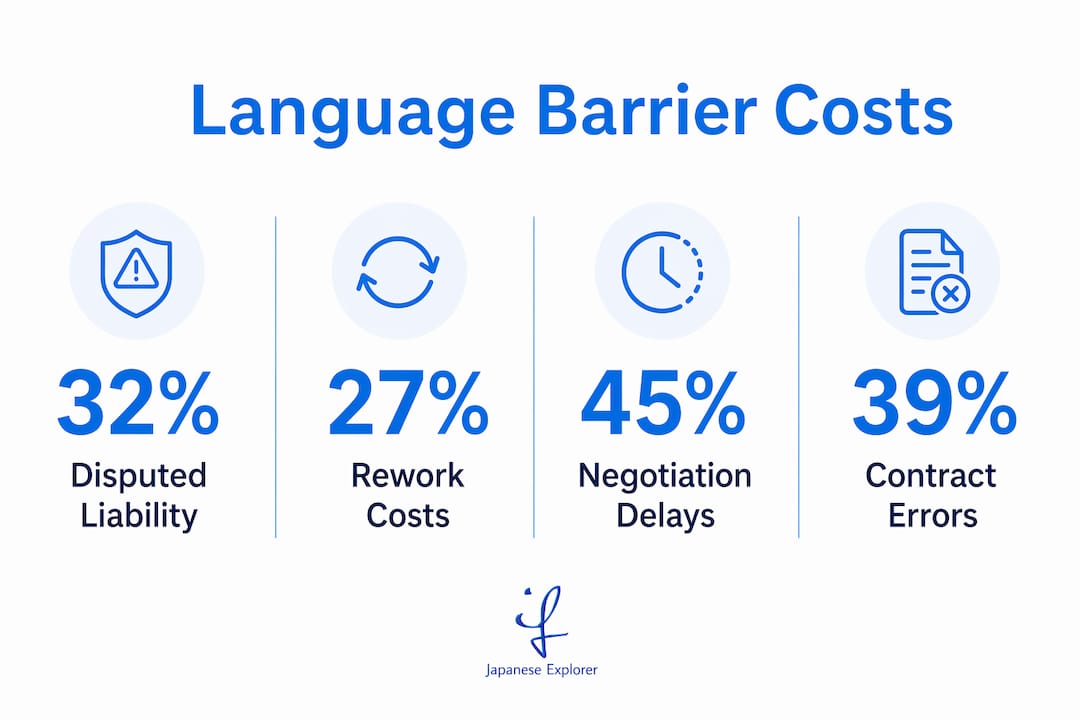
The table below maps the most common language barrier failures to their operational consequences in Japan-Singapore trade:
| Language Barrier Type | Operational Consequence |
|---|---|
| Misinterpretation of Incoterms | Disputed liability for shipping costs, damage, or customs clearance |
| Negotiation confidence loss | Exporters accept weaker pricing and terms due to communication uncertainty |
| Payment term ambiguity | Delayed payments, strained cash flow, and relationship deterioration |
| Contract clause errors | Costly rework, legal disputes, and potential deal termination |
| Buyer trust erosion | Lost repeat business and damaged long-term trade relationships |
The negotiation confidence issue deserves specific attention. When exporters cannot communicate with precision, bargaining power shifts to buyers. The exporter becomes reactive rather than assertive, accepting terms they would reject if they could articulate their position clearly. This dynamic is not hypothetical. It is a documented pattern in international trade communication research.
Incoterms misinterpretation is equally damaging. A misread term like CIF versus FOB can shift thousands of dollars in liability between parties. When that misread originates in a translation error rather than a genuine commercial disagreement, the damage to the relationship is compounded by the sense that it was entirely avoidable.
The lesson for trade analysts is direct: language barriers map to measurable KPIs. Dispute rates, rework costs, and contract cycle times all worsen when communication quality drops. Treating language investment as overhead rather than risk management is a strategic error.
What does research say about language and trade volumes?
Peer-reviewed economics research confirms what experienced trade professionals observe in practice. A causal relationship exists between common native language and bilateral trade volume. This is not correlation. The research isolates language as a causal variable that shifts trade flows between countries.
The implications for Japan-Singapore trade are direct. Singapore’s bilingual English-Chinese population, combined with its English working language environment, creates a language alignment with Japanese firms that no other ASEAN market matches at the same depth. Japanese businesses can operate in English at the institutional level while their Singapore partners often bring additional Mandarin capability for regional expansion into markets like Malaysia and Indonesia.
The Japan-Singapore Economic Partnership Agreement, signed in 2002, formalized this advantage at the policy level. The JSEPA strengthened business ties and created frameworks for digital trade collaboration where language clarity is operationally critical. As trade digitalization accelerates in 2026, the importance of clear cross-border communication between Japanese and Singaporean counterparts only increases.
For business analysts building trade models, language alignment belongs in the variable set alongside tariff rates, logistics costs, and regulatory complexity. The research supports treating it as a quantifiable factor rather than a soft consideration.
How can trade professionals optimize cross-cultural communication?
Practical communication strategy in Japan-Singapore trade requires more than hiring a translator. It requires integrating language planning into market entry operations from the earliest stage. Here is what that looks like in practice:
- Audit your communication stack before market entry. Identify every touchpoint where language transitions occur: contracts, marketing materials, regulatory submissions, and internal reporting. Map which of these currently rely on machine translation alone.
- Invest in business Japanese proficiency for your Singapore-based team. Staff who can read and respond to Japanese-language communications from headquarters reduce the feedback delay that slows operational decisions. Learning Japanese for business relationships produces returns that show up in contract speed and partner trust.
- Use machine translation as a drafting tool, not a final output. Every document that enters a formal trade process should pass through human review by a bilingual professional. This is the standard that leading Japanese trading houses apply internally.
- Build negotiation scripts in both languages. For high-stakes negotiations, prepare your key positions and responses in both English and Japanese. This preparation reduces the cognitive load during the negotiation itself and prevents the confidence loss that language uncertainty creates.
- Treat cultural language exchange as relationship maintenance. Small investments in Japanese business etiquette and communication norms, such as understanding the role of formality in Japanese business correspondence, signal respect and build the trust that sustains long-term trade partnerships.
- Measure language-related friction in your operations. Track metrics like contract revision cycles, dispute rates, and response times on Japanese-language communications. These numbers will tell you where language barriers are costing you money.
The benefits of learning Japanese in Singapore extend well beyond personal development. For trade professionals, Japanese language competence is a direct competitive advantage in a bilateral relationship worth billions in annual commerce.
Key takeaways
Language alignment is the most underinvested competitive variable in Japan-Singapore trade, with measurable impact on negotiation outcomes, contract accuracy, and bilateral trade volumes.
| Point | Details |
|---|---|
| Singapore’s English advantage | English as Singapore’s working language accelerates legal, regulatory, and operational workflows for Japanese firms. |
| Multilingual staffing as governance | Japanese trading houses like Mitsui & Co. fund structured language training to protect relationship quality and reduce translation risk. |
| Language barriers cost money | Misread Incoterms, negotiation confidence loss, and contract errors all trace directly to communication failures. |
| Research confirms causal impact | Peer-reviewed studies show common language causally increases bilateral trade volume, not just correlates with it. |
| Practical strategy starts with auditing | Map every language transition point in your trade operations before investing in communication improvements. |
Why language strategy deserves a line in your trade budget
I have spent years watching trade professionals treat language as a support function rather than a strategic input. The pattern is consistent. A firm enters the Japan-Singapore corridor with strong products and competitive pricing, then loses ground to a competitor whose team simply communicates better. The loss rarely shows up labeled as a language problem. It shows up as a lost contract renewal, a negotiation that went sideways, or a Japanese partner who quietly shifted volume elsewhere.
The research on language’s causal effect on trade confirms what I have observed directly. Language is not a soft factor. It is a hard variable with measurable consequences. The firms that treat it that way build durable advantages. The firms that treat it as overhead keep wondering why their relationships with Japanese counterparts never quite reach the depth they expect.
My honest view is that machine translation has made this problem worse, not better. It creates the illusion of communication while masking the gaps that matter most in high-stakes trade contexts. A machine-translated contract looks complete. A machine-translated negotiation sounds fluent. Neither is reliable enough to stake a major trade relationship on without human verification. The Japanese trading houses that invest in multilingual staff understand this. Their competitors who rely on automated tools are taking risks they have not fully priced.
If you are a trade professional working the Japan-Singapore corridor, structured Japanese language training is not a personal development expense. It is a business investment with a calculable return.
— Paul
Build the language skills your trade career demands
If this article has made one thing clear, it is that language competence is a direct input to trade performance in the Japan-Singapore corridor. Japanese Explorer, based at 10 Anson Road, Level 22, International Plaza, Singapore 079903, right above Tanjong Pagar MRT, offers business Japanese courses designed specifically for working professionals who need practical, high-stakes communication skills.
Courses run from beginner through advanced levels, with dedicated business Japanese tracks covering negotiation language, formal correspondence, and meeting communication. Flexible group, private, and online Japanese classes mean you can build proficiency around your schedule. All instruction follows the Association for Japanese-Language Teaching curriculum, delivered by certified bilingual instructors. If your work touches Japan-Singapore trade, this is the skill that pays for itself.
FAQ
How does language affect japan-singapore trade outcomes?
Language directly determines negotiation accuracy, contract reliability, and the speed of operational feedback between Japanese headquarters and Singapore teams. Poor communication quality shifts bargaining power to buyers and increases dispute rates.
Why do japanese trading houses invest in multilingual staff?
Japanese firms like Mitsui & Co. treat multilingual staffing as a governance tool to preserve relationship quality and reduce the risks that machine translation introduces in high-stakes business communication.
What are the most common language barrier risks in bilateral trade?
Misinterpretation of Incoterms, payment term ambiguity, and negotiation confidence loss are the most documented failures. Each maps to measurable operational costs including disputes, rework, and lost contracts.
Does research support language as a causal trade factor?
Yes. Peer-reviewed economics research confirms that common native language causally increases bilateral trade volume, making language alignment a quantifiable variable in trade analysis rather than a soft consideration.
How can trade professionals reduce language friction with japanese partners?
Audit every language transition point in your trade operations, use human review on all machine-translated documents, and invest in business Japanese proficiency for team members who manage Japanese partner relationships directly.