TL;DR:
- Japanese slang in 2026 spreads rapidly through pop culture and short-form videos, reflecting current youth trends. Education reforms aim to combine logic and literature to foster empathy and nuanced communication in response to AI’s influence. Cultural nostalgia and futuristic aesthetics shape communication styles, making cultural understanding vital for authentic fluency.
Japanese language trends in 2026 are defined by four forces reshaping how people speak, learn, and connect: youth-driven slang, sweeping curriculum reforms from Japan’s Ministry of Education (MEXT), retro cultural revivals, and AI-influenced learning methods. These forces do not operate in isolation. Slang born in purikura booths spreads through short-form video. Educational philosophy shifts in response to AI. Cultural nostalgia shapes the words young people choose. For language enthusiasts and professionals, understanding these shifts is the difference between surface-level fluency and genuine cultural competence.
What are the most popular new slang and youth language trends in 2026 Japan?
Japanese slang in 2026 moves fast, and its origins are specific. The phrase “sugite metsu” topped teen buzzwords in early 2026, cited by 18.8% of teens surveyed. That number signals a phrase that crossed from niche group chat to mainstream youth vocabulary in a matter of weeks.
The band M!LK is the engine behind much of this momentum. M!LK dominated youth culture with 55.7% of teen girls ranking them the top act of the year. Their music did not just chart. It generated the “ba-ku-re-tsu” pose, now a fixture in purikura photo booths across Japan. Other buzzwords like “meroi” and “frenemy” entered everyday teen speech through the same pop-culture pipeline.
Slang in Japan has always traveled through visual and social channels rather than traditional media. Short-form video accelerates this cycle dramatically. A phrase can go from a song lyric to a classroom joke to a meme format within days. For learners, this means textbook vocabulary ages faster than ever.
- “Sugite metsu” expresses something so extreme it loops back to destruction. Think of it as the 2026 equivalent of “too much.”
- “Meroi” functions as a compliment for something effortlessly cool or aesthetically pleasing.
- “Frenemy” entered Japanese youth speech directly from English, reflecting the global reach of social media culture.
- “Ba-ku-re-tsu” is a physical pose as much as a word, showing how slang now lives in gesture and image, not just speech.
Pro Tip: When you encounter new Japanese slang, look up its pop-culture origin before memorizing its definition. Knowing that “sugite metsu” came from an M!LK song tells you its register, its emotional weight, and exactly when not to use it in a business meeting.
How is Japanese language education evolving with the 2032 curriculum reforms?
MEXT’s proposed curriculum reorganization is the most significant structural change to Japanese language education in a generation. The reform targets 2032 implementation and aims to merge logic-oriented and literature-oriented subjects into a unified framework. The goal is to produce graduates who can reason clearly and communicate with empathy.
The reasoning behind this shift is direct. Students have been gravitating toward logic-focused courses and away from literature. MEXT identified a concrete cause: reading short social media posts and AI summaries reduces exposure to complex texts. Less exposure to complex texts means weaker reading stamina, lower empathy, and reduced ability to handle nuanced communication. The reform is a structural correction to a behavioral trend.
“The reforms aim to cultivate uniquely human qualities like empathy and nuanced communication that complement, rather than compete with, AI technological advances.”
— MEXT curriculum reform rationale, 2026
The practical implications for learners and professionals are significant. Here is what the reform changes and why it matters:
- Literature returns to the core curriculum. Students will engage with longer, more complex texts again. For adult learners studying Japanese, this signals that literary vocabulary and formal reading comprehension will remain relevant skills.
- Logic and rhetoric are integrated, not separated. The ability to construct a clear argument in Japanese becomes as valued as the ability to appreciate a poem. Business Japanese learners benefit directly from this shift.
- Communication skills receive formal weight. The curriculum treats interpersonal communication as a teachable, assessable skill. This aligns with what employers in Japan already demand.
- AI usage in classrooms is acknowledged, not banned. The reform accepts AI as a classroom reality and builds around it rather than against it.
Japanese language education is also professionalizing at the structural level. The shift from volunteer-based teaching models to professional, government-supported networks marks a significant change in teaching quality and learner outcomes. For adult learners choosing a Japanese language school, this context matters. Certified, experienced instructors are not a luxury. They are the standard the field is moving toward.
What cultural revivals are shaping Japanese language and communication in 2026?
Youth identity in 2026 Japan blends two seemingly opposite impulses: nostalgia for the Heisei era and fascination with a futuristic Y3K aesthetic. Both movements shape how young people communicate, what words they choose, and how they present themselves.
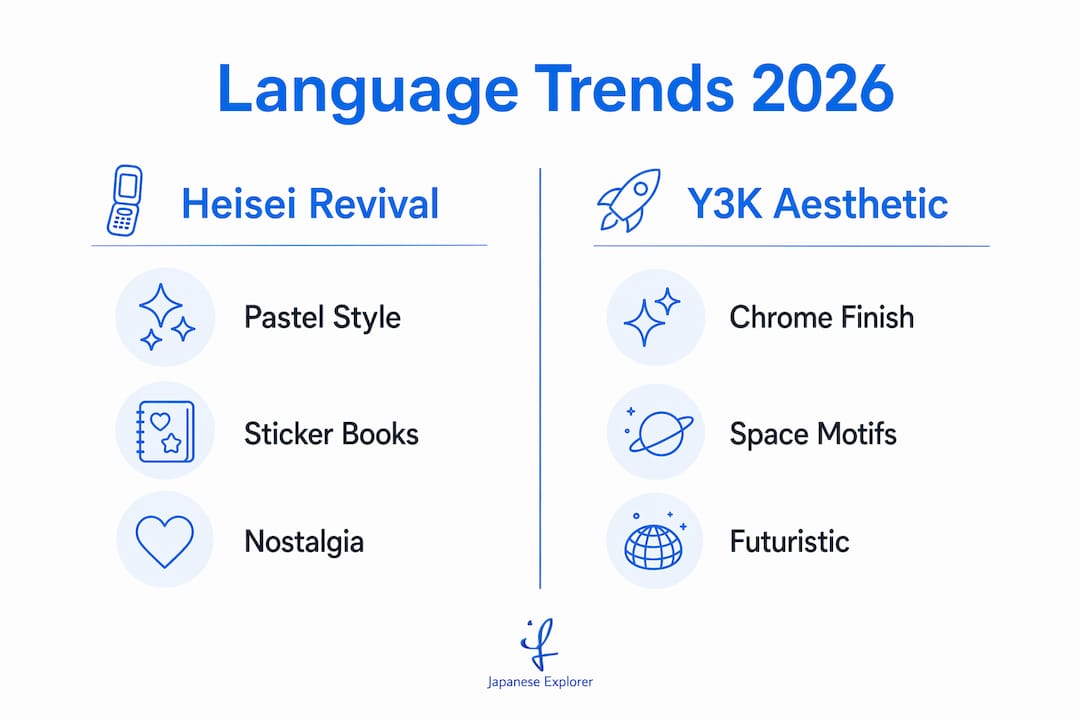
The revival of physical sticker books, known as shiiru-chō, is one of the clearest signals of Heisei nostalgia. Gen Z is collecting and trading physical stickers in an era of digital everything. This tactile turn reflects a desire for tangible, personal expression that screens cannot replicate. Language follows the same logic. Handwritten notes, physical diaries, and analog communication are gaining cultural prestige among young Japanese people.
The Y3K aesthetic runs in the opposite direction. Chrome finishes, space motifs, and metallic fashion create a visual language of the future. Yet Y3K borrows heavily from early 2000s digital aesthetics, making it simultaneously retro and forward-looking. Youth culture blends nostalgia and futurism into a complex identity that resists simple categorization.
| Cultural element | Nostalgic (Heisei revival) | Futuristic (Y3K aesthetic) |
|---|---|---|
| Visual style | Pastel stickers, printed photos, analog textures | Chrome, metallic, space-age motifs |
| Communication mode | Handwritten notes, physical sticker books | Digital collage, AI-generated visuals |
| Language register | Warm, personal, emotionally expressive | Clipped, ironic, tech-inflected |
| Slang origin | Pop music, purikura culture | Online platforms, AI parody |
The cultural significance for learners is real. Japanese communication style is not just grammar and vocabulary. It is context, register, and cultural reference. A learner who understands why a young Japanese person might prefer a handwritten card over a text message understands something no textbook teaches directly.
What role does AI play in Japanese language learning and communication in 2026?
AI’s role in Japanese language learning has moved past the experimental phase. AI in language education now focuses on pragmatic applications: generative AI tutors, multimodal learning materials, and analytics that track individual learner progress. The hype cycle is over. What remains is a set of tools that work when used correctly.

The cultural side of AI’s influence is equally interesting. New slang styles parodying AI-generated syntax have emerged online. Young Japanese speakers deliberately write in what they call “ChatGPT syntax,” using overly formal sentence structures and unusual word choices for comic effect. This is language creativity at its most current. It shows that learners and native speakers alike are processing AI’s presence through humor and parody.
For learners, AI tools offer genuine advantages:
- Personalized feedback on pronunciation, grammar, and pitch accent without waiting for a teacher’s correction.
- Multimodal input combining audio, text, and visual materials that match different learning styles.
- On-demand practice that fills the gaps between formal lessons, especially useful for busy adult learners.
- Vocabulary reinforcement through spaced repetition systems that AI can now adapt in real time based on your error patterns.
The risk is equally real. AI cannot replicate the social pressure of a real conversation, the cultural nuance of a native speaker’s correction, or the human qualities that effective teaching requires. Learners who rely exclusively on AI tools often develop fluency in controlled contexts but struggle in authentic interactions.
Pro Tip: Use AI tools for drilling and pattern practice between lessons, but treat every session with a human instructor as irreplaceable. The native speaker myth creates real social barriers in Japan even for highly proficient speakers. Human interaction builds the cultural confidence that AI cannot.
Key Takeaways
Japanese language trends in 2026 require learners to engage with slang, cultural context, educational reform, and AI tools simultaneously to build genuine communicative competence.
| Point | Details |
|---|---|
| Slang moves through pop culture | Track buzzwords like “sugite metsu” back to their cultural source to understand register and usage. |
| MEXT reforms target 2032 | Curriculum changes will integrate logic and literature to build empathy and communication skills in the AI era. |
| Cultural nostalgia shapes language | Heisei revival and Y3K aesthetics both influence how young Japanese people communicate and what words carry prestige. |
| AI tools are practical, not magic | Use generative AI for drilling and spaced repetition, but pair it with human instruction for authentic fluency. |
| Professionalization raises standards | Government-supported teaching networks are improving quality across Japanese language education globally. |
Why cultural depth matters more than vocabulary counts
I have watched learners plateau at an intermediate level for years, and the pattern is almost always the same. They know the grammar. They have memorized the vocabulary lists. But they cannot read the room. They miss the cultural reference behind a joke, or they use a slang term in the wrong register, and the conversation stalls.
The trends shaping Japanese in 2026 make this gap wider, not narrower. Slang now carries a specific cultural timestamp. “Sugite metsu” is not just a phrase. It is a reference to a specific band, a specific moment, a specific pose in a photo booth. If you do not know that, you are not just missing a word. You are missing a shared experience.
The MEXT curriculum reforms tell a similar story from the institutional side. Japan’s education system is explicitly trying to rebuild the capacity for nuanced, empathetic communication because technology has eroded it. That is a signal worth taking seriously. The future of Japanese language learning is not about speaking more words faster. It is about understanding what those words carry with them.
I also think the native speaker myth deserves more attention than it gets in language learning circles. Even highly proficient speakers can face social exclusion in Japan based on this belief. That is uncomfortable, but ignoring it does not help learners. Knowing the barrier exists lets you prepare for it, build cultural confidence, and develop the interpersonal skills that make a real difference in professional and social settings.
— Paul
Japanese Explorer: courses built for where the language is heading
Japanese Explorer offers adult learners in Singapore a direct path into the Japanese language as it actually exists in 2026, not as it appeared in textbooks a decade ago. Courses cover conversational Japanese, business Japanese, and corporate training, all taught by certified bilingual instructors who bring cultural context into every lesson.
Whether you prefer small group classes that build speaking confidence through real interaction, or the flexibility of an online Japanese course via Zoom, Japanese Explorer structures learning around practical communication skills. The curriculum aligns with the Association for Japanese-Language Teaching standards, which means you build grammar, speaking, and listening together rather than in isolation. Classes run from beginner through advanced and business levels, with corporate training available for teams. Japanese Explorer is located at 10 Anson Road, Level 22, International Plaza, Singapore 079903, directly above Tanjong Pagar MRT.
FAQ
What is the top Japanese slang buzzword in 2026?
“Sugite metsu” is the top buzzword among Japanese teens in 2026, cited by 18.8% of teens surveyed. It was popularized by the band M!LK and spread rapidly through purikura culture and short-form video.
What are MEXT’s 2032 curriculum reforms?
Japan’s Ministry of Education proposed merging logic-oriented and literature-oriented subjects by 2032 to improve communication skills and empathy in an AI-influenced era. The reform directly responds to students reading fewer complex texts due to social media and AI summaries.
How is AI changing Japanese language learning in 2026?
AI now powers personalized tutors, multimodal learning materials, and spaced repetition systems that adapt to individual learner error patterns. The most effective approach pairs AI drilling tools with human instruction for authentic communicative fluency.
What is the Y3K aesthetic and how does it affect Japanese language?
Y3K is a futuristic aesthetic blending chrome, space motifs, and early 2000s digital styles popular among Japanese Gen Z. It influences language register, favoring clipped, ironic, and tech-inflected expression in online communication.
How do I learn Japanese effectively in 2026?
The most effective approach combines structured lessons with a certified instructor, AI tools for between-session practice, and active engagement with current Japanese pop culture to stay current with slang and cultural context.