TL;DR:
- Japanese business emails follow a strict eight-part structure to ensure professionalism and proper etiquette. Mastering uchi-soto distinctions and a conclusion-first body greatly improve communication clarity and respect cultural norms. Using these structured techniques helps avoid common errors and enhances your credibility in Japanese business correspondence.
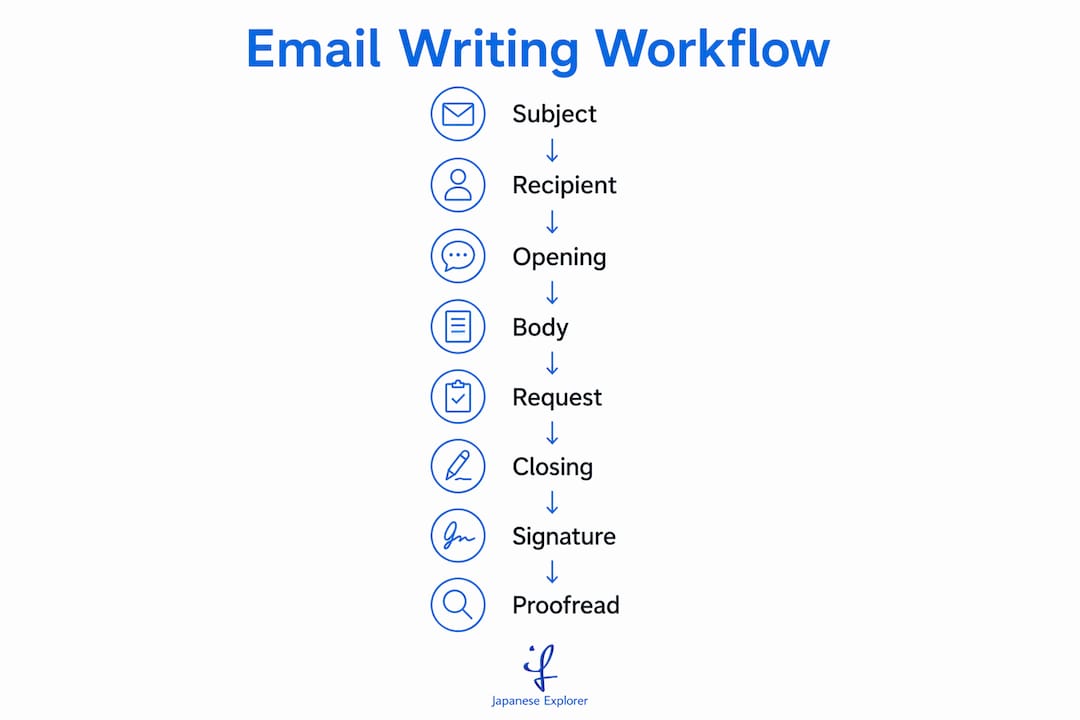
Japanese business email writing follows a fixed eight-part structure that determines whether your message reads as professional or careless. This workflow for Japanese email writing is not optional etiquette. It is the standard format expected by Japanese colleagues, clients, and partners across every industry. Professionals and students who master this structure gain a clear advantage in business communication. You will learn each step in the sequence, understand the cultural logic behind it, and pick up the practical techniques that make your emails land well every time.
What are the eight essential steps in the workflow for Japanese email writing?
Japanese professional emails require a fixed eight-part structure that must appear in a specific order. Skipping or rearranging any element signals inexperience and can damage your professional reputation. Here is each step explained clearly.
-
Subject line. Keep it under 30 characters and use a bracketed category tag to signal priority. The bracketed category tag convention is a uniquely Japanese operational practice. A subject like “【日程調整】 Meeting Schedule for March 15” tells the recipient exactly what action is needed before they even open the email.
-
Recipient fields (To, Cc, Bcc). To is for those expected to reply, Cc is for those who need awareness, and Bcc is for discreet sharing. Misusing these fields sends the wrong signal about who holds responsibility for a response.
-
Addressee line. Open with the recipient’s company name, department, and full name followed by the honorific “sama” for external contacts or “san” for internal colleagues. When writing to a group, use the collective honorific “gossha ichido” or “mina sama.” This line sets the relational tone before a single word of content appears.
-
Opening greeting. Use “Otsukaresama desu” for internal colleagues and “Itsumo osewa ni natte orimasu” for external partners. These are not interchangeable. Using the wrong greeting immediately signals that you do not understand the inside/outside distinction central to Japanese professional culture.
-
Self-introduction. Include your name, company, and department when writing to someone for the first time or after a long gap. Repeat contacts do not need a full introduction, but a brief reminder of your role is courteous in external emails.
-
Email body. Lead with your conclusion, then provide supporting reasons, then close with your specific request. This conclusion-first approach respects the reader’s time and makes it easy for them to respond quickly. Burying the main point at the end is a common mistake that frustrates Japanese readers.
-
Closing remarks. End with a polite phrase that matches your relationship with the recipient. “Yoroshiku onegai itashimasu” is the standard close for most business emails. Adjust the formality level based on whether you are writing internally or externally.
-
Signature. Include your full name, company name, department, phone number, and email address. Japanese business signatures are detailed by convention. A missing phone number or department name reads as incomplete and unprofessional.
How do cultural norms like “uchi-soto” shape your email etiquette?
The “uchi-soto” concept, meaning inside versus outside, is the single most important cultural framework for Japanese email writing. It determines your greeting, your honorifics, your level of formality, and even how you refer to your own colleagues when speaking to an external party.
- Internal emails (uchi): Use “Otsukaresama desu” as your opening. Keep language direct and relatively concise. Heavy keigo (formal honorific language) sounds stiff and unnatural between colleagues who work together daily.
- External emails (soto): Open with “Itsumo osewa ni natte orimasu.” Use full honorifics and polished keigo throughout. Refer to your own company’s actions with humble forms (kenjogo) and elevate the recipient’s actions with respectful forms (sonkeigo).
- Cushion phrases before requests: Phrases like “Otesuu desu ga” (meaning “I know this is a bother, but…”) soften requests and signal awareness of the recipient’s effort. Skipping these phrases makes requests sound blunt or even rude, regardless of how polite the rest of your email is.
- Hierarchy awareness: Address senior recipients with greater formality. Even within the same company, rank affects word choice. A message to your direct manager differs from one to the company president.
- Common honorific mistakes: Using “sama” for internal colleagues or applying sonkeigo to your own actions are frequent errors. Both signal a misunderstanding of keigo structure and can cause confusion or unintended offense.
Polite language in Japanese business is not about using the most complex expressions. It is about using the right expression for the right relationship. Over-politeness in an internal email can feel distant or even sarcastic. Under-formality in an external email reads as disrespectful.
Pro Tip: Write the recipient’s name and company at the top of your draft before anything else. This forces you to consciously identify whether the email is internal or external, which sets the correct register for everything that follows.

What tools and techniques improve clarity in Japanese business emails?
Clarity in Japanese business emails comes from structure and formatting, not just vocabulary. Poor communication often stems from incorrect information placement rather than weak language skill. These techniques keep your emails readable and professional.
- Manual line breaks every 15–25 full-width characters. Line breaks prevent walls of text and improve readability across different email clients and devices. Japanese email clients do not auto-wrap text the same way English ones do, so manual breaks are a professional necessity, not a stylistic preference.
- Conclusion-first body structure. State your main point in the first sentence of the body. Follow with two or three supporting reasons. End with a clear, specific request. This sequence reduces back-and-forth and respects the recipient’s time.
- Bullet points and numbered lists. Use these for multiple items, schedules, or conditions. A wall of prose listing five meeting times is harder to scan than a clean numbered list. Japanese business readers appreciate organized information.
- Concise subject lines with category tags. The subject line acts as an operational tag. A recipient managing 100 emails a day uses your subject line to decide when and how to respond. Keep it specific and front-load the category.
Pro Tip: Simplifying your expressions is considerate. A shorter, clearer sentence reduces the mental load on your reader and speeds up their response. Aim for one idea per sentence in the email body.
The table below shows how the conclusion-first structure compares to a common mistake pattern.
| Structure type | Body opening | Reader experience |
|---|---|---|
| Conclusion first | State the main request immediately | Fast to process, easy to act on |
| Context first | Long background before the point | Reader must search for the request |
| Mixed order | Request buried mid-paragraph | Confusing, easy to miss key details |
For a deeper look at Japanese business document structure, the same conclusion-first logic applies across memos, reports, and proposals.
What common challenges do learners face and how do you fix them?
Even motivated learners hit the same walls when composing Japanese business emails. Recognizing these patterns early saves you from repeated mistakes.
- Confusing internal and external norms. Using “Itsumo osewa ni natte orimasu” with a colleague in the next office sounds odd and overly formal. Always identify the uchi-soto relationship before you type the greeting.
- Overusing keigo. Heavy keigo in internal emails sounds unnatural and creates distance. Reserve full honorific language for external partners and senior executives outside your team.
- Ignoring the fixed structure. Jumping straight into the content without an addressee line or opening greeting signals that you are unfamiliar with Japanese email conventions. Recipients notice the absence of these elements immediately.
- Incorrect honorific usage. Applying “sama” to yourself or using sonkeigo for your own company’s actions are classic keigo errors. These mistakes do not just sound awkward. They can signal disrespect or confusion about the relationship.
- Sending an email with errors. Mistakes happen. The correct response is a prompt apology email. Mark the subject line with a correction tag such as “【お詫び】” (apology), include a brief explanation, and request deletion of the original if needed. Acting quickly preserves your professional credibility.
“The most damaging email mistakes in Japanese business contexts are not grammar errors. They are structural omissions and wrong register choices that signal cultural unfamiliarity. A grammatically imperfect email with the right structure and greeting reads as more professional than a grammatically perfect email that skips the addressee line and uses the wrong opening phrase.”
AI drafting tools can help you prepare email drafts faster, but the responsibility for cultural accuracy and correct keigo sits entirely with you. Tools do not know whether your recipient is internal or external, senior or junior, or whether your relationship is new or established.
Key Takeaways
Mastering the workflow for Japanese email writing requires a fixed eight-part structure, correct uchi-soto awareness, and consistent use of conclusion-first body organization.
| Point | Details |
|---|---|
| Follow the eight-part structure | Every Japanese business email needs subject, recipient fields, addressee, greeting, intro, body, closing, and signature in order. |
| Apply uchi-soto distinctions | Use “Otsukaresama desu” internally and “Itsumo osewa ni natte orimasu” externally to set the right professional tone. |
| Lead with your conclusion | State your main point first in the body, then provide reasons and requests to respect the reader’s time. |
| Use cushion phrases before requests | Phrases like “Otesuu desu ga” soften requests and prevent your email from reading as blunt or demanding. |
| Correct mistakes with an apology email | Mark the subject with “【お詫び】” and act quickly to preserve your professional credibility after an error. |
What I have learned from years of watching learners write Japanese emails
The biggest misconception I see is that learners believe better vocabulary solves their email problems. It almost never does. The emails that get ignored or misread are structurally broken, not linguistically weak. A learner who writes simple, clear sentences in the right order consistently outperforms someone with advanced vocabulary who buries the request in paragraph three.
The fixed eight-part workflow is not a constraint. It is a gift. Once you internalize it, you stop agonizing over how to start or end an email. The structure makes those decisions for you. What remains is the content itself, and that is where your real communication skill shows.
I also want to say something honest about AI tools. They are genuinely useful for drafting a first pass, especially when you are tired or working under time pressure. But they cannot feel the relationship between you and your recipient. They do not know that your client prefers a warmer tone, or that your manager expects brevity above all else. Use AI as a drafting assistant, then review every line yourself with the uchi-soto framework in mind.
The learners who improve fastest are the ones who treat every email as a practice session. They review sent emails, note what worked, and adjust. That habit, more than any single technique, is what builds real fluency in Japanese business communication.
— Paul
Build your Japanese email skills with Japanese Explorer
Knowing the structure is one thing. Writing confidently under real business pressure is another.

Japanese Explorer offers business Japanese courses designed specifically for professionals who need practical email writing skills, not just textbook grammar. The curriculum covers keigo, uchi-soto distinctions, and the full eight-part email workflow in a structured, instructor-led format. You can choose from small group classes, private sessions, or online Japanese courses via Zoom, all taught by certified bilingual instructors. Corporate training options are also available for teams. Japanese Explorer is located at 10 Anson Road, Level 22, International Plaza, Singapore 079903, right above Tanjong Pagar MRT.
FAQ
What is the correct structure for a Japanese business email?
A Japanese business email follows an eight-part fixed structure: subject line, recipient fields, addressee line, opening greeting, self-introduction, body, closing remarks, and signature, always in that order.
What is the difference between internal and external email greetings in Japanese?
Use “Otsukaresama desu” for internal colleagues and “Itsumo osewa ni natte orimasu” for external partners. Using the wrong greeting signals unfamiliarity with the uchi-soto distinction central to Japanese business culture.
How do you write a subject line for a Japanese business email?
Keep the subject under 30 characters and open with a bracketed category tag such as “【確認】” (confirmation) or “【依頼】” (request). This tag acts as an operational signal that helps recipients prioritize their inbox.
What should you do if you send a Japanese business email with a mistake?
Send a prompt apology email with “【お詫び】” in the subject line, include a brief explanation of the error, and request deletion of the original message if needed. Acting quickly is the professional standard in Japanese business culture.
Why do Japanese business emails use cushion phrases before requests?
Cushion phrases like “Otesuu desu ga” acknowledge the effort required of the recipient before making a request. Skipping them makes requests sound demanding, regardless of how polite the surrounding language is.