
TL;DR:
- Mastering kana is essential before progressing to grammar and vocabulary, as it unlocks faster comprehension of written Japanese.
- Consistent daily practice with tools like Anki, phased conversation training, and realistic routines lead to steady language acquisition and long-term retention.
Training Japanese is defined as the structured, systematic development of language skills across writing systems, vocabulary, grammar, listening, and speaking to achieve measurable communication ability. Whether your goal is ordering ramen in Osaka, reading a business contract, or passing the JLPT, the method you use matters far more than raw effort. Tools like Anki, resources like Genki and Tae Kim’s Guide to Japanese Grammar, and platforms like NHK News Web Easy each play a specific role in a well-built learning system. This guide walks you through every stage, from your first hiragana stroke to your first real conversation, with practical steps you can start today.
What foundational skills and tools do you need to start training in Japanese?
Mastering hiragana and katakana before touching kanji or grammar is the single most important first move you can make. These two phonetic scripts unlock the ability to decode written Japanese, which makes every grammar lesson and vocabulary card dramatically easier to absorb. Skipping this step is like trying to read English before learning the alphabet. Most learners can master both scripts in two to three weeks with daily focused practice.
Once you have the kana down, your digital toolkit becomes your best training partner. Here are the core tools every serious learner should set up:
- Anki (free, cross-platform): The gold standard for spaced repetition flashcard review. Use it daily for vocabulary and kanji.
- Yomitan (browser extension): Hover over any Japanese word on a webpage to get an instant dictionary definition. It also integrates directly with Anki for one-click card creation.
- AnkiConnect (Anki plugin): Allows Yomitan and other tools to push cards into your Anki decks automatically, removing friction from the card creation process.
- Genki I and II (textbooks): The most widely used beginner grammar series. Structured, clear, and built around real conversation scenarios.
- Tae Kim’s Guide to Japanese Grammar (free online): A concise, logic-driven grammar reference that explains Japanese on its own terms rather than forcing English comparisons.
Pro Tip: Set a daily new card limit in Anki of no more than 10 to 15 new words when starting out. Adding 30 cards a day sounds productive, but the review pile compounds fast and leads to burnout within weeks.
For building vocabulary fast, sentence-based cards outperform single-word cards from day one. Seeing a word in context tells your brain not just what it means, but how it behaves in real Japanese.

How to use spaced repetition and sentence mining effectively
Spaced repetition leverages the spacing effect, a cognitive psychology principle that shows reviewing information at increasing intervals dramatically improves long-term retention compared to cramming. Anki’s algorithm, rooted in Ebbinghaus’s forgetting curve, schedules each card for review just before you are likely to forget it. This means every minute you spend reviewing in Anki is working harder than an equivalent minute of re-reading notes.
The most common mistake inside Anki is falling into what learners call “Ease Hell.” This happens when you repeatedly mark cards as hard, which causes Anki to show them far too frequently. The fix is adjusting your deck settings: set your learning steps to something like 1m 10m, your graduating interval to 1 day, and your easy interval to 4 days. These settings keep the algorithm healthy and prevent any single card from dominating your review sessions.
Here is how to build an effective sentence mining workflow:
- Read or listen to native Japanese content at a level slightly above your current ability.
- Highlight unfamiliar words using Yomitan in your browser. The extension displays definitions instantly without breaking your reading flow.
- Send the sentence to Anki via AnkiConnect with one click. The full sentence, the target word, and the definition are captured automatically.
- Review the card in context. Your card shows the full sentence with the target word highlighted, not just an isolated word and translation.
- Rate honestly. If you genuinely knew the word without hesitation, mark it “Good.” If you had to think hard, mark it “Hard.” Avoid “Easy” unless the card feels completely trivial.
The principle behind step one is called i+1 sentence mining. Each sentence you mine should contain exactly one unknown element. Sentences with three or four unknowns create cognitive overload and tank retention. Sentences you already understand completely offer no new learning. The sweet spot is one new piece per card.
| Approach | Best for | Retention quality |
|---|---|---|
| Pre-made decks (e.g., Core 2000) | Beginners building core vocabulary | Good for high-frequency words |
| Manual sentence mining | Intermediate and advanced learners | Higher, because content is personally relevant |
| Isolated word cards | Quick reference only | Low without sentence context |
Pre-made Anki decks like Core 2000 or Core 6000 are genuinely useful for beginners because they cover the most common Japanese words efficiently. Once you reach around 1,500 to 2,000 known words, switching to personal sentence mining produces noticeably better results because the content connects to things you actually care about.
Pro Tip: Set up a dedicated SRS routine by checking out Japanese Explorer’s guide on SRS setup for learners to configure Anki correctly from the start.
What are effective practices for developing Japanese conversation skills?
Conversation training follows a clear progression: passive listening first, then text-based output, then live speaking with feedback. Jumping straight to voice calls before you have enough vocabulary and listening exposure leads to frustration and rehearsed, narrow fluency. The goal is to build a strong input foundation before demanding output from yourself.
Here is a practical phase-by-phase approach to Japanese conversation training:
- Phase 1: Shadowing. Listen to simple, clear audio such as NHK News Web Easy podcasts or Pimsleur Japanese and repeat sentences aloud immediately after hearing them. Focus on rhythm, pitch, and natural phrasing rather than perfect pronunciation. Shadowing trains your mouth to produce Japanese sounds before your brain has to construct sentences from scratch.
- Phase 2: Text chat. Use language exchange platforms to find Japanese native speakers who want to practice English. Text-based exchange removes the pressure of real-time speaking and gives you time to look up words and construct accurate sentences. Apps like HelloTalk and Tandem are popular for this.
- Phase 3: Voice lessons. Once you can hold a basic text conversation, add weekly sessions with a tutor on italki or a structured class. A qualified instructor catches pronunciation errors, pitch accent mistakes, and grammar habits that a language partner might not notice or correct.
- Phase 4: Immersive input. Watch Japanese TV shows with Japanese subtitles, not English ones. NHK World, anime with Japanese subtitles, and YouTube channels aimed at native speakers all build the listening comprehension that feeds directly into speaking ability.
Starting spoken practice early prevents the common problem of learners who can read well but freeze the moment someone speaks to them. You do not need to be fluent before you start speaking. You need enough vocabulary and listening exposure to make the conversation productive, which typically means around 300 to 500 known words and two to three months of consistent listening practice.
For more targeted advice on improving your listening skills, Japanese Explorer has a dedicated resource that covers practical exercises for every level.
What common mistakes in training Japanese should you avoid?
Most learners who stall or quit make the same handful of errors. Recognizing them early saves months of wasted effort.
- Skipping kana mastery. Jumping into vocabulary apps or grammar before fully internalizing hiragana and katakana creates a permanent drag on your reading speed. Every kanji and grammar pattern you encounter will be harder to process.
- Ignoring daily SRS reviews. Inconsistent review habits cause backlogs that grow exponentially. Missing three days of Anki reviews can leave you with 200 or more cards waiting, which feels defeating and often leads to quitting the deck entirely.
- Using isolated vocabulary cards. A card showing “猫 = cat” teaches recognition but not usage. A card showing “その猫はとても大きいです” (That cat is very big) teaches the word, its reading, and a natural sentence pattern simultaneously.
- Adding too many new cards at once. Cognitive overload from excessive new card intake is one of the top reasons learners abandon Anki. Fifteen new cards a day is sustainable. Fifty is not.
- Delaying speaking practice indefinitely. Many learners tell themselves they will start speaking “when they are ready.” That moment rarely arrives on its own. Build speaking into your routine from month two onward.
“The learners who succeed are not the ones who study the hardest in a single week. They are the ones who show up every day, even when it is just 20 minutes.” This is the core truth behind every successful Japanese learning story.
Avoid these common pitfalls in online learning and your progress will be noticeably more consistent and rewarding.
How to create a sustainable Japanese training routine
Consistent daily study outperforms sporadic intense sessions every time. Adults who study 30 minutes a day, every day, reach JLPT N5 proficiency in roughly 3 to 6 months. That is a realistic, achievable target that does not require quitting your job or canceling your social life.
Here is how to build a routine that actually sticks:
- Anchor your study to an existing habit. Review Anki cards during your morning commute or right after your first coffee. Habit stacking removes the need for willpower.
- Allocate time by skill. A beginner’s 30-minute daily session might look like: 10 minutes of Anki reviews, 10 minutes of Genki grammar, and 10 minutes of listening to a Japanese podcast.
- Add a weekly speaking session. Even one 30-minute conversation session per week compounds significantly over six months.
- Track your progress monthly. Note how many Anki cards you have learned, which grammar patterns feel natural, and whether you can understand more of your listening material than last month.
- Adjust based on feedback. If kanji are blurring together, spend a week focusing on reading in context. If speaking feels stiff, increase your shadowing time.
| Week focus | Beginner (0 to 3 months) | Intermediate (3 to 12 months) |
|---|---|---|
| Vocabulary | 10 new Anki cards daily | 15 to 20 sentence-mined cards daily |
| Grammar | 1 Genki chapter per week | Tae Kim’s guide, reading native content |
| Listening | NHK News Web Easy, 15 min/day | Anime, podcasts, YouTube in Japanese |
| Speaking | Shadowing exercises | Weekly tutor session plus language exchange |
For a more personalized approach, Japanese Explorer’s guide on creating a study plan walks you through tailoring each element to your specific goals and schedule.
Key takeaways
Effective Japanese training combines early kana mastery, daily spaced repetition with Anki, phased conversation practice, and a consistent routine built around realistic daily time commitments.
| Point | Details |
|---|---|
| Master kana first | Learn hiragana and katakana before kanji to unlock faster grammar and vocabulary acquisition. |
| Use Anki with sentence cards | Sentence-based cards with i+1 mining produce far better retention than isolated word cards. |
| Phase your speaking practice | Progress from shadowing to text chat to voice lessons to build fluency without frustration. |
| Consistency beats intensity | Thirty minutes daily reaches JLPT N5 in 3 to 6 months; sporadic cramming does not. |
| Avoid SRS backlogs | Keep daily new card limits low and review every day to prevent burnout and card pile-up. |
Why I think most Japanese learners overcomplicate the early stage
I have seen hundreds of adult learners walk through the door at Japanese Explorer, and the pattern is almost always the same. They spend the first month researching the perfect app, the best textbook, and the ideal study schedule. Then they spend the next month second-guessing their choices. By month three, they have barely touched the language itself.
The truth is that the tools matter far less than the habit. Anki is excellent, but a physical flashcard you review every morning beats a perfectly configured Anki deck you open twice a week. Genki is a great textbook, but Tae Kim’s free guide will get you to the same place if you actually read it consistently.
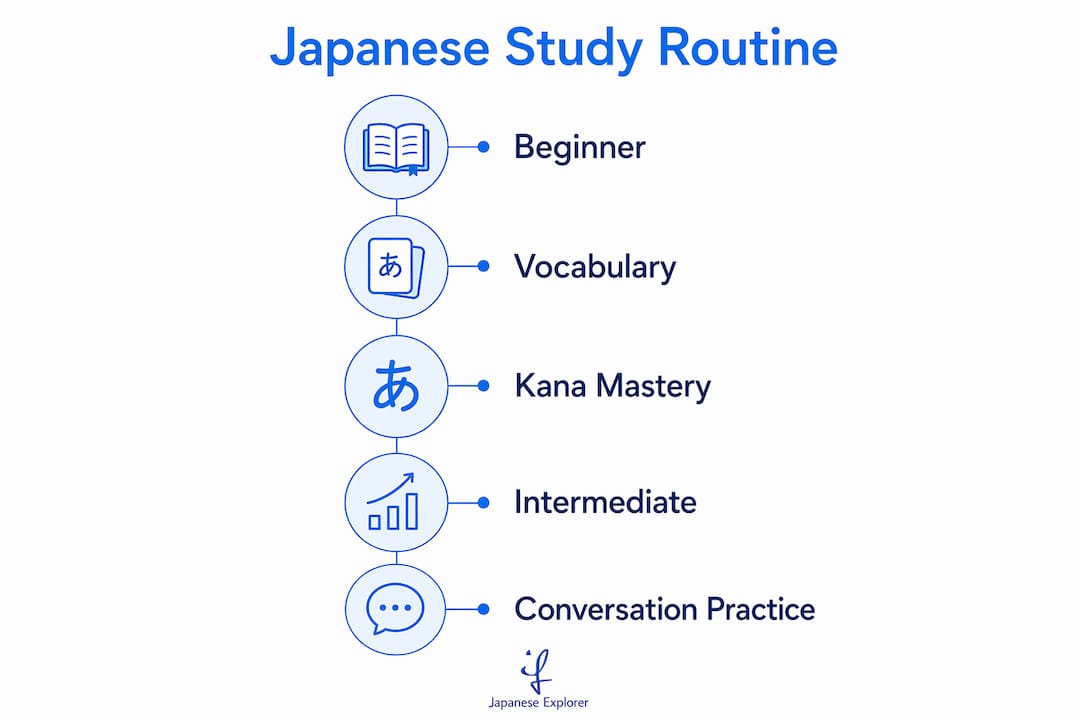
What I have found actually works is this: commit to kana for two weeks, add Anki for vocabulary in week three, and start shadowing in month two. That sequence is not glamorous, but it is the one that produces real progress. The learners who plateau are almost always the ones who skipped the kana foundation or who let their Anki reviews pile up for weeks at a time.
Mistakes are not setbacks in Japanese. They are data. When a tutor corrects your pitch accent or a language partner laughs at a grammar mix-up, that moment sticks in your memory far longer than any flashcard. Embrace the corrections. They are the fastest path forward.
— Paul
Take your training further with Japanese Explorer
Self-study tools like Anki and Yomitan are powerful, but there comes a point where structured instruction accelerates your progress in ways that solo study simply cannot match.

Japanese Explorer offers adult conversational and business Japanese courses in Singapore and online via Zoom, taught by certified bilingual instructors who focus on real-world communication from day one. Whether you want small group classes in a supportive environment or prefer the flexibility of an online Japanese course you can join from anywhere, there is a format that fits your schedule and goals. Corporate training programs are also available for teams looking to build professional Japanese communication skills. Located above Tanjong Pagar MRT at 10 Anson Road, Level 22, International Plaza, Singapore 079903, Japanese Explorer makes it easy to take your training to the next level.
FAQ
What does training Japanese actually mean?
Training Japanese refers to the structured practice of Japanese language skills including writing systems, vocabulary, grammar, listening, and speaking. It combines tools like Anki with resources like Genki to build measurable, practical communication ability.
How long does it take to reach basic Japanese fluency?
Adults who study consistently for 30 minutes a day reach JLPT N5 in approximately 3 to 6 months. Contact hours and daily consistency predict speed more reliably than any other factor.
Should I learn hiragana and katakana before anything else?
Yes. Mastering kana first unlocks your ability to decode Japanese text, which makes every subsequent grammar and vocabulary lesson significantly easier to absorb.
When should I start speaking practice in my Japanese training?
Start shadowing in your second month and add text-based conversation shortly after. Waiting until you feel “ready” for live speaking typically delays fluency. Early spoken practice prevents production bottlenecks later.
Is Anki worth using for Japanese vocabulary improvement?
Anki is one of the most effective tools for long-term vocabulary retention because it adapts review intervals to your performance using the spacing effect. Sentence-based cards produce the best results at every level.