TL;DR:
- Japanese business documents require keigo, fixed structures, and precise vocabulary to convey professionalism. Mastering these conventions and cultural norms ensures effective communication and relationship management in Japanese workplaces.
Japanese business documents (ビジネス文書, bijinesu bunsho) are defined by three non-negotiable requirements: formal honorific language called keigo, fixed structural templates, and precise vocabulary using the です・ます (desu/masu) polite writing style. For expatriates and foreign business professionals working in Japanese companies, mastering these conventions separates functional communication from genuinely professional writing. This guide walks you through every layer, from document structure and keigo selection to the cultural communication patterns that trip up even experienced professionals.
How to write Japanese business documents: structure and format
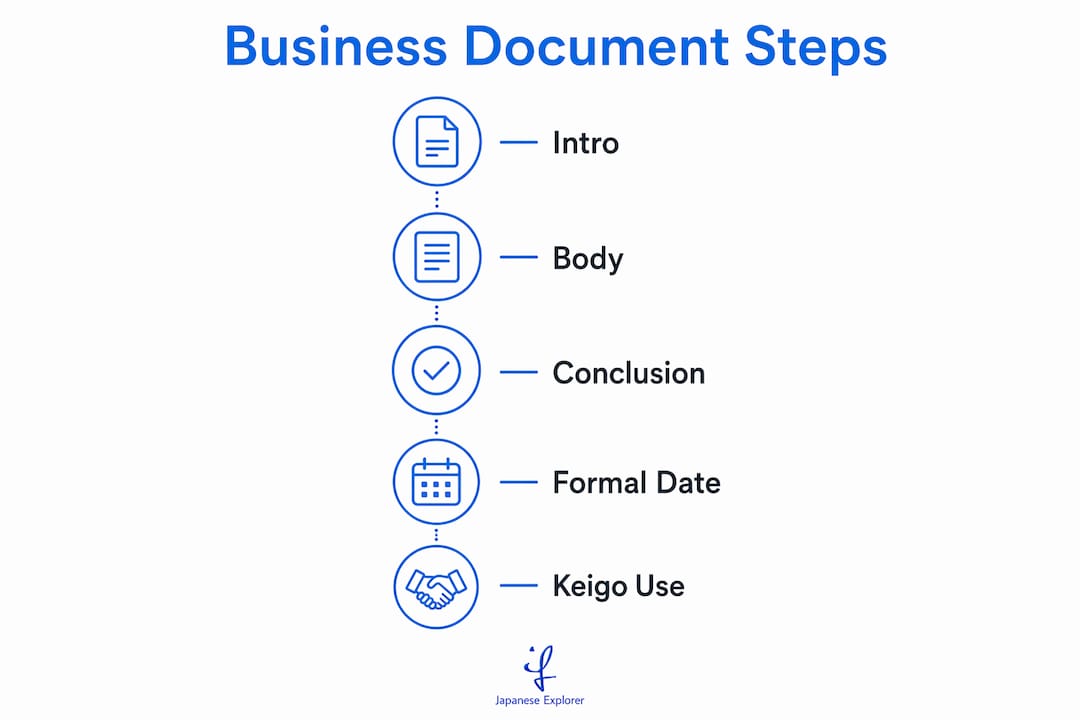
Every Japanese business document follows a predictable layout. Once you recognize the pattern, you can apply it across emails, reports, proposals, and meeting minutes with confidence.
The standard document layout includes these core components in order:
- 件名 (けんめい, kenme): Document title or subject line
- 日付 (ひづけ, hiduke): Date, written in formal Japanese notation (e.g., 令和7年5月15日)
- 宛先 (あてさき, atesaki): Recipient, including company name, department, and title
- 発信者 (はっしんしゃ, hasshinsha): Sender’s name, title, and department
- 前文 (まえぶん, maebun): Opening remarks, typically a seasonal greeting or courtesy phrase
- 主文 (しゅぶん, shubun): Main content, structured around a clear purpose
- 末文 (まつぶん, matsubun): Closing remarks, expressing gratitude or requesting continued support
- 署名 (しょめい, shomei): Signature block with full contact information
Different document types adapt this skeleton in specific ways. Business emails add a 9-part structure that includes the recipient’s full company name and department before the name itself. Reports (報告書) and proposals (提案書) prioritize numeric clarity and factual sequencing. Meeting minutes (議事録) require a dedicated section for decisions and action items, kept separate from discussion notes.
Here is a quick reference for how format requirements shift by document type:
| Document type | Key structural feature | Common mistake |
|---|---|---|
| Business email (メール) | Conclusion-first body, full recipient address | Missing company name in external emails |
| Meeting minutes (議事録) | Separate decisions from action items | Mixing discussion notes with final decisions |
| Report (報告書) | Numeric and factual clarity, structured sections | Vague language without data or outcomes |
| Proposal (提案書) | Problem, solution, benefit structure | Burying the recommendation in the middle |
| Daily report (日報) | Goals, work content, results, challenges, next steps | Omitting challenges or next-day plans |
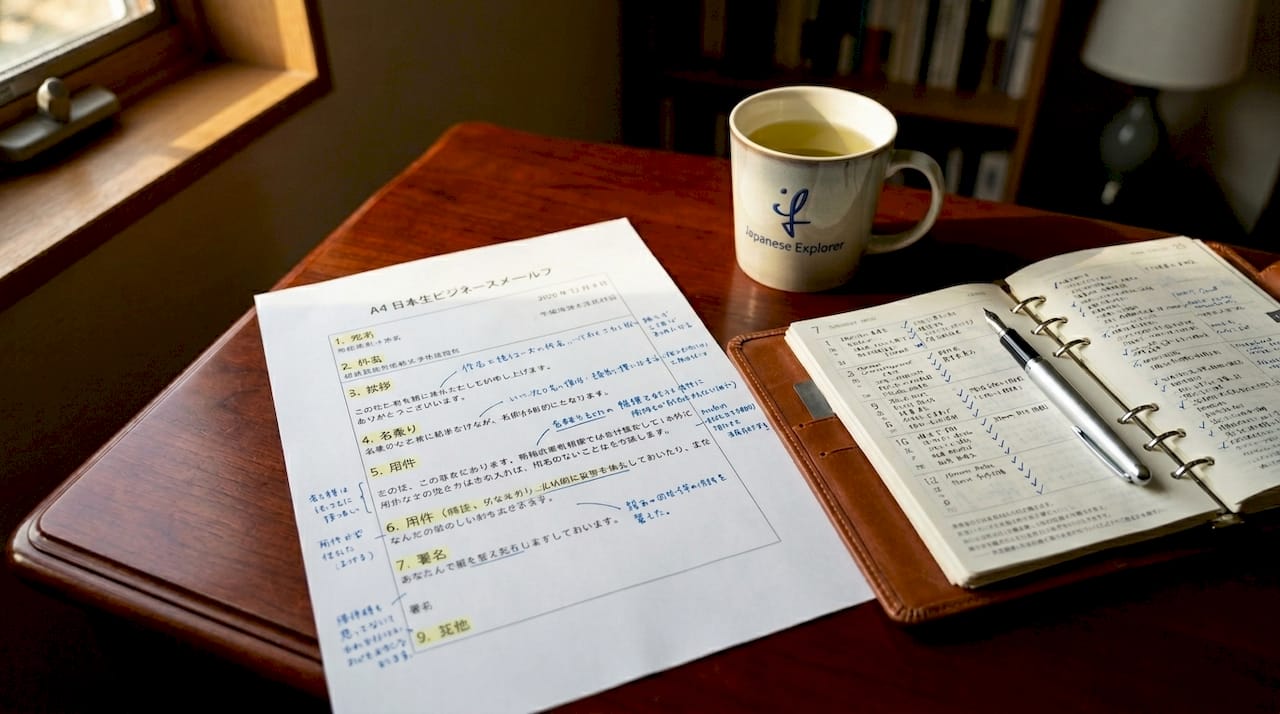
Formal date notation is worth special attention. Japanese business documents use the Japanese imperial calendar (元号, gengō) in formal contexts. The current era is 令和 (Reiwa), so 2026 is 令和8年. Many companies also accept the Western calendar in internal documents, but external correspondence to Japanese clients typically calls for the imperial format.
How to use keigo appropriately in Japanese business writing
Keigo is not a single register. It divides into three distinct categories, and mixing them incorrectly creates an impression ranging from awkward to outright rude, even when your grammar is technically correct.
The three categories are:
- 尊敬語 (そんけいご, sonkeigo): Respectful language used to elevate the actions of others, especially superiors and clients
- 謙譲語 (けんじょうご, kenjōgo): Humble language used to lower your own actions when speaking to or about superiors
- 丁寧語 (ていねいご, teineigo): Polite language using です and ます forms, appropriate for general professional communication
The most common error non-native speakers make is applying humble forms to someone else’s actions. For example, using いただく (itadaku, humble form of “to receive”) when describing what your client did is grammatically incorrect and socially jarring. The correct keigo selection depends on three variables: whether the document is internal or external, the relative status of the recipient, and the function of the document (request, report, or apology).
Here is a comparison of keigo usage across common document functions:
| Document function | Keigo type to use | Example phrase |
|---|---|---|
| Requesting action from a client | 尊敬語 + 丁寧語 | ご確認いただけますでしょうか |
| Reporting your own completed work | 謙譲語 + 丁寧語 | ご報告申し上げます |
| Apologizing for a mistake | 謙譲語 + 丁寧語 | 誠に申し訳ございません |
| Greeting an external recipient | 丁寧語 + seasonal phrase | 平素より大変お世話になっております |
Understanding Japanese honorifics takes time, but the payoff is significant. Japanese colleagues and clients notice keigo precision immediately. Getting it right signals cultural respect; getting it wrong signals inexperience regardless of how fluent your Japanese is otherwise.
Pro Tip: Keep a personal reference sheet of 10 to 15 keigo phrases organized by document function. Rotate through them deliberately until they become automatic. Spaced repetition works for vocabulary, and it works just as well for keigo patterns.
What are the best practices for writing emails, meeting minutes, and reports?
Writing business emails in Japanese
Japanese business email structure follows a conclusion-first principle. State your purpose in the opening lines, not after three paragraphs of context. Recipients read the subject line and first two sentences as a headline. If those lines are vague, the email loses impact immediately.
Follow this sequence for external business emails:
- Full recipient address: company name, department, title, then name with 様 (sama)
- Your company name and name as the sender
- Opening greeting: 平素より大変お世話になっております (Heiso yori taihen osewa ni natte orimasu)
- Purpose statement: one clear sentence explaining why you are writing
- Main content: itemized points with deadlines and responsibilities stated explicitly
- Request or next step: specific, not implied
- Closing phrase: 何卒よろしくお願いいたします (Nanitotzo yoroshiku onegai itashimasu)
- Signature block: name, title, company, phone, email
For internal emails, the seasonal greeting is optional and the tone can be slightly less formal, though still polite. Clear subject lines with purpose signals like 【確認依頼】(confirmation request) or 【ご報告】(report) help recipients prioritize their inbox.
Writing meeting minutes (議事録)
Meeting minutes in Japan are official records read by both attendees and people who were absent. They must be objective, accurate, and structured to stand alone without verbal explanation.
Required fields for 議事録 include:
- Meeting name and purpose
- Date, time, and location
- Attendees with full titles and departments
- Agenda items in order
- Discussion summaries attributed by speaker
- Decisions made (決定事項, kettei jikō)
- Action items (ToDo) with the responsible person and deadline for each item
The critical distinction is keeping decisions and action items in separate sections. Mixing them with discussion notes creates ambiguity about what was actually agreed. Separating decisions from tasks is the single most effective way to prevent follow-up confusion.
Pro Tip: Before sending any business document, run through a quick checklist: correct To/CC/BCC fields, full company and recipient names, appropriate keigo level, conclusion-first layout, explicit deadlines, and attached files confirmed. This takes 90 seconds and prevents the most common errors.
Writing reports and proposals
Reports (報告書) prioritize facts and numbers over narrative. Lead with the outcome or finding, then provide supporting data. Proposals (提案書) follow a problem-solution-benefit structure: state the current issue, present your recommended solution, and quantify the expected benefit. Burying the recommendation in the middle of a proposal is a common mistake that reduces its persuasive impact significantly.
What communication challenges do expatriates face in Japanese business writing?
Foreign business professionals face a specific set of difficulties that go beyond vocabulary. 40% of foreign nationals report struggling with ambiguous expressions in Japanese workplace communication, and 39% identify the timing and granularity of reporting (報連相, hōrensō) as a key challenge. These are not language problems. They are cultural calibration problems.
Key challenges expatriates face include:
- Indirect refusals: A phrase like 少し難しいかもしれません (It might be a little difficult) often means no. Reading intent from phrasing rather than literal meaning is a skill that takes deliberate practice.
- Reporting frequency (報連相): Japanese workplaces expect regular reporting, consultation, and contact updates. Under-communicating progress is interpreted as disengagement or incompetence.
- Implicit hierarchy in writing: Documents addressed to senior colleagues require more formal keigo and more elaborate opening and closing phrases than those sent to peers.
- Consensus culture (nemawashi): Written proposals often follow informal prior discussions. A proposal that arrives without prior consultation can feel abrupt, regardless of how well it is written.
“Japanese workplaces prioritize alignment and harmony (wa), so writing should avoid direct confrontation and incorporate polite cushioning to respect hierarchy and group consensus.” — 01GROWTH
The practical fix for most of these challenges is making your writing more explicit, not less. State who is responsible for what, by when, and what the expected outcome is. Japanese business writing values precision in action units even while using indirect language for tone. You can be polite and specific at the same time. Reviewing Japanese meeting phrases used in professional settings also helps you recognize the patterns that signal agreement, hesitation, or redirection in written form.
Understanding how Japanese language builds business relationships gives you a broader frame for why these communication norms exist. They are not arbitrary formalities. They reflect a workplace culture built on long-term trust and mutual respect.
Key takeaways
Mastering Japanese business documents requires keigo precision, fixed structural formats, and cultural awareness of indirect communication norms to write with genuine professionalism.
| Point | Details |
|---|---|
| Fixed document structure | Every Japanese business document follows a standard layout: title, date, recipient, sender, opening, main content, closing, and signature. |
| Keigo selection by context | Choose respectful, humble, or polite forms based on document function and the recipient’s status relative to yours. |
| Conclusion-first emails | State your purpose in the first two lines of any business email; recipients treat the opening as a headline. |
| Meeting minutes precision | Separate decisions from action items and always assign a responsible person and deadline to each task. |
| Expatriate communication gaps | Indirect refusals, reporting frequency expectations, and consensus culture require cultural calibration beyond language skill alone. |
What I’ve learned from writing Japanese business documents as an expatriate
The first time I sent a formal proposal to a Japanese client, I was confident in my keigo. I had studied the forms, checked the structure, and used every polite phrase I knew. The response was cordial but distant. It took me a while to realize the problem had nothing to do with grammar. I had sent the proposal without any prior informal discussion, which in Japanese business culture signals that you have skipped the relationship-building step entirely.
That experience taught me something no textbook covers clearly: Japanese business writing is not just a formatting exercise. It is a relationship management tool. Every document you send carries a social signal about how well you understand the other person’s position, their time, and their need for consensus before commitment.
The keigo mistakes come first for most learners, and they are fixable with practice. The fundamentals every businessperson needs are learnable in a structured course. But the deeper skill, reading what a document is really communicating beneath its polite surface, takes time and genuine cultural exposure. My advice is to treat every piece of writing you receive from a Japanese colleague as a learning sample. Notice the phrases they use to soften a request, how they sequence information, and where they place the actual ask. That pattern recognition accelerates your own writing faster than any grammar drill.
Patience matters here. Japanese business writing rewards consistency and attention to detail. The professionals who improve fastest are the ones who ask for feedback on their documents, not just their spoken Japanese.
— Paul
Improve your Japanese business writing with Japanese Explorer
If you are serious about writing professional Japanese business documents, structured instruction makes the difference between slow trial and error and real, measurable progress.
Japanese Explorer offers business Japanese courses designed specifically for working professionals and expatriates. The curriculum covers keigo mastery, document writing templates, business email structure, and the cultural communication norms that matter in real Japanese workplaces. You can also choose flexible online classes via Zoom or join a small group at the training center at 10 Anson Road, Level 22, International Plaza, right above Tanjong Pagar MRT. Corporate training programs are available for teams. Explore the course options and take the next step toward confident, professional Japanese communication.
FAQ
What is keigo and why does it matter in Japanese business documents?
Keigo is the system of honorific language in Japanese, divided into respectful (尊敬語), humble (謙譲語), and polite (丁寧語) forms. Incorrect keigo usage creates awkward or rude impressions even when the rest of the document is grammatically correct.
How do Japanese business emails differ from Western business emails?
Japanese business emails follow a fixed 9-part structure that includes the recipient’s full company name and department, a formal greeting, a conclusion-first body, and a detailed signature block. Western emails typically allow a more flexible structure with less emphasis on formal opening phrases.
What should Japanese meeting minutes always include?
Meeting minutes (議事録) must include the meeting name, date, location, attendees with titles, agenda items, discussion summaries, decisions made, and action items with a responsible person and deadline assigned to each task.
How can expatriates handle indirect communication in Japanese business writing?
Expatriates should learn to read intent from phrasing rather than literal meaning, since phrases like “it might be a little difficult” typically signal a refusal. Making your own writing explicit about responsibilities and deadlines reduces the risk of misinterpretation on both sides.
What is 報連相 (hōrensō) and how does it affect business writing?
報連相 refers to the Japanese workplace norm of regular reporting (報告), consultation (連絡), and contact updates (相談). It shapes how frequently and in how much detail you are expected to communicate progress through written documents and emails.