TL;DR:
- Building Japanese vocabulary effectively combines spaced repetition, high-frequency word focus, mnemonics, and active immersion into a unified system. Mastering hiragana and katakana before starting vocabulary decks prevents reliance on romanization, ensuring faster native script reading progress. Using Anki decks like Tango N5 or Core 2000 alongside real content immersion and contextual mining accelerates recognition and retention, fostering practical fluency over time.
Building Japanese vocabulary is best achieved through a strategic combination of spaced repetition systems, high-frequency word focus, mnemonic techniques, and active immersion. These are not separate methods you pick between. They work together as a system, and learners who apply all four consistently see the fastest gains. Research shows you can reach an N5-level vocabulary base of roughly 800 words in 30 days using tools like Anki with a structured daily review routine. This guide walks you through exactly how to build that system, step by step, so you spend less time guessing and more time actually retaining words.
How to build Japanese vocabulary: what you need before you start
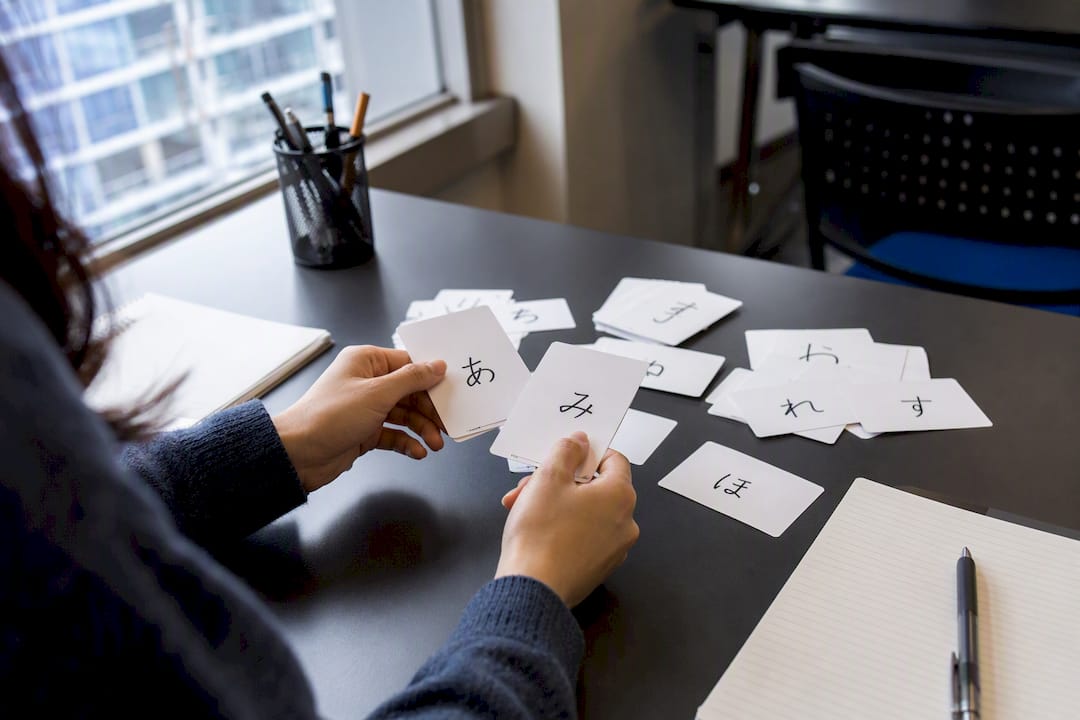
The single most important prerequisite is mastering hiragana and katakana before you touch a vocabulary deck. Skipping this step means you will be reading romanized Japanese, which creates a dependency that slows your progress for months. Both phonetic alphabets can be learned in one to two weeks with daily practice, and the payoff is immediate. Once you read in native script, your brain starts processing Japanese as a language rather than a transliteration puzzle.
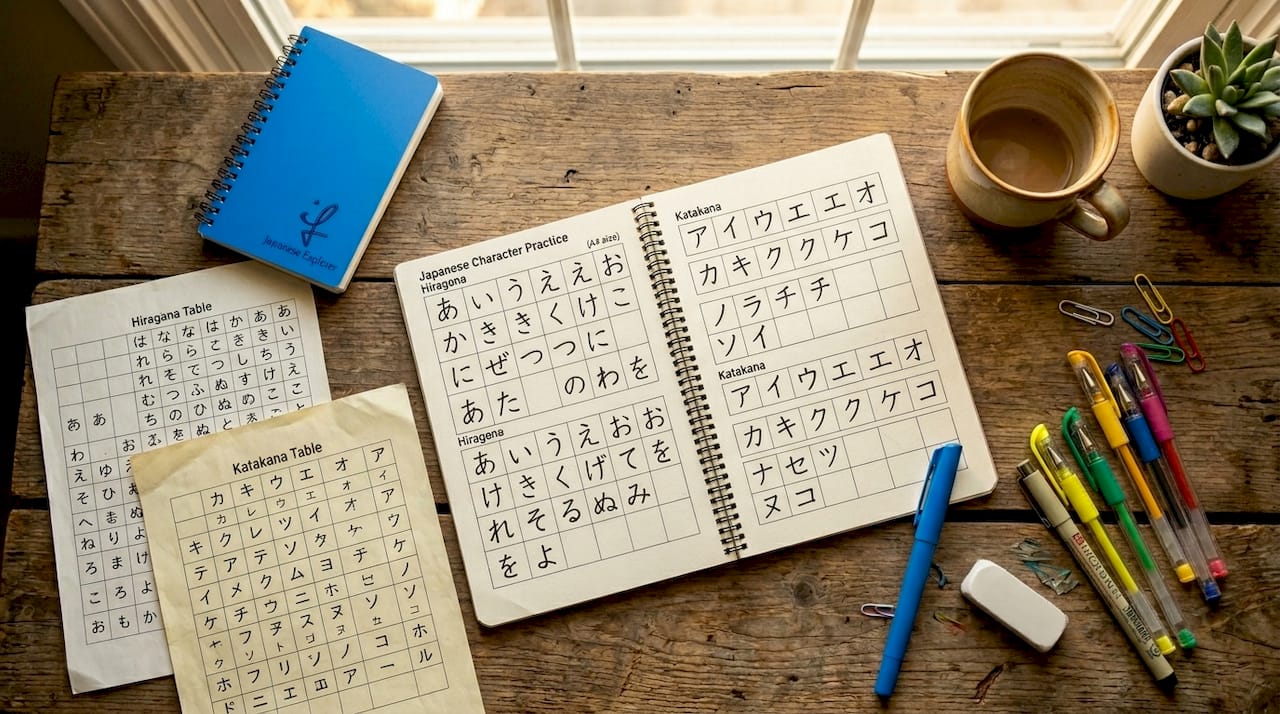
After you have the scripts down, your next move is selecting the right vocabulary resource. Pre-made Anki decks like Tango N5 and Core 2000 are the most efficient starting points for beginners. These decks are organized by frequency and include audio, example sentences, and kanji readings. You are not building from scratch. You are plugging into a system that thousands of learners have already tested and refined.
Here is what your starter toolkit should include:
- Anki (free SRS software): your primary vocabulary review tool
- Tango N5 or Core 2000 deck: pre-built, frequency-ordered, audio-included
- Maggie Sensei: a free grammar reference site with clear explanations and natural example sentences
- A native audio source: NHK Web Easy, JapanesePod101, or YouTube channels with subtitles
Set a daily new card goal of 25 to 30 cards for N5 level. That pace, combined with review sessions, maps to roughly 20 minutes in the morning for new cards and two shorter review sessions during commute time or in the evening. Consistency at this pace is what produces the N5 vocabulary base in 30 days.
Pro Tip: Do not add new cards on days when your review backlog exceeds 100 cards. Clearing the backlog first protects your retention rate and prevents the deck from becoming overwhelming.
How does spaced repetition accelerate vocabulary acquisition?
Spaced repetition is the practice of reviewing information at increasing intervals, timed to catch each memory just before it fades. It is not a study style preference. It is a memory science principle, and the data behind it is clear. SRS outperforms massed practice by 10 to 30%, making it the most efficient vocabulary learning tool available to language learners.
The key insight is that the timing of reviews matters more than the total hours you study. Reviewing a word five times over five days is far less effective than reviewing it at day one, day three, day seven, and day fourteen. Anki handles this scheduling automatically, which is why it is the tool of choice for serious Japanese learners worldwide.
Frequency-based learning compounds the benefit. Learning the 100 highest-frequency kanji gives you recognition of roughly 50% of characters in everyday reading. Expanding to 500 kanji pushes that to 75 to 80%. This means prioritizing common words and characters gives you disproportionate reading comprehension early, which keeps motivation high and creates more opportunities for natural exposure.
| Approach | Retention after one week | Best for |
|---|---|---|
| Massed practice (cramming) | 20 to 30% | Short-term tests only |
| Spaced repetition (SRS) | 60 to 80% | Long-term vocabulary retention |
| SRS plus sentence context | Highest measured | Practical usage and fluency |
One critical boundary to understand: SRS alone won’t generate fluency. It builds a strong memory for words, but it does not teach you grammar or how to speak. The most effective learners use a deliberate hybrid approach. SRS handles vocabulary recall. Structured classes or a tutor handle grammar, speaking, and listening comprehension. These two tracks reinforce each other rather than compete.
Pro Tip: Set Anki’s new card limit to zero on weekends and use that time exclusively for speaking practice or grammar review. This prevents burnout and keeps your hybrid study system balanced.
Using keyword mnemonics to memorize tough Japanese words
The keyword mnemonic method is a two-step technique that connects the sound of a Japanese word to a familiar English word, then anchors both to a vivid mental image. It sounds simple, but the results are striking. Mnemonic methods boost retention to 60 to 80% after one week, compared to just 20 to 30% for rote repetition. That gap is too large to ignore.
Here is how the two-step process works in practice:
- Find the keyword. Take the Japanese word and identify an English word that sounds similar. For 猫 (neko, meaning “cat”), the keyword is “neck.” For 橋 (hashi, meaning “bridge”), the keyword is “hash.”
- Build the image. Create a vivid, slightly absurd mental scene connecting the keyword to the meaning. For neko, picture a cat wearing a giant neck brace. For hashi, imagine a bridge made entirely of hash browns. The more specific and strange the image, the better it sticks.
The method works because your brain encodes visual and emotional information far more reliably than abstract sound sequences. You are giving the word a story, not just a label. When you encounter 猫 in a reading passage, your brain retrieves the neck brace image, which leads you straight to “cat.”
Use mnemonics selectively, not for every word. Common, high-frequency words like 食べる (taberu, “to eat”) or 大きい (ookii, “big”) appear so often in immersion that repetition alone will cement them. Save the mnemonic technique for words that refuse to stick after five or more reviews. Integrating these stories directly into your Anki card notes means the image appears alongside the word during every review session, reinforcing the connection each time.
Pro Tip: Personalize your mnemonic images using people, places, or memories from your own life. A bridge made of hash browns is good. A bridge made of hash browns outside your childhood home is far more memorable.
How contextual immersion and active mining improve practical vocabulary
Rote memorization builds a word list. Immersion builds a language. The difference shows up the moment you try to use a word in conversation and realize you only know its dictionary definition, not how it actually sounds in a sentence. Contextual memory anchors from specific scenes, podcasts, or conversations dramatically improve recall compared to arbitrary word lists.
Active mining is the practice of pulling unknown or partially known words from your immersion content and adding them directly to your SRS deck. When you encounter a word in a specific scene from an anime episode or a news article on NHK Web Easy, that scene becomes part of the word’s memory. You are not just learning what the word means. You are learning where it lives in real Japanese.
Here are practical immersion sources organized by difficulty level:
- Beginner: NHK Web Easy (simplified news), Hiragana Times, Genki textbook dialogues
- Intermediate: anime with Japanese subtitles, JLPT N4 and N3 graded readers, JapanesePod101 intermediate series
- Advanced: standard NHK news, Japanese podcasts like Nihongo con Teppei, native manga and novels
Combining SRS with sentence context rather than isolated words leads to better understanding and practical use of vocabulary. Tools like Clozemaster provide thousands of fill-in-the-blank sentences at varying difficulty levels, which bridges the gap between flashcard review and real reading. Learning vocabulary in whole words and sentences, rather than isolated kanji readings, accelerates reading comprehension and retention at every level.
One more principle worth applying: learning kanji as part of words rather than in isolation accelerates correct readings and practical knowledge. The kanji 生, for example, is read differently in 生活 (seikatsu, “daily life”), 生ビール (nama biiru, “draft beer”), and 生まれる (umareru, “to be born”). Learning it in context from the start prevents the confusion that trips up so many learners. You can also use a vocabulary building checklist to track which immersion sources and mining habits you are maintaining week by week.
Key takeaways
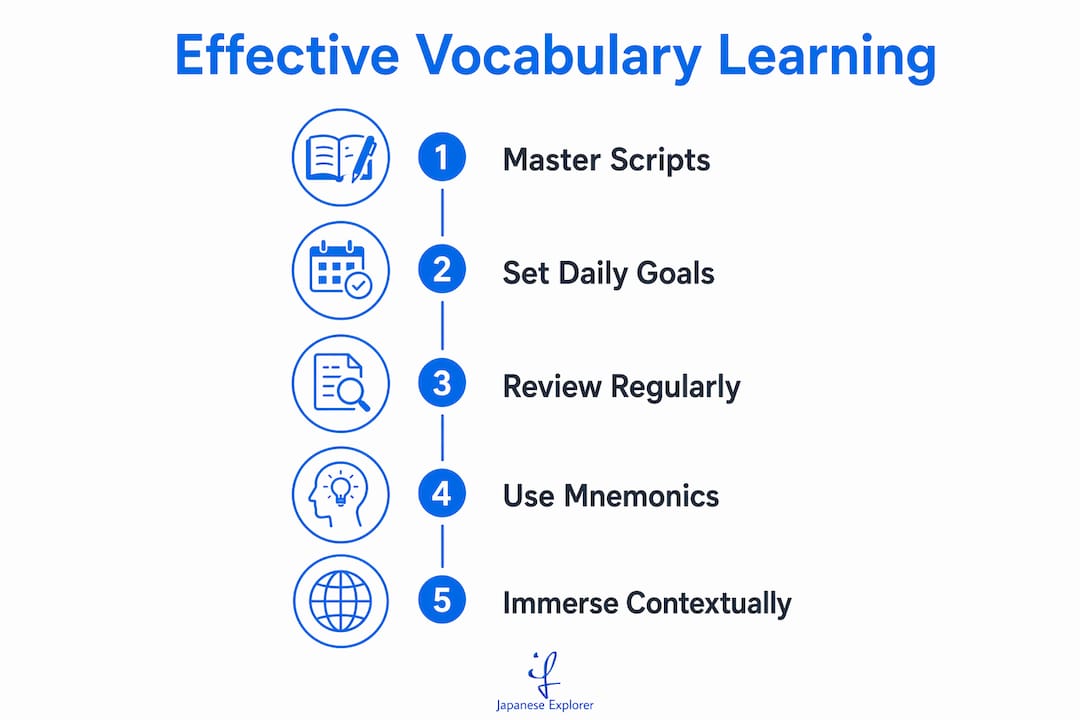
Building Japanese vocabulary efficiently requires combining spaced repetition, frequency-based learning, keyword mnemonics, and active immersion into one consistent daily system.
| Point | Details |
|---|---|
| Master scripts first | Learn hiragana and katakana before starting any vocabulary deck to avoid romanization dependency. |
| Use SRS with frequency decks | Anki with Tango N5 or Core 2000 at 25 to 30 cards daily builds an 800-word base in 30 days. |
| Apply mnemonics selectively | Reserve the keyword mnemonic method for words that resist retention after multiple reviews. |
| Mine from real content | Add words from anime, podcasts, and news directly to your SRS deck for contextual memory anchors. |
| Pair SRS with structured study | Spaced repetition handles recall; classroom or tutor-led study handles grammar and speaking fluency. |
What I’ve learned from watching learners plateau and break through
I have seen a consistent pattern across learners at Japanese Explorer. The ones who plateau fastest are those who treat vocabulary study as a single activity. They open Anki, do their cards, close the app, and consider the work done. The ones who break through are doing something different. They are using their vocabulary in the same week they learn it, whether that means watching an episode of a show, having a short exchange with a tutor, or writing a few sentences in a journal.
The mnemonic technique is one area where I think most guides underserve learners. They present it as a general strategy when it is really a precision tool. Using it on every word wastes time and dilutes the method. Using it on the ten words per week that genuinely will not stick is where it earns its reputation. The retention difference between a vivid personal image and a blank flashcard is not marginal. It is the difference between remembering a word for a week and remembering it for years.
My honest observation on immersion: most learners start too late and at too high a level. You do not need to understand everything you listen to or read. You need to be in contact with real Japanese regularly, even when it is mostly noise. That contact builds familiarity with rhythm, pitch, and common patterns that no flashcard deck can replicate. Pair that with consistent progress habits and the vocabulary you study starts to feel like a language rather than a list.
— Paul
Take your vocabulary further with Japanese Explorer
Building vocabulary on your own gets you started. Applying it with real people, in real conversations, is what makes it permanent.
Japanese Explorer offers small group classes, private lessons, and online Japanese courses taught by certified bilingual instructors who integrate vocabulary, grammar, and speaking in every session. The curriculum follows the Association for Japanese-Language Teaching framework, so your vocabulary study connects directly to structured language progression. Whether you are working toward JLPT proficiency or conversational confidence, the Japanese language courses at Japanese Explorer give your self-study a structured backbone. Classes are held at 10 Anson Road, Level 22, International Plaza, Singapore 079903, right above Tanjong Pagar MRT, with flexible online options available.
FAQ
How many Japanese words should I learn per day?
For JLPT N5 level, 25 to 30 new Anki cards daily is the recommended pace. At that rate, combined with consistent reviews, you can build an 800-word vocabulary base in approximately 30 days.
What is the best tool for Japanese vocabulary learning?
Anki is the most widely used and research-supported tool for Japanese vocabulary acquisition. Pre-made decks like Tango N5 and Core 2000 provide frequency-ordered words with audio and example sentences built in.
Does spaced repetition really work for Japanese?
Yes. Spaced repetition systems outperform massed practice by 10 to 30% for long-term retention. The key is consistent daily reviews rather than long infrequent sessions.
How do I remember difficult Japanese words?
The keyword mnemonic method connects the sound of a Japanese word to a familiar English word and a vivid mental image. This technique raises retention rates to 60 to 80% after one week, compared to 20 to 30% for rote repetition.
Should I learn kanji separately from vocabulary?
No. Learning kanji as part of whole words rather than in isolation accelerates correct readings and practical comprehension. The same kanji character often has multiple readings depending on the word, so context is the most reliable teacher.
Recommended
- How To Build Your Japanese Vocabulary Without Straining | Japanese Explorer
- 4 Easy Yet Powerful Ways To Help You Memorise Japanese Words | Japanese Explorer
- 4 Learning Tips To Master The Japanese Language Quickly | Japanese Explorer
- Best Tips on How To Master the Japanese Language Fast | Japanese Explorer