
The fastest way to build online Japanese speaking practice is to combine a daily low-stakes habit with one weekly high-feedback session. AI conversation tutors and voice-message drills work best for quick habit-building; peer language exchanges and virtual meetups suit casual conversational confidence; paid 1:1 tutors and structured online courses deliver the correction and progression needed for exam or job goals. Below, you’ll find the criteria, setup steps, and routines to make each one count.
TL;DR:
- AI conversation apps provide unlimited practice at low cost but offer shallow, generic feedback without cultural nuance.
- Paid tutors and structured courses deliver targeted correction, with courses especially useful for measurable progress and exam preparation.
- The most effective routine combines daily short practice with weekly live sessions, emphasizing consistency over method perfection.
- Technical setup, goal clarity, and partner choice significantly influence the success of online speaking practice, especially for beginners.
- Regular review and focused repetition of corrections accelerate improvement, with tools like recordings and shadowing boosting retention.
Table of Contents
- What Are the Main Types of Online Japanese Speaking Practice?
- How Do You Choose the Right Speaking Practice Option?
- How Do I Set Up My First Online Speaking Session?
- What’s a Realistic Weekly Routine for Speaking Practice?
- What Does a Structured Online Course Add to Speaking Practice?
- What Challenges Come Up in Online Japanese Speaking Practice?
- How Do You Overcome Speaking Anxiety in Online Sessions?
- How Do You Use Feedback From Speaking Sessions to Improve?
- What Tools Help With Online Speaking Practice?
- Why Practice Consistency Beats Perfect Methods
- Ready to Practice Japanese Speaking With Real Structure?
- Sources
- FAQ
What Are the Main Types of Online Japanese Speaking Practice?
Online Japanese speaking practice splits into five practical categories, and each one solves a different problem. Knowing which lane you’re in saves you from wasting months on the wrong tool.
AI conversation tutors give you unlimited, judgment-free repetition. Many commercial AI apps package sessions into short, frequent bursts designed to build a speaking habit without much cost or scheduling friction. The trade-off: feedback is often generic, and there’s no real cultural nuance behind the corrections.
Language exchanges and peer meetups connect you with other learners or native speakers for free, casual conversation. Recurring, informal “oshaberi” style gatherings give adult learners frequent chances to talk and tend to feel far less stressful than a formal classroom drill, according to organizers of free online Japanese conversation meetups. The catch: quality varies session to session, and there’s no guaranteed structure.
Paid 1:1 tutors offer targeted correction on your specific weak points, whether that’s pitch accent or keigo. You pay for consistency and attention, not volume.
Structured online courses integrate speaking with grammar and listening inside a planned curriculum, which matters if you want measurable progress rather than just “more talking.”
Virtual meetups with a social framing, like izakaya-style Zoom sessions, blend culture and conversation to keep attendance high over time.
- AI tutors: available 24/7, low cost, shallow feedback
- Meetups and exchanges: free or low cost, inconsistent quality, great for warm-ups
- Paid tutors: highest feedback quality, highest cost per hour
- Structured courses: best for steady progression, requires a schedule commitment
Community spaces vary in moderation. Established, organizer-run meetups tend to set expectations upfront, while open-ended forums can be hit-or-miss on safety and etiquette.
How Do You Choose the Right Speaking Practice Option?
Start by naming your goal honestly. “I want to feel less nervous ordering food” and “I need to pass a business Japanese interview in three months” call for completely different tools, even though both are technically “speaking practice.”
Run through this checklist before committing time or money:
- Goal clarity: are you chasing fluency (speaking more, faster) or accuracy (speaking correctly)? AI tools and meetups favor fluency; tutors and courses favor accuracy.
- Feedback frequency: how often do you need correction to stay motivated? Daily AI drills give instant feedback but shallow depth; a weekly tutor session gives deep feedback but less often.
- Scheduling: can you commit to a fixed weekly slot, or do you need something available at 11 p.m. on a Tuesday?
- Partner type: do you want a native speaker, a fellow learner at your level, or a certified instructor?
- Cost expectations: free meetups cost time and consistency; paid tutors cost money but save time getting corrected.
The trade-off almost everyone underestimates is speed versus quality. A free meetup gets you talking tonight, but a structured course gets you talking correctly over a predictable timeline. Neither is wrong, but picking one while expecting the other’s benefits is where most learners get frustrated and quit.
Watch for a few red flags: platforms with no visible moderation policy, tutors who won’t specify their teaching background, and any “practice group” that turns into a sales pitch for unrelated products.
Pro Tip: If you can only choose one thing this month, pick the option that matches your calendar, not your ambition. A perfect curriculum you attend twice is worse than an imperfect meetup you attend weekly.
How Do I Set Up My First Online Speaking Session?
Your first session determines whether you come back for a second. A little preparation turns an awkward fifteen minutes into a habit you’ll actually keep.
- Test your tech the night before. Check your microphone, put on headphones to avoid echo, confirm a stable connection, and review the platform’s recording and privacy settings so you know exactly what’s being saved.
- Write a one-sentence self-introduction in Japanese and practice saying it out loud twice. This removes the scariest first ten seconds.
- Prepare three topic prompts you can bring up if the conversation stalls: your weekend, a recent meal, or a question about your partner’s city.
- Pick one target phrase or grammar point you want to use naturally during the session. One is plenty for a first attempt.
- Set a session goal and timer. Fifteen to twenty minutes is realistic for a first live conversation.
- During the call, prioritize flow over perfection. Let small mistakes pass; jot down anything you want to look up later instead of stopping mid-sentence.
- After the call, save a short voice memo or transcript and note two things that tripped you up.
- Schedule the next session before you close the laptop. Momentum dies in the gap between sessions, not during them.
If your conversation partner is in a different time zone, sending voice messages between live sessions keeps practice going without forcing an awkward 6 a.m. call. Most community meetups also recommend arriving with at least a basic elementary level so the conversation stays productive for everyone in the group, per Oshaberi IZAKAYA’s organizer notes.
What’s a Realistic Weekly Routine for Speaking Practice?
Consistency beats intensity almost every time with spoken language. Three sample routines show how that plays out across different schedules:
- Beginner (aiming for daily habit): 10 minutes of AI conversation drills, five days a week, plus one 30-minute community meetup on the weekend.
- Intermediate (aiming for fluency): 15 minutes of AI or voice-message practice daily, one weekly language exchange call, and one biweekly tutor session for targeted correction.
- Busy professional (aiming for business readiness): two 20-minute structured course sessions a week, plus five minutes of shadowing recorded phrases each morning during a commute.
Shadowing short audio clips of phrases you’ve actually used in conversation, looped for thirty to sixty seconds, helps convert rehearsed lines into words you can produce without thinking. Reviewing a transcript or recording within a day of a live session, then spending three to five minutes on notes and one shadowing drill, meaningfully speeds up how fast new phrases stick.
Two simple numbers worth tracking: minutes spoken per week, and how many new phrases you used unaided in your most recent session. Watching those climb, even slowly, tells you the routine is working.
- Track minutes spoken, not minutes studied
- Count new unaided phrases, not vocabulary memorized
- Review within 24 hours of every live session
What Does a Structured Online Course Add to Speaking Practice?
A structured online course solves the one problem casual practice can’t: it tells you whether you’re actually improving. Free meetups and AI drills are excellent for volume, but they rarely tell you if your grammar is drifting or your pitch accent is stuck.
At Japanese Explorer, online courses follow a curriculum aligned with the Association for Japanese-Language Teaching, which weaves speaking, grammar, and listening into every lesson rather than treating conversation as a bonus activity. That structure means each session builds on the last instead of restarting from scratch.
Classes are taught by bilingual, certified instructors, which matters more than it sounds. A certified teacher catches the pitch-accent slip or the wrong level of politeness that a well-meaning conversation partner simply won’t notice.
This format tends to fit three kinds of learners best:
- Professionals preparing for business Japanese who need accountable, scheduled progress rather than open-ended chatting
- Learners heading toward a language proficiency exam who need grammar and speaking tracked together
- Anyone who has tried casual practice for months and plateaued without noticing why
If you’ve hit that plateau, browsing how structured speaking exercises build on each other might explain the gap between “talking a lot” and “talking better.”
What Challenges Come Up in Online Japanese Speaking Practice?
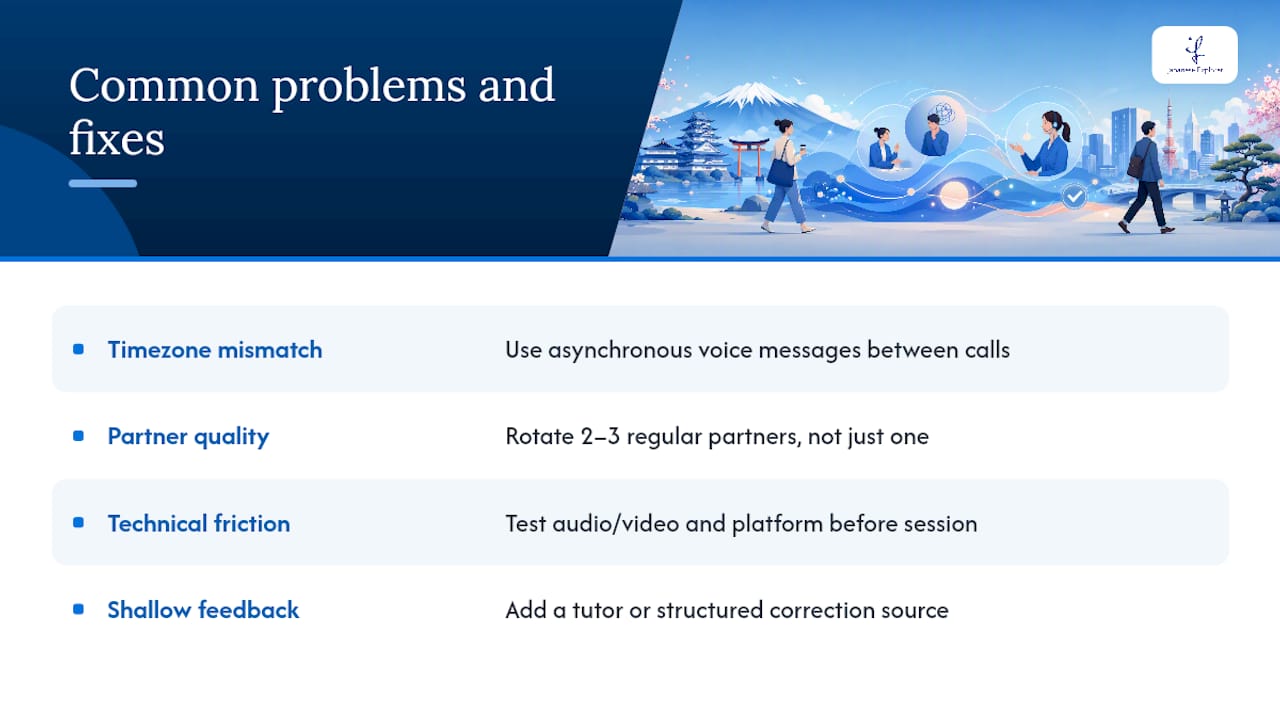
Three problems show up over and over for learners practicing online, and each has a workaround.
Timezone mismatches kill momentum fastest. If your best conversation partner is twelve hours away, live calls become rare. The fix is leaning on asynchronous voice messages between live sessions, which keeps spoken practice going without forcing anyone into a 4 a.m. call.
Inconsistent partner quality is the second big one, especially in free exchanges. Some partners are generous and patient; others disappear after one session or don’t correct anything at all. Rotating between two or three regular partners, rather than relying on one, protects you from losing your whole routine when one person goes quiet.
Technical friction derails more sessions than people admit. Choppy audio, laggy video, or an unfamiliar platform interface eats up minutes you meant to spend talking. Testing your setup before a session, not during it, avoids the ten minutes of “can you hear me now” that kill a short practice slot.
Shallow feedback loops round out the list. AI tools and casual meetups rarely tell you why something was wrong, just that it was. Pairing casual practice with at least one source of structured correction, whether a tutor or a course, closes that gap without giving up the volume casual practice provides.
How Do You Overcome Speaking Anxiety in Online Sessions?
Speaking anxiety in a new language is rarely about vocabulary. It’s about the fear of sounding foolish in front of a stranger, and a screen somehow makes that fear louder, not quieter.
The most reliable fix is lowering the stakes on purpose. Choose your first few sessions from community formats built for exactly this problem. Virtual izakaya-style meetups, for instance, wrap conversation practice inside a social, low-pressure setting specifically because that framing reduces performance pressure and encourages more natural speech, according to Oshaberi IZAKAYA’s session design.
A few habits help beyond format choice:
- Prepare one sentence you know cold before every session so you never open with dead silence.
- Accept that pausing to think is normal conversation, not failure, in any language.
- Turn off self-critique mid-sentence. Save the review for after the call, when you can actually act on it.
- Choose voice-first tools when you’re not ready for live pressure. Systems that let you speak first and receive corrections afterward preserve your conversational flow instead of interrupting it, which is particularly useful while you’re moving from understanding Japanese to producing it spontaneously.
Confidence builds from repetition, not from a single breakthrough conversation. The fifth session always feels easier than the first, and the twentieth barely resembles it.
How Do You Use Feedback From Speaking Sessions to Improve?
Feedback you don’t act on is just noise. The learners who improve fastest treat every correction as raw material for the next session, not a grade on the last one.
Right after a session, spend three to five minutes reviewing what happened while it’s still fresh. Note the specific phrase or grammar point that tripped you up, not a vague “I struggled with particles” impression. Recording your session or saving a transcript makes this concrete instead of relying on memory.
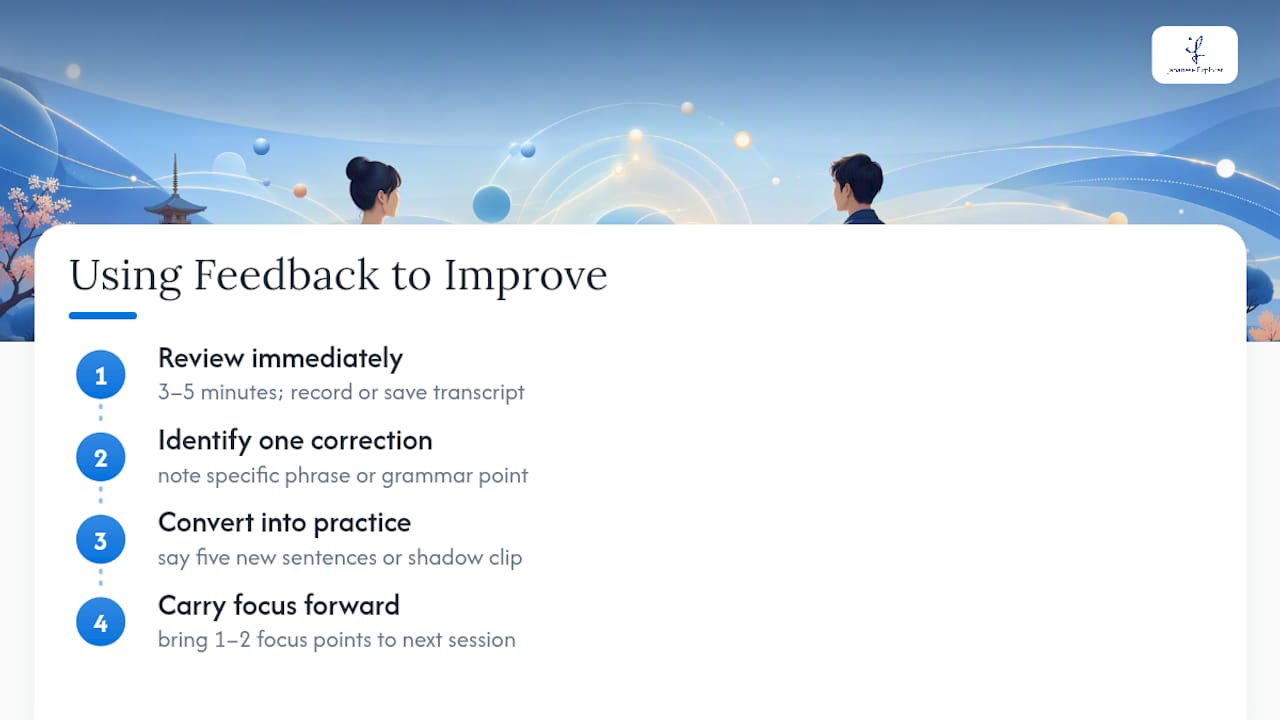
Then convert that note into practice. If a tutor corrected your use of a particle, don’t just remember the rule. Say five new sentences using it correctly before your next session. If a native speaker rephrased something you said, save the fixed version as a short audio clip and shadow it in thirty-second loops until it feels automatic rather than memorized.
Bring the same one or two focus points into your next session on purpose. Structured feedback compounds when you keep pulling the thread instead of starting fresh every time. This is exactly where a paid tutor or a conversation-focused class earns its cost over casual practice: someone is tracking your recurring mistakes across sessions, not just within one.
What Tools Help With Online Speaking Practice?
The right tools remove friction between “I want to practice” and “I’m actually talking.” A few categories matter more than the rest.
Recording and transcription turn a fleeting conversation into something you can review. Most video call platforms include built-in recording, and pairing that with a transcript lets you catch mistakes you didn’t notice while speaking.
Voice-first practice apps let you speak freely and get corrections afterward instead of mid-sentence, which keeps momentum intact for intermediate learners moving toward spontaneous speech.
Translation apps have a narrow, useful role during live conversation: clarifying a single stuck word, not translating whole sentences. Understanding how translation tools actually function in real conversations helps you use them as a bridge rather than a crutch that stalls your own production.
Pronunciation and shadowing tools that let you loop short audio clips are worth more than most learners expect. Looping a native speaker’s phrase for thirty to sixty seconds and repeating it aloud converts a corrected sentence into something you can say without thinking.
- Built-in call recording for post-session review
- Transcription for catching missed corrections
- Voice-first apps for delayed feedback
- Audio looping for shadowing practice
Why Practice Consistency Beats Perfect Methods
The research on this topic points to one uncomfortable truth: most learners spend more time debating which app or method is “best” than they spend actually talking. That’s backwards. A mediocre AI tutor used daily will outperform a perfect tutor booked once a month, simply because spoken fluency responds to repetition more than to method quality.
Conventional advice tends to oversell finding the “right” platform. What it underestimates is scheduling discipline. Nobody plateaus because they picked the wrong meetup; they plateau because they attended three sessions and stopped. If I had to prioritize one thing for a reader starting today, it wouldn’t be choosing between AI tools, exchanges, or a structured course. It would be picking a weekly time slot and defending it for six weeks straight.
Where a structured course earns its place isn’t in replacing casual practice. It’s in giving you a second, more accountable layer once the habit exists. Casual talking builds the habit. A curriculum builds the accuracy that habit alone won’t.
— Paul
Ready to Practice Japanese Speaking With Real Structure?
If you’ve tried AI drills and casual meetups and still feel like your speaking has plateaued, a structured course fills the exact gap those tools leave open: consistent, tracked correction from someone qualified to give it. Some structured online Japanese courses run over Zoom in group, private, and business formats, with speaking practice integrated into lessons rather than added as an afterthought.

Each class typically follows a curriculum aligned with the Association for Japanese-Language Teaching and is taught by bilingual, qualified instructors who address pitch-accent and politeness-level mistakes that casual partners tend to miss. Business learners can find role-specific courses covering meeting language and client communication, while conversational learners get regular, scheduled speaking time that doesn’t depend on finding a partner online each week.
Classes run from our training center at 10 Anson Road, Level 22, International Plaza, right above Tanjong Pagar MRT, for learners who want an in-person option alongside online sessions. To see current formats and schedules, visit the online Japanese course page and pick the class time that fits your week.
Sources
- Free Online Japanese Conversation (Meetup)
- Oshaberi IZAKAYA — Online Japanese conversation meetups
- How to send voice messages to a different language partner (Oralingo blog)
FAQ
What Is the Fastest Way to Start Practicing Japanese Speaking Online?
Join a free community meetup or open an AI conversation app today, since both remove the barrier of finding a partner or scheduling weeks ahead.
Do I Need to Be Fluent Before Joining a Language Exchange?
No, but most organized meetups recommend arriving with at least a basic elementary level so conversation stays productive for everyone in the group.
How Often Should I Practice Speaking Japanese to See Progress?
Short daily sessions of five to ten minutes combined with one longer weekly live conversation tend to build retention better than occasional long sessions.
Is a Structured Online Course Better Than Free Practice Options?
A structured course adds tracked correction and curriculum-based progression that casual practice can’t offer, which makes it a strong complement once you already have a speaking habit; Japanese Explorer’s online courses build that structure directly into every lesson.
How Do I Reduce Anxiety During Online Speaking Sessions?
Choose low-pressure, socially framed formats like virtual izakaya meetups first, prepare one sentence in advance, and save self-critique for after the call rather than during it.