
Here, “Japanese MOELC” refers to private and online adult Japanese courses run by Japanese Explorer, not the government language center program that phrase usually points to. If you want conversational or business Japanese, the fastest next step is a placement test or a trial lesson, which routes you straight into a course built for adult learners and corporate teams.
TL;DR:
- Private lessons are the fastest way to develop targeted workplace fluency, especially for mastering keigo or business email skills.
- Online classes using Zoom are just as effective as in-person lessons for improving proficiency, provided the curriculum is well-designed and students speak regularly.
- A placement test ensures learners are placed at the right level, preventing boredom or frustration from lessons that are too easy or too advanced.
- Choosing between private and group classes depends on whether learners prioritize rapid, personalized progress or steady, lower-cost conversational practice.
- A typical timeline for becoming workplace-ready includes basic greetings in the first week and progression to role-specific vocabulary and keigo within the first month or quarter.
Table of Contents
- What Does “Japanese MOELC” Mean in This Guide?
- Who Actually Needs This Kind of Course?
- How Do You Choose the Right Course Format?
- What Does the Curriculum Actually Cover?
- How Do You Actually Get Started?
- What I’ve Noticed About Learners Who Actually Improve
- Ready to Book Your Placement Test or Trial Lesson?
- Sources
- FAQ
What Does “Japanese MOELC” Mean in This Guide?
In this article, “Japanese MOELC” means Japanese Explorer’s private and online Japanese courses for adults: conversational lessons, business Japanese, and corporate training. It has nothing to do with the government-run centers that some searches for this phrase turn up.
Japanese Explorer’s version covers a working adult’s actual needs, structured around real formats you can book:
- Private one-on-one lessons for targeted, fast-paced learning
- Small group classes for social practice and steady progress
- Online Zoom classes for flexible, location-free scheduling
- Business Japanese for workplace communication and client-facing roles
- Corporate training programs custom-built for teams and departments
This guide does not cover children’s classes, exam prep for school-level Japanese, or any program tied to a national curriculum. If you are an adult who wants to speak Japanese confidently at work or in daily life, you are in the right place.
Who Actually Needs This Kind of Course?
Not every learner has the same goal, and that is exactly why Japanese Explorer routes people differently depending on where they stand. A busy professional heading into a Tokyo posting has different needs than someone who has been stuck at intermediate level for years, unable to shake a habit of speaking too casually in meetings.
Here is how the common profiles tend to sort themselves:
- Relocating professionals preparing for a transfer benefit from a hybrid path: online lessons for three to six months beforehand, then in-person practice once they land, according to relocation-focused training strategies for Tokyo moves.
- Client-facing staff who need to sound polished on calls and in emails usually do best in private lessons, where feedback is immediate and the curriculum can be tailored to their exact role.
- Corporate teams learning together are often better served by a corporate training program, which keeps everyone moving through the same material at a shared pace.
- Self-learners stuck at N3 to N2 who understand grammar but freeze in workplace registers usually need targeted business Japanese, not another beginner refresher.
A short placement test clarifies which of these you are, so you are not guessing your way into the wrong class.
How Do You Choose the Right Course Format?
Choosing well comes down to five things: your current proficiency, your actual goal, your schedule, your budget, and whether you are learning alone or need to bring a team along. Get honest about these before you talk to any school, and the conversation moves a lot faster.
Ask these questions before signing up for anything:
- Is there a placement test? A real one places you by ability, not guesswork, so your first lesson matches your level instead of wasting time on material you already know.
- Can I try a sample lesson first? A trial class shows you the instructor’s style and the pacing before you commit money.
- Are the instructors certified and bilingual? Bilingual, trained instructors can explain grammar in English when you are stuck, then push you back into Japanese immediately.
- Does the curriculum follow a recognized teaching framework? Japanese Explorer’s programs are guided by the Association for Japanese-Language Teaching, which keeps grammar, speaking, and listening integrated in every lesson rather than siloed.
- How small are the classes, and how is progress checked? Smaller classes mean more speaking time per person; regular checks catch gaps before they compound.
If your goal is workplace fluency fast, start with private lessons for the targeted feedback loop. If you want steady conversational growth with lower cost per session, group classes fit better, since private lessons tend to run higher because of the one-on-one time, while marketplace-style online tutoring sits at the lower end of the price range, per comparisons of online and in-person tutoring costs. Corporate teams typically get custom quotes based on group size and syllabus scope.
Pro Tip: Do not choose a format based on what sounds impressive. A comparison of private lessons versus group classes shows private instruction accelerates specific goals like keigo or business email, while group classes build the social stamina that private lessons cannot replicate.
What Does the Curriculum Actually Cover?
Business Japanese breaks down into a handful of practical areas, and a good curriculum walks you through them in a deliberate order rather than throwing everything at you at once. A structured map of business Japanese groups the skills into six areas: keigo (politeness registers), business email conventions, meeting and phone phrases, workplace etiquette, role-specific vocabulary, and everyday office phrases.
Here is what that typically looks like across a course:
- Everyday office phrases and self-introductions come first, because automating these frees up mental bandwidth for harder material later.
- Keigo tiers get introduced with a simple decision framework rather than memorized formulas for every situation.
- Business email structure covers openings, requests, and closings you will reuse constantly.
- Meeting and phone phrases cover turn-taking, clarifying questions, and polite interruptions.
- Role-specific vocabulary gets layered in based on your industry or job function.
A realistic roadmap runs in stages: Day 1 covers greetings and self-introduction scripts, Week 1 adds basic email openers, Month 1 introduces meeting phrases and simple keigo choices, and Quarter 1 brings it together with role-specific vocabulary and more complex email requests.
One thing worth knowing before you agonize over format: research comparing online and in-person tutoring finds no consistent measurable proficiency advantage for either delivery mode. Curriculum design and how much you actually speak in each lesson matter far more than whether you are in a room or on Zoom. That is good news if your schedule only allows online Zoom classes; you are not sacrificing outcomes by skipping in-person sessions.
How Do You Actually Get Started?
Getting into the right class takes three steps, and none of them require you to already know what level you are.
- Take the placement test. This routes you into a course that matches your actual ability instead of one that assumes too much or too little. Skipping this step is the single most common reason learners end up bored or overwhelmed in the first few weeks.
- Book a trial lesson. Bring a couple of real workplace situations you struggle with, like drafting a request email or introducing yourself to a client, and see how the instructor handles them.
- For corporate training, request a scoping call. Japanese Explorer’s team runs a needs analysis first, builds a custom syllabus around your team’s actual job functions, then delivers the program on the schedule that works for your department.
None of this requires a long commitment upfront. A placement test and a trial lesson give you enough information to decide within a week.
What I’ve Noticed About Learners Who Actually Improve
The learners who improve fastest are not the ones who grind grammar drills for hours. They are the ones who automate a small set of everyday office phrases and self-introductions until those come out without thinking, then apply a simple A/B/C keigo decision rule instead of agonizing over every sentence.
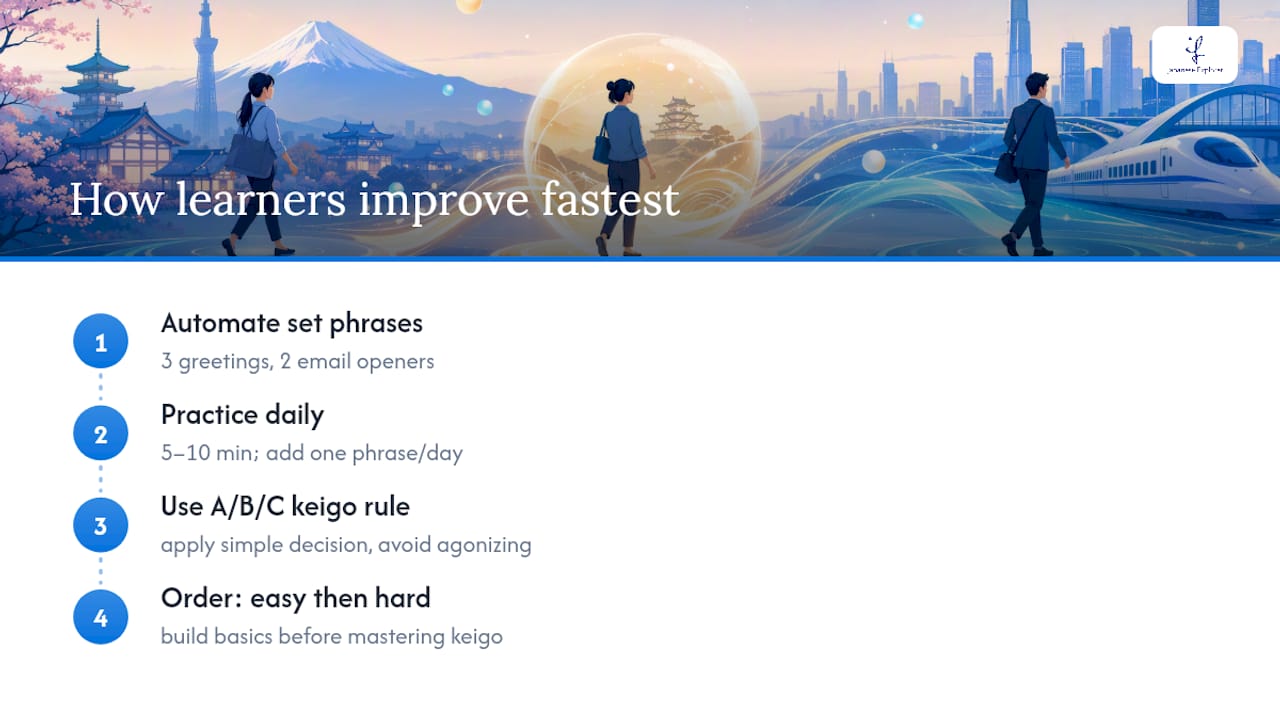
The most common mistake I see is learners trying to master perfect keigo before they can even get through a self-introduction smoothly. That backwards order burns motivation fast. A structured curriculum flips this: build the easy wins first, then layer in the harder register choices once the basics are automatic.
Here is a drill worth trying for five to ten minutes daily: pick three greetings and two email openers, say or write them until they feel automatic, then add one new phrase each day, maybe even including Japanese kaomoji to add friendly flair to your messages. Small, repeated wins compound faster than any amount of passive review.
— Paul
Ready to Book Your Placement Test or Trial Lesson?
Japanese Explorer gives you a direct path into the right class instead of a maze of generic options. If you want flexible scheduling, the online Japanese course puts full lessons on Zoom without sacrificing the interactive practice that actually builds fluency. If your goal is workplace communication, the business Japanese course walks through keigo, email, and meeting phrases in the order that gets you speaking sooner. Want one-on-one pacing? The private Japanese classes page covers tailored curricula built around your schedule. And if you are scoping training for a whole department, the corporate training program starts with a needs analysis before building your syllabus.
Every course runs on a curriculum guided by the Association for Japanese-Language Teaching and taught by bilingual, certified instructors, whether you learn at 10 Anson Road, Level 22, International Plaza, Singapore 079903 (right above Tanjong Pagar MRT) or from home. Start with a placement test to find your level, then book a trial lesson or request a corporate proposal to move forward.
Sources
- Business Japanese: A Complete Map of the 6 Areas (+ 90-Day Roadmap) | Real-World Japanese
- Online vs. In-Person Japanese Tutoring: Which Actually Works Better | J-Compass
FAQ
What Is Japanese MOELC in This Context?
Here, it refers to Japanese Explorer’s private and online adult Japanese courses, covering conversational, business, and corporate training, not the government language center program.
How Does the Placement Test Work?
The placement test evaluates your current level in a short assessment, then routes you into a course that matches your ability so you avoid wasted lessons on material that is too easy or too advanced.
Are Online Classes as Effective as In-Person Lessons?
Research comparing online and in-person tutoring finds no consistent proficiency advantage for either format; curriculum quality and how much you actually speak matter more than the delivery mode.
Should I Choose Private Lessons or Group Classes?
Choose private lessons if you need fast, targeted progress on specific goals like business email or keigo, and group classes if you want steady conversational practice at a lower per-person cost.
How Long Does It Take to Get Workplace-Ready in Japanese?
A typical roadmap moves from basic greetings in Week 1 to meeting phrases and keigo choices by Month 1, with role-specific vocabulary and complex email requests developing by Quarter 1.