Shadowing means repeating Japanese audio out loud in real time, trailing the speaker by roughly half a second to one second instead of pausing to translate or take notes. Done in short daily sessions, the Japanese shadowing method reliably improves pronunciation, pitch accent, and your ability to follow native speech at full speed. It builds muscle memory for the mouth and ear together, which is something flashcards and grammar drills simply cannot do.
That said, shadowing has one real limitation: it trains your motor and listening skills, not your ability to generate new sentences on the fly. Pair it with live conversation to turn the gains into usable speech.
- Improves: pronunciation, rhythm, connected speech, listening speed
- Builds: muscle memory for mouth movements and pitch patterns
- Requires pairing with: live speaking practice, since shadowing alone won’t teach you to construct new sentences
Key Takeaways
Shadowing improves Japanese pronunciation, prosody, and listening speed fastest when practiced in short daily sessions and paired with live speaking feedback.
| Point | Details |
|---|---|
| Keep sessions short | Cap shadowing at 15 minutes daily using 20 to 40 second clips to avoid burnout. |
| Fix one thing at a time | Correct a single pitch pattern or sound per session instead of chasing several errors. |
| Match material to your level | Choose audio you mostly understand before hiding the transcript. |
| Pair with live conversation | Follow shadowing with tutor or conversation practice to transfer patterns into spontaneous speech. |
| Get guided feedback | Japanese Explorer’s private and small-group lessons add instructor correction that solo shadowing can’t provide. |
Table of Contents
- What Is the Japanese Shadowing Method?
- What Does Shadowing Actually Improve, and Where Does It Fall Short?
- How Do You Practice Shadowing for 15 Minutes a Day?
- How Do You Choose the Right Audio and Clip Length?
- What Mistakes Derail Shadowing Practice?
- What Should Progress Look Like Week by Week?
- How Do You Turn Shadowing Into Real Conversation Skill?
- How Do Structured Lessons Use Shadowing for Faster Results?
- What Free Tools and Resources Can You Start With Today?
- Ready to Turn Shadowing Practice Into Real Fluency?
- Sources
- FAQ
What Is the Japanese Shadowing Method?
Shadowing works because you never stop the audio to fix a mistake. You let it run, chase the speaker at a half-second to one-second delay, and let errors pass so your ear and mouth stay locked onto the natural flow of the language. Stopping to self-correct mid-pass breaks the exact skill you’re trying to build, which is real-time processing speed.
There are several variants worth knowing, and picking the right one for your level matters:
- Murmur shadowing — speaking quietly or under your breath, ideal for beginners still building confidence with sounds.
- Text shadowing — reading along with a transcript while you speak, which reduces the guessing game for new learners.
- Prosody shadowing — hiding the transcript and focusing purely on pitch and rhythm once you already know the vocabulary.
- Background shadowing — shadowing while doing something else (walking, chores) to build automaticity once the pattern feels easy.
Relying on text forever caps your listening gains, since your ear stops doing the work.
What Does Shadowing Actually Improve, and Where Does It Fall Short?
Shadowing’s biggest payoff is prosodic: pitch accent, sentence rhythm, and the connected speech patterns that textbooks rarely teach (why “夕方は” often sounds like “yugatawa” in fast native speech, for instance). Classroom research and literature reviews on shadowing describe consistent gains in pronunciation, comprehensibility, and fluency when the technique is practiced regularly and paired with structured procedures.
- Pitch and rhythm matching improves faster than most learners expect, often within a few weeks of daily practice
- Listening speed increases because you’re forced to process audio at native pace, not a slowed-down learner pace
- Motor coordination between hearing a sound and producing it gets faster with repetition
Where it falls short: shadowing is not a vocabulary or grammar engine. A critical review of shadowing research notes that its acquisition impact on new words and structures is limited and depends heavily on how much you already comprehend before you start shadowing. If you don’t understand a clip, shadowing it just trains you to mimic noise. And once you reach advanced fluency, returns diminish. The exercise still sharpens accent, but it stops teaching you much that’s new.
How Do You Practice Shadowing for 15 Minutes a Day?
You don’t need an hour. A tight, repeatable 15-minute block, run daily, builds more consistency than an occasional 90-minute marathon session. This structure mirrors the routines most commonly recommended for beginner shadowing practice, adapted into a five-step sequence that scales with your level.
The 15-minute routine:
- Choose your clip (2 minutes). Pick 20 to 40 seconds of audio you mostly understand without a transcript.
- Listen once through, no speaking (1 minute). Just absorb the rhythm and get oriented.
- Murmur shadow with the transcript visible (3 minutes). Speak quietly, following along, letting mistakes pass.
- Do 3 to 5 full passes without stopping (6 minutes). Hide the transcript on later passes if comprehension allows. Keep the audio running continuously.
- Pick one fix and record yourself (3 minutes). Choose a single sound, particle, or pitch pattern to focus on, then record one final pass to compare against the original.
Rules that keep this sustainable:
- Keep clips between 20 and 40 seconds. Longer clips overload working memory before you’ve built the pattern.
- Cap the session at 15 minutes. Sessions that stretch past that tend to produce diminishing focus and burnout within days, not weeks.
- Correct one thing per session, never a list. Trying to fix pitch, particles, and vowel length all at once usually means fixing none of them.
- Never pause mid-pass to perfect a word. Let the recording run and fix it on the next loop.
Pro Tip: Record the same 30-second clip once a week using your phone’s voice memo app. You won’t hear the improvement day to day, but stacking four weekly recordings side by side makes the progress impossible to miss.
As for progression, don’t add more minutes to the session. Instead, increase the difficulty of the material: move from slowed-down learner audio to natural-speed clips, then from scripted dialogue to unscripted interviews or drama scenes. The 15-minute ceiling stays fixed; what changes is what you’re chasing inside it.

How Do You Choose the Right Audio and Clip Length?
The single biggest reason learners quit shadowing isn’t laziness. It’s picking material that’s too hard, which turns a confidence-building drill into a frustrating guessing exercise. Good shadowing material sits right at the edge of your current comprehension, not past it.
- Beginners: graded audio with transcripts, like NHK Web Easy, which pairs simplified news scripts with full audio and is widely recommended across teacher and learner communities as a free entry point.
- Low intermediate: learner-focused podcasts that run at a controlled pace with clear pronunciation.
- Intermediate and above: short clips from Japanese dramas or YouTube channels aimed at native audiences, trimmed to 20 to 40 seconds.
Before committing to a clip, run this check: listen once without the transcript. If you can follow most of the words, it’s shadowing material. If you catch fewer words, downgrade to something easier or slow the playback speed instead of forcing it. Most guides on the shadowing technique recommend this listen, read, repeat sequence specifically because jumping straight to unscaffolded audio causes early dropout.
For clipping and playback control, a basic voice memo app or free video editor works fine for trimming. If you’re working from video content without captions, an AI transcription tool like YumiLM can generate a usable transcript fast, saving you from typing out dialogue by hand.
What Mistakes Derail Shadowing Practice?
Most shadowing failures trace back to one of four habits, and each has a simple fix.
- The perfection trap. Trying to nail every sound in a single session stalls progress. Pick one micro goal, a single pitch pattern or particle, per session.
- Sessions that run too long. Anything past 15 minutes invites fatigue and resentment toward the practice. Cap it and stop, even mid-clip.
- Transcript dependence. Reading along forever means your ear never learns to do the work alone. Use text as a scaffold for the first pass or two, then hide it.
- Material that’s simply too hard. If you’re shadowing gibberish to your own ear, slow the playback speed or drop to easier audio instead of pushing through.
Pro Tip: If you catch yourself re-listening to the same three seconds over and over trying to catch every syllable, that’s a signal the clip is too advanced. Downgrade rather than grind.
What Should Progress Look Like Week by Week?
Shadowing gains show up gradually, and having a rough timeline keeps you from quitting during the plateau weeks.
- Week 1: Focus on murmur shadowing with transcripts visible, 15 minutes daily, using graded audio you understand at 80% or higher.
- Week 2: Drop the transcript for the second half of each session. Expect your lag behind the speaker to shrink from around one second to closer to half a second.
- Week 3: Introduce one unscripted clip per week (a short interview or drama scene) alongside your regular material.
- Week 4: Record and compare against your Week 1 recording. Listen specifically for pitch pattern matching and reduced hesitation.
The clearest diagnostic isn’t a test score, it’s your own recordings stacked side by side. If your lag behind the audio has shrunk and your pitch curve tracks the original more closely, the routine is working. If a specific sound or particle keeps tripping you up after three or four weeks, that’s the point to bring it to a tutor for targeted correction rather than keep drilling it alone. Classroom procedures that combine instructor feedback with iterative recordings over 8 to 10 checkpoints tend to produce measurable pronunciation gains faster than solo practice alone.
How Do You Turn Shadowing Into Real Conversation Skill?
Shadowing trains your mouth to produce sounds and patterns automatically, but it won’t teach you to build a new sentence under pressure. That transfer, from a rehearsed motor pattern to spontaneous communicative control, only happens when you use the language live. Pairing shadowing with immediate conversation practice is consistently the fastest route from drill to usable speech.
A simple pairing routine works well:
- Shadow a clip for 15 minutes, focusing on one prosodic feature.
- Immediately after, spend 10 minutes in conversation (with a tutor, exchange partner, or class) trying to use phrases or intonation patterns from that same clip.
- Ask whoever you’re speaking with to specifically flag pitch errors, rhythm issues, and unnatural pausing, not just grammar mistakes.
- Repeat with a new clip in your next session rather than reusing the same one indefinitely.
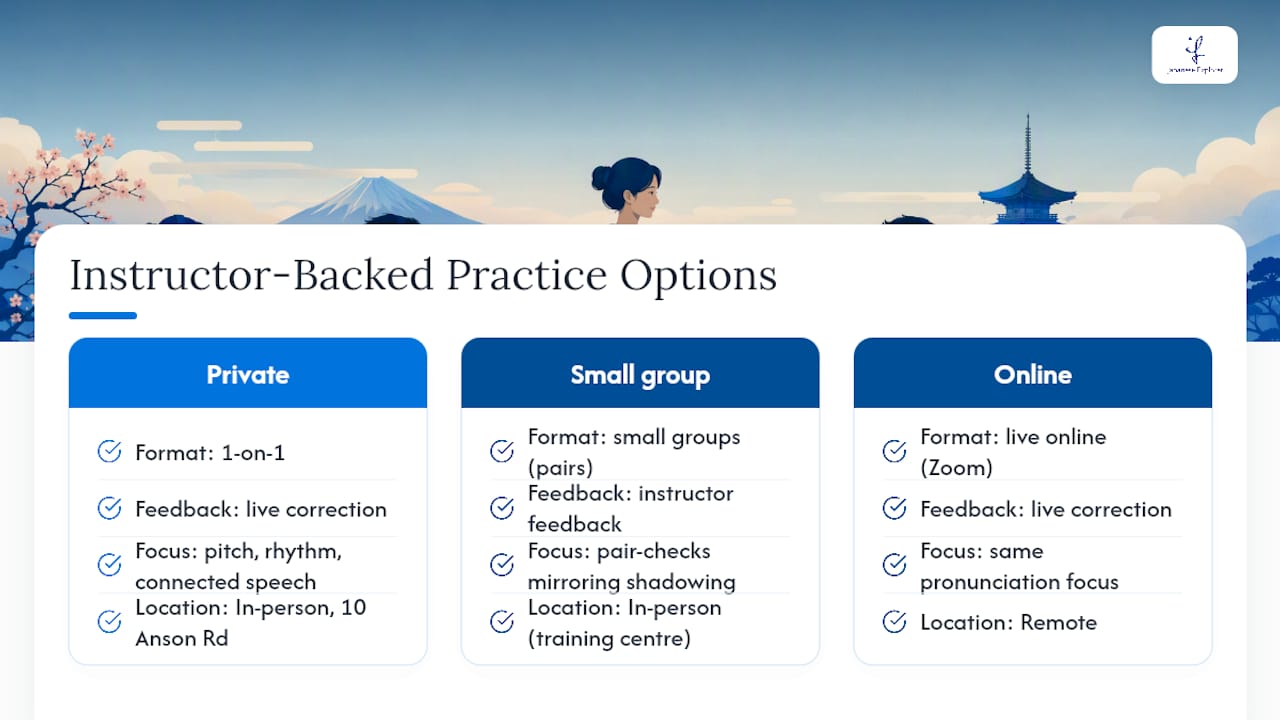
Private feedback works especially well here, since a private Japanese course lets an instructor listen for the exact pitch or rhythm error you flagged during shadowing and correct it on the spot.
How Do Structured Lessons Use Shadowing for Faster Results?
Solo shadowing works, but structured lessons add something a phone and a transcript can’t: a trained ear checking your output in real time. In a classroom setting, shadowing typically gets sequenced into a lesson with pair checks, where two students shadow the same clip and flag each other’s pronunciation before the instructor weighs in.
- Instructors often use IPA notation to pinpoint exactly where a vowel or pitch pattern is drifting from the target.
- Progress gets tracked through repeated recordings submitted over several weeks, letting both student and instructor hear improvement rather than guess at it.
- Group sessions add peer pressure in a good way. Hearing a classmate nail a pitch pattern you’re struggling with is often more motivating than any app notification.
Structured procedures that combine assigned outside shadowing with classroom recording checks and pair correction consistently produce more measurable pronunciation gains than shadowing practiced in isolation.
This is the model behind how accent and pitch work gets built into structured group and private lessons: shadowing as homework, correction as classwork.
What Free Tools and Resources Can You Start With Today?
You don’t need to buy anything to start shadowing tonight. Here’s a short starter kit:
- NHK Web Easy — free graded news audio with transcripts, ideal for beginner to intermediate shadowing since comprehension support is built in.
- Learner-focused YouTube channels and podcasts — controlled pace audio that’s easier to shadow than native-speed content.
- A phone voice memo app — free, always available, and enough for recording and comparing your weekly progress.
- AI transcription tools like YumiLM — useful for generating quick transcripts from video clips that don’t already have captions.
- A basic video editor or clipping app — for trimming longer videos down to the 20 to 40 second range shadowing works best with.
Start with whichever resource matches material you already enjoy watching or listening to. Motivation matters more than the “perfect” tool.
Ready to Turn Shadowing Practice Into Real Fluency?
Shadowing gets your mouth and ear working together, but it can’t replace a trained instructor catching the one pitch error you can’t hear in your own recordings. That’s where guided practice closes the gap solo drilling can’t.

Our private Japanese lessons build pronunciation correction directly into every session, with an instructor listening for pitch, rhythm, and connected speech in real time rather than you guessing from a phone recording. If you’d rather practice with peers, our small-group classes use pair-check activities that mirror the shadowing routine described above, with instructor feedback layered on top. And if you’re not based near our training centre at 10 Anson Road, Level 22, International Plaza, Singapore 079903 (right above Tanjong Pagar MRT), our online Japanese course delivers the same live correction over Zoom.
Take our placement test to find the class level where your shadowing practice will actually get sharpened, not just repeated back at you.
A note on shadowing with adult learners
What I’ve noticed working with adult learners is that consistency beats intensity every time. Someone who shadows for 10 focused minutes daily outpaces someone who does an hour once a week, almost without exception. The small daily win, hearing your own recording sound slightly closer to native rhythm, is what keeps people showing up.
One habit worth stealing from the classroom: record the same short passage every week and keep every file. Students who do this stop needing outside validation that they’re improving. They can just hear it themselves.
— Paul
Sources
- Shadowing procedures in teaching and integration for listening/pronunciation (JALT article)
- How to Shadow Japanese: A 15-Minute Routine for Beginners | Yui’s Japanese Culture Lab
- The Shadowing Technique for Learning Japanese (FluentU)
- Shadowing in Japanese: The Fluency Hack That Works | Kaiwa Blog
FAQ
What Are Some Effective Techniques for Studying Japanese?
Shadowing, spaced repetition for vocabulary, reading graded material like NHK Web Easy, listening to native audio daily, writing practice with kanji, and regular conversation practice are among the most commonly recommended techniques for building all-around fluency.
Why Do Japanese Speakers Say “Oi Oi Oi”?
It’s an informal interjection used to express surprise, disbelief, or mild protest, similar to saying “whoa, whoa, whoa” or “come on” in English, and it shows up frequently in casual and comedic speech, which makes it useful shadowing material for natural rhythm.
What Do the JLPT Levels N1 Through N5 Mean?
The JLPT levels run from N5 (basic) to N1 (advanced), measuring reading, listening, and grammar proficiency, with N5 covering simple daily phrases and N1 covering complex, native-level text and speech.
Can Shadowing Alone Make You Fluent in Japanese?
No. Shadowing builds pronunciation, rhythm, and listening speed, but reaching real fluency requires pairing it with live conversation practice, whether through a tutor, exchange partner, or structured class.