For most working adults, the best path into Japanese is a blended, online-first course with dedicated business modules, not a purely in-person or purely app-based route. It works because it fits around meetings and commutes, forces frequent speaking practice, and builds the exact vocabulary your job needs. If that describes you, the fastest next step is a placement test or a trial lesson, so your course starts at the right level instead of the wrong one.
TL;DR:
- A blended course combining instructor-led sessions with online practice offers the best balance of flexibility and targeted feedback for busy adults.
- Most adult learners can attain basic workplace conversational skills within twelve weeks through consistent practice and real-world speaking.
- A placement test is essential to identify the correct starting level and avoid wasting time in classes that are too easy or too difficult.
- Tutors charging $20 to $70 per hour, depending on qualifications, significantly accelerate speaking progress compared to app-only study methods.
- Business Japanese focus areas include keigo, email, meetings, workplace culture, and role-specific vocabulary, with goal-oriented milestones set for each month.
Table of Contents
- Which Japanese Course Format Actually Fits Adult Schedules?
- How Do Adults Learn Japanese Differently Than Teenagers?
- What Does Business Japanese Actually Require?
- How Do You Choose the Right Japanese Course?
- Are Adult Japanese Courses Really Different From School Curricula?
- Do Teaching Methods for Adults Differ From Traditional Classroom Instruction?
- What Do Adult Learners Say About Switching From School-Style Japanese?
- How Do You Know What Level of Japanese You’re Actually At?
- What Self-Study Resources Actually Help Adult Learners?
- What Should You Expect After Twelve Weeks of Study?
- Ready to Start With a Course Built for Working Adults?
- Sources
- FAQ
Which Japanese Course Format Actually Fits Adult Schedules?
The format you choose matters more than the textbook you use. Online, face-to-face, group, private, and blended courses each solve a different problem, and the right pick depends on how your week actually looks, not how you wish it looked.
Online lessons give you scheduling flexibility, recorded materials you can replay after a long day, and access to a wider pool of tutors than your neighborhood offers. The tradeoff is that online lessons rely more on your own initiative to stay engaged, since a screen does not catch a slumped posture or a hesitant pause the way a teacher in the room does.
Face-to-face classes give you the opposite strengths. Instructors read your body language, correct pronunciation in real time, and create a classroom energy that keeps you accountable. That immediacy has a cost: fixed locations and fixed time slots, which can be brutal if your job runs on shifting deadlines.
Group versus private lessons is really a tradeoff between speaking time and price. Private lessons put you talking for the full hour; group classes cost less per person but split that speaking time among five or six people.
- Online: flexible scheduling, recorded lessons, broader tutor selection.
- Face-to-face: faster correction, stronger classroom accountability.
- Group: lower cost per hour, built-in peer practice.
- Private: maximum speaking time, higher price per hour.
- Blended: scheduled instructor sessions plus independent online practice.
Blended courses, which pair a live instructor with structured online practice, tend to deliver the strongest results for busy professionals because they combine feedback with flexibility. Reviewing how online classes offer flexibility is worth doing before you commit to a format, since the right mix depends on how much unscheduled time you actually have each week.
Pro Tip: If your calendar changes weekly, pick a course that lets you swap between a live online slot and a recorded catch-up session. Losing one week to a work crisis shouldn’t mean losing your whole month of progress.
How Do Adults Learn Japanese Differently Than Teenagers?
Adults bring one major advantage into language learning that teenagers rarely have: metacognition. You already know how you learn best, whether that means flashcards, structured drills, or talking your way through mistakes, and using that self-awareness to drive goal-oriented study accelerates progress compared to passive exposure.
Active practice beats passive review every time. Watching anime with subtitles feels productive, but speaking out loud, even to yourself, builds the muscle memory that conversation actually requires.
- Set a specific milestone (a JLPT level or a workplace scenario) instead of a vague “get better” goal.
- Speak daily, even for five minutes, rather than cramming once a week.
- Review mistakes immediately rather than letting them pile up unaddressed.
- Use a placement test to confirm your starting point before building a study plan around it.
Communicative confidence matters more than textbook perfection here. In a real meeting, being understood clearly beats reciting flawless grammar that takes you ten extra seconds to produce. That priority shift, from “sounding correct” to “getting the message across,” is one of the biggest mental adjustments adult learners need to make.
What Does Business Japanese Actually Require?
Business Japanese breaks down into six practical areas: keigo (formal register), business email, meetings and phone calls, workplace culture, role-specific vocabulary, and everyday office phrases. This is the six-area framework that structures a focused 90-day roadmap, and it works because it prioritizes what you will actually say over what a textbook thinks you should memorize.
A smart first move is mastering “daily glue” phrases, the greetings, task acknowledgments, and email openers you will use constantly, before tackling the more mentally demanding keigo rules. That sequencing frees up cognitive space for the harder register decisions later.
- Month one: daily glue phrases, basic email openers, and simple greetings.
- Month two: meeting vocabulary, phone etiquette, and a starter keigo framework.
- Month three: role-specific vocabulary (IT, sales, finance) and workplace culture nuances.
For keigo specifically, a simple A/B/C register heuristic, casual, polite, and formal, gives you an immediately usable rule instead of chasing full mastery on day one.
Proficiency expectations vary by role. JLPT N2 is commonly expected for roles conducted primarily in Japanese, while N3 to N2 is often sufficient for English-friendly positions. The Business Japanese Proficiency Test measures workplace communication specifically, which makes it a more direct benchmark than general JLPT levels for professionals tracking job readiness.
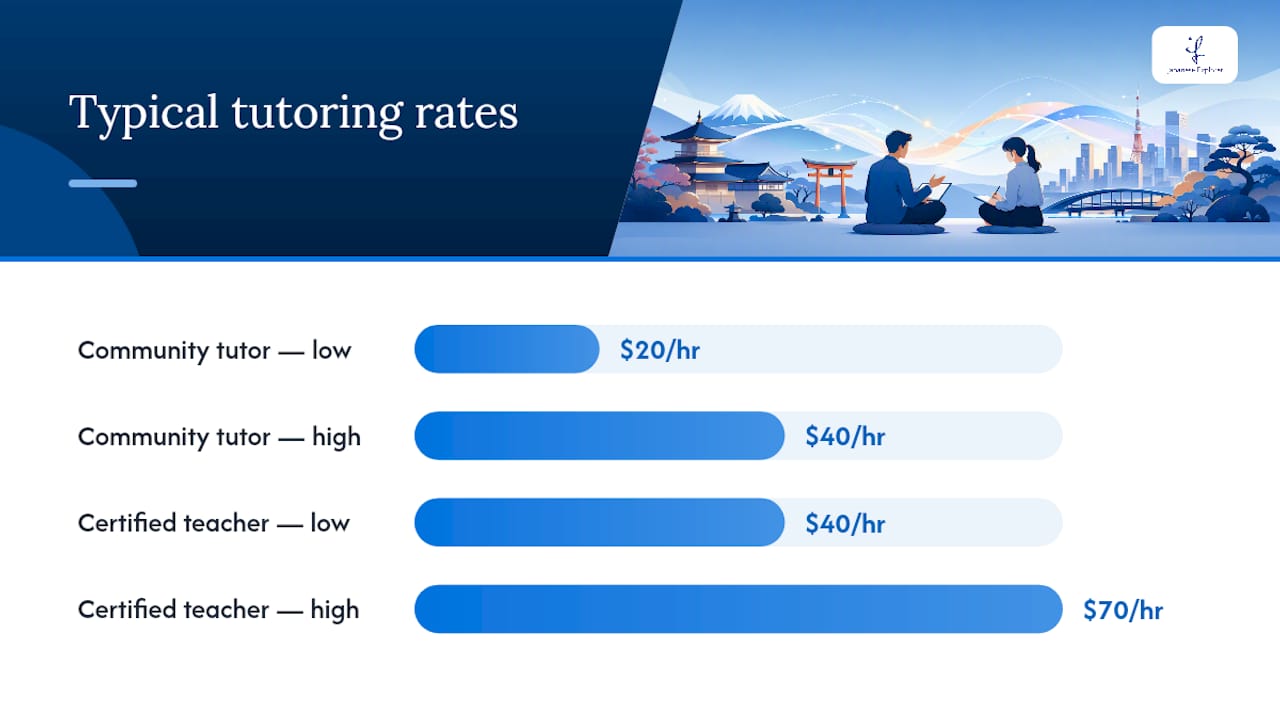
Statistic Callout: Learners with regular tutor sessions show notably faster speaking progress than those relying on apps alone, and typical tutoring rates run $20 to $40 per hour for community tutors and $40 to $70 per hour for certified teachers.
How Do You Choose the Right Japanese Course?
Picking a course comes down to six checkable criteria: instructor credentials, class size, placement testing, syllabus specificity, scheduling flexibility, and price relative to what you actually get.
- Instructor credentials: Ask whether teachers are bilingual and formally trained, not just native speakers with no teaching background.
- Class size: Six or fewer students usually means real speaking time each session.
- Placement testing: A course that skips this step risks putting you in a class that bores or overwhelms you.
- Syllabus specificity: “Conversational Japanese” is vague. “Meeting phrases, email structure, and keigo basics by week six” is a real plan.
- Flexibility: Confirm whether missed sessions can be made up online or rescheduled.
- Price versus value: Group lessons cost less per hour, but factor in how much actual speaking time you get for that price.
Ask providers directly: “Can I try a trial lesson before committing?” “How many students are typically in a group class?” “Is there a placement test, and how does it shape which class I join?” Their answers tell you more than any marketing page will.
Red flags are consistent across the industry: courses with no speaking practice built in, outcomes described only in vague terms like “become fluent,” and any provider that skips placement testing entirely. If a course cannot tell you what you will be able to say by week eight, it likely does not have a real plan for getting you there.
Pro Tip: Book a trial lesson even if you are fairly confident about the course. A single session tells you more about teaching style and pace than any syllabus PDF ever will.
Are Adult Japanese Courses Really Different From School Curricula?
Yes, and the difference goes deeper than pacing. Courses adapted from secondary school curricula are typically built around exam syllabi, grammar sequences tied to standardized testing, and vocabulary chosen for breadth rather than immediate use. That structure serves a very different goal: passing a national assessment on a fixed academic timeline.
Adult learner courses flip that priority. Instead of building toward an exam scheduled months away, a working professional needs vocabulary they can use in Monday’s meeting or Tuesday’s email. Grammar still matters, but it gets introduced in the order you will actually need it, not the order a textbook committee decided decades ago.
The practical result is that adult courses tend to move faster through foundational material and slower through workplace-specific content like keigo and meeting phrases, precisely the areas a general curriculum treats as advanced or optional. A course built for adults also assumes you can self-direct, set your own milestones, and study outside class hours in ways a structured academic program does not require.
If you have ever tried applying a school-style textbook to your job and found it left you unable to write a basic work email, this is likely why. The content was never built for your actual use case, even if the vocabulary overlapped on paper.
Do Teaching Methods for Adults Differ From Traditional Classroom Instruction?
Substantially, yes. Traditional instruction, the kind built for a school-age audience, tends to lean on repetition drills, written tests, and a fixed sequence everyone follows regardless of individual goals. It works reasonably well for students with years ahead of them to absorb material gradually.
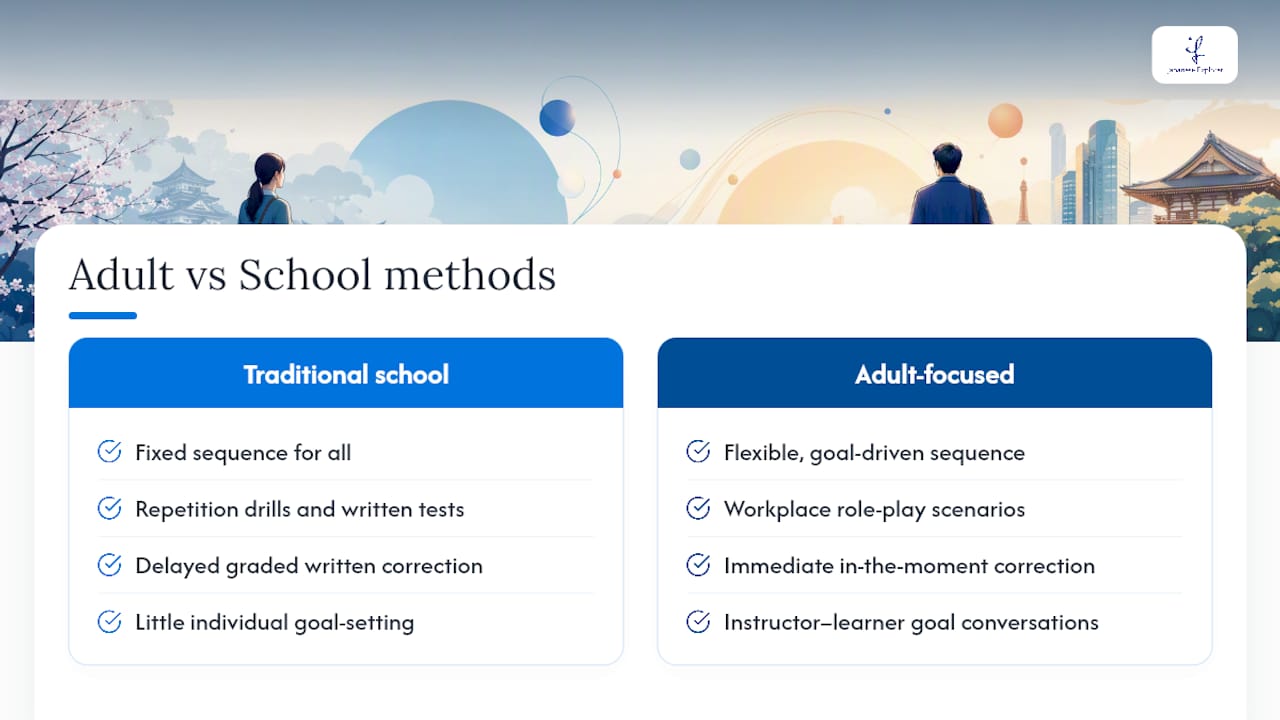
Adult education flips that model toward relevance and speed. Effective adult courses use role-play scenarios pulled from real workplace situations, error correction that happens in the moment rather than on a graded paper returned a week later, and goal-setting conversations where you and your instructor define what “success” looks like for your specific job.
Active speaking tactics matter more in adult methodology too. Techniques like echoing a teacher’s pronunciation, shadowing recorded dialogue, and recording your own speech for playback close the gaps that passive listening leaves behind, and they show up far more often in adult-focused programs than in classroom curricula built around silent reading and written grammar exercises.
The other major difference is pacing control. Adult courses generally let you move faster through material you already grasp and slower through material that trips you up, since there is no cohort of thirty students to keep synchronized. That flexibility is one of the clearest practical advantages adult learners have over a fixed academic track.
What Do Adult Learners Say About Switching From School-Style Japanese?
Adults who first encountered Japanese through a school-style curriculum, then returned to it years later through an adult-focused course, consistently describe the same shift: material that once felt abstract suddenly feels usable. Grammar patterns that seemed arbitrary in a classroom setting click once they are tied to an email you actually need to send or a meeting you actually need to survive.
This pattern shows up often enough to be a meaningful signal for anyone judging their own past frustration with Japanese. If you studied it in school and walked away thinking you were “bad at languages,” the more likely explanation is that the curriculum was built for a different goal than the one you had.
Adult learners also tend to report faster confidence gains once they start speaking regularly instead of just reading and writing, echoing the broader finding that active, goal-directed study outperforms passive exposure for adults specifically. The combination of real-world stakes, a job that needs the language now, and instruction built around that urgency, tends to produce noticeably quicker progress than an academic timeline ever allowed.
None of this means school-based instruction failed you. It means the goals were different, and matching your course to your actual goal now is the variable that changes outcomes.
How Do You Know What Level of Japanese You’re Actually At?
Before picking any course, get an honest read on where you stand. Most adults overestimate their reading ability and underestimate their speaking ability, since years of textbook study builds recognition skills that never get tested in actual conversation.
A structured placement test solves this by testing grammar, vocabulary, and often spoken response in one sitting, giving you a level that reflects your real ability rather than your self-perception. This matters because starting in the wrong class wastes both time and money. Land in a class too advanced, and you spend weeks lost. Land in one too basic, and you spend weeks bored and disengaged.
If a formal test is not available yet, a rough self-check works as a stopgap: can you introduce yourself and ask basic questions without translating in your head first? Can you read a simple email and follow its general meaning, even if you miss some vocabulary? Can you follow a slow conversation between two native speakers on a familiar topic? Your honest answers to those three questions point roughly toward beginner, intermediate, or advanced placement.
Taking an actual placement test removes the guesswork entirely and gives you a documented starting point to measure progress against later, which matters more than it sounds once you are three months into a course and want proof you are actually improving.
What Self-Study Resources Actually Help Adult Learners?
Class time alone rarely gets you to fluency. What happens between lessons, the fifteen minutes you spend reviewing on a train or the recorded conversation you replay before bed, often determines how fast you progress.
Spaced repetition apps handle vocabulary retention efficiently, feeding you words right before you would otherwise forget them. Recording yourself speaking and playing it back exposes pronunciation habits you cannot hear in real time, a tactic that directly improves spoken accuracy when done consistently after lessons.
Podcasts and slow-paced listening content build the ear training that classroom time alone cannot fully provide, since real speech moves faster and less clearly than a textbook dialogue. Immersive cultural content, travel shows, cooking programs, or culture-focused travel content, gives context to phrases you learn in class and makes vocabulary stick because it is tied to something memorable rather than a flashcard in isolation.
The mistake most adult learners make with self-study is treating it as passive review instead of active practice. Rereading notes feels productive but rarely builds speaking ability. Speaking your notes aloud, even alone in a room, does far more for retention than another quiet read-through ever will.
What Should You Expect After Twelve Weeks of Study?
A well-structured first twelve weeks combines speaking drills, grammar taught in context rather than isolation, and role-play scenarios that mirror situations you will actually face at work or in daily life. Placement testing at the start shapes everything that follows, since it determines whether week one covers basics you already know or material that genuinely stretches you.
By the end of a focused twelve-week course, most adult learners can comfortably handle everyday workplace openings, greetings, small talk, and task confirmations, along with safe, professional email openers that will not embarrass them in front of a Japanese colleague. Meeting phrases, the vocabulary for agreeing, disagreeing politely, and asking clarifying questions, tend to arrive by week eight or nine for learners who practiced speaking consistently rather than just reviewing grammar.
These outcomes assume regular practice between sessions, not just attendance. A learner who shows up to class but never speaks outside it will progress noticeably slower than one who reviews for even ten minutes daily.
— Paul
Ready to Start With a Course Built for Working Adults?
Japanese Explorer gives working adults a faster, less wasteful starting point than piecing together apps and free YouTube lessons on your own: a placement test tells you exactly where to begin, and a curriculum guided by Association for Japanese-Language Teaching standards means you are not the one designing your own syllabus from scratch.
Classes are taught by instructors who structure every lesson around grammar, speaking, and listening together, rather than treating them as separate skills to master in isolation. Formats include group, private, or online over Zoom, so the course adapts to your schedule instead of demanding you rearrange your week around it. Professionals aiming specifically at workplace Japanese can go straight to the business Japanese course, while companies looking to upskill teams can explore corporate training options. If you are not sure where you stand yet, start with the placement test, or browse the full small-group class schedule to see what fits your week. Classes run from the training centre at 10 Anson Road, Level 22, International Plaza, right above Tanjong Pagar MRT or entirely online if that suits you better. Book a trial lesson this week and find out exactly where your Japanese stands before committing to a full course.
Sources
- How to Learn Japanese as an Adult: 5 Science-Backed Methods – GaijinPot
- Business Japanese: A Complete Map of the 6 Areas (+ 90-Day Roadmap) | Real-World Japanese
- Is it worth getting a Japanese tutor? Costs, benefits, and when to hire – Preply
- 5 Tips to Get the Most Out of Online Japanese Lessons – NihongoKnow
FAQ
What Is the Best Japanese Course Format for Busy Professionals?
A blended format, combining scheduled instructor-led sessions with independent online practice, generally works best because it delivers live feedback without requiring a rigid weekly commute.
How Long Does It Take to Reach Conversational Japanese as an Adult?
Most adults reach basic workplace conversational ability within twelve weeks of consistent study, though reaching JLPT N2 level typically takes considerably longer and depends on study frequency.
Do I Need to Take a Placement Test Before Starting a Course?
Yes. A placement test confirms your actual starting level, which prevents you from landing in a class that is either too advanced or too basic for your real ability.
How Much Does a Japanese Tutor or Course Typically Cost?
Community tutors generally charge $20 to $40 per hour, while certified teachers charge $40 to $70 per hour, with group classes costing less per person than private lessons.
What Is the Difference Between JLPT and BJT for Business Japanese?
JLPT measures general Japanese proficiency across five levels, while the Business Japanese Proficiency Test specifically evaluates workplace communication skills, making it a more direct benchmark for professional readiness.