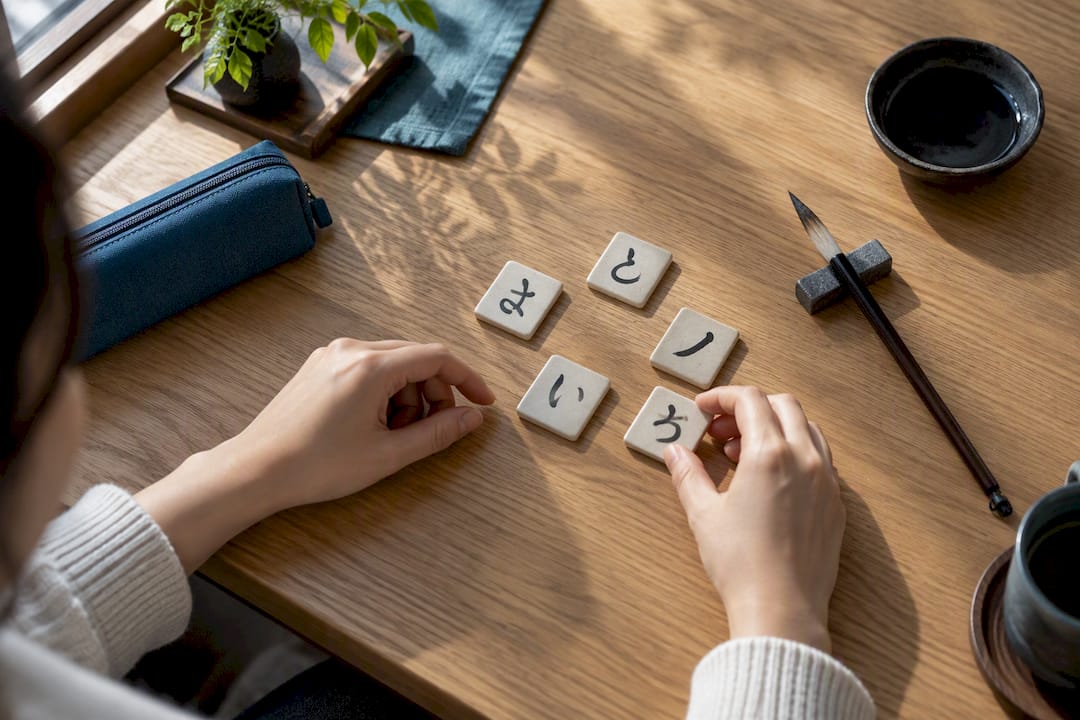
Use the Japan Foundation’s official hiragana chart and stroke-order animations alongside this guide. The sections below explain the character groups, extended sounds and ways to practise before starting Japanese lessons.
What Is Hiragana (and why it’s taught first)
If you’re serious about Japanese, Hiragana is your first milestone. It’s a phonetic syllabary (not an alphabet) with 46 base characters, used for native words, particles, and verb/adjective endings. Mastering it unlocks pronunciation, grammar endings, and most beginner texts. Historically, hiragana evolved from cursive forms of kanji (man’yōgana); today it’s the script that makes sentences readable, even when kanji are unknown.
The Hiragana Chart (五十音図 / gojūon): How it’s organised
The gojūon table arranges sounds by rows of vowels (a, i, u, e, o) and columns of consonants (k, s, t, n, h, m, y, r, w). Learn the five pure vowels first—あ, い, う, え, お—then “attach” consonants to unlock か/き/く/け/こ, さ/し/す/せ/そ, and so on. This structure makes memorisation methodical and predictable.
Why the chart matters for beginners
- You see every core sound at a glance.
- You can group practice by row (vowels) or column (consonant families).
- It sets you up for extended sounds (see below).
Stroke Order: The difference between “recognisable” and “readable”
Good handwriting isn’t about art—it’s about legibility and speed. Hiragana has consistent stroke direction (generally top-to-bottom, left-to-right), which produces balanced shapes and makes your writing instantly recognisable to natives.
Starter examples (first five vowels)
For あ (a), い (i), う (u), え (e) and お (o), select the character on the official chart to follow its stroke-order animation and hear its pronunciation. Practise the numbered strokes instead of relying on a shorthand description of the shape.
How to practise stroke order properly
- Use grid paper for size and alignment.
- Write two lines per day (not twenty) so you can focus on form.
- Ask for corrections early; bad habits fossilise quickly.
Extended Hiragana: Dakuten, Handakuten, Yōon & small っ
Once the base 46 are comfortable, you’ll meet these sound modifiers:
- Dakuten (゛): voice the consonant
- か→が, さ→ざ, た→だ, は→ば
- Handakuten (゜): p-sounds
- は→ぱ
- Yōon (ゃ/ゅ/ょ): contracted blends after an -i kana
- き + ゃ→きゃ (kya), し + ゅ→しゅ (shu), ち + ょ→ちょ (cho)
- Small っ (sokuon): doubles the next consonant
- さか (saka) vs さっか (sakka)
These are vital for real-world pronunciation, covered in our Japanese Online Course where you can practise listening and reading exercises interactively.
What this changes for reading and speech
These marks expand the sound set without adding “new letters,” so you’ll read words more naturally (loanwords via katakana follow a parallel logic later).
Hiragana Mnemonics: Remember shapes in days, not months
Your brain loves pictures and stories. Link each shape to a visual cue:
- あ (a) looks like an apple with a stem.
- い (i) like two eels side-by-side.
- そ (so) like a sewing stitch.
Use a consistent mnemonic set, say them aloud, and review with spaced repetition. For most adults, solid daily mnemonics + 10–15 minutes of writing will lock the chart within 1–3 weeks.
Pronunciation: Vowels first, then rhythm
Japanese pronunciation is syllable-timed. Get these right early:
- Five vowels: a /a/, i /i/, u /ɯ/, e /e/, o /o/ (short and clean).
- Keep syllables even; avoid English-style stress drift.
- Learn the particle exceptions (は read “wa”, へ read “e”) to avoid confusion in sentences.
Reading Comes Before Perfection (yes, start early)
Don’t wait to “finish the chart” before you read. Start with:
- single-kana words (あめ, いえ, さけ)
- furigana above kanji in beginner texts
- graded readers with audio
Five minutes a day builds automaticity—recognition without sounding out every kana.
A Simple 14-Day Hiragana Plan (busy-proof)
Daily (10–15 min)
- Write two lines of today’s set (focus on form).
- Review SRS deck (10–20 cards).
- Read six words out loud (mix old + new).
Day 1–3: vowels + K column
Day 4–6: S + T
Day 7–8: N + H
Day 9: M + Y
Day 10: R + W/ん
Day 11: dakuten / handakuten
Day 12: yōon (きゃ/しゅ/ちょ etc.)
Day 13: small っ + contrast drills (saka/sakka)
Day 14: recap + mini reading
Need structured accountability? Our Japanese Language Courses in Singapore guide you through hiragana, katakana, and grammar foundations with flexible scheduling for working adults.
Common Beginner Mistakes (and quick fixes)
- Mix-ups (ぬ/め, さ/ち, る/ろ): make a look-alike list and drill pairs side-by-side.
- Over-reliance on rōmaji: taper it off after week one; force kana reading.
- Skipping stroke order: set one form goal per session (e.g., “clean curve on あ”).
- Not saying sounds aloud: tie ear + mouth + hand every time you practise.
Hiragana vs Katakana vs Kanji (where this fits in the system)
- Hiragana: native words, grammar endings, particles.
- Katakana: foreign words, names, emphasis, onomatopoeia.
- Kanji: meaning-bearing characters that disambiguate homophones.
You’ll learn katakana soon after (same sounds, different shapes), then layer in high-frequency kanji. Hiragana gives you full sentence access from day one.
Tools & Resources (quality over quantity)
- Printable chart + stroke sheets: keep one by your desk.
- SRS apps: build your own deck so mnemonics match your brain.
- Audio packs: short, clear recordings of the 46 + extensions.
- Trusted primers:
- Tofugu: Learn Hiragana — excellent mnemonic set.
- NHK: Easy Japanese — bite-sized lessons with audio.
Conclusion
Hiragana is the shortest path to real Japanese. Learn the chart, lock in stroke order, leverage mnemonics, and read a little every day. In two weeks, you’ll hear and see the progress—then katakana and basic kanji won’t feel daunting.
Start strong with our Beginner Japanese Course, or level up with our Advanced Japanese Class today.
Hiragana Practice Worksheet
Print this page or work through it on screen. The gojuon table below follows the order used by the Japan Foundation’s Marugoto course. Select any character on their chart for stroke-order animations.
Gojuon Reference Table (46 base characters)
| a | i | u | e | o | |
|---|---|---|---|---|---|
| Vowels | あa | いi | うu | えe | おo |
| k- | かka | きki | くku | けke | こko |
| s- | さsa | しshi | すsu | せse | そso |
| t- | たta | ちchi | つtsu | てte | とto |
| n- | なna | にni | ぬnu | ねne | のno |
| h- | はha | ひhi | ふfu | へhe | ほho |
| m- | まma | みmi | むmu | めme | もmo |
| y- | やya | ゆyu | よyo | ||
| r- | らra | りri | るru | れre | ろro |
| w- | わwa | をo / wo | |||
| んn | |||||
Exercise 1: Fill in the missing hiragana
Write the hiragana character that completes each row. Cover the reference table above before you start.
- か, き, ___, け, こ
- さ, ___, す, せ, そ
- た, ち, つ, ___, と
- な, に, ぬ, ね, ___
- は, ひ, ___, へ, ほ
- ___, み, む, め, も
- ら, ___, る, れ, ろ
Exercise 2: Romaji to hiragana
Write the hiragana for each romaji word. Each word uses only gojuon characters.
- sakura (cherry blossom): ___ ___ ___
- neko (cat): ___ ___
- yama (mountain): ___ ___
- kawa (river): ___ ___
- sushi: ___ ___
Exercise 3: Dakuten and handakuten
Add the correct diacritical mark (゛ or ゜) to change the base character into the target sound.
- か → ___ (ga)
- た → ___ (da)
- は → ___ (ba)
- は → ___ (pa)
- さ → ___ (za)
Answers
Exercise 1: 1. く (ku) 2. し (shi) 3. て (te) 4. の (no) 5. ふ (fu) 6. ま (ma) 7. り (ri)
Exercise 2: 1. さくら 2. ねこ 3. やま 4. かわ 5. すし
Exercise 3: 1. が 2. だ 3. ば 4. ぱ 5. ざ
Character order and reading labels can be checked against the Japan Foundation’s Marugoto hiragana reference. These are original practice exercises, not official JLPT questions or a placement assessment. Roman letters are reading aids; use the linked reference for listening and stroke order.
For taught lessons, compare Japanese Explorer’s beginner course and its current syllabus and intakes. The trial-class page explains the booking option and published terms.