For structured, teacher-led online Japanese lessons, Japanese Explorer is the strongest overall pick. It pairs a syllabus mapped to real proficiency levels with certified bilingual instructors who give live feedback over Zoom, which is exactly what self-study apps cannot replicate. If your goal is different, three alternatives fit specific needs well: a self-paced SRS plus graded-reader stack for disciplined solo learners, audio-first courses for fast listening and speaking gains, and 1:1 tutors for targeted output correction.
- Structured syllabus built around measurable levels, not random lesson order
- Qualified instructors who correct speaking and writing in real time
- Clear outcomes you can track month to month, not just streaks or badges
Key Takeaways
Structured, teacher-led online Japanese lessons combining a leveled syllabus, live feedback, and spaced repetition produce faster, more measurable progress than app-only study.
| Point | Details |
|---|---|
| Structure beats randomness | Choose a course mapped to proficiency levels rather than a random collection of lessons. |
| Feedback closes the gap | Live correction from a qualified instructor turns passive recognition into active speaking ability. |
| Match format to goal | Self-paced SRS suits solo learners; tutors suit business or targeted correction needs. |
| Budget realistic timelines | Expect roughly several hundred hours for JLPT N5 and 12 to 18 months for conversational fluency. |
| Japanese Explorer for structure | Offers live Zoom classes, certified bilingual instructors, and placement testing for adult learners. |
Useful Free Resources to Continue Your Research
- Marugoto Japanese Online Course: structured A1 to A2 content with tutor support
- NHK WORLD-JAPAN: graded video lessons for everyday conversation
- JF Japanese e-Learning Minato: flexible self-paced courses with downloadable materials
- Tofugu’s Japanese guide: SRS and kanji strategy explained in depth
Table of Contents
- What Makes a Good Online Japanese Course?
- Why Japanese Explorer Is Our Top Pick for Structured Learning
- Other Course Types and When They Make Sense
- How Do You Choose the Right Online Japanese Course?
- How Long Does It Take to See Progress, and What Does It Cost?
- Why Flashcard-Only Study Plans Stall Progress
- Ready to Start? Here’s What Your First Month Looks Like
- Sources
- FAQ
What Makes a Good Online Japanese Course?
A good course is built around a syllabus that maps to actual proficiency levels, not a random pile of videos. Look for lessons that progress logically from kana through grammar structures, with each unit building on the last instead of jumping around based on what’s trending.
Instructor quality matters more than most learners expect. A course taught by a qualified, bilingual teacher who can explain grammar in your native language while modeling native pronunciation will get you speaking faster than a native-only immersion class with no scaffolding. Comprehensible input, meaning material pitched just slightly above your current level, keeps you engaged without drowning you in unfamiliar vocabulary, according to Japanese Explorer’s study plan research. Spaced repetition for vocabulary and kanji is well documented as effective, and Tofugu’s guide to learning Japanese recommends pairing SRS with graded reading rather than using it alone.
Trust signals worth checking before you commit:
- Sample lessons or a recorded demo you can watch before paying
- Instructor bios listing certification and teaching experience
- A placement test to confirm you start at the right level
- Course scope that names speaking, listening, reading, writing, and kanji separately
Red flags are just as telling. Flashcard-only apps with zero speaking practice, courses with no visible syllabus, and programs offering no feedback loop on your output all tend to stall learners around the same plateau.
Why Japanese Explorer Is Our Top Pick for Structured Learning
Japanese Explorer’s curriculum follows guidance from the Association for Japanese-Language Teaching, which keeps grammar, speaking, and listening integrated in every lesson rather than siloed into separate tracks. Classes run live over Zoom with certified bilingual instructors, so you get real-time correction instead of a recorded lecture you passively watch.
The difference between a course that works and one that doesn’t usually comes down to whether a real instructor is watching you practice and correcting you before mistakes become habits.
What the program offers:
- Live Zoom lessons with certified bilingual instructors
- Flexible group and private class formats depending on your schedule and budget
- A placement test so you start at the right level instead of repeating material you already know
- Lesson structure covering speaking, listening, reading, writing, and dedicated kanji support
It’s a strong fit across several profiles. Best for structured beginners who want a clear path from kana to conversational fluency. Best for business Japanese, with a corporate training track built around workplace scenarios. Best for adult learners who want teacher feedback on pronunciation and grammar rather than app-based guessing.
Starting is straightforward: take the placement test, review your recommended level, and enroll in either a small-group class or the dedicated online course.
Other Course Types and When They Make Sense
Not every learner needs a live instructor from day one. Self-paced SRS plus graded-reader combinations suit disciplined learners who enjoy independent study and want to build vocabulary and reading speed on their own schedule. The Guide to Japanese free resource follows this model well, sequencing kana, vocabulary, and grammar with example dialogues you work through solo.
Audio-first courses accelerate listening comprehension and speaking confidence quickly, since you’re absorbing natural rhythm and pitch from day one. The trade-off is reading and writing tend to lag behind unless you deliberately add kanji practice alongside.
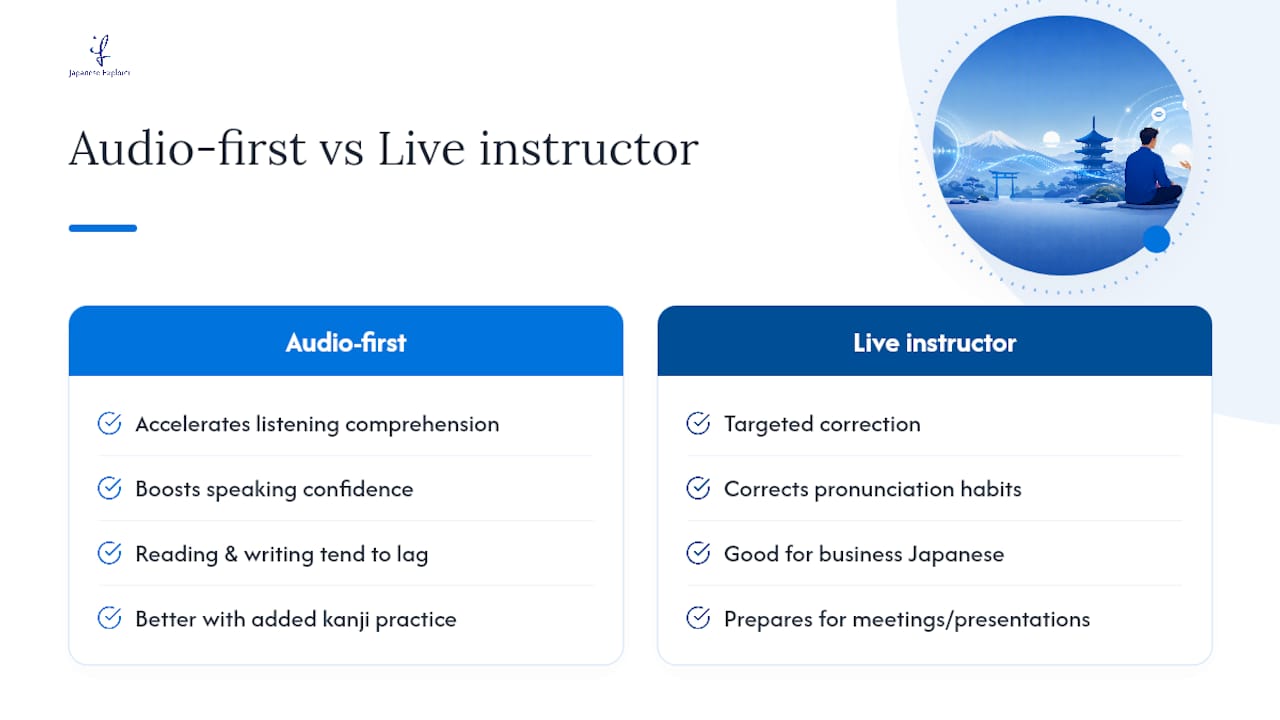
1:1 tutoring earns its cost when you need targeted correction, especially for business Japanese or specific pronunciation habits that group settings can’t address individually. Private lessons work well for professionals prepping for a specific meeting or presentation.
Kanji-focused SRS tools deserve a place in almost every learner’s routine once vocabulary volume grows past a few hundred words, since flashcards alone struggle to keep pace with kanji recall demands.
Pro Tip: If you’re prepping for the JLPT, stack a live grammar-focused class with a kanji SRS tool and 15 minutes of graded reading daily. For pure conversation goals, weight your week toward audio input and live speaking practice over flashcards.
How Do You Choose the Right Online Japanese Course?
Start with a short list of questions before you hand over payment details:
- Does the course include a placement test, or does everyone start at lesson one regardless of prior study?
- Are instructors certified, and can you see their teaching background?
- Is the format live, recorded, or a mix, and does that match how you actually learn?
- What does feedback look like: corrected homework, live speaking practice, or nothing at all?
- How large are group classes, and does that leave room for individual speaking time?
- What’s the cancellation or refund policy if the pace doesn’t fit your schedule?
How you weight these depends on your goal. Beginners should prioritize structure and pacing over speed. JLPT candidates need strong grammar coverage and kanji volume. Business learners should check whether the curriculum includes workplace vocabulary and meeting etiquette, not just textbook dialogue.
Watch for dealbreakers during any trial or free class:
- The instructor never corrects your pronunciation or grammar during the session
- Homework exists but nobody reviews it before the next class
- The syllabus jumps between unrelated topics with no visible progression
- Class size is so large you get less than a few minutes of speaking time
A four-week trial is long enough to judge fit. Track your attendance, whether homework gets reviewed, and whether you can complete a slightly harder task in week four than you could in week one. If you can’t measure any progress by then, the format isn’t right for you.
How Long Does It Take to See Progress, and What Does It Cost?
Progress timelines are more predictable than most learners assume. Shinobi Japanese estimates that kana takes about two weeks of focused study, JLPT N5 level takes roughly several hundred hours of study, and conversational ability generally arrives after 12 to 18 months of consistent practice.
Cost varies significantly by format:
- Self-paced subscriptions and SRS tools tend to be the cheapest entry point, often billed monthly
- Group live classes sit in the middle, bundling instructor access with a fixed schedule
- Private tutoring costs more per hour but compresses timeline for specific goals like business Japanese
Intensity changes everything. Roughly 30 minutes of daily study, split between SRS review, grammar, and graded input, gets a motivated learner to N5 level in about six months. Doubling that intensity shortens the timeline, but consistency across months matters more than any single long study session.
Why Flashcard-Only Study Plans Stall Progress
Many learners get stuck in what amounts to flashcard purgatory: endless vocabulary review with no real communication practice attached. Comprehensible input research suggests the fix is exposure to material just slightly above your current level, whether through reading, listening, or conversation, rather than isolated memorization drills.
Teacher-guided practice bridges the gap between passive recognition and active production. Recognizing a word on a flashcard is not the same skill as producing it correctly in a sentence under time pressure, and that’s precisely where live feedback earns its value.
Rote memorization gets you recognition. Only production practice, ideally corrected by a real instructor, gets you fluency.
A balanced weekly routine might run 10 minutes of SRS review, 10 minutes of grammar study, and 15 minutes of graded reading or listening daily, supplemented by at least one live speaking session per week where an instructor can catch mistakes before they calcify into habits.
A Note From Paul
I recommend Japanese Explorer because structured, teacher-led lessons consistently outperform app-only study for adults who want measurable progress, not just streaks. This isn’t a claim that self-study can’t work. It’s a reminder that a real instructor catching your mistakes early saves months of relearning things the wrong way.
Ready to Start? Here’s What Your First Month Looks Like
Enrolling starts with a placement test so you’re not stuck repeating material you already know or thrown into content too advanced to follow. From there, your first month typically includes a syllabus overview session, weekly live Zoom classes, and homework that gets reviewed with direct feedback, not just a grade.
If you’ve been comparing self-paced apps against live instruction, the trade-off usually comes down to this: apps are cheaper upfront but leave your speaking and writing uncorrected, while live classes cost more but catch mistakes before they become habits. Japanese Explorer’s small-group classes and dedicated online course both include that live correction loop, plus flexible scheduling if you’re balancing work and study. Business learners can explore the corporate Japanese course built specifically around workplace communication. Take the placement test today to see which class level and format fits your schedule and goals.
Sources
- MARUGOTO JAPANESE ONLINE COURSE
- How to Learn Japanese in 2026: A Complete Beginner’s Guide · Shinobi Japanese
- Learn Japanese: A Ridiculously Detailed Guide
FAQ
What Is the Best Online Platform to Learn Japanese?
For structured, teacher-led progress, Japanese Explorer’s online course stands out for combining a leveled syllabus with certified bilingual instructors and live feedback over Zoom.
What Is the Best Free Online Course to Learn Japanese?
Marugoto by the Japan Foundation is a strong free option, offering structured A1 to A2 content that integrates cultural context with practical communication.
What Is the 80/20 Rule in Japanese?
Is Self-Study or a Live Class Better for Learning Japanese?
Self-study works for disciplined learners focused on reading and vocabulary, but live classes with instructor feedback tend to correct speaking and writing mistakes faster, which matters most for conversational and business goals.
How Long Does It Take to Become Conversational in Japanese?
Most consistent learners reach conversational ability in roughly 12 to 18 months, depending on daily study intensity and how much live speaking practice they get.