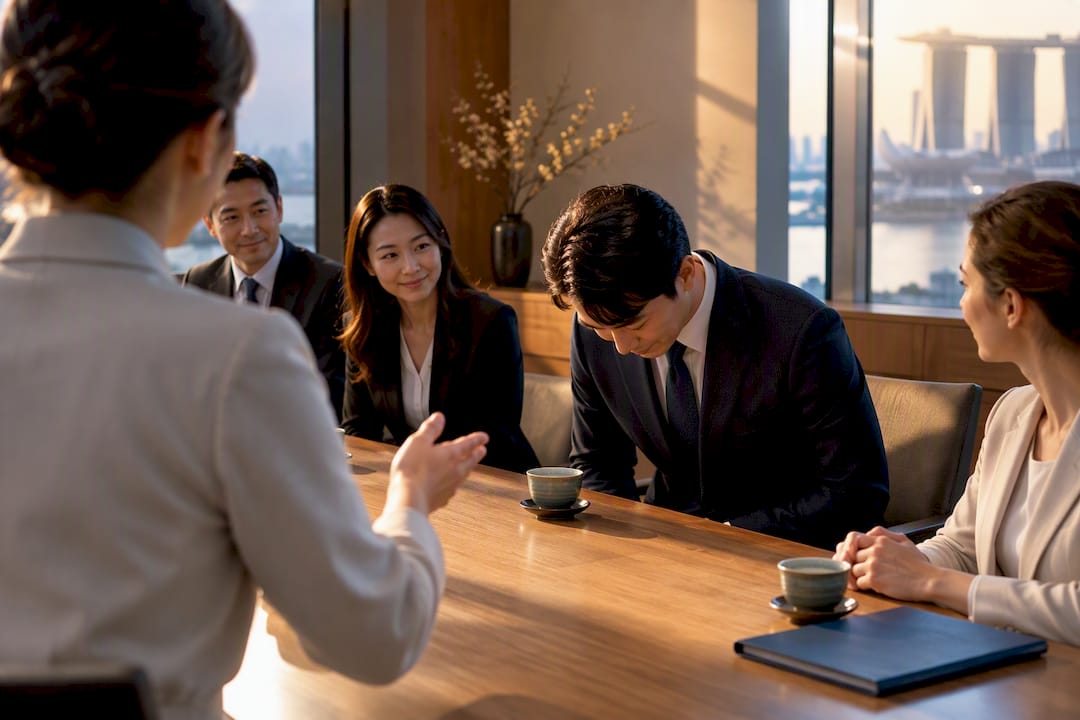
You need eight phrase groups to present confidently in Japanese: openings, transitions, data language, agreement and disagreement, closings, question handling, keigo basics, and cultural etiquette. Polite 丁寧語 (teineigo) is your safest default for almost every business audience. Below you will find copyable lines with romaji and English translations, ready to practice and adapt.
TL;DR:
- Japanese presentations often rely on verbal signposts like next, continuing on, and moving to the next point, with a pause after each transition phrase.
- Softening language in disagreements, such as using “However” or “I also agree,” helps maintain harmony and respect during discussions.
- A typical closing includes stating decisions, upcoming steps, and offering contact information, ending with a polite thank you phrase.
- During questions, use phrases like “Do you have any questions?” or “Could you explain that again?” to manage inquiries diplomatically.
- Default to polite language forms such as teineigo, avoiding advanced honorifics unless confidently used, to maintain professionalism and clarity.
Table of Contents
- Opening lines and self-introduction phrases
- How do you signal moving between points?
- Agreeing and disagreeing without causing friction
- Closing lines that confirm decisions and thank the room
- Handling questions, clarifications, and follow-ups
- Keigo basics every presenter should memorize
- Why consensus culture shapes what you say and show
- Turning phrases into fluent delivery
- Build presentation confidence with structured practice
- Sources
- FAQ
Opening lines and self-introduction phrases
Your first ten seconds set the tone, so keep them simple and polite. A time-appropriate greeting followed by a short self-introduction covers most situations without risk of sounding stiff or overfamiliar.
- おはようございます (Ohayou gozaimasu): “Good morning,” used before noon.
- こんにちは (Konnichiwa): “Good afternoon,” the safe daytime default.
- 私、[name]と申します (Watashi, [name] to moushimasu): “My name is [name],” a humble self-introduction.
- 本日の議題は〜でございます (Honjitsu no giday wa ~ de gozaimasu): “Today’s agenda is…”
After the greeting, state your role and company plainly: “[会社名]の[名前]と申します” covers company and name together. Follow with the agenda line above, then move straight into your first point. Japanese audiences generally expect a brief structural preview before the content starts, so this two-line opening does real work.
How do you signal moving between points?
Japanese presentations lean on verbal signposts more than slide transitions alone. These phrases keep listeners oriented as you move from one section to the next.
- 次に (Tsugi ni): “Next,” for advancing to a new topic.
- 続いて (Tsuzuite): “Continuing on,” a softer alternative to 次に.
- 先ほど申し上げたように (Sakihodo moushiageta youni): “As I mentioned earlier,” for callbacks.
- まとめると (Matomeru to): “To summarize,” before a recap.
- それでは次へ移ります (Soredewa tsugi e utsurimasu): “Let’s move to the next point now.”
A practice example: “続いて、売上データについてご説明いたします” (“Continuing on, I will explain the sales data”) links a transition word directly to the next section’s content, which is how these phrases are actually used rather than dropped in isolation.
Pro Tip: Pause for one full breath after a transition phrase. It gives the audience a moment to mentally close the previous point before you open the next one.
Agreeing and disagreeing without causing friction
Direct disagreement can land harder in Japanese than the same words would in English, so softening language matters here more than almost anywhere else in the talk.
- おっしゃる通りです (Ossharu toori desu): “You are absolutely right,” a strong agreement.
- 私も同意いたします (Watashi mo doui itashimasu): “I also agree.”
- 恐れ入りますが、別の見方もございます (Osoreirimasu ga, betsu no mikata mo gozaimasu): “I’m sorry to say, but there is another perspective.”
- しかしながら (Shikashinagara): “However,” a formal pivot word.
To reframe diplomatically, combine the cushion phrase with a soft pivot: “おっしゃる通りですが、しかしながら別の視点からも検討する価値があると思います” acknowledges the point first, then introduces an alternative without rejecting anything outright.
Closing lines that confirm decisions and thank the room
A clean close matters as much as a strong open. Confirm what was decided, state what happens next, and thank the audience before you sit down.
- 本日の決定事項は〜です (Honjitsu no kettei jikou wa ~ desu): “Today’s decision is…”
- 次は〜を予定しております (Tsugi wa ~ o yotei shite orimasu): “Next, we plan to…”
- 以上でございます。ありがとうございました (Ijou de gozaimasu. Arigatou gozaimashita): “That concludes my presentation. Thank you very much.”
- ご不明な点がございましたら、いつでもご連絡ください (Gofumei na ten ga gozaimashitara, itsudemo go-renraku kudasai): “If you have any questions, please contact me anytime.”
A short adaptable script: state the decision, state the next step, offer contact, then close with “以上でございます。ありがとうございました.” Four lines cover nearly every closing you will need.
Handling questions, clarifications, and follow-ups
Question time often reveals whether your keigo holds up under pressure, so keep your stock phrases ready before you invite questions.
- ご質問はございますか? (Go-shitsumon wa gozaimasu ka?): “Do you have any questions?”
- もう一度ご説明いただけますか? (Mou ichido go-setsumei itadakemasu ka?): “Could you explain that once more?”
- つまり〜ということでしょうか? (Tsumari ~ to iu koto deshou ka?): “So, does that mean…?”
- 確認のうえ、改めてご報告いたします (Kakunin no ue, aratamete go-houkoku itashimasu): “I will confirm and report back to you.”
When you cannot answer fully on the spot, the deferral phrase above is far better than guessing. It signals diligence rather than unpreparedness, and it sets up a natural follow-up email or meeting.
Keigo basics every presenter should memorize
Japanese politeness splits into three registers: 丁寧語 (teineigo, general politeness), 尊敬語 (sonkeigo, honoring the listener), and 謙譲語 (kenjougo, humbling yourself). For live presentations, teineigo is the safe default unless you are confident with the other two.
- 申します (moushimasu): humble form of “to say,” used in self-introductions.
- 拝見する (haiken suru): humble form of “to see,” used when referencing a document.
- いたします (itashimasu): humble form of “to do,” a safe verb ending across many sentences.
Misusing advanced sonkeigo or kenjougo in front of an audience often reads worse than simply staying polite and plain, so resist the urge to reach for a fancier form mid-sentence if you are not certain of it. A short practice sentence to internalize: “資料を拝見し、いたしましたことをご報告いたします” combines all three verbs above in one humble, low-risk line.
Pro Tip: If you are unsure whether a verb form is too casual or too advanced, default to teineigo. A slightly plain sentence reads better than an incorrectly honored one.
Why consensus culture shapes what you say and show
Many Japanese organizations build agreement before the meeting even starts, a practice known as nemawashi. Decisions are often already shaped through informal one-on-one conversations, which means the presentation itself can function as a confirmation step rather than the moment of persuasion.
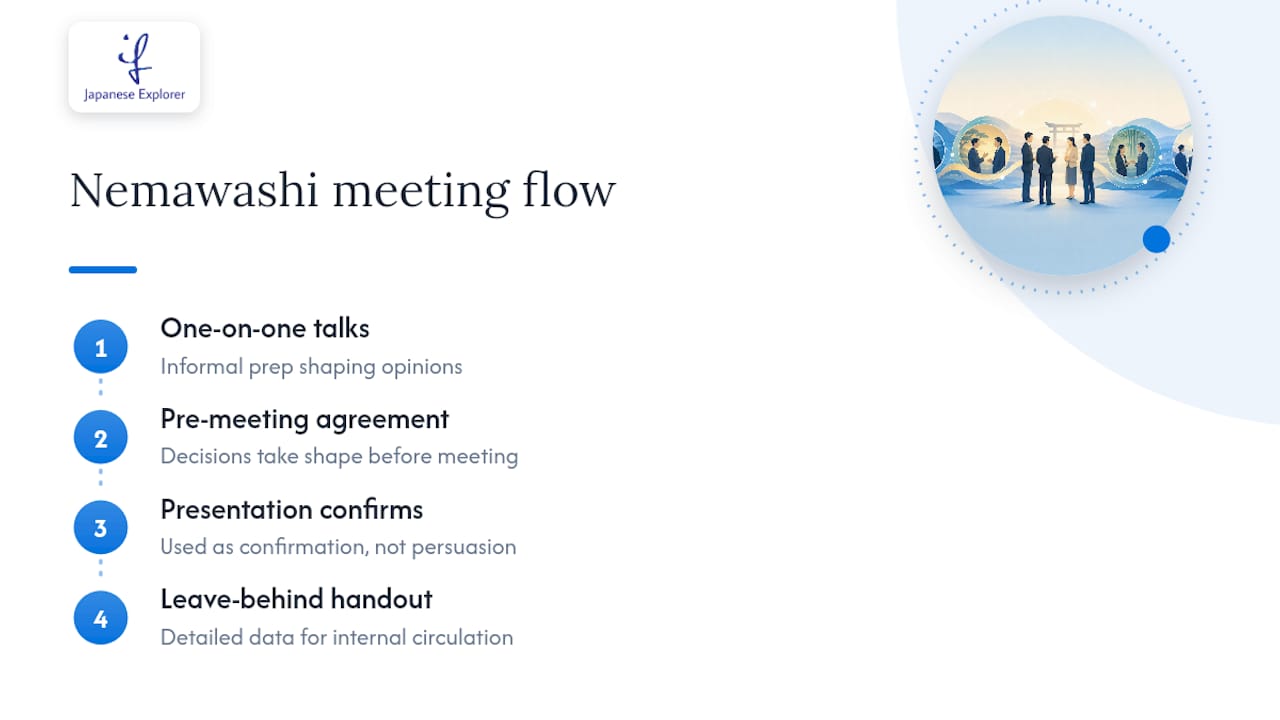
That changes how you should phrase your ask. Instead of pushing for an immediate yes, frame next steps as an invitation to continue discussion: “この点について、引き続きご検討いただけますでしょうか” (“Could we continue discussing this point?”) respects the slower, consensus-driven pace many rooms expect. It also pairs naturally with the handout habit covered earlier: detailed data in the leave-behind material, not the slide, gives stakeholders something concrete to circulate internally after the meeting ends.
Turning phrases into fluent delivery
Reading a list of phrases is one thing. Saying them naturally under the pressure of a real presentation is another. I always tell learners to role-play the whole sequence out loud, opening through closing, before the actual talk, using a colleague or even a phone recording as the audience.
Match your formality to the room rather than defaulting to the most polite option every time. A casual internal update does not need the same keigo density as a client pitch. If you want structured practice with feedback, our guide on meeting phrases for business success and our piece on polite language in Japanese business both build directly on what is covered here.
— Paul
Build presentation confidence with structured practice
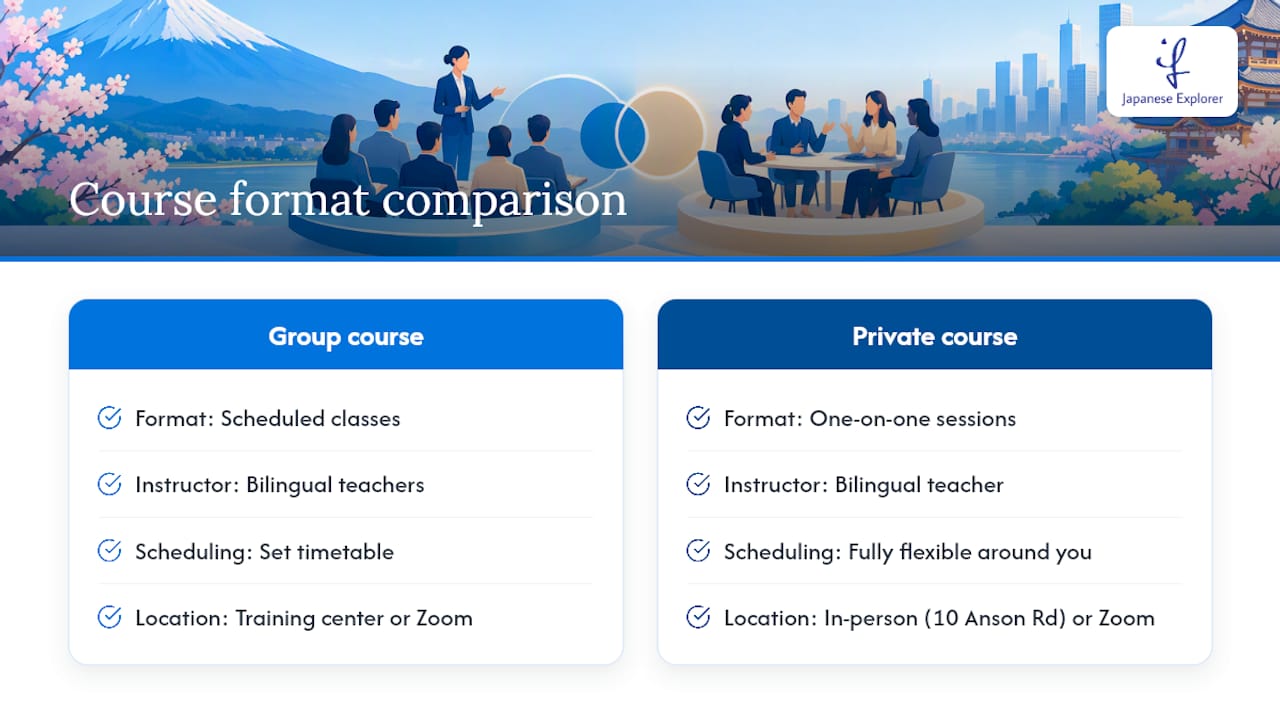
Memorizing phrases gets you through the script, but real confidence comes from practicing them with a bilingual instructor who can correct your pitch, timing, and keigo in real time. Japanese Explorer offers a Business Japanese Course focused on practical, workplace-ready communication, taught by bilingual instructors who explain grammar and etiquette in English.
If you would rather work one-on-one on your own upcoming presentation, the Private Physical or Online Business Japanese Course can be scheduled entirely around your timeline, whether that means weekly sessions building up to a big pitch or an intensive short course before a deadline. Classes run in person at our training center at 10 Anson Road, Level 22, International Plaza, right above Tanjong Pagar MRT, or online over Zoom if that fits your schedule better.
Whichever format suits you, the fastest way to stop second-guessing your keigo is to say the lines out loud with someone who can correct them. Check course availability and enroll through the Business Japanese Course page today.
Sources
- Nemawashi – Wikipedia
- Japanese Business Etiquette and Keigo(敬語): Your Professional Communication Guide | Ponz
- Presenting in Japan: How to balance Western simplicity with Japanese data hunger | Dale Carnegie Japan
FAQ
What are some good phrases to start a presentation?
A time-appropriate greeting such as おはようございます (good morning) or こんにちは (good afternoon), followed by a humble self-introduction like 私、[name]と申します, covers most business openings. Follow immediately with an agenda line such as 本日の議題は〜でございます to preview your structure.
What are 10 key Japanese phrases for presentations?
A practical starter set includes おはようございます, 〜と申します, 次に, まとめると, ご覧ください, 出典は〜です, おっしゃる通りです, しかしながら, ご質問はございますか, and 以上でございます、ありがとうございました. Each covers a different stage of the talk, from opening through closing.
How do you conclude a presentation in Japanese?
State the decision reached, mention the next step, and close with 以上でございます。ありがとうございました, which means “That concludes my presentation, thank you very much.” Offering a follow-up contact line beforehand, such as ご不明な点がございましたらご連絡ください, rounds out a polite close.
What is the Japanese style of presentation called?
There is no single named style used across all business settings, though formats like Takahashi and PechaKucha are used for specific pacing and slide-design needs. Standard business presentations often follow polite teineigo structures with staged openings, data presentation, discussion, and closing sections rather than a single named format.