Group classes in Singapore typically run S$300 to S$700 per term, private lessons cost varying amounts per hour, and intensive courses start around several hundred dollars for condensed programs, according to current listings. Online courses usually undercut in-person pricing. Your fastest next step: compare two course types against your actual goal, then ask each provider for a trial lesson and a written fee breakdown, since your payable amount often shifts once training credits and GST are applied.
TL;DR:
- Course prices can vary widely, with group terms costing S$300 to S$700 and private lessons ranging from S$100 to S$150 per hour.
- Intensive courses start around S$670 but can be significantly more depending on hours and bundled services, while online classes tend to be cheaper than in-person options.
- Course fees are often subject to GST and can be reduced with government training credits or employer sponsorships, depending on individual eligibility.
- Matching your course format to your specific goal, such as conversation or JLPT prep, can affect the cost and instructional intensity required.
- Always clarify the total payable fee, instructor credentials, class size, and session locations before committing to avoid billing surprises.
Table of Contents
- Japanese Course Cost in Singapore by Format
- What a Real Fee Breakdown Looks Like
- What Actually Moves the Price Up or Down
- Budgeting, Paying, and Trimming Your Out-of-Pocket Cost
- Why Trust This Pricing Guide
- A Decision Checklist Before You Book Anything
- How Japanese Explorer Can Help You Get Started
- Where to Verify Fees and Schedules
- Sources
- FAQ
Japanese Course Cost in Singapore by Format
Price in Singapore’s Japanese language market swings hard depending on format, and the gap between the cheapest and priciest option can be five times the cost for the same number of learning hours. Here’s how the main formats stack up.
- Group adult classes: Most schools price a term (usually 8 to 12 weeks) in the mid-hundreds range, which typically works out to somewhere in the moderate price per hour range once you divide by total class hours. This remains the most budget-friendly way to build a foundation, especially for absolute beginners who benefit from the social pressure of a classroom.
- Private lessons: One-on-one tutoring commands a premium, with market rates running S$100 to S$150 an hour at the tutor’s location, and often higher if the tutor travels to you. Many tutors offer a trial lesson at a lower cost before you commit to a package, which is worth taking advantage of before signing anything longer.
- Intensive courses: Bootcamp-style programs compress months of material into weeks, and that convenience costs money. Short intensive packages start around S$670 and climb from there depending on hours and whether housing is bundled in.
- Online classes: Zoom-based courses generally price lower than in-person equivalents because providers save on venue costs, and many offer per-course or subscription pricing rather than a flat term fee. If your schedule is unpredictable, online remains the more forgiving option since rescheduling is usually simpler than with a fixed classroom seat.
- Corporate training: Companies sponsoring Japanese language training for staff usually negotiate a day rate or a per-employee package rather than paying individual course fees, and pricing depends heavily on group size and how customized the curriculum needs to be for the industry.
- JLPT preparation: Test-prep courses are priced separately from the JLPT test registration fee itself, so budget for both. Prep course fees track closely with intensive or group class rates, but the exam registration is a separate, fixed government cost you pay directly to the test administrator.
If you’re weighing formats against your actual timeline, this guide to matching course type with your goal breaks down realistic timeframes for conversational versus exam-focused study.
What a Real Fee Breakdown Looks Like
Numbers on a course page rarely tell the whole story, so it helps to see how a full fee actually breaks down before you pay a cent.
- A beginner-to-intermediate package listing several hundred dollars full fee. After available training credits are applied through the course portal, some learners see their estimated payable fee drop to as low as S$0, though this depends entirely on your individual credit balance and eligibility.
- A similar multi-level course listed at around a thousand dollars full fee. Materials and registration are often bundled into this figure, but always ask whether GST is included in the quoted number or added afterward.
- An intensive short course starting at several hundred dollars. Condensed into fewer weeks with more contact hours per session, this format front-loads the cost but compresses the calendar time.
- Institutional full-time tuition can range in the several hundred dollars per month. Figures published by The Japanese School Singapore explicitly note GST in their fee schedule, illustrating how full-time institutional programs sit in an entirely different price bracket from part-time adult courses.
When you request a quote, ask specifically about minimum commitment hours, whether materials are billed separately, and whether the registration fee is a one-time charge or recurs each term. A beginner-focused course page should list these details clearly, and if a provider won’t put the breakdown in writing, treat that as a caution flag rather than an oversight.
What Actually Moves the Price Up or Down
Five variables explain almost every price difference you’ll see between two Japanese courses quoting wildly different numbers for what looks like the same thing.
- Skill level and intensity. A conversational beginner course costs far less than JLPT N2 prep or business Japanese, which demand more specialized instruction and denser material.
- Instructor qualifications and class size. Smaller classes and instructors with formal teaching credentials tend to sit at the higher end of the price band, since you’re paying for more individual attention per session.
- Timing. Evening and weekend slots frequently carry a premium over weekday daytime classes, simply because demand for those hours is higher.
- Frequency and duration. A longer course spread over more weeks usually costs less per hour than a compressed intensive version, even though the intensive option gets you to fluency faster.
- Format fit for your goal. Conversational fluency, business communication, and JLPT readiness each call for a different course structure, and paying for the wrong one wastes both money and time.
Pro Tip: If your goal is workplace fluency rather than passing an exam, don’t default to the cheapest group class just because it’s available. A business Japanese course built around workplace scenarios will get you further in three months than a general conversational class will in six.
Matching format to goal is the single biggest lever you control. Someone prepping for JLPT N3 in four months needs a different cadence than someone who just wants to order food confidently on a trip to Osaka, and the price difference between those two paths usually reflects the actual instructional intensity, not padding.
Budgeting, Paying, and Trimming Your Out-of-Pocket Cost
Start by adding tuition, materials, and GST together, then dividing by the number of months your course runs. That monthly figure is the number to compare against your actual budget, not the sticker price on the homepage.
- Ask your employer about sponsorship. Many companies budget for staff language development, especially when it supports client-facing or regional roles, so it’s worth a direct conversation with HR before you pay out of pocket.
- Check training credit eligibility before assuming the full fee applies to you. Government-administered training credits can reduce your payable amount substantially depending on your individual balance, and course portals typically show an estimated payable fee that updates once your credit is factored in, though final eligibility should always be confirmed directly with the provider.
- Ask about instalment plans. Not every school advertises this, but many will split a term fee into two or three payments if you simply ask.
- Take the trial lesson. Whether it’s a private tutor or a group class taster session, a trial before you commit is the cheapest insurance against wasting a full term’s fee on a bad fit.
- Watch for red flags. A quote that seems unusually low compared to everything else you’ve seen, vague answers about what’s included, or reluctance to put a fee breakdown in writing are all signs to ask more questions before paying anything.
Why Trust This Pricing Guide
This guide draws on publicly listed course fees, government course-portal data, and direct comparison with Japanese Explorer’s own course structure as a working local example of how adult Japanese pricing plays out in Singapore.
Japanese Explorer runs its curriculum guided by the Association for Japanese-Language Teaching, and offers the full spread of formats covered in this guide: adult group classes, private lessons, business Japanese, online classes, and JLPT preparation. That range matters here because it means the price comparisons above aren’t theoretical; they reflect formats that are actually available and being taught right now.
A school that can show you exactly how its curriculum maps grammar, speaking, and listening across levels gives you a much clearer basis for comparing price to value than one that just lists a fee and a course title.
When you contact any provider, whether it’s Japanese Explorer or elsewhere, check these before paying anything:
- Whether instructors are bilingual and have formal teaching credentials, not just native fluency.
- Whether the curriculum follows a recognized structural standard rather than an ad hoc syllabus.
- Whether class size is disclosed upfront, since a “small group” can mean six students or sixteen depending on who you ask.
- Whether the course page lists actual contact hours, not just a term length in weeks.
A Decision Checklist Before You Book Anything
Here’s how I’d think through this if I were choosing today. Private lessons make sense when your schedule is erratic or your goal is narrow and urgent, like an upcoming work trip. Group classes win on cost-per-hour and suit steady, long-term learners. Intensive courses fit people racing toward a deadline, JLPT or otherwise. Online classes are the right call when convenience matters more than in-person interaction.
Before you commit to any provider, ask these five questions: What’s the total payable fee after any credits I qualify for? Is GST included in the quoted price? Can I take a trial lesson first? What’s your class size and instructor’s background? Where and when exactly are sessions held? Confirming those five answers up front saves you from the most common billing surprises in this market.
— Paul
How Japanese Explorer Can Help You Get Started
Japanese Explorer gives you a fixed, transparent path into Japanese without the guesswork of comparing scattered course listings across the city. Where many providers bury their real payable fee behind vague quotes, Japanese Explorer lists its Group Japanese Classes at a straightforward one-off fee, its private conversational lessons with clear package pricing, and its Business Japanese Course options for professionals who need workplace fluency rather than tourist phrases.
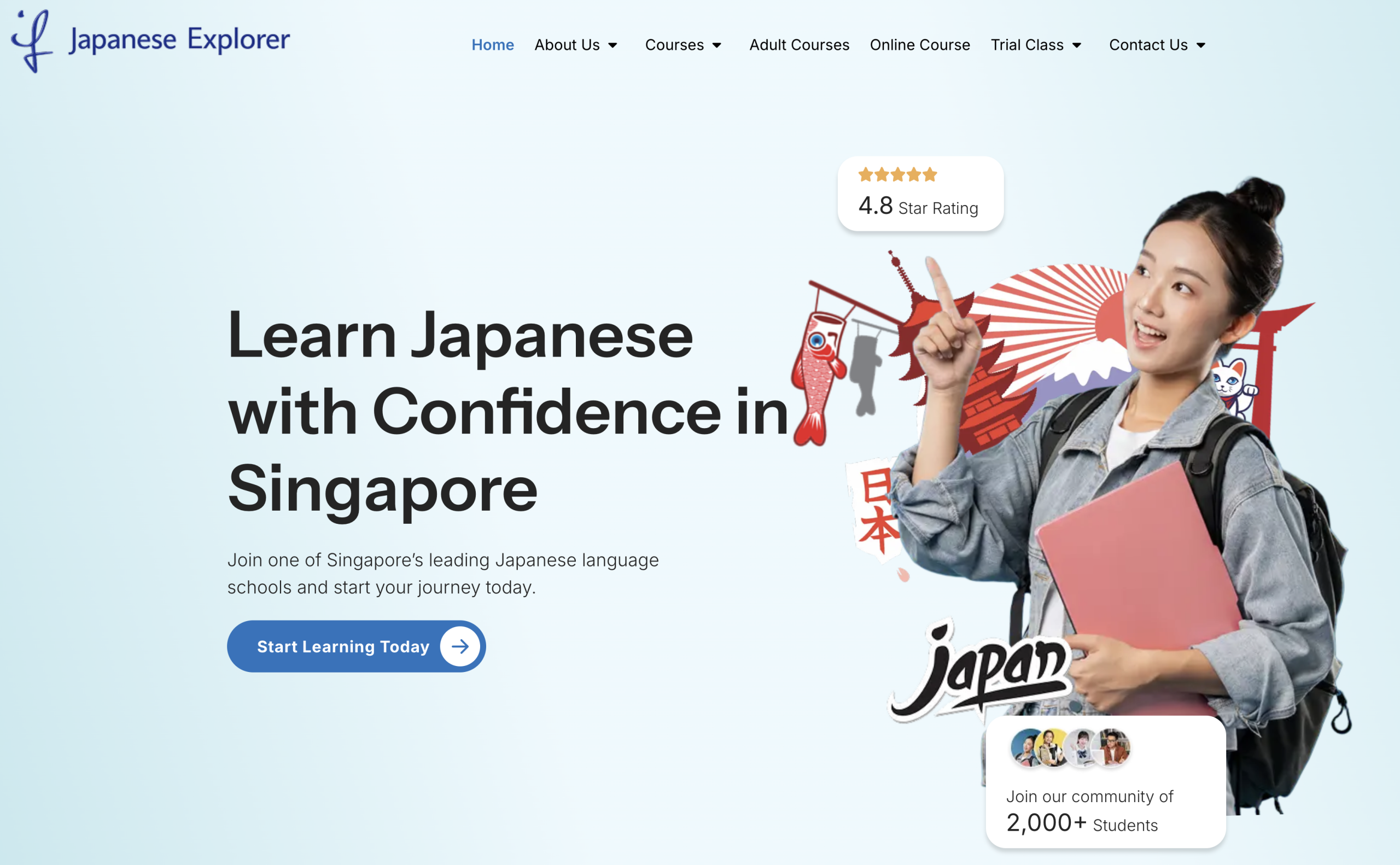
Whether you’re aiming for casual conversation, exam readiness, or client-facing fluency at work, the school’s full range of course formats covers adult group classes, private tutoring, and JLPT preparation under one curriculum guided by the Association for Japanese-Language Teaching. Classes are held at 10 Anson Road, Level 22, International Plaza, Singapore 079903, right above Tanjong Pagar MRT, so getting there after work is straightforward. If you’re ready to see real numbers instead of estimates, check current course fees and ask about a trial lesson before your next term starts.
Where to Verify Fees and Schedules
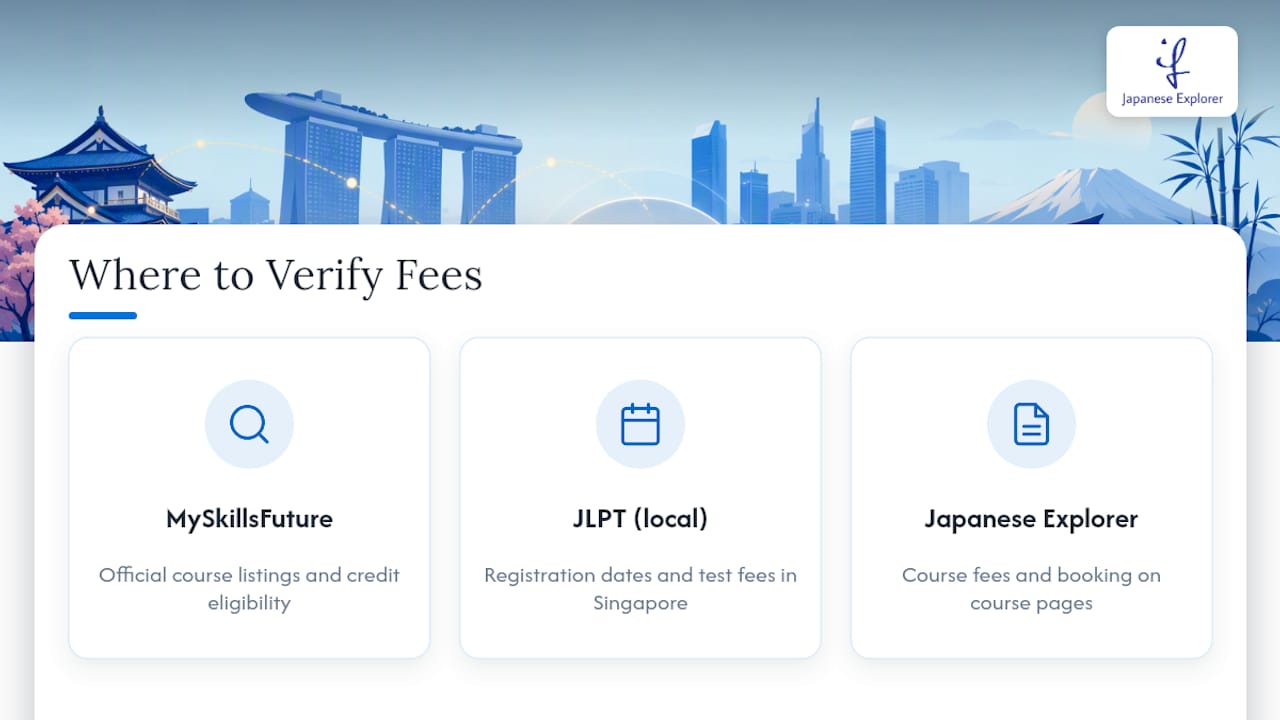
For official course listings and credit eligibility, check the MySkillsFuture course search directly. For JLPT registration dates and test fees specific to Singapore, confirm details on the local JLPT test page. For Japanese Explorer’s own course fees and booking, visit the course pages directly.
Sources
- Japanese Language I, II, III (Beginner to Intermediate to Advanced) | APPS PTE. LTD. | MySkillsFuture
- MySkillsFuture | Search For japanese language Courses
- THE JAPANESE SCHOOL SINGAPORE FEES FOR 2026
- Intensive Japanese – Part Time – Lexis Japan | Language International
FAQ
How much does a Japanese course cost in Singapore?
Group courses typically run S$300 to S$700 per term, private lessons cost S$100 to S$150 an hour, and intensive courses start around S$670. Japanese Explorer’s Group Japanese Classes are priced at $350 one-off, with private physical or online conversational courses priced between $1280 and $1580 one-off, according to the publisher.
Can I learn Japanese in three months?
You can build solid conversational basics in three months with intensive or private lessons, but reaching JLPT-level proficiency in that window is unrealistic for most learners. Business Japanese or exam-focused goals typically need six months or longer of consistent study.
How much does it cost to take the JLPT in Singapore?
JLPT registration fees are set separately by the test administrator and are distinct from any prep course fee you pay a language school. Confirm the current registration cost directly on the official JLPT test information page since test administration fees can change between sitting dates.
Can I use government training credits for a Japanese class?
Some Japanese language courses listed on the official course portal show an estimated payable fee that drops after available training credits are applied, though eligibility depends on your individual credit balance and the specific course’s listing status. Check the course search portal directly to confirm whether a specific course qualifies before assuming it applies to your enrollment.