
This guide gives you a categorized, workplace-ready set of technical Japanese vocabulary: computer terms, development jargon, ops phrases, and the ritual expressions you will hear in standups and code reviews. Each entry includes kana, romaji, and a short usage note, plus a task-ordered study sequence and curated resources so you can start applying it to your own tickets and Slack threads this week.
TL;DR:
- Recognizing workplace verbs like fix, review, and confirm is more effective for participation than memorizing nouns alone.
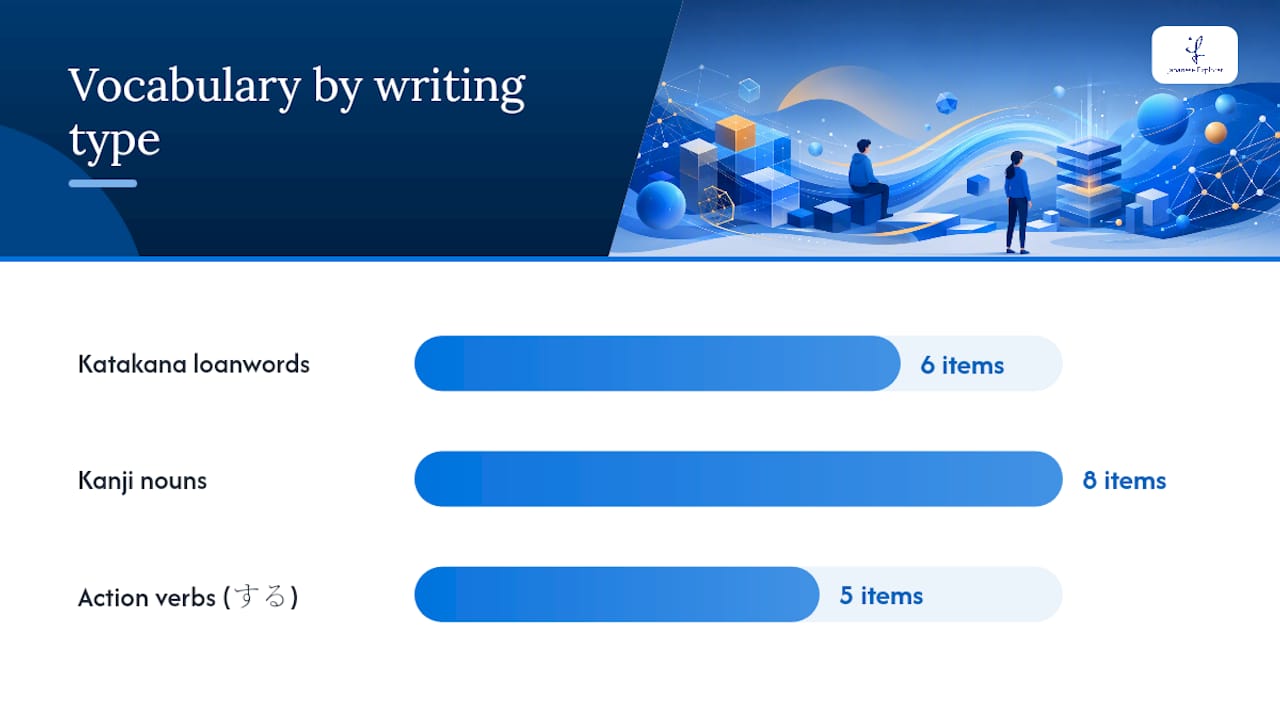
- Many technical terms are borrowed from English in katakana, but action words are often formed with Japanese kanji and する, requiring both vocab types.
- Formal reports use noun-heavy, passive constructions, while spoken Japanese favors shorter, casual forms like プルリク instead of pull request.
- Building a glossary with context-based samples and verifying spellings against your team’s style improves long-term retention and accuracy.
- Fluency benefits most from live practice, so courses tailored to your work documents and daily speaking help bridge recognition and production gaps.
Table of Contents
- Technical Japanese Vocabulary for Everyday Computer Use
- Programming and Development Vocabulary for Code and Review
- Infrastructure, DevOps, and Incident-Response Terms
- Standup Phrases, Pull Request Requests, and Choosing Your Register
- Building a Glossary That Actually Sticks
- Where to Find Reliable Glossaries and Study Decks
- Industry-Specific Technical Vocabulary Beyond Software
- Common Technical Acronyms and Abbreviations
- Written Versus Spoken Technical Japanese
- Vocabulary for Formal Reports and Technical Documents
- Sentence Patterns in Technical Manuals and Documentation
- Prioritize Verbs Over Nouns and You’ll Feel the Difference Fast
- Practice This Vocabulary in a Real Course, Not Just Flashcards
- Sources
- FAQ
Technical Japanese Vocabulary for Everyday Computer Use
A large share of Japanese IT vocabulary comes straight from English, written in katakana. That is good news for engineers: once you know the katakana syllabary, you can often sound out a word and land within one guess of its English source. コンピューター (konpyuutaa, computer) and インターネット (intaanetto, internet) are nearly self-explanatory the moment you can read the script.
That said, plenty of everyday interface and hardware terms mix katakana loanwords with native kanji compounds, and you need both to navigate a Japanese-language ticket or UI.
- パソコン (pasokon) — personal computer, a shortened loanword used constantly in casual speech
- 画面 (gamen) — screen or display
- 設定 (settei) — settings or configuration
- 保存する (hozon suru) — to save (a file)
- 削除する (sakujo suru) — to delete
- 入力 (nyuuryoku) — input
- 出力 (shutsuryoku) — output
- 通知 (tsuuchi) — notification
- 更新する (koushin suru) — to update
- 再起動 (saikidou) — restart/reboot
- アカウント (akaunto) — account
- パスワード (pasuwaado) — password
- 接続 (setsuzoku) — connection
- 端末 (tanmatsu) — terminal or device
- 共有する (kyouyuu suru) — to share
Notice the pattern: nouns borrowed from English stay in katakana (パスワード, アカウント), while actions built on native Japanese roots use kanji plus a light verb like する or 保存する. Learning the verb form alongside the noun is what actually lets you produce a sentence instead of just recognizing a label.
One catch worth flagging early: Japanese technical writing tolerates more than one accepted spelling for the same loanword. サーバー and サーバ both mean “server,” and コンピューター sometimes appears as コンピュータ without the long vowel mark. IPA terminology guidance confirms both forms are accepted and recommends matching whatever spelling your company or documentation already uses rather than picking one as universally “correct.” When you log a new word in your personal glossary, note which variant your team actually types, not the textbook version.
Programming and Development Vocabulary for Code and Review
Development vocabulary splits cleanly into nouns you will read in code comments and verbs you will need to write in pull requests. Both matter, but the verbs are what let you actually participate in a review instead of just following along.
- 関数 (kansuu) — function. “この関数を修正する必要があります” (kono kansuu o shuusei suru hitsuyou ga arias) means “This function needs to be fixed.”
- 変数 (hensuu) — variable
- デバッグする (debate suru) — to debug
- 実装する (jissou suru) — to implement. Common in tickets: “この機能を実装しました” (I implemented this feature).
- 修正する (shuusei suru) — to fix or correct
- テストする (tenuto suru) — to test
- デプロイする (depuroi suru) — to deploy
- コミットする (komitto suru) — to commit
- マージする (maaji suru) — to merge
- レビューする (rebyuu suru) — to review
Casual shorthand shows up constantly in Slack and chat but rarely in formal docs. プルリク is short for プルリクエスト (pull request), and engineers frequently borrow the English acronym LGTM outright rather than translating it. Save the shorthand for peer chat and default to the full form (プルリクエストを送りました, “I sent a pull request”) in anything a manager or client might read.
Infrastructure, DevOps, and Incident-Response Terms
On-call work runs on a small, high-frequency vocabulary set, and getting it wrong during an incident update is costly. These are the terms that show up in run books, monitoring alerts, and status channels.
- 障害 (shougai) — outage or failure. “障害が発生しました” (shougai ga hassei shimashita) — “An outage has occurred.”
- 復旧する (fukkyuu suru) — to recover or restore service
- 影響範囲 (eikyou han’i) — scope of impact
- 監視 (kanshi) — monitoring
- サーバー (saabaa) — server (also written サーバ, per IPA guidance above)
- 負荷 (fuka) — load, as in server load
- 冗長化 (jouchouka) — redundancy/failover setup
- 脆弱性 (zeijakusei) — security vulnerability
- ログ (rogu) — log file
In a status update, “現在復旧作業中です” (genzai fukkyuu sagyou chuu desu) reads as “Recovery work is currently in progress,” a phrase you will type more often than almost anything else on this list once you carry pager duty.
Standup Phrases, Pull Request Requests, and Choosing Your Register
Ritual phrases carry more weight than raw vocabulary size in daily meetings. A handful of set expressions, used correctly, gets you through a standup or a review request even before your noun vocabulary catches up.
- Standup update: “進捗を共有します” (shinchoku o kyouyuu shimasu) — “I’ll share my progress.” Follow with a status noun like 完了 (canyon, done) or 対応中 (taiou chuu, in progress).
- Requesting a review: Polite form, “レビューをお願いできますか” (rebyuu o onegai dekimasu ka, “Could I ask you to review this?”); casual form among peers, “レビューお願い” (rebyuu onegai).
- Confirming an issue: “確認します” (kakunin shimasu, “I’ll check/confirm”) is one of the most-used verbs in engineering Japanese, appearing in nearly every bug report thread.
- Reporting a fix works: “再現しないことを確認しました” (saigen shinai koto o kakunin shimashita) — “I confirmed it no longer reproduces.”
Register matters more with clients and senior stakeholders than with peers. Default to です/ます form in any written report or client-facing meeting, and reserve dropped-copula casual speech (だ/だよ endings) for team chat with colleagues at your level. For a deeper phrase set built specifically for meetings, see this breakdown of Japanese meeting phrases for business success. If you are still building listening speed, prioritize recognizing these phrases in speech before worrying about producing them fluently yourself. Reading comprehension comes faster than speaking accuracy for most learners, and standups reward listening first.
Building a Glossary That Actually Sticks
A glossary entry that only records an English gloss is nearly useless a month later. The NICT information-processing terminology dictionary models each entry with a kanji headword, kana pronunciation and pitch accent, part of speech, usage notes, and even an update history, and that structure is worth copying at a personal scale.
- Record six fields per term: kanji, kana, romaji, part of speech, register (formal/casual), and one real sample sentence pulled from your own work.
- Sequence your study by task, not alphabet: start with interface and daily-operations terms, then move to development vocabulary, then testing and security, then systems and cloud terms, and finish with business and presentation language.
- Pull terms from where you actually work. Extract unfamiliar words from real Slack messages, tickets, and PRs rather than memorizing a dictionary from the front. Engineering learning guidance from Sakura Science Club backs this up: context-based extraction beats isolated memorization for retention.
- Verify uncertain terms against an authoritative source or your project’s own style guide before locking them into your glossary, since two teams can use different accepted spellings for the same word.
Pro Tip: Do not translate 対応する as a single fixed word. Depending on context it means “to handle,” “to address,” or “to be compatible with” — the meaning shifts with what follows it, so log a sample sentence every time you see it used a new way.
Where to Find Reliable Glossaries and Study Decks
Pick your resource based on what you’re solving for: breadth, workplace relevance, or repetition practice.
- JETERM / CJK technical terms database holds roughly 920,000 entries across engineering domains. Treat it as a lookup reference for unfamiliar or industry-specific terms, not a starting curriculum.
- Wizcorp’s developer glossary organizes vocabulary into workplace groups (devices, security, servers, presentations) and is built as a study framework, not just a word list.
- Mercari’s engineer vocabulary list compresses the essentials into a tighter set aimed at intermediate learners who need meeting and documentation fluency fast.
- The AnkiWeb IT/software deck provides sentence-based cards with audio and fumigant, which suits listening practice far better than static word lists.
Reading and speaking these terms out loud in a structured class accelerates retention beyond flashcards alone. Japanese Explorer’s business and private courses build custom glossaries directly from a learner’s own work documents.
Industry-Specific Technical Vocabulary Beyond Software
Software vocabulary overlaps heavily with electronics, automotive, and general engineering terminology, since Japan’s manufacturing sector shaped much of the technical register still used across industries. If your role touches hardware, IoT, or manufacturing partners, a few adjacent terms are worth adding to your glossary even if you never write firmware yourself.
回路 (kairo, circuit), 基板 (kiban, circuit board), and センサー (sensā, sensor) come up constantly in IoT and embedded-systems work. Automotive and manufacturing partners will use 品質管理 (hinshitsu kanri, quality control), 仕様 (shiyou, specification), and 試作 (shisaku, prototype) in ways that overlap directly with software spec documents. 精度 (seido, precision/accuracy) shows up in both hardware tolerance discussions and machine-learning model evaluation, a useful reminder that vocabulary drift between fields runs both ways in Japanese engineering culture.
If your company works with electronics or automotive partners, do not assume your software glossary covers you. 半導体 (handoutai, semiconductor) and 組み込み (kumikomi, embedded) describe entire subfields with their own dense terminology, and a general IT vocabulary list will leave gaps there. The safest approach is the same one recommended earlier: pull unfamiliar terms directly from the documents your specific partners send you, log them with a sample sentence, and verify spelling variants against their own materials rather than a generic dictionary. Cross-industry terms are exactly where JETERM’s domain breadth earns its place in your resource list, since a compact developer glossary was never built to cover semiconductor fabrication or automotive quality standards.
Common Technical Acronyms and Abbreviations
Japanese technical writing borrows English acronyms wholesale far more often than it translates them, which is genuinely convenient for English-speaking engineers. API, UI, UX, CPU, SQL, and HTTP all appear untranslated in Japanese documentation, spoken exactly as the English letters or occasionally spelled out in katakana (エーピーアイ for API, though most engineers just say the English letters).
Where Japanese abbreviates differently, it usually shortens a longer Japanese-origin term rather than an English one. プルリク for pull request and ローカル (rotary, short for “local environment”) are the two you will hit daily. 本番 (honban) means “production” in the deployment sense and is almost always used bare, without an English equivalent attached, so do not expect to hear “プロダクション” nearly as often as you might guess.
A few acronyms carry different weight in Japanese business contexts than in English-language engineering culture. KPI gets used constantly in status meetings and carries slightly more formality than its casual use in English-speaking startups. PDCA (Plan, Do, Check, Act) is a genuinely Japanese management framework, not a borrowed term, and shows up in retrospectives and process documents far more than most English speakers expect. Knowing that PDCA is homegrown, rather than an imported acronym like API, helps you read the tone of a meeting correctly, since it often signals a more structured, process-oriented discussion than a typical agile retro.
Written Versus Spoken Technical Japanese
Written technical Japanese leans harder on kanji compounds and drops the softening language that spoken Japanese relies on constantly. A bug report will read 再現しない (does not reproduce) with no hedging, while the same point spoken aloud in a meeting often gets wrapped in softer phrasing like 再現しないようです (it seems like it doesn’t reproduce), even when the speaker is just as certain.
Spoken technical Japanese also compresses far more aggressively. Engineers say プルリク instead of プルリクエスト, and サバ instead of サーバー, in casual conversation, but almost nobody writes those shortened forms in a ticket or a design document. If you learn vocabulary primarily from written sources like GitHub issues or Confluence pages, expect a real adjustment period the first time you sit in a live standup, because spoken pacing drops particles and trails off mid-sentence in ways textbooks rarely model.
The reverse gap trips people up too. Written reports use far more formal connectives, such as しかしながら (however) instead of the spoken but, and rely on nominalized phrases like ~することが可能である (“it is possible to do ~”) where speech would simply say ~できる. If your listening comprehension is strong but your written reports feel stiff or wrong to native colleagues, the fix is usually vocabulary, not grammar: you are likely importing spoken shorthand into a register that expects the fuller written form.
Vocabulary for Formal Reports and Technical Documents
Formal Japanese technical documents follow a more rigid structure than the flexible phrasing of daily standups, and the vocabulary shifts to match. Reports typically open with 概要 (gaiyou, overview/summary) and close with 結論 (ketsuron, conclusion), bracketing the technical detail in between.
Inside the body, expect 目的 (mokuteki, purpose/objective), 背景 (haikei, background), 課題 (kadai, issue or challenge to be addressed), and 対策 (taisaku, countermeasure or solution). A postmortem or incident report specifically will use 原因 (gen’in, root cause) and 再発防止 (saihatsu boushi, prevention of recurrence) as near-mandatory sections, since Japanese engineering culture places heavy emphasis on documenting how a fix prevents the same failure twice.
Formal documents also favor nominal, noun-heavy phrasing over the verb-driven sentences common in chat. Where a Slack message might say 直しました (naoshimashita, “I fixed it”), a formal report is more likely to write 修正を実施した (shuusei o Hisashi shita, “the fix was carried out”), a more distanced, passive-leaning construction typical of written technical registers. Learning both forms of the same idea, casual verb and formal nominal phrase, is often the single fastest way to raise your writing from serviceable to professional.
Sentence Patterns in Technical Manuals and Documentation
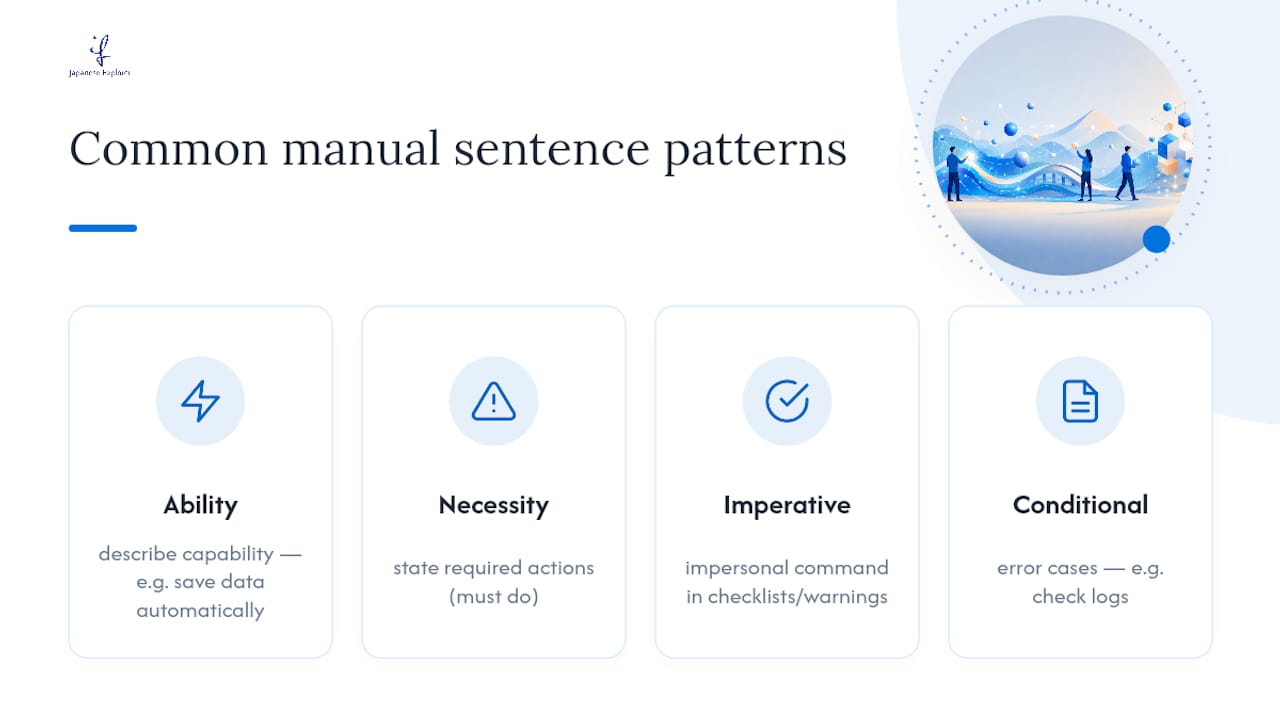
Technical manuals rely on a small set of recurring grammatical patterns, and recognizing them cuts your reading time dramatically once they click. The most common is the ~することができる construction (“it is possible to do ~”), used to describe a system’s capabilities: システムはデータを自動的に保存することができる (“the system is able to save data automatically”).
Instructions and warnings favor a distinct pattern too: ~する必要がある (“it is necessary to do ~”) or the blunter imperative ~すること (a bare dictionary-form-plus-こと ending common in checklists and safety warnings, functioning like an impersonal command). You will also see conditional structures constantly, especially ~た場合 (“in the case that ~ has happened”) used to describe error states: エラーが発生した場合、ログを確認してください (“if an error occurs, check the log”).
Passive voice appears far more in manuals than in conversation, since documentation tends to describe what happens to a system rather than who did it. ファイルが保存される (“the file is saved”) reads as standard technical prose, where a spoken equivalent would more naturally say ファイルを保存する with an explicit actor implied. Once you recognize these four or five patterns, a manual that looked dense on first read usually turns out to be the same handful of structures repeated with different vocabulary dropped in.
Prioritize Verbs Over Nouns and You’ll Feel the Difference Fast
Nouns feel like progress because you can count them, but verbs and ritual phrases are what actually unlock a meeting or a pull request. Learning five verbs (確認する, 対応する, 修正する, 実装する, 再現する) alongside two standup phrases will get an engineer through more real conversations than fifty isolated nouns. Apply the task-ordered sequence above to your own tickets and Slack history this week, not to a generic word list.
— Paul
Practice This Vocabulary in a Real Course, Not Just Flashcards
Glossaries and Anki decks get you recognition. Fluency in a live standup or a client call takes actual speaking practice, and live courses can help bridge that gap. If you need a custom vocabulary set built around your own project documents, the private online or physical Conversational Japanese Course works one-on-one to build a glossary from material you actually use at work, with a one-time registration fee starting from $50 per student. Teams preparing for client meetings or cross-border projects get more out of the Business Japanese Course, which runs from $350 and focuses on professional register, presentation language, and meeting role-play rather than generic conversation. For engineers who want steady, lower-cost repetition instead of one-on-one coaching, the Group Japanese Classes at $350 give you regular practice alongside peers working through similar material.
All courses run through certified bilingual instructors on a curriculum guided by the Association for Japanese Language Teaching, with lessons available in person at 10 Anson Road, Level 22, International Plaza, Singapore 079903 (right above Tanjong Pagar MRT) or online over Zoom. Reach out to build a course plan around your actual work vocabulary rather than a generic syllabus.
Sources
- Wizcorp/japanese-dev-lingo
- NICT information-processing terminology dictionary
- Information-technology Promotion Agency (IPA) terminology guidance
- mercari/engineer-vocabulary-list
- Japanese IT/Software Engineering Vocabulary With Audio – AnkiWeb
FAQ
What Is the Fastest Way to Learn Technical Japanese Vocabulary?
Prioritize workplace verbs and ritual phrases (確認する, 対応する, standup openers) before expanding your noun vocabulary, since verbs unlock actual participation in meetings and reviews faster than memorizing labels. Pull unfamiliar terms directly from your own tickets and Slack threads rather than starting from a large reference database.
Do Japanese Engineers Use English Loanwords for Most Tech Terms?
Many core computer and interface nouns are katakana loanwords borrowed from English, such as パソコン (personal computer) and アカウント (account), which makes them easier to recognize on sight. Development and workplace verbs, however, are usually built from native kanji roots plus する, so you need both vocabulary types to function day to day.
Is It Better to Focus on Reading or Speaking First?
Reading comprehension for technical documents tends to develop faster than speaking accuracy, so recognizing standup and PR phrases before you can produce them fluently is normal and expected. Structured speaking practice, such as role-play drills in a private or business course, closes that gap faster than flashcards alone.
Can a Course Help With Vocabulary Specific to My Job?
Yes. Japanese Explorer’s private Conversational Japanese Course builds a custom glossary from a learner’s own work documents, and the Business Japanese Course focuses specifically on professional register and meeting language for teams.