
If your goal is conversational or workplace Japanese, start with a small-group or private course built on task-based lessons tied to JF Standard can-do goals, not a program that just marches through grammar charts. Aiming for the JLPT instead? Choose a course that pairs test drilling with real speaking practice, since the exam alone won’t build fluency. Japanese Explorer offers group, private, online, and business formats that match each of these goals, so the right pick usually comes down to your schedule and how fast you want to move.
TL;DR:
- Choosing a course should prioritize speaking practice and real-world tasks rather than solely focusing on grammar or exam drills.
- Courses built around the JF Standard’s six proficiency levels with can-do checkpoints aid measurable progress across speaking, reading, and writing skills.
- Small classes, high speaking time, and active correction outperform large, lecture-style courses for learners aiming for conversational fluency.
- Progress mainly depends on weekly practice hours; three to five hours weekly can achieve basic conversation in three months, with full fluency taking up to a year.
- Verify course syllabuses for task-based content, roleplay scenarios, and clear progress benchmarks before enrollment to match goals accurately.
Table of Contents
- Which Japanese Course Format Actually Fits Your Goals?
- What Should A Quality Syllabus Actually Cover?
- How Do You Choose Between Competing Japanese Courses?
- How Long Does Learning Japanese Really Take?
- Why Task-Based, Conversation-First Lessons Actually Work
- What Most Advice On Learning Japanese Gets Backwards
- Ready to Start? Here’s Your Next Step
- Where to Verify the Frameworks Behind These Courses
- Sources
- FAQ
Which Japanese Course Format Actually Fits Your Goals?
Group classes, private lessons, online sessions, and corporate training solve different problems, and picking based on convenience alone is how learners end up stuck for years.
Group classes work well for beginners who want steady, social progress at a manageable price. Most run in small cohorts over a term of several weeks, mixing grammar with paired speaking drills. Private lessons move faster because every minute is built around your goals, your pace, and your mistakes, which matters if you’re prepping for a trip, a transfer, or an exam on a deadline. Online classes delivered live over Zoom give you the same structured curriculum without the commute, and they’ve become a mainstream option for busy professionals who’d otherwise skip lessons entirely. Corporate training is built for teams: it drills workplace scenarios like meetings, client calls, and email etiquette rather than travel phrases.
- Group classes: best for beginners on a budget, steady weekly pace
- Private lessons: best for fast timelines, exam prep, or highly specific goals
- Online/Zoom classes: best for flexibility and consistent delivery without travel
- Corporate training: best for teams needing shared workplace vocabulary
Term lengths typically run for several weeks for group formats, while private and corporate packages are often structured in blocks of hours you can schedule around your own calendar.
What Should A Quality Syllabus Actually Cover?
A syllabus worth paying for starts with hiragana and katakana in the first few sessions, then introduces kanji in small, graded batches instead of dumping hundreds of characters on you at once. Grammar should never sit in isolation. It should be taught alongside a communicative task, like ordering food, making a reservation, or writing a polite work email.
The JF Standard for Japanese-Language Education is the benchmark most serious programs build around. It organizes learning into six proficiency levels, each anchored by specific “can-do” statements, so a learner and a teacher can both point to what “intermediate” actually means in practice rather than guessing. For professionals, that same framework pushes lessons toward workplace tasks like introductions, meeting language, and appropriate politeness levels rather than only textbook drills.
A strong syllabus generally includes:
- Staged kanji introduction, not an overwhelming early dump
- Roleplay for real situations: shopping, appointments, workplace exchanges
- Regular can-do checkpoints so you can see measurable progress
- Coursebooks aligned with recognized frameworks, such as the Marugoto and Irodori materials used across Starter to Intermediate levels
Quick fact: Programs that structure lessons around six proficiency levels with concrete can-do tasks give learners a way to measure real progress instead of just “finishing a textbook.”
How Do You Choose Between Competing Japanese Courses?
Start by matching your goal to a format, then to specific syllabus features, because a course that’s perfect for a JLPT candidate can be the wrong fit for someone who just wants to order food confidently in Osaka.
- Name your goal precisely. “Conversational Japanese” and “business Japanese” require different lesson content, even if both are labeled beginner-friendly.
- Ask about weekly speaking time. A course heavy on worksheets and light on live output won’t build fluency, no matter how polished the textbook looks.
- Ask about class size. Fewer students per teacher means more correction and more chances to actually talk.
- Ask how progress gets measured. A program using can-do checkpoints or portfolio assessments can show you concrete growth; one that can’t explain its own benchmarks is a warning sign.
- Ask about make-up policies and total fees upfront. Missed sessions and hidden add-on costs are where budgets quietly blow up.
A common trap worth naming directly: picking a JLPT-branded course when your real goal is speaking. The JLPT tests reading, listening, and grammar knowledge, and it does not measure or require spoken output, so it can leave conversational learners short on the one skill they actually wanted.
Pro Tip: Ask any school to show you a sample can-do checklist for the level you’re entering. If they can’t produce one, they likely don’t have a structured syllabus behind the marketing.
How Long Does Learning Japanese Really Take?
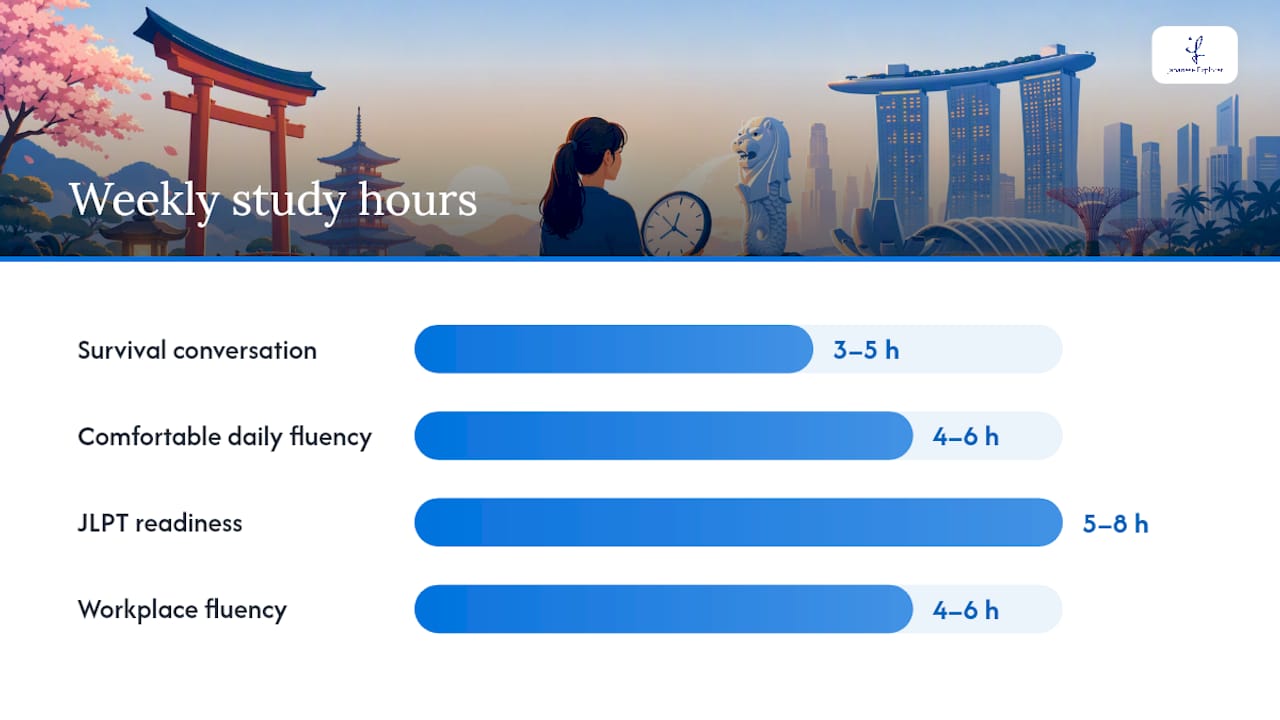
Progress tracks closely with weekly hours, not just calendar time. A learner putting in 3 to 5 hours per week of structured practice and self-study can usually reach survival-level conversation in about three months, while comfortable, communicative fluency for daily situations tends to take 6 to 12 months of consistent weekly classes plus review outside class.
Intensive formats compress the calendar but demand far more weekly hours and steady feedback to turn all that study time into actual speaking ability, rather than passive recognition. JLPT preparation adds its own runway. Since the exam is used by employers and institutions as a credential rather than a fluency test, it’s worth confirming what level a specific job or school actually requires before committing to a study timeline.
| Goal | Weekly intensity | Realistic timeline | Typical cost shape |
|---|---|---|---|
| Survival conversation | 3–5 hours | a few months | Group course per term, typically moderate cost |
| Comfortable daily fluency | 4–6 hours | several months up to about a year | Private lessons priced per package |
| JLPT exam readiness | 5–8 hours | several months per level | Combined prep course plus self-study |
| Workplace/business fluency | 4–6 hours | several months up to about a year | Corporate package priced per team |
Course catalog listings show adult programs commonly running as weekly sessions over 8 to 12 week terms, with private lessons priced per hour or per package rather than a flat term fee.
Why Task-Based, Conversation-First Lessons Actually Work
Task-based lessons succeed because they mirror how you’ll actually use the language, not how a textbook chapter is organized. Instead of memorizing a grammar rule in isolation, you practice it inside a real scenario: booking a hotel, negotiating a deadline, writing a polite decline email. That’s the same logic behind the JF Standard’s can-do framework, and it’s why programs built around it tend to produce learners who can actually speak, not just recognize vocabulary on a quiz.
For business learners specifically, that means roleplaying meetings, phone calls, and email exchanges with corrective feedback, plus early exposure to polite speech levels rather than saving them for an advanced module. Look for programs staffed by bilingual, certified instructors who teach across group, private, online, and business formats, since that flexibility usually signals a school built around adult learners rather than one adapted from a children’s curriculum.
- Small classes with regular speaking-focused homework and correction
- Business modules covering meetings, email conventions, and keigo
- Flexible formats: group, private, and online delivery under one roof
Pro Tip: If a course promises fluency but can’t describe a single roleplay scenario in its curriculum, ask what “speaking practice” actually means before you enroll.
What Most Advice On Learning Japanese Gets Backwards
Most guides treat “how long does it take to learn Japanese” as a single number, as if a JLPT-focused grinder and a conversational traveler need the same 12 months. They don’t, and treating them the same is exactly why so many adults quit after a term. The real question isn’t how long Japanese takes. It’s which specific outcome you’re paying for, and whether the course you picked was ever built to deliver it.
The conventional wisdom oversells grammar mastery and undersells speaking time. A learner who can conjugate every verb form but freezes during an actual conversation hasn’t failed at Japanese. They’ve been taught the wrong thing well. What the research on task-based design keeps confirming is that small classes with live correction and workplace-relevant roleplay outperform grammar-heavy courses for anyone whose real goal is communication, whether that’s ordering coffee or closing a deal in Tokyo.
If you take one thing from this article, make it this: name your goal precisely before you shop for a course, then interrogate the syllabus for can-do checkpoints and speaking time. Everything else, including price and schedule, is secondary to that fit.
— Paul
Ready to Start? Here’s Your Next Step
Japanese Explorer runs group classes, private conversational lessons, and dedicated business Japanese courses, all delivered physically or online so you’re not stuck choosing between structure and flexibility. Unlike a generic language app or a one-size-fits-all workbook, every course here is built around task-based lessons and bilingual, certified instructors who can adjust the syllabus to your actual goal, whether that’s holding a conversation, prepping for JLPT, or handling a client meeting in Japanese.
Group classes start at $350, while private physical or online conversational courses range from $1,280 to $1,580 depending on the package you choose. If your goal is workplace fluency, the business Japanese course starts from $350, with private business packages running $1,480 to $1,780. Use the checklist from earlier in this article when you speak with the team: ask about class size, speaking time, and how progress gets measured. Japanese Explorer’s training centre sits at 10 Anson Road, Level 22, International Plaza, right above Tanjong Pagar MRT, making a first visit an easy stop before or after work. Reach out through the course page to book a placement conversation and get matched to the right level before you commit.
Where to Verify the Frameworks Behind These Courses
- JF Standard for Japanese-Language Education explains the six proficiency levels and can-do tasks that define what a strong syllabus should measure.
- The ultimate guide to the JLPT exam clarifies what the test actually measures and where it fits into employer or institutional requirements.
- Japan Foundation resource pamphlet covers the Marugoto and Irodori materials many staged adult courses draw from.
Sources
- JF Standard for Japanese-Language Education (pamphlet)
- The ultimate guide to the JLPT exam (Team Languages)
- MySkillsFuture course listings (search results)
- Japan Foundation resource pamphlet (Marugoto/Irodori references)
FAQ
How Much Does It Cost to Learn Japanese in Singapore?
Costs vary by format: group courses at Japanese Explorer start at $350, while private conversational lessons range from $1,280 to $1,580 and business-focused private packages run $1,480 to $1,780. A one-time registration fee starting from $50 per student also applies to private lessons.
How Long Does It Realistically Take to Learn Japanese?
With 3 to 5 hours of weekly practice, most learners reach survival-level conversation in about three months, while comfortable daily fluency typically takes 6 to 12 months of consistent classes plus self-study. Intensive formats can compress that timeline but demand significantly more weekly hours to see the same results.
Can You Learn Japanese in Three Months?
You can reach a functional, survival level of conversation in three months with 3 to 5 hours of weekly structured practice, but full conversational fluency generally needs 6 to 12 months. Three months is realistic for basics like greetings, ordering, and simple exchanges, not for handling nuanced workplace conversations.
What Is the 80/20 Rule in Japanese?
There’s no single official definition, but many learners apply it to mean roughly 20% of common grammar patterns and vocabulary cover about 80% of everyday conversation. This is a rough learning heuristic, not a fixed standard, and it works best paired with structured, task-based lessons rather than random vocabulary lists.