For O-Level Japanese revision, five books cover almost everything you need: Genki for structured grammar drills, Minna no Nihongo if you want Japanese-only immersion, Japanese for Busy People for fast conversational gains, Japanese from Zero! for confident self-study, and the Kodansha Kanji Learner’s Course for systematic kanji memorization. Tobira is worth adding only once you have outgrown the beginner stage. Read the short profiles below to match one to how you actually study.
TL;DR:
- Genki is suitable for classroom and self-study learners aiming for near N4-level, with structured chapters and drill workbooks for exam practice.
- Minna no Nihongo suits immersion learners aiming beyond O-Level, but requires a tutor or support due to its entirely Japanese main text and separate English notes.
- Japanese from Zero! offers an approachable self-study option with workbook support, ideal for maintaining momentum in early weeks without classroom guidance.
- Audio resources from Genki and Japanese for Busy People are crucial for improving listening comprehension and should be prioritized, especially for exam success.
- Pairing any core textbook with Kodansha KLC or graded kanji readers improves character recall and fills gaps in traditional vocabulary learning methods.
Table of Contents
- Which Japanese Textbooks Actually Help With O-Level Prep?
- How Do You Compare These Books Side by Side?
- Your Buying Checklist for O-Level Study Materials
- Do These Editions Match the Current Syllabus?
- What Do Students Actually Say About These Books?
- What Do These Books Cost in Singapore?
- A Singapore Student’s Playbook for Choosing These Books
- Where Japanese Explorer Fits Into Your O-Level Prep
- Where to Verify These Recommendations
- Sources
- FAQ
Which Japanese Textbooks Actually Help With O-Level Prep?
Not every textbook on a “best Japanese books” list is built for exam pressure. Some are written for university semesters, others for casual hobbyists with no test date in sight. The books below made the cut because they cover grammar, vocabulary, and listening in a way that maps onto what an O-Level paper actually tests.
- Genki (Genki I & II + workbooks) is best for classroom-led study and structured self-study. Its chapter format walks through grammar points methodically, and the paired workbooks give you drill practice you can time yourself on. Expect it to carry you to roughly N4-level competency once you finish both volumes. It is widely stocked and orderable through major Singapore bookstores.
- Minna no Nihongo (Beginner series) suits immersion learners aiming beyond O-Level. The main text is entirely in Japanese, with grammar notes sold separately in English, which forces faster reading habits but works best with a teacher or tutor nearby for support.
- Japanese for Busy People (Revised 4th Edition) fits learners who need practical spoken Japanese without excess grammar theory. It comes in kana and romanized editions, and AJALT notes the full three-level series is built for classroom pacing.
- Japanese from Zero! works well for self-study learners who want an approachable, almost tutorial-style walkthrough. Its workbook-style chapters and online supplements make it easy to keep momentum without a classroom.
- Tobira: Beginning Japanese is a bridge book, not a starting point. It fits students who have already finished a beginner series and want readings and content that stretch them toward intermediate fluency.
- Kodansha Kanji Learner’s Course (KLC) handles the kanji side separately, using mnemonics and graded reading sets so characters stop blurring together after chapter five. Pair it with any core textbook.
Availability in Singapore is generally solid for Genki, Minna no Nihongo, and Japanese from Zero!, since they show up repeatedly on international bestseller lists. Tobira and Marugoto sometimes require ordering online, so check stock a few weeks before term starts.
How Do You Compare These Books Side by Side?
Four things actually decide whether a book helps you pass, not just whether it looks thorough on a shelf.
- Learning goal: Are you drilling for exam-style grammar recall, or trying to build real conversational speed? Genki and Japanese for Busy People lean toward the former; Japanese from Zero! and Minna no Nihongo lean toward natural fluency.
- Script approach: Kana-only texts force faster reading, romanized texts feel safer at first but slow long-term progress.
- Level reached: Genki I & II gets you close to N4; Minna no Nihongo’s beginner set covers similar ground but pushes reading harder.
- Extras included: Workbooks, audio files, and answer keys matter more than most students realize when self-checking listening sections.
For O-Level listening papers specifically, audio-supported books like Genki and Japanese for Busy People matter more than text-only options.
Pro Tip: Drop romaji within your first four to eight weeks. Practitioners consistently find that switching to kana early reduces pronunciation errors and stops you from mentally translating every word back into English letters during a timed reading section.
Your Buying Checklist for O-Level Study Materials
Buy in this order, not all at once:
- Core textbook first. Pick one main series, either Genki, Minna no Nihongo, or Japanese for Busy People, based on whether your school or tutor already uses it in class.
- Matching workbook. Skip this and you lose your main source of timed practice questions.
- Audio files or CD. Listening comprehension is a scored O-Level component, so don’t treat audio as optional.
- A kanji resource. Add Kodansha KLC once you have covered basic hiragana and katakana, usually four to six weeks in.
- One graded reader. These reinforce kanji you’ve already learned instead of introducing new material cold.
In Singapore, weigh budget against how many volumes a series demands. Genki alone runs two volumes plus two workbooks, while Japanese for Busy People spans three levels that AJALT estimates at roughly 50 to 120 hours per level depending on class intensity. Factor in shipping time if a title isn’t sitting on a local shelf.
Do These Editions Match the Current Syllabus?
None of these books were written specifically for O-Level Japanese, and that’s worth saying plainly. They’re general-purpose language textbooks that happen to cover grammar and vocabulary ranges overlapping with what the exam tests. The newer editions matter here. Genki’s most recent edition reorganized several grammar points for clearer sequencing, and Japanese for Busy People’s Revised 4th Edition tightened its pacing compared to older printings still floating around secondhand markets.
If you’re buying secondhand to save money, check the edition number against what your school or tutor references, since page numbering and exercise sets shift between editions. Minna no Nihongo’s translation and grammar notes booklets are sold separately from the main text, and older combined editions sometimes get confused with the current split format when ordering online.
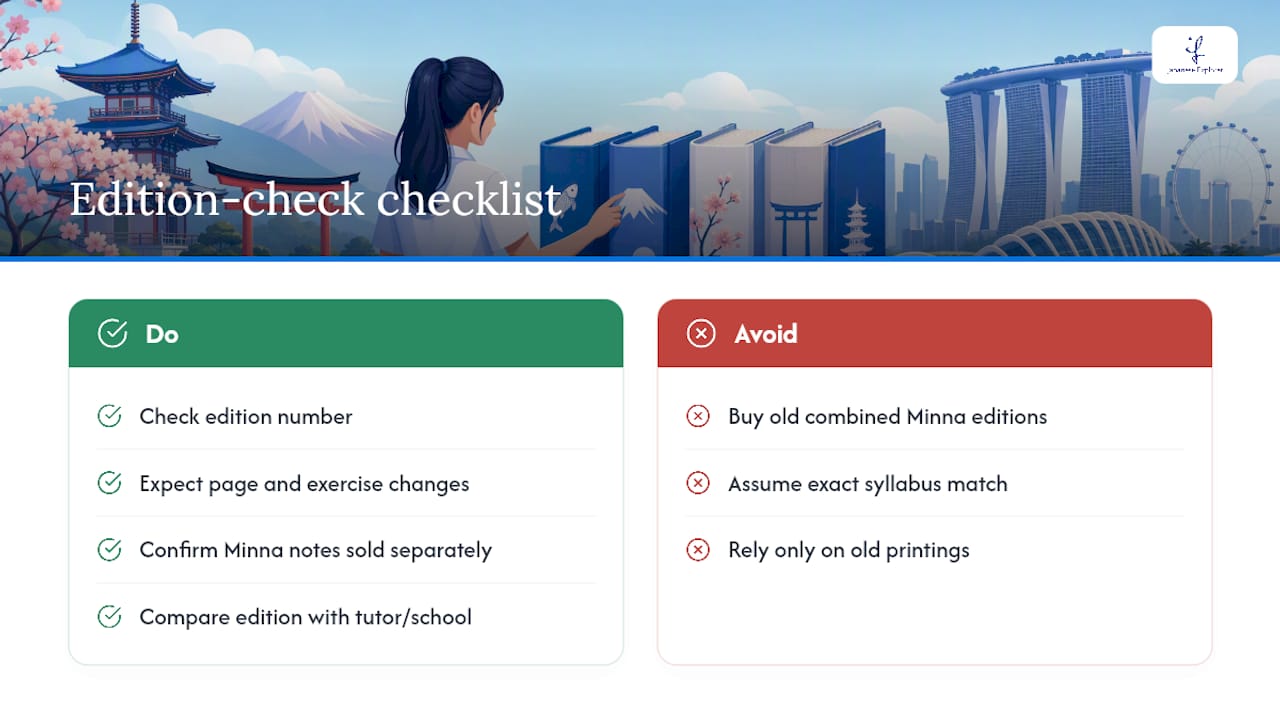
None of these series will match a syllabus checklist item for item, so treat them as your grammar and vocabulary engine, and lean on past exam papers or a tutor for the specific question formats you’ll face on test day.
What Do Students Actually Say About These Books?
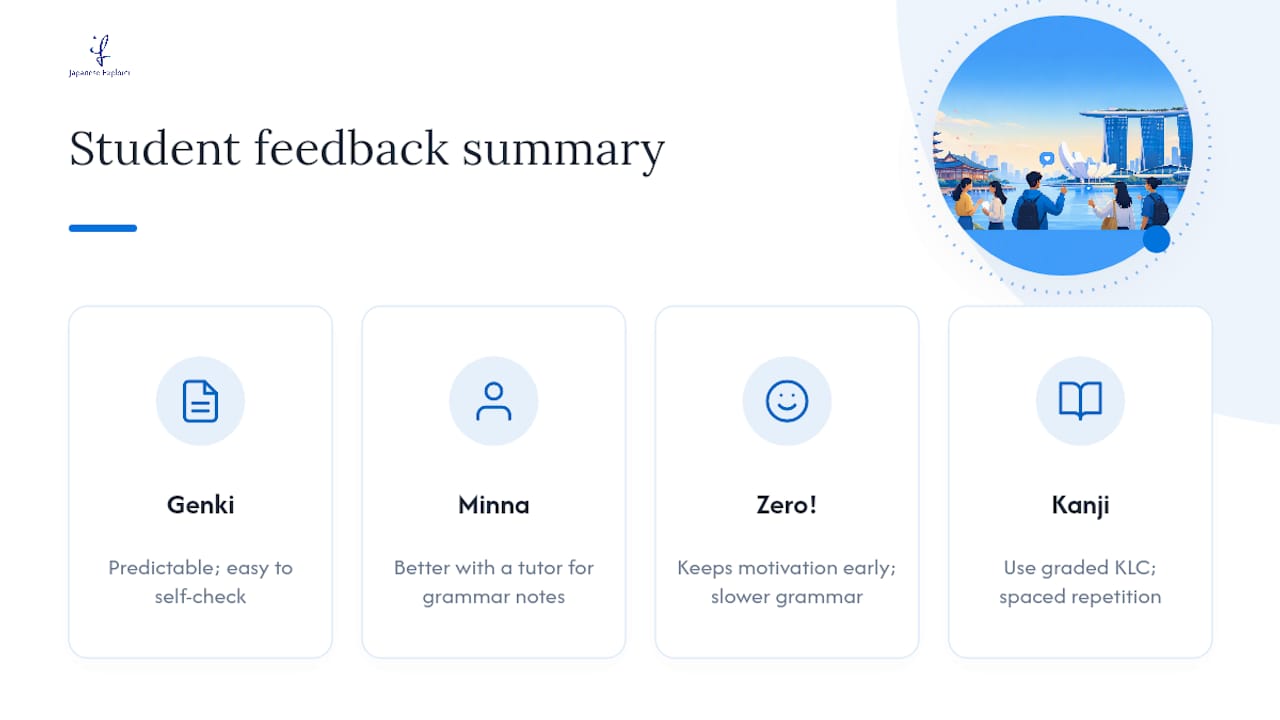
Feedback patterns repeat across forums and classroom experiences rather than any single formal study. Genki draws consistent praise for being predictable and easy to self-check, which matters when you’re revising alone at 11 PM before a test. Students who found Minna no Nihongo tough on their own tend to report better results once paired with a tutor who can explain the Japanese-only grammar notes.
Japanese from Zero! gets recurring mentions for keeping motivation up during the slow early weeks, largely due to its lighter, conversational writing style. The trade-off some students notice is that it moves a little slower than Genki through grammar density, so pairing it with extra drill practice helps if your exam date is close.
Kanji is where most frustration shows up, and it’s rarely about the textbook. Students who skip a dedicated kanji resource and rely only on the vocabulary lists inside their main textbook tend to plateau earlier. Adding Kodansha KLC or a similar graded system tends to smooth that out, since it reintroduces characters through spaced repetition rather than one-time exposure.
What Do These Books Cost in Singapore?
Expect to pay somewhere between $30 and $60 per volume for Genki, Minna no Nihongo, or Japanese for Busy People at major bookstores, with workbooks typically priced lower than the main textbook. Prices climb if you need the full multi-volume Japanese for Busy People set across all three levels.
Physical copies are usually easiest to find for Genki and Minna no Nihongo, since both appear consistently on regional bestseller lists. Tobira and Marugoto are less predictable on local shelves and often need to be ordered through online retailers, which adds a week or two of lead time you should plan around before term starts.
Kodansha KLC and companion graded readers are typically available through the same online channels, occasionally with ebook versions for the kanji course itself, though audio components for kanji study are far less common than for the main conversational textbooks. If your test date is close, order early rather than assuming same-week stock.
A Singapore Student’s Playbook for Choosing These Books
Most advice online treats textbook choice like a personality quiz, matching learning style to book style. That’s backwards for O-Level prep. The better question is what your classroom or tutor already uses, because switching to a different grammar sequence mid-year creates more confusion than any book’s individual strengths make up for.
If you’re studying largely on your own, Japanese from Zero! or Genki with its workbook gives you the clearest self-check loop. If you’re already in tutoring, Minna no Nihongo’s immersion pays off faster because you have someone to untangle the Japanese-only notes. The overlooked piece is kanji. Students treat it as something to absorb passively from textbook vocabulary lists, and that’s exactly why kanji recall becomes the weakest score category on exam day. Pair whatever core book you choose with Kodansha KLC from week five or six onward, not as an afterthought in the final month.
— Paul
Where Japanese Explorer Fits Into Your O-Level Prep
Textbooks build your grammar and vocabulary foundation, but they can’t replace a live conversation partner correcting your pronunciation in real time, and that gap shows up hardest in the listening and speaking sections. Japanese Explorer runs MOE Japanese O Level Tuition alongside private and online lessons, giving you a structured complement to whichever textbook series you’ve already chosen.
A short block of private lessons focused on speaking drills and timed listening practice can close the exact gaps that self-study with Genki or Minna no Nihongo tends to leave open, particularly if you’re two or three months from your exam date. Classes are taught by bilingual instructors at 10 Anson Road, Level 22, International Plaza, Singapore, right above Tanjong Pagar MRT, with Group Japanese Classes available if you prefer a classroom setting over one-to-one sessions. Check current availability and get a quote for a private Japanese package built around your exam timeline on the company’s website.
Where to Verify These Recommendations
- AJALT’s official notes on Japanese for Busy People’s classroom design
- FiveBooks’ expert roundup comparing Tobira, Marugoto, Genki, and Minna no Nihongo
- Kodansha KLC’s official course site for kanji study structure
- Migaku’s textbook comparison for Genki versus Minna no Nihongo
Check local bookstores or university shops for physical stock before ordering online, and note that audio files often ship separately from the kanji-focused titles.
Sources
- Japanese for Busy People Series|AJALT
- The Best Books to Learn Japanese – FiveBooks Expert
- The Kodansha Kanji Learner’s Course (KLC) • Kanji Learner’s Course Official Site
- The Five Best Japanese Textbooks for Beginners (Migaku)
FAQ
Which book should I buy first for O-Level Japanese?
Start with Genki if your school or tutor already references it in class, since matching your classroom sequence matters more than personal preference. Otherwise, Japanese from Zero! or Japanese for Busy People both give a gentler entry point for self-study.
Is Minna no Nihongo too hard for O-Level students?
It’s more demanding than Genki because the main text is entirely in Japanese, but it’s manageable with tutor support or a private lesson to unpack the separate grammar notes. Immersion learners aiming for skills beyond O-Level tend to benefit most from it.
Do I need a separate kanji book?
Yes, most core textbooks introduce kanji through vocabulary lists rather than a structured system, which isn’t enough for steady recall. The Kodansha Kanji Learner’s Course paired with graded readers fills that gap more reliably.
How much does it cost to buy these textbooks in Singapore?
Expect roughly $30 to $60 per volume for Genki, Minna no Nihongo, or Japanese for Busy People at major bookstores, with workbooks priced lower. Tobira and Marugoto often cost more to source since they’re less commonly stocked locally.
Can tuition help if I’m already using these textbooks?
Yes, textbooks build grammar and vocabulary, but speaking and listening skills improve faster with live correction. Japanese Explorer’s private and online lessons are designed to target exactly those gaps alongside whatever textbook you’re already using.