A rirekisho (履歴書) is Japan’s standardized resume, built around fixed boxed fields rather than the free-form layout Western job seekers know. Your first move is simple: grab a JIS-style template or a reliable printable version, then fill every box exactly as instructed, matching your photo, dates, education, and work history to strict formatting rules. Skip a convention and Japanese HR teams often set the application aside without reading further.
TL;DR:
- Filling out every box precisely and consistently across date, photo, name, and contact details is crucial to avoid immediate rejection.
- Mid-career applicants should prepare both a rirekisho and a detailed shokumu keirekisho, while graduates typically submit only the rirekisho.
- Do not mix calendar systems; choose either Western or Japanese era dates and use it throughout the document to prevent signals of carelessness.
- Typed or digital PDFs are often acceptable and sometimes preferred, but traditional companies may expect a handwritten form with no corrections.
- Craft specific, concise self-PR and motivation statements with concrete proof points, as these sections are critical for making a positive impression.
Table of Contents
- What Is the Japanese Resume Format Called, and What Does It Cover?
- Rirekisho Standard Format: Exact Field-by-Field Walkthrough
- Should You Handwrite or Type Your Rirekisho?
- How Do You Write a Strong 自己PR and 志望動機?
- Do You Need a Cover Letter for a Japanese Job Application?
- What Mistakes Get a Rirekisho Rejected Instantly?
- Where Can You Find a Reliable Template?
- Why Getting the Rirekisho Right Is a Language Problem, Not Just a Formatting One
- Where to Verify Format Details and Find Templates
- Sources
- FAQ
What Is the Japanese Resume Format Called, and What Does It Cover?
The rirekisho is what most people mean when they search for the Japanese resume format, but it is only half the paperwork most professionals submit. It is a standardized document with fixed boxed fields for personal details, education, and work history, most often paired with a second document called the shokumu keirekisho when the employer wants more detail on your career.
The two documents do different jobs. The rirekisho is a factual record, closer to an HR file than a pitch. The shokumu keirekisho is where you explain what you actually accomplished, with narrative detail and, ideally, measurable outcomes. Employers treat the rirekisho as documentation and the shokumu keirekisho as your case for the role.
Which applicants need which document, and when:
- New graduates typically submit only the rirekisho, since they have little work history to narrate.
- Mid-career professionals almost always pair the rirekisho with a shokumu keirekisho to show progression and results.
- International applicants often prepare an English CV as well, especially for multinational employers or bilingual roles.
- Always check the job posting first. Some companies specify exactly which documents they want and in what file format, and that instruction overrides any general rule in this guide.
Rirekisho Standard Format: Exact Field-by-Field Walkthrough
Every rirekisho follows the same skeleton, whether you’re filling out a paper form or a digital PDF version of the JIS standard template. Work through it in this order, and you’ll avoid the mistakes that get applications quietly filed in the “no” pile.
- Date of submission. Write the date you’re actually submitting the form, not the date you started filling it out. Pick either the Western calendar or the Japanese era system (Reiwa) and use that same system everywhere else on the document. Mixing the two is one of the fastest ways to signal carelessness.
- Photo. Use a recent photo, roughly 3 cm by 4 cm, with a plain background and formal attire. Casual selfies or vacation crops are an instant red flag to Japanese recruiters who expect passport-style formality.
- Name and furigana. Write your name in the alphabet or kanji you normally use, then add furigana in katakana above or beside it so anyone reading the form knows exactly how to pronounce it. This step trips up a lot of international applicants who assume furigana is optional.
- Contact details. Address, phone number, and email go in the boxed fields exactly as labeled. Don’t improvise extra fields or leave boxes blank without a reason.
- Education (学歴). List schools chronologically, one line per entry, starting with the entry heading itself. For schools outside Japan, add the country name and a short parenthetical (for example, “State University (United States)”) so the reader isn’t guessing at an unfamiliar institution.
- Work history (職歴). Use separate lines for joining and leaving each company. Note internal transfers as their own line if they involved a title or department change. Finish the section with ‘以上’, which signals “end of list” and is a small but easily missed convention.
- Licenses and qualifications (免許・資格). List each credential with its official name and the date earned. Skip translations that don’t match the credential’s actual title.
- Self-PR and reason for application. Keep both boxes short, specific to the company, and free of generic filler. More on exactly how to write these in the next section.
- Desired conditions, commute time, and dependents. When you have no strong preference on salary or working conditions, a safe, commonly used phrase is “貴社の規定に従います” (“I will follow your company’s policy”). It reads as flexible, not passive.
Pro Tip: Keep a second copy of your finished rirekisho as a reference file. When you apply to your next company, you’ll reuse most of the boxes untouched and only need to rewrite the self-PR and reason-for-application sections.
For extra guidance on notation conventions like dates and name formatting, Com’s guide to Japanese document writing walks through the details that trip up most first-time applicants.
Should You Handwrite or Type Your Rirekisho?
Both are acceptable today, but the two paths carry different expectations, and picking the wrong one for a given employer still costs applicants interviews.
Traditional companies, particularly in manufacturing, government-adjacent roles, and some legacy corporations, still expect a handwritten rirekisho as a sign of sincerity and effort. Startups, tech firms, and companies used to hiring internationally are usually fine with typed or digitally filled PDF forms, and many now request them outright for faster processing.
Formatting details matter more than most applicants expect:
- Never use correction fluid on a handwritten form. A single mistake means starting that section over on a fresh copy.
- Stick to one calendar system throughout, Western or Japanese era, and never switch mid-document.
- Use one font family only when typing. Gothic (ゴシック) or Mincho (明朝) are both standard; mixing them within one document looks unpolished.
- Export as a single PDF, scan handwritten forms at a reasonably sharp resolution (300 DPI is a safe default), and name the file clearly, such as “LastName_FirstName_Rirekisho.pdf”.
Recruiters who receive dozens of applications a week routinely say inconsistent formatting and photo issues are among the most common reasons a rirekisho gets set aside before the content is even read.
How Do You Write a Strong 自己PR and 志望動機?
Self-PR (自己PR) and reason for application (志望動機) are the only two boxes on the entire form where you get to sound like a person instead of a filing system, so use them well.
A simple three-part structure works for both: state a strength or motivation, back it with a brief, specific proof point, then connect it to what the employer gains. Two to four sentences is usually enough. Longer answers tend to dilute the point rather than strengthen it.
Formality matters here more than volume. Since the rirekisho is a formal document, write in polite Japanese if you’re submitting Japanese-language paperwork, and keep the tone concise and company-specific rather than generic.
- New graduate example (自己PR): “大学ではマーケティングを専攻し、ゼミの研究発表で優秀賞を受賞しました。この分析力を活かし、貴社のマーケティング業務に貢献したいと考えています。” (In college I majored in marketing and earned a top research award in my seminar. I want to bring that analytical ability to your company’s marketing work.)
- Mid-career example (志望動機): “前職では5年間、法人営業として売上を20%向上させました。この経験を活かし、貴社の海外展開に貢献したいと考えております。” (In my previous role, I grew corporate sales by 20% over five years as an account executive. I want to apply that experience to support your company’s overseas expansion.)
Adapt the proof point to the specific role rather than reusing one line across every application. Com’s breakdown of formal business Japanese phrasing is a useful reference if you want more example sentences in this register.
Do You Need a Cover Letter for a Japanese Job Application?
A Japanese cover letter, called 送付状 (soefujo), functions less like a Western cover letter and more like a formal transmittal note that briefly announces what you’re sending and why. It relies on set phrases rather than an extended personal pitch, and its primary role is polite formality, not persuasion.
Whether you need one depends on how you’re applying. A paper 送付状 is customary when mailing physical documents. For online or email applications, the email body itself typically takes over that role, so a separate attached cover letter usually isn’t necessary.
A basic 送付状 template follows this order:
- Date of writing, aligned to the right.
- Recipient’s company name and department, aligned to the left.
- Your name and address, listed below the recipient.
- A short subject line, often just “履歴書送付の件” (“Regarding the enclosed resume”).
- A brief body: a greeting, a one-line statement of purpose, and a polite closing.
- An enclosure list noting exactly what’s included (rirekisho, shokumu keirekisho, certificates).
For postal submissions, stack documents with the 送付状 on top, followed by the rirekisho, then the shokumu keirekisho, all inside a clean envelope with no folds if possible. For email, use a clear subject line like “【応募】マーケティング職_山田太郎” and name your PDF attachment the same way you’d name any other document in this process.
What Mistakes Get a Rirekisho Rejected Instantly?
Most rejections come down to a short, predictable list of errors rather than anything about the applicant’s actual qualifications.
- Mixing calendar systems (Western dates in one section, Japanese era dates in another).
- Using a casual or outdated photo instead of a formal, recent one.
- Typos in the company’s name, which reads as carelessness toward that specific employer.
- Dates that don’t match between the rirekisho and the shokumu keirekisho.
- Leaving employment gaps unexplained rather than addressing them briefly and factually.
If you have a gap or a foreign qualification that doesn’t translate directly, name it plainly and briefly rather than leaving the reader to guess. A short note like “2020年4月〜2021年3月 ワーキングホリデー(オーストラリア)” handles a gap year cleanly without over-explaining it.
Pro Tip: Before you send anything, read your rirekisho and shokumu keirekisho side by side and confirm every date matches exactly. Recruiters check this first, and a mismatch is often read as sloppiness rather than an honest typo.
Where Can You Find a Reliable Template?
University career centers, especially those serving international students, often publish printable JIS-style templates you can fill in by hand or digitally. Several expat career guides also offer downloadable versions formatted for common word processors.
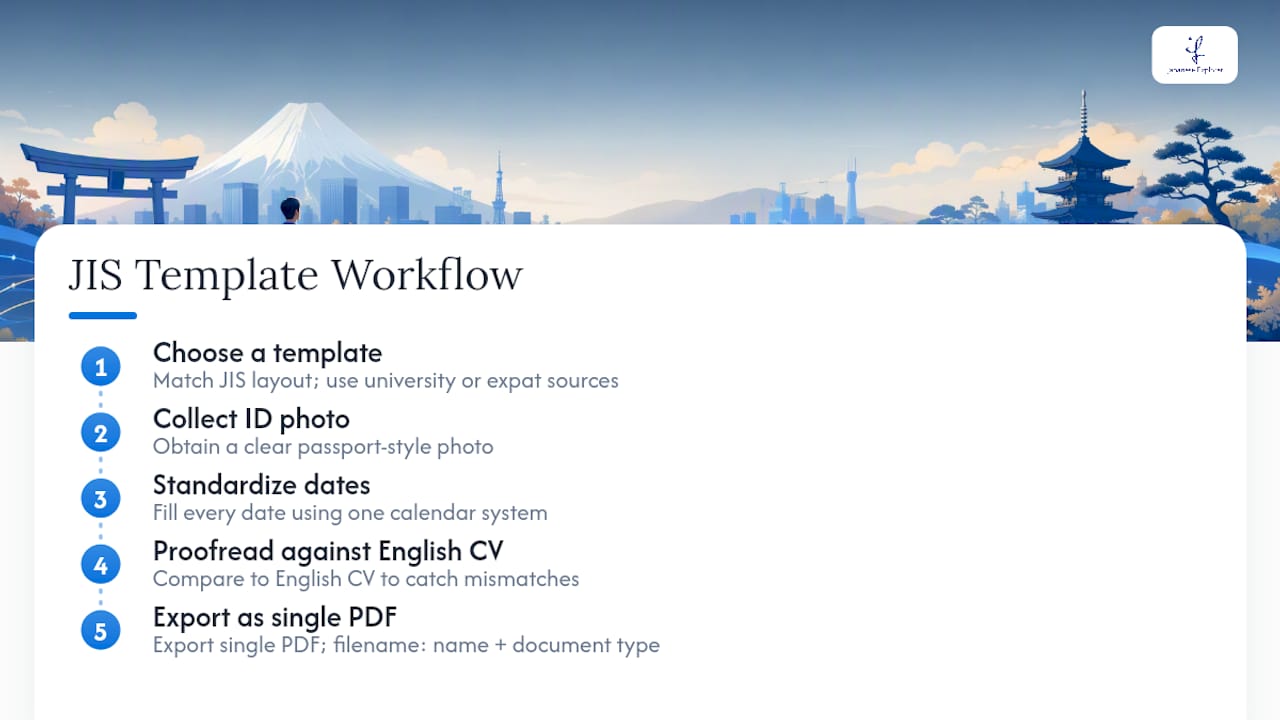
Whatever source you use, follow a simple five-step workflow: pick a template that matches the JIS layout, collect your ID photo, fill in every date using one consistent calendar system, proofread against your English CV to catch mismatches, and export everything as a single PDF before sending. If you’re scanning a handwritten form, aim for a resolution sharp enough to read clearly on screen, and save the file with your name and document type in the filename so recruiters can find it fast.
Why Getting the Rirekisho Right Is a Language Problem, Not Just a Formatting One
Most guides treat the rirekisho as a formatting exercise: fill this box, follow that rule. That’s true, but it misses the harder part. The self-PR and reason-for-application boxes are where fluency actually gets tested, because vague, translated-sounding Japanese stands out immediately next to boxed fields that are otherwise rigid and precise.
Three things speed this up more than reading another checklist. First, practicing set phrases out loud until they sound natural rather than memorized. Second, having someone fluent review your draft before you submit it, since small grammar slips in a formal document read very differently than the same slip in casual conversation. Third, pairing your document prep with interview practice, since employers often ask you to expand verbally on exactly what you wrote in your self-PR box.
None of this requires a huge time investment, but it does require actual practice with feedback, not just another template. If you want structured help with the business Japanese and keigo that make these sections sound native rather than translated, Com’s small-group classes and private lessons both cover this kind of document and interview prep directly, and either is worth exploring if a specific application deadline is approaching.
— Paul
Where to Verify Format Details and Find Templates
Career centers at universities with international programs, along with established expat career guides, are reliable places to find JIS-style templates and updated formatting advice. Always follow the specific submission format an employer requests over any general guide, this one included, since individual company instructions take priority.
Sources
- Japanese Resume Guide for International Students (2025)
- Writing a Japanese resume (rirekisho): template and tips for expats
- How to Write a Resume Cover Letter: With a Template | Ficilcom
FAQ
How Do You Write a Resume for a Job in Japan?
Use a rirekisho, Japan’s standardized resume template, and fill every boxed field (photo, dates, education, work history, self-PR) exactly as instructed. Mid-career applicants typically pair it with a shokumu keirekisho for detailed work history.
What Are the Three Most Common Resume Formats?
Outside Japan, the three most common resume formats are chronological, functional (skills-based), and combination (a mix of both). In Japan, the standardized rirekisho replaces these formats entirely for most job applications.
What Is a Resume Called in Japanese?
A resume in Japanese is called a rirekisho (履歴書). When more detail on work experience is needed, applicants also prepare a shokumu keirekisho (職務経歴書), which functions closer to a Western-style CV.
Do I Need to Handwrite My Rirekisho?
It depends on the employer. Traditional companies often still expect a handwritten form, while startups and international-facing companies typically accept typed or digital PDF submissions.
What Should I Write in the Self-PR Box?
Keep it to two to four sentences: state a strength, back it with a brief specific example, then connect it to what the employer gains. Company-specific answers perform far better than generic ones.