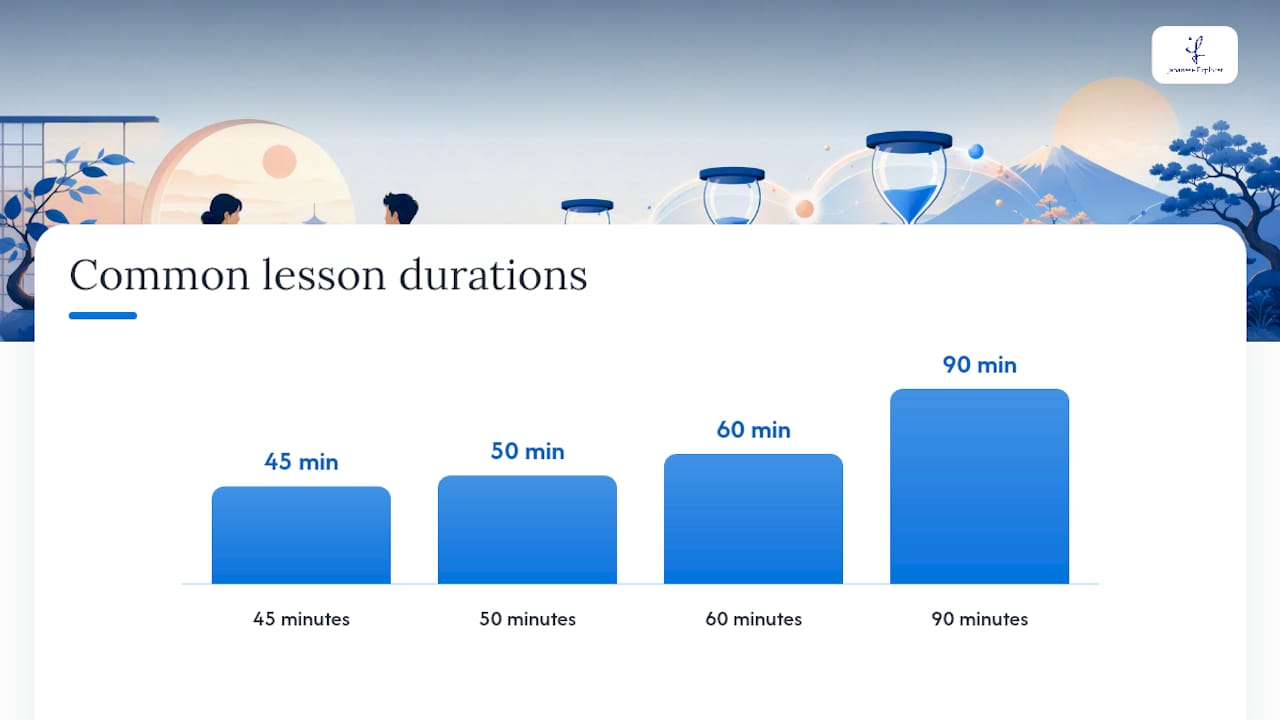
A private Japanese lesson is a one-on-one, goal-driven session where your instructor customizes every element — warm-up, review, new input, guided practice, feedback, and homework — around your specific objectives, whether that’s passing the JLPT, holding a business meeting in Japanese, or simply holding a conversation with confidence. Unlike a group class, the private Japanese lesson format bends entirely to you: your pace, your gaps, your schedule, and your chosen lesson length. Common durations include 45, 50, 60, or 90 minutes, with format and structure tailored to those timeframes.
Every well-run private session typically includes these core elements:
- Warm-up (greetings, quick oral review, or a short listening prompt)
- Review of previous lesson material or homework
- New input (grammar point, vocabulary set, or reading/listening passage)
- Guided practice (controlled drills, then freer conversation or writing)
- Feedback on errors and pronunciation
- Homework assignment targeting identified weaknesses
Japanese Explorer’s private lessons follow a curriculum guided by the Association for Japanese-Language Teaching, which means the structure above isn’t improvised — it reflects a proven pedagogical sequence that integrates grammar, speaking, and listening in every session.
Key Takeaways
A structured private Japanese lesson covers warm-up, review, new input, guided practice, feedback, and homework — all customized to your goals, whether that’s JLPT prep, business Japanese, or everyday conversation.
| Point | Details |
|---|---|
| Standard lesson structure | Every session includes warm-up, review, new input, practice, feedback, and homework. |
| Lesson length options | Common durations are 45, 50, 60, and 90 minutes; 60 minutes suits most adult learners. |
| Format choice | Online Zoom lessons cost less and offer more flexibility; in-person suits pronunciation and immersive roleplay. |
| Progress pace | Twice-weekly lessons combined with daily self-study can help learners make significant progress in beginner to lower-intermediate Japanese within a few months. |
| Japanese Explorer | Offers private and online lessons for adults with bilingual instructors and a structured curriculum. |
Table of Contents
- What does a private Japanese lesson format look like minute by minute?
- In-person vs online: which format works better for you?
- How are lessons tailored to your specific goals?
- Sample 60-minute lesson plans for beginner and intermediate learners
- How often should you take lessons, and how fast will you progress?
- What affects the price of private Japanese lessons?
- How to prepare for your first private lesson
- How do you choose the right private Japanese teacher?
- What should you expect from a trial lesson?
- A note on what makes private lessons worth the investment
- Japanese Explorer’s private lessons: what you get and how to book
- Useful sources
- FAQ
What does a private Japanese lesson format look like minute by minute?
Most private lessons run common durations suited to adult learners. Here’s how a typical 60-minute session breaks down:
| Phase | Time | What happens |
|---|---|---|
| Warm-up | 5 min | Casual conversation, quick oral review |
| Homework review | 10 min | Correct errors, reinforce patterns |
| New input | 15 min | Grammar explanation, vocabulary, or reading |
| Guided practice | 15 min | Controlled drills, sentence building |
| Free practice | 10 min | Roleplay, discussion, or writing task |
| Feedback and homework | 5 min | Error summary, next assignment |
A 45-minute session compresses the free-practice block. A 90-minute session expands new input and adds a second roleplay or a listening task. Who controls the balance? Ideally, both of you. A good teacher arrives with a plan, but you can and should negotiate: if you need more speaking time and less drilling, say so before the lesson starts.
In-person vs online: which format works better for you?
Both formats deliver genuine results. The right choice depends on your schedule, budget, and learning style.
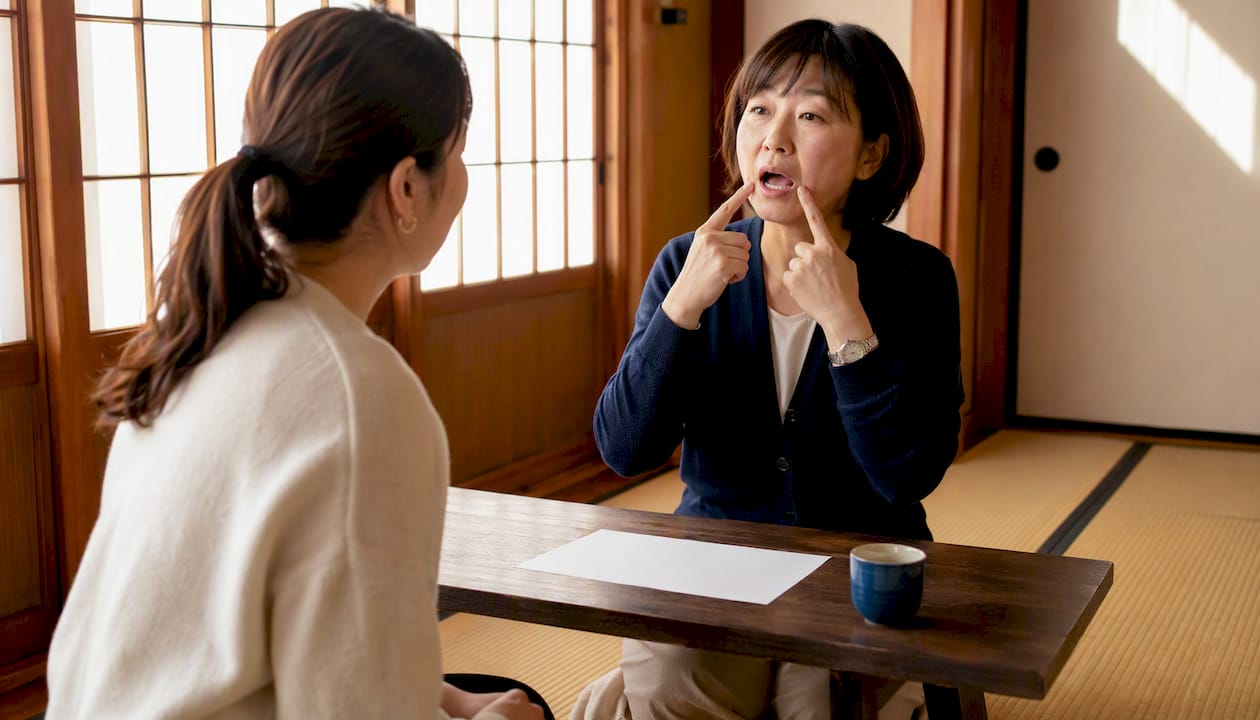
In-person advantages: Richer nonverbal feedback (the teacher can model mouth position for pitch accent), physical materials like flashcard sets, and a more immersive atmosphere for roleplay. Pronunciation and shadowing work tend to land better face-to-face.
Online advantages: No commute, lower cost in most cases, and far more scheduling flexibility. You can book a Zoom session with a qualified instructor regardless of where you live. Screen-sharing makes it easy to work through grammar sheets, slides, or shared documents in real time.
Tech checklist for online lessons:
- Stable internet connection (wired is more reliable than Wi-Fi)
- Headset with a microphone for clear audio
- Camera enabled so your teacher can see your facial expressions
- A shared folder or screen-share tool for lesson materials
- Confirmed time zone before your first booking
Pro Tip: Test your audio and video setup at least 15 minutes before your first online session. A dropped connection in the first five minutes wastes lesson time and rattles your confidence.
In-person lessons often cost more due to overhead or travel, while online lessons tend to be less expensive and offer more scheduling flexibility. For pronunciation-heavy work, consider starting in-person and transitioning online once your ear is trained. You can read more about online flexibility options to weigh the trade-offs.
How are lessons tailored to your specific goals?
This is where one-on-one Japanese classes genuinely outperform group formats. Your teacher adjusts the entire lesson plan around what you actually need.
- Conversation fluency: Topical roleplays, spontaneous Q&A, and vocabulary sets built around your real interests (travel, anime, daily life)
- JLPT prep: Grammar pattern drilling, timed reading comprehension, mock listening tests, and spaced repetition vocabulary review. Check the JLPT levels guide to map your target level to lesson content.
- Business Japanese: Meeting phrases, email templates, keigo (formal register), and workplace roleplay scenarios. A business Japanese course module can be woven directly into private sessions.
- Travel Japanese: Survival phrases, numbers, directions, and restaurant or hotel vocabulary
At intake, a good teacher will ask: What is your current level? Do you have a test deadline? Where will you actually use Japanese? Do you prefer a textbook or conversation-first approach? Those answers shape the first three lessons immediately.
Pro Tip: Bring a real-world sample to your intake session — a work email you need to write, a scene from a show you want to understand, or a photo from a trip. Concrete material gives your teacher something specific to build from.
Sample 60-minute lesson plans for beginner and intermediate learners
Beginner (60 minutes)
- 0–5 min: Warm-up in Japanese — greetings, “how was your week?” using known phrases
- 5–15 min: Homework review — correct written exercises, reinforce verb conjugation
- 15–35 min: New input — introduce one grammar point (e.g., て-form) with three example sentences
- 35–48 min: Guided practice — fill-in-the-blank drills, then two short original sentences
- 48–55 min: Roleplay — order food at a restaurant using the new form
- 55–60 min: Feedback summary and homework (five sentences using て-form in context)
Intermediate (60 minutes)
- 0–5 min: Oral check-in — describe your weekend in Japanese, teacher notes errors silently
- 5–20 min: Listening or reading task — short audio clip or passage, comprehension questions, discussion
- 20–35 min: Task-based speaking — explain a process or opinion using target grammar
- 35–52 min: Roleplay — simulated workplace scenario (e.g., a client meeting or phone call)
- 52–60 min: Error review and homework (write a short email or journal entry)
For a 45-minute session, cut the roleplay to five minutes. For 90 minutes, double the free-practice block or add a second listening task. JLPT-focused sessions swap the roleplay for a timed grammar or reading drill.
Pro Tip: Ask your teacher to keep a running error log across sessions. Patterns in your mistakes — consistently dropping particles, mixing up plain and polite form — are far more useful to fix than random corrections.
How often should you take lessons, and how fast will you progress?
| Frequency | Who it suits | Realistic 3-month outcome |
|---|---|---|
| Once weekly | Busy professionals, casual learners | Solid grasp of beginner grammar; basic conversation |
| Twice weekly | Motivated learners with a goal deadline | Reach conversational N4–N5 range; workplace basics |
| Intensive (3–5x/week) | Pre-departure, exam sprint, career pivot | Functional intermediate level; JLPT N4 within reach |
Progress depends heavily on what you do between sessions. Homework consistency, daily exposure, and quality teacher feedback all compound to improve results.
Most private lessons operate on a booking-by-appointment model rather than fixed school terms, allowing flexible start dates. Popular evening and weekend slots often require advance booking.
What affects the price of private Japanese lessons?
Several variables determine what you’ll pay:
- Instructor experience and credentials (certified bilingual teachers command higher rates)
- Lesson length (50 vs 90 minutes shifts the per-session cost significantly)
- In-person vs online (in-person typically costs more due to venue or travel overhead)
- Custom materials (bespoke worksheets or mock JLPT tests may carry a small prep fee)
- Bundle discounts (prepaid packs of 5 or 10 lessons usually reduce the per-lesson rate)
- Time of day (some providers charge more for prime evening slots)
Per-lesson fees at language schools vary by provider, instructor level, and location. Before committing, ask specifically: Is there an enrollment fee? What is the cancellation policy? Do unused prepaid lessons roll over? Some schools require advance payment for lesson blocks and charge a material fee separately.
How to prepare for your first private lesson
Arriving prepared makes a real difference in how much you get from that first session.
- Write down your top three goals (e.g., “pass JLPT N4 by December,” “hold a 5-minute conversation”)
- Note your current level honestly — even “complete beginner” is useful information
- Bring any materials you already own (a textbook, a vocabulary list, a grammar workbook)
- For online lessons: test your camera, mic, and internet connection beforehand
- Have a notebook or digital note app ready for vocabulary and error notes
- Prepare two or three questions about the teacher’s approach, homework load, and how progress will be measured
If you’re joining from a different time zone for a Zoom session, confirm the session time in both time zones when you book to avoid a missed start.
How do you choose the right private Japanese teacher?
Not every qualified teacher is the right fit for your goals. Use this checklist when screening candidates:
- Experience teaching adult learners (not just children or exam students)
- Familiarity with your target area: JLPT, business Japanese, or conversational fluency
- Bilingual ability so they can explain grammar in English when needed — bilingual instructors reduce confusion at critical learning moments
- Willingness to share a sample lesson plan or conduct a trial session
- Clear homework and feedback method (not just “we’ll talk”)
Questions to ask in a discovery call:
- How do you assess my level at the start?
- What does a typical lesson look like for someone at my stage?
- How do you track progress between sessions?
- What is your cancellation and make-up policy?
- Can I see an example of the homework you assign?
Red flags: No clear lesson plan, vague goals (“we’ll just chat”), inconsistent availability, and no concrete feedback method. A good teacher welcomes these questions — they signal you’re a serious learner.
What should you expect from a trial lesson?
A well-structured trial typically runs 30–60 minutes and covers four things: a short level check, a discussion of your goals, a brief teaching sample, and immediate feedback with a suggested plan.
Assessment items you might encounter:
- A short speaking prompt (“Tell me about your day in Japanese”)
- A listening excerpt with two or three comprehension questions
- A quick grammar check (fill-in-the-blank or sentence correction)
- A sample homework task to take away
After the trial, you should walk away knowing your approximate level, what the first three lessons will cover, and how homework will be structured. If the teacher can’t tell you those three things, that’s a sign to keep looking.
Pro Tip: Take a placement test before your trial if one is available. Arriving with an objective level assessment saves 10–15 minutes of the trial and lets you spend that time on actual teaching.
A note on what makes private lessons worth the investment
There’s a version of this conversation that treats private lessons as a premium luxury — something you upgrade to once you’ve “tried” group classes. That framing gets it backwards. For adult learners with specific, time-sensitive goals (a job interview in Tokyo, a JLPT deadline, a client relationship to build), a group class is often the slower, less efficient path. You spend a significant portion of every group session waiting for others to catch up or racing to keep pace.
The private lesson format removes that friction entirely. Every minute is yours. The teacher’s attention is undivided, the feedback is immediate, and the homework is designed for exactly the gap you showed in that session. That’s not a luxury — it’s just a better use of your study hours.
Where people go wrong is treating private lessons as a passive experience: showing up, listening, and expecting fluency to follow. The learners who progress fastest treat each session as a sprint, not a stroll. They do the homework, they review their error logs, and they push back when a lesson isn’t challenging enough. The format gives you the conditions to accelerate. What you do with those conditions is up to you.
Japanese Explorer’s private lessons: what you get and how to book
Japanese Explorer offers personalized private lessons for adult learners, with flexible scheduling across in-person and Zoom formats. Whether you’re targeting JLPT, building business Japanese for workplace use, or starting from zero for conversational confidence, lessons are taught by bilingual certified instructors following a curriculum guided by the Association for Japanese-Language Teaching.
Private lesson options include business Japanese modules, JLPT preparation, corporate training, and online Zoom sessions that fit around a working schedule. You can also explore the full range of Japanese language courses or go straight to the online course page if Zoom is your preferred format. To get started, book a consultation or trial session directly through the private lessons page and arrive with your goals ready.
Useful sources
- Online Japanese Course | Japanese Explorer
- Private Japanese Language Lessons: Shinjuku Japanese Language Institute
- Accent Reduction for Professionals | InPronunci
FAQ
What is included in a typical private Japanese lesson?
A private lesson typically includes a warm-up, homework review, new grammar or vocabulary input, guided and free practice, real-time feedback, and a homework assignment tailored to your identified weaknesses.
How long is a private Japanese lesson?
Most providers offer sessions of 45, 50, 60, or 90 minutes. A 60-minute session is the most common choice for adult learners balancing work and study.
Is online or in-person better for learning Japanese privately?
Online Zoom lessons offer more scheduling flexibility and lower cost; in-person sessions are better for pronunciation work and immersive roleplay. Japanese Explorer offers both formats for adult learners.
How many private lessons per week do I need to make progress?
Two lessons per week, combined with daily self-study, gives most adult learners a realistic path to conversational ability within three months. Once weekly works for learners with lighter schedules or longer timelines.
What should I bring to my first private Japanese lesson?
Bring a clear list of your goals, any materials you already own, and two or three questions about the teacher’s approach and homework method. For online sessions, test your camera and microphone before the session starts.