TL;DR:
- Japanese Explorer provides a structured, bilingual curriculum for adult learners seeking conversational, JLPT, and business Japanese in Singapore. It offers flexible in-person and online classes guided by AJALT standards, with trial lessons available to ensure the right match. Alternative options include IKOMA, Bunka, iTalki, JapanesePod101, and Udemy, each catering to different learning needs and schedules.
If you want a practical, adult-focused alternative to Hougang Japanese Language School, Japanese Explorer is the top pick. Located at 10 Anson Road, Level 22, International Plaza, right above Tanjong Pagar MRT, it offers group, private, and live-online classes for conversational, JLPT, and business Japanese, all taught by bilingual certified instructors with a curriculum guided by the Association for Japanese-Language Teaching (AJALT). Singapore’s broad ecosystem of Japanese language schools means you have real choices, and this shortlist covers the best of them.
Quick shortlist of hougangjapanese.com alternatives:
- Japanese Explorer — Best overall for adult conversational, JLPT, and business Japanese in Singapore (in-person + live online)
- IKOMA Language School — Best for structured group classes with a long track record in Singapore
- Bunka Language School — Best for learners who want a Japanese-culture-immersive classroom experience
- iTalki — Best for flexible 1:1 lessons with native or bilingual tutors, fully online
- JapanesePod101 — Best audio-first supplement for listening and vocabulary building
- Udemy — Best low-cost self-paced option for grammar and JLPT drills
Book a trial lesson or take a placement test before committing to any provider. A good trial tells you the class size, the instructor’s teaching style, and whether the pace matches your level.
Table of Contents
- What are the best alternatives to hougangjapanese.com?
- Profiles of each recommended alternative
- How to choose the best alternative for your goals
- What are the best online and self-study options?
- Key Takeaways
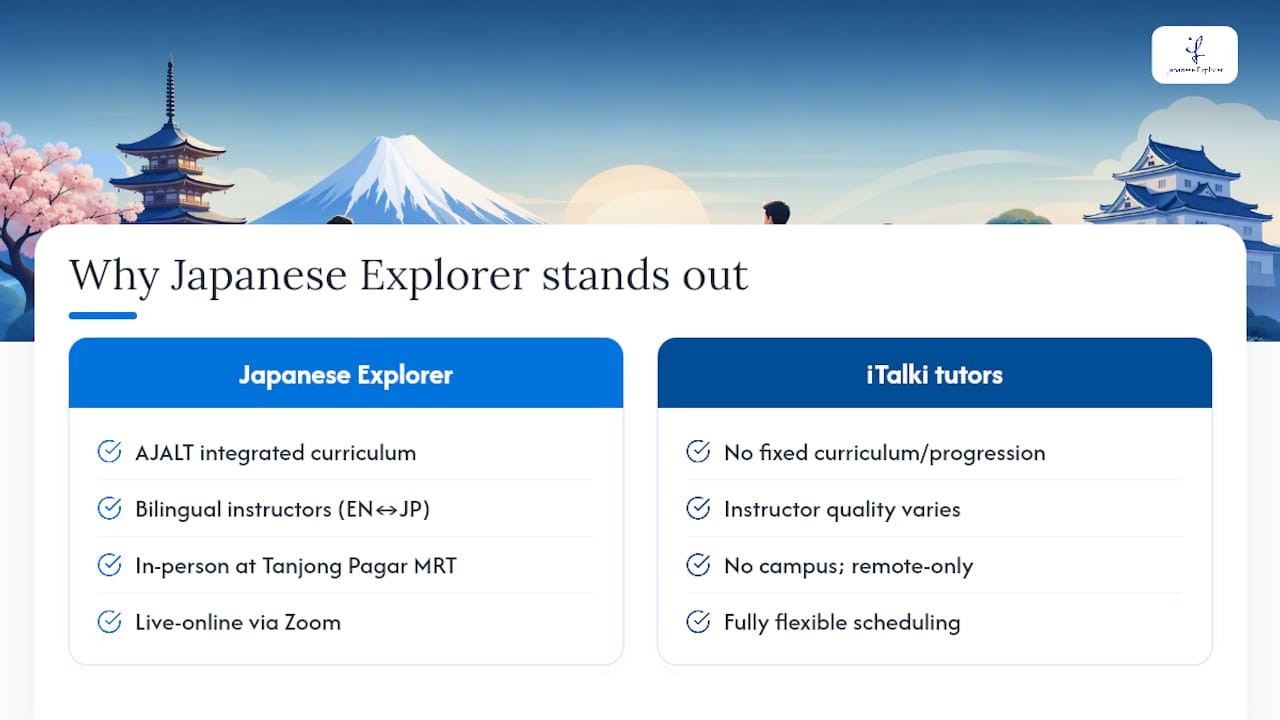
- Why Japanese Explorer stands out for adult learners
- Ready to try Japanese Explorer?
- Useful sources
- FAQ
What are the best alternatives to hougangjapanese.com?
The table below covers the six most recommended options across the dimensions that matter most to adult learners. Japanese Explorer leads on the combination of AJALT-guided curriculum, bilingual instructors, and flexible scheduling, which makes it the strongest like-for-like alternative for most adult learners in Singapore.
| Provider | Best for | Format | Pricing model | Schedule & flexibility | Teacher credentials | Trial policy |
|---|---|---|---|---|---|---|
| Japanese Explorer | Conversational, JLPT, business | In-person + live online | Published course fees; group and private tiers | Evening and weekend groups; private slots flexible | Bilingual, certified, AJALT-guided | Trial lesson available; placement test offered |
| IKOMA Language School | Structured group progression | In-person (Singapore) | Term-based group fees | Fixed term schedule; some weekend options | Experienced instructors | Enquire for trial |
| Bunka Language School | Cultural immersion + language | In-person (Singapore) | Term-based | Weekday and weekend classes | Native and bilingual teachers | Enquire for trial |
| iTalki | Flexible 1:1 speaking practice | Live online | Per-lesson (community tutors and professional teachers) | Fully flexible; book any time zone | Varies; filter by certification | Trial lesson at reduced rate |
| JapanesePod101 | Listening and audio drills | Self-study (audio/video) | Subscription tiers; free tier available | Fully self-paced | Produced by native speakers | Free trial available |
| Udemy | Self-paced grammar and JLPT | Self-study (video) | One-time course purchase | Fully self-paced | Varies by course creator | 30-day refund policy |
Japanese Explorer’s AJALT-guided curriculum sets it apart from most local alternatives: every lesson integrates grammar, speaking, and listening rather than treating them as separate modules.
The sitelike.org aggregator indexes dozens of sites listed as similar to hougangjapanese.com, which confirms that the market for Japanese language learning in Singapore is wide. That breadth is useful context, but it also means quality varies significantly from one provider to the next.
Profiles of each recommended alternative
Japanese Explorer — best overall for adult learners
Format: In-person at 10 Anson Road (above Tanjong Pagar MRT) and live online via Zoom. Levels: Beginner through advanced, JLPT N5–N1 prep, business Japanese, and corporate training. Pricing: Published course fees for small group classes and private lessons; online courses available separately. Trial: Yes, trial lessons and a placement test are offered.
The curriculum follows AJALT guidelines, which means each lesson builds grammar, speaking, and listening together rather than in isolation. Instructors are bilingual and certified, so beginners get clear explanations in English while still hearing natural Japanese throughout the class. Evening and weekend group slots make it realistic for working adults, and the private lesson option suits anyone who needs a faster pace or a non-standard schedule.
Booking: Take the placement test first if you have any prior Japanese exposure, then book a trial group or private lesson through the website.
Location note: Tanjong Pagar MRT is directly below the building, so commute time from most parts of Singapore is under 30 minutes.
IKOMA Language School — best for structured group progression
Format: In-person, Singapore. Levels: Beginner to advanced, JLPT prep. Pricing: Term-based group fees. Trial: Enquire directly.
IKOMA has a long history in Singapore’s language school market and runs structured term programs that suit learners who prefer a classroom setting with clear progression milestones. The fixed-term schedule works well if your week is predictable, though it offers less flexibility than a school with rolling enrollment. Student reviews generally highlight the organized curriculum and consistent teaching quality.
Bunka Language School — best for cultural immersion
Format: In-person, Singapore. Levels: Beginner to intermediate, some advanced. Pricing: Term-based. Trial: Enquire directly.
Bunka weaves Japanese cultural content into its language lessons, which appeals to learners motivated by travel, anime, or a genuine interest in Japanese society. If your goal is purely JLPT certification or business Japanese, a more exam-focused school may serve you better. For conversational learners who want the cultural context alongside the grammar, Bunka is a natural fit.
iTalki — best for flexible 1:1 online lessons
Format: Live online only. Levels: All levels; you choose the tutor. Pricing: Per-lesson rates set by individual tutors; community tutors are typically lower cost than professional teachers. Trial: Most tutors offer a discounted trial lesson.
iTalki is the go-to marketplace when you want speaking practice on your own schedule. You can filter tutors by native speaker status, certification, teaching style, and hourly rate, then book a slot that fits your calendar. The trade-off is consistency: tutor quality varies, and you may need to try two or three before finding the right match. It works best as a speaking-practice supplement alongside a structured course rather than as a standalone curriculum.
JapanesePod101 — best audio supplement
Format: Self-study, audio and video lessons. Levels: Absolute beginner to advanced. Pricing: Subscription tiers; a free tier with limited access is available. Trial: Free tier acts as a trial.
JapanesePod101 delivers structured audio lessons that build listening comprehension and vocabulary through repetition. It pairs well with any live class because it fills the gap between lessons, keeping your ear tuned to natural speech patterns. The free tier gives you enough content to judge whether the format suits your learning style before paying for a subscription.
Udemy — best for self-paced grammar and JLPT prep
Format: Self-study, video courses. Levels: Beginner to JLPT N2; varies by course. Pricing: One-time course purchase, frequently discounted. Trial: 30-day refund policy effectively functions as a trial.
Udemy hosts a wide range of Japanese courses covering grammar fundamentals, JLPT-focused drills, and conversational basics. The one-time purchase model keeps costs low, and the refund policy removes the financial risk of trying a new course. The limitation is that video courses cannot give you real-time speaking feedback, so Udemy works best as a grammar and reading foundation rather than a complete learning solution.
How to choose the best alternative for your goals
The right school depends on four things: your goal, your schedule, your budget, and how you learn best. Here is a practical checklist to work through before you commit.
Decision criteria:
- Goal clarity: Are you aiming for conversational fluency, JLPT certification (N5 through N1), or business Japanese for work? Each goal points to a different provider type.
- Schedule fit: Can you attend fixed weekly classes, or do you need fully flexible booking? In-person schools run on term schedules; online tutors and self-study tools adapt to you.
- Teacher credentials: Look for bilingual instructors if you are a beginner. A teacher who can explain grammar in English while modeling natural Japanese speech accelerates early progress significantly.
- JLPT alignment: If certification is your goal, confirm that the school’s syllabus maps to JLPT levels. Not every conversational course covers the grammar patterns tested at N3 and above.
- Price transparency: Published pricing is a green flag. Vague “contact us for fees” responses can signal inflexible packages or hidden costs.
- Trial availability: Any reputable school offers a trial lesson or placement test. Skip providers that require full term payment upfront with no trial option.
Questions to ask before enrolling:
- What is the class size for group lessons?
- How does the instructor track individual progress?
- What happens if I miss a class?
- Is there a refund or credit policy for unused lessons?
- Does the curriculum follow a recognized framework such as AJALT or JLPT level descriptors?
Red flags to watch for:
- No trial lesson and no placement test
- Syllabus described only in vague terms (“we cover all levels”)
- Pricing available only after a sales call
- All instruction in Japanese only, with no bilingual support for beginners
Typical learning timelines with regular weekly lessons:
| Target level | Approximate study hours | Estimated months (2 lessons/week) |
|---|---|---|
| JLPT N5 (beginner) | 150 hours | 6–9 months |
| Conversational A2 | 150 hours | 6–9 months |
These ranges assume consistent attendance and regular self-study between lessons. A step-by-step learning guide for Singapore can help you map your personal timeline more precisely.
What are the best online and self-study options?
Online tools work best when you treat them as targeted supplements rather than complete replacements for live instruction. Each tool has a specific strength, and combining two or three covers the full range of skills you need.
- JapanesePod101 — Audio-first listening practice; ideal for commutes and downtime. Structured by level, so you can follow a progression rather than picking random episodes.
- Udemy — Grammar and JLPT drills at your own pace; best used to front-load grammar knowledge before or alongside a live course.
- Bunpro — A spaced repetition system (SRS) built specifically for Japanese grammar points, mapped to JLPT levels. More rigorous than Duolingo for serious learners. App comparison reviews consistently show that grammar-focused tools like Bunpro outperform gamified apps for learners targeting JLPT N4 and above.
- Canary — A music-based interactive language platform that builds vocabulary and natural phrasing through songs; a genuinely enjoyable supplement for conversational learners who find flashcard drills tedious.
When self-study alone is enough: If you are at an absolute beginner stage and your goal is casual conversation or travel Japanese, a structured self-study combination of Udemy (grammar) plus JapanesePod101 (listening) plus a weekly iTalki session can get you to A2 without a formal school enrollment.
When you need live instruction: JLPT N3 and above, business Japanese, and any goal involving writing or reading kanji at speed all benefit from a teacher who can correct your output in real time. Self-study tools cannot replicate that feedback loop.
Pro Tip: Structure your week as follows: 20–30 minutes of Bunpro grammar review daily, one JapanesePod101 audio lesson during your commute, and one live group or private lesson per week. That combination covers grammar retention, listening input, and speaking output without requiring more than an hour a day.
You can learn more about why interactive platforms complement live lessons if you want to understand the research behind blended learning approaches.
Key Takeaways
Japanese Explorer is the strongest like-for-like alternative to Hougang Japanese for adult learners in Singapore, combining AJALT-guided curriculum, bilingual instructors, and both in-person and live-online formats.
| Point | Details |
|---|---|
| Top alternative | Japanese Explorer covers conversational, JLPT, and business Japanese with bilingual certified instructors. |
| Start with a placement test | Take the placement test before enrolling to land in the right level from day one. |
| Match the tool to the goal | Use Udemy or Bunpro for grammar, JapanesePod101 for listening, and iTalki for speaking practice. |
| Typical timeline to N5 | Most adult learners reach JLPT N5 in roughly 6–9 months with two lessons per week and consistent daily self-study. |
| Japanese Explorer next step | Book a trial lesson or explore course options to find the right format for your schedule. |
Why Japanese Explorer stands out for adult learners
Most school comparisons focus on price and location. Those matter, but they are not what separate a good Japanese learning experience from a frustrating one. What actually moves the needle for adult learners is curriculum structure and instructor quality, and that is where Japanese Explorer earns its recommendation.
The curriculum follows AJALT guidelines, which means the progression is deliberate: grammar, speaking, and listening are woven into every lesson rather than siloed into separate modules. That integration matters because adults learn by connecting new language to real communication, not by memorizing grammar tables in isolation. Bilingual instructors make that connection explicit, explaining why a grammar pattern works the way it does in English before you practice it in Japanese.
The school’s location above Tanjong Pagar MRT removes one of the most common reasons adult learners drop out: a difficult commute after a long workday. And for learners who cannot make it in person, the live-online Zoom format replicates the classroom dynamic without the travel. What to expect from a Japanese course in Singapore gives you a realistic picture of the learning experience before you commit.
The one honest caveat: no single school is perfect for every learner. If your schedule is completely unpredictable, a marketplace tutor on iTalki may suit you better for the first few months. But for adult learners who want a structured, progressive path to conversational or business Japanese, Japanese Explorer is a well-organized, practical choice.
Ready to try Japanese Explorer?
Japanese Explorer offers small group classes and a live-online Japanese course for adult learners at every level, from complete beginners to those preparing for JLPT N2. The school is located at 10 Anson Road, Level 22, International Plaza, directly above Tanjong Pagar MRT, with evening and weekend slots designed for working adults.
If you work in a Japanese-facing role, the business Japanese course covers workplace vocabulary, formal registers, and meeting etiquette. Corporate teams can also arrange group training through the corporate training program. Not sure which level to start at? Take the placement test and get routed into the right class from your very first lesson.
Useful sources
The following sources informed this article and are worth bookmarking for your own research:
- Best Japanese Language Schools in Singapore 2026|Learn Japanese
- 8 places to study Japanese in Singapore and 4 tips to pick it up faster – Digital Senior
- Top 39 sites like hougangjapanese.com & alternatives
- Private Japanese Lessons near Hougang – SGLessons
- Udemy
- JapanesePod101
- Best Japanese Learning Apps: Real Comparison for 2025 & 2026 – Migaku
FAQ
Is there a better app than Duolingo for learning Japanese?
Yes. Grammar-focused tools like Bunpro explain Japanese grammar patterns in depth and map directly to JLPT levels, making them more effective for serious learners than Duolingo’s gamified approach. App comparison reviews recommend pairing a grammar-first app with an audio resource like JapanesePod101 for better overall results.
What is the best way to learn Japanese fluently?
Combining live instruction with targeted self-study produces the fastest results. A structured course at a school like Japanese Explorer builds grammar and speaking skills with real-time feedback, while daily app drills and audio listening fill the gaps between lessons.
Is Bunpro better than Duolingo for Japanese?
For adult learners targeting JLPT certification or business Japanese, Bunpro’s spaced repetition grammar system is more rigorous than Duolingo. Duolingo suits casual beginners who want a low-pressure introduction; Bunpro suits learners who need to retain grammar patterns at speed.
How long does it take to reach JLPT N5?
Most adult learners reach JLPT N5 in roughly 6–9 months with two lessons per week and consistent daily self-study. The timeline shortens with private lessons or a more intensive schedule.
Can I learn Japanese online instead of attending classes in Singapore?
Yes. Japanese Explorer offers a live-online Japanese course via Zoom that replicates the classroom experience for remote learners. Platforms like iTalki and JapanesePod101 are also solid online options, though they work best as supplements to structured live instruction rather than standalone solutions.