Katakana loanwords, or gairaigo, are foreign-origin words written in katakana and reshaped to fit Japanese sounds. If you already know your kana, you have most of what you need to start reading them today.
Here’s what matters most as you get started:
- Katakana works like a visual flag. When you spot it in a sentence, your brain should immediately think “foreign word incoming.”
- The vast majority of modern gairaigo come from English, so your existing vocabulary is a real head start, not a coincidence.
- Some words are traps. マンション (manshon) looks like “mansion” but actually means a plain condominium unit, not a sprawling estate.
Japanese speakers use an estimated 3,000 to 5,000 loanwords in daily conversation, which means skipping katakana study leaves a real gap in your listening and reading comprehension.
Key Takeaways
Katakana loanwords give you a real reading shortcut, but only if you learn the sound-mapping rules and watch for false friends instead of assuming every word means what it looks like.
| Point | Details |
|---|---|
| Katakana signals foreign origin | Treat it as a visual flag for gairaigo, but remember it also marks onomatopoeia and names. |
| English dominates modern borrowings | Most of the 3,000 to 5,000 loanwords in daily use trace back to English. |
| Learn the sound-mapping rules | Vowel insertion, the long vowel mark, and small ッ let you reverse-engineer unfamiliar words. |
| Watch for false friends | Words like マンション and コンセント look English but carry different Japanese meanings. |
| Structured practice speeds recognition | Com’s group, online, and business Japanese courses build katakana fluency into real conversation practice. |
Table of Contents
- What Are Katakana Loanwords and Where Do They Come From?
- How Does Katakana Represent Foreign Sounds?
- What Word-Building Patterns Should You Recognize?
- What Katakana Loanwords Will You See Most Often?
- Which Katakana Words Are False Friends?
- How Do You Decode an Unfamiliar Katakana Word?
- What Exercises Build Katakana Recognition Fast?
- A Teacher’s Note on Common Katakana Mistakes
- Ready to Practice Katakana With Real Feedback?
- Sources
- FAQ
What Are Katakana Loanwords and Where Do They Come From?
Gairaigo means “words that came from outside,” and katakana is the script Japanese uses to mark them as foreign in origin. This isn’t a minor detail. Katakana does for Japanese readers roughly what italics do for English readers when we write words like déjà vu or raison d’être. It’s a signal that says, “treat this one differently.”
Most modern borrowings come from English, but not all of them. Portuguese gave Japanese words like パン (pan, bread) and タバコ (tabako, tobacco) centuries before English became the dominant source. Dutch, French, German, and Chinese have all contributed too. German is common in medical and mountaineering vocabulary, French shows up heavily in fashion and food terms, and Chinese loanwords occupy a strange middle ground: they’re sometimes written in katakana and sometimes in kanji, depending on how established the word has become.
A few exceptions are worth flagging early:
- Katakana also marks onomatopoeia (ワンワン for a dog’s bark) and emphasis, not just borrowed vocabulary.
- Foreign personal names and place names are almost always katakana, even though they aren’t “loanwords” in the vocabulary sense.
- Older borrowings sometimes use ateji, meaning kanji chosen for their sound rather than meaning, or even hiragana, so katakana is a strong pattern rather than an ironclad rule.
Once you can tell the difference between “this is gairaigo” and “this is katakana for another reason,” you’ll stop guessing and start reading with actual confidence. Our hiragana vs. katakana breakdown digs into script function if you want the fuller picture.
How Does Katakana Represent Foreign Sounds?
Japanese has a much smaller sound inventory than English, so every loanword goes through a kind of translation filter. Learning that filter is the single highest-leverage skill for reading gairaigo, because it lets you reverse-engineer words you’ve never seen before.
A few adaptation rules do most of the work:
- Vowel insertion: Japanese syllables (except ん) always end in a vowel, so consonant clusters get vowels stuffed in between them. “Strike” becomes ストライク (sutoraiku).
- Final consonant handling: word-final consonants usually pick up a vowel too, except for n, which becomes ン. “Pen” becomes ペン (pen), clean and simple.
- The long vowel mark (ー): this stretches a vowel sound, so “computer” becomes コンピューター (konpyuutaa), with that final ー signaling the drawn-out “ar” sound.
- Small ッ (gemination): this doubles the following consonant sound, turning “cut” into カット (katto).
- Combination kana: newer sound combinations like フォ (fo), ティ (ti), and トゥ (tu) let Japanese approximate sounds that don’t exist in the traditional syllabary, so “coffee” is コーヒー but “cafe” uses フェ in some borrowings and カフェ in others.
Once you internalize these phonotactic adaptation patterns, guessing unfamiliar words gets a lot easier, particularly when you also know common substitutions like /th/ becoming /s/ (think → シンク, shinku).
Pro Tip: Stressed syllables in the English original usually get the long vowel mark or an extra mora in Japanese. If you’re unsure how to katakana-ize a word, say it out loud slowly and notice which syllable you naturally lean on. That’s usually where the ー or doubled consonant lands.
What Word-Building Patterns Should You Recognize?
New katakana words rarely appear out of nowhere. They tend to follow a handful of productive patterns, and research on English loanwords in Japanese identifies clipping, compounding, and affixation as the primary mechanisms behind nearly all of them.
Clipping shortens longer words, often past the point of easy recognition. スマホ (sumaho) comes from スマートフォン (smartphone), and パソコン (pasokon) comes from パーソナルコンピューター (personal computer). Compounding glues two loanwords together to describe something specific, the way フライドポテト (fried potato, meaning French fries) combines two separate borrowings into one dish. Affixation attaches a productive suffix to a stem, so -アップ (up) and -ダウン (down) get bolted onto all sorts of bases to mean “increase” or “decrease.”
Then there’s wasei-eigo, literally “Japan-made English.” These words look English but were built inside Japan, often by combining pieces in ways that never existed in the source language.
| Pattern | Examples | Recognition Cue |
|---|---|---|
| Clipping | スマホ, パソコン, アニメ | Shortened, often 3–4 mora, harder to trace to English |
| Compounding | フライドポテト, アイスコーヒー | Two recognizable loanword chunks joined together |
| Affixation | パワーアップ, イメージダウン | A common root plus -アップ, -ダウン, or similar |
| Wasei-eigo | サラリーマン, ハンドルキーピング | Sounds plausible in English but doesn’t exist that way |

Wasei-eigo trips up even confident learners because your brain wants to translate it literally. That instinct works about half the time and misleads you the other half.
What Katakana Loanwords Will You See Most Often?
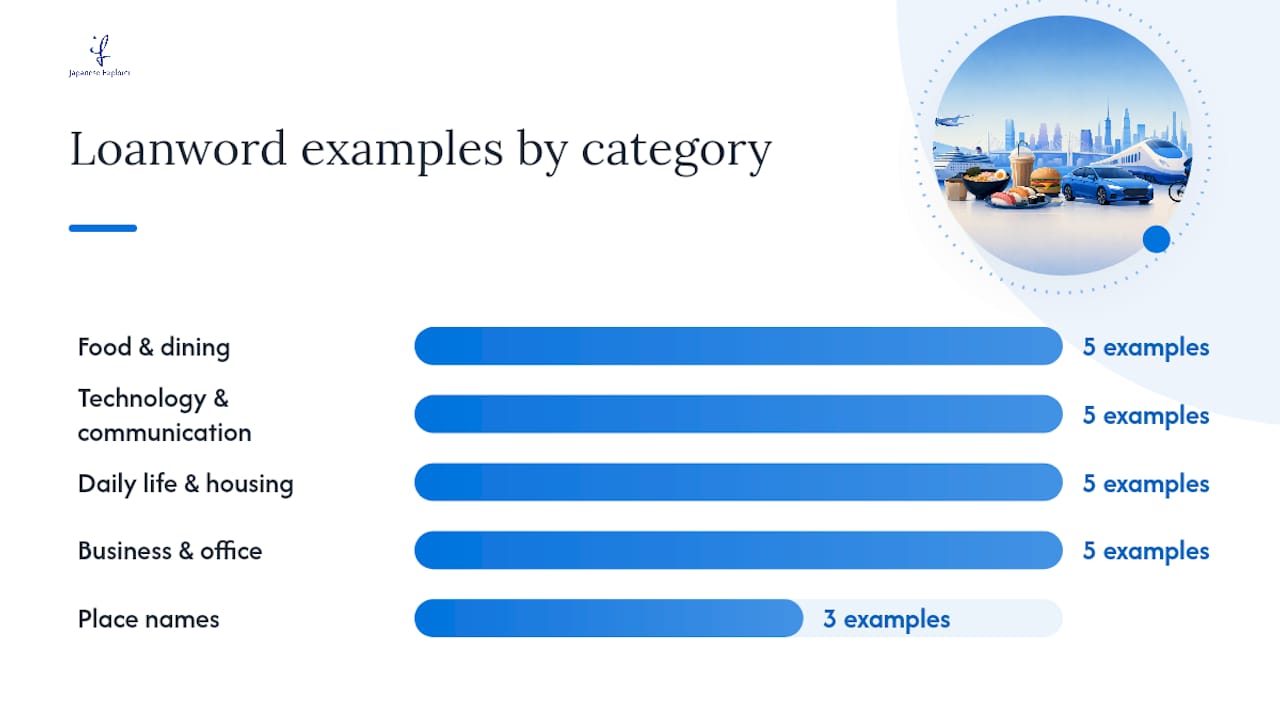
Once you start noticing katakana in real reading material, you’ll realize how often it shows up: menus, product packaging, office emails, train announcements, and casual conversation are full of it. Building a working list by category is more efficient than memorizing words at random.
Food and dining
- レストラン (resutoran) — restaurant
- メニュー (menyuu) — menu
- バイキング (baikingu) — a buffet, oddly named after the Viking Restaurant chain that popularized the format in Japan
- コーヒー (koohii) — coffee
- ビール (biiru) — beer
Technology and communication
- スマホ (sumaho) — smartphone, a clipped form worth knowing since it’s now more common than the full word
- メール (meeru) — email, note that this refers specifically to email, not postal mail
- パソコン (pasokon) — personal computer
- ネット (netto) — the internet, another clipping
- アプリ (apuri) — app, clipped from アプリケーション
Daily life and housing
- アパート (apaato) — a low-rise apartment building, distinct from マンション which refers to a larger condo-style building
- エアコン (eakon) — air conditioner, clipped from エアコンディショナー
- コンビニ (konbini) — convenience store, clipped from コンビニエンスストア
- タオル (taoru) — towel
- ソファ (sofa) — sofa
Business and office terms
- オフィス (ofisu) — office
- ミーティング (miitingu) — meeting
- スケジュール (sukejuuru) — schedule
- プレゼン (purezen) — presentation, clipped from プレゼンテーション
- レポート (repooto) — report
Place names
- ニューヨーク (nyuuyooku) — New York
- シンガポール (shingapooru) — Singapore
- ヨーロッパ (yooroppa) — Europe, borrowed originally through Dutch rather than English
Notice how many of these are clipped forms. That’s not a coincidence. Japanese speakers gravitate toward shorter, punchier versions of long borrowed words, which means the “obvious” full form you’d expect from English is often not the one you’ll actually encounter. Our vocabulary examples from beginner to business page has more categorized lists if you want to keep building from here.
Which Katakana Words Are False Friends?
This is where katakana study gets genuinely tricky, and where a lot of confident-sounding learners get quietly embarrassed. Some loanwords look exactly like the English word you know, but the meaning has drifted, sometimes by a little and sometimes by a lot.
| Katakana Word | Expected English Meaning | Actual Japanese Meaning | Example Sentence |
|---|---|---|---|
| マンション (manshon) | Mansion, a grand estate | A mid-to-high-rise condominium | 新しいマンションに引っ越しました。(I moved into a new condo.) |
| コンセント (konsento) | Consent, agreement | An electrical wall outlet | コンセントはどこですか?(Where’s the outlet?) |
| バイキング (baikingu) | Viking, the seafaring people | A buffet-style meal | 朝食はバイキングです。(Breakfast is buffet-style.) |
| スマート (sumaato) | Smart, intelligent | Slim or sleek in appearance | 彼はスマートな体型です。(He has a slim build.) |
| クレーム (kureemu) | Claim, a general assertion | A complaint | クレームが多い店です。(This shop gets a lot of complaints.) |
These shifts happen for reasons that make sense once you see the pattern. Words often narrow in meaning as they get borrowed, keeping only one slice of the original definition. マンション kept the “impressive building” connotation but lost the “single grand house” part, since actual mansions barely exist in dense Japanese cities. Learner guides flag these traps consistently because they’re some of the most common sources of real miscommunication, not just quiz mistakes.
Katakana loanwords also spawn actual verbs, and this catches a lot of learners off guard the first time they see it. サボる (saboru, to skip class or slack off) comes from the French sabotage, and ググる (guguru, to google something) comes directly from “Google.” Both attach hiragana okurigana endings to a katakana stem, letting them conjugate exactly like native Japanese verbs: サボった (skipped), ググってみる (try googling it).
Pro Tip: Whenever a katakana word seems too easy, that’s exactly when to double check it. The words that trip up learners most aren’t the obscure ones. They’re the ones that look so obviously like English that you never think to question them.
How Do You Decode an Unfamiliar Katakana Word?
Reading gairaigo well isn’t about memorizing every possible word. It’s about running a quick mental process every time you hit an unfamiliar one.
- Spot the katakana. Notice the script shift itself; that’s your cue this word probably isn’t native Japanese.
- Sound it out and map likely vowel insertions. Say the word aloud and mentally strip the inserted vowels and the long vowel mark to guess at a source word.
- Check for clipping or wasei-eigo. If the straightforward guess doesn’t make sense, consider whether it’s a shortened form or a Japan-made combination.
- Confirm in a dictionary. Don’t leave it to a guess if the meaning actually matters for what you’re reading.
Beyond that four-step habit, a few study tactics make a real difference over time:
- Build category-based lists (food, tech, travel) rather than one giant undifferentiated pile of vocabulary.
- Use a spaced repetition system with both the katakana and the romaji on your flashcards, since reading speed and pronunciation improve separately.
- Read real material. Restaurant menus, convenience store packaging, and manga to learn Japanese are underrated because the katakana density is high and the context does a lot of the explaining for you.
- Treat cognate recognition as a starting point, not a finish line. Applied linguistics research on loanwords suggests that leaning on surface similarity works early on, but you need to actively study Japanese-specific meanings once you hit intermediate level, or false friends like マンション will keep tripping you up.
A simple weekly routine works better than sporadic cramming: pick one category, learn ten to fifteen words, then spend a few minutes hunting for those exact words in something you’re already reading. Quick wins add up fast once the pattern-recognition habit kicks in. If you want a deeper framework for retention, our vocabulary expansion tips piece covers spaced repetition in more depth.
What Exercises Build Katakana Recognition Fast?
Reading about decoding strategies only gets you so far. Two quick exercises will show you where your gaps actually are.
- Menu decoding drill. Find a Japanese restaurant menu online or in an app, and try to identify ten katakana words in under five minutes. Write down your best guess at the English source before checking a dictionary.
- Reverse katakanization. Take five English words (say, “chocolate,” “elevator,” “volunteer,” “schedule,” “internet”) and try writing plausible katakana versions using the vowel insertion and long vowel mark rules before checking the actual forms.
A few resources are worth keeping on hand as you build this skill:
- A Japanese-English dictionary app with katakana search support, for quick confirmation when your guess feels shaky.
- Curated katakana vocabulary lists organized by theme, which beat generic frequency lists for actual reading comprehension.
- Our own katakana guide for a structured walkthrough of reading rules and common pitfalls.
- Pronunciation practice resources like this overview of sound adaptation challenges for readers coming from other Asian-language backgrounds, which covers similar mapping issues from a different angle.
Doing this consistently for a couple of weeks tends to produce a noticeable jump in how fast you recognize loanwords without translating word by word.
A Teacher’s Note on Common Katakana Mistakes
The mistake I see most often isn’t confusion over the script itself. It’s overconfidence. Learners assume every katakana word means exactly what it looks like, then get quietly derailed by マンション or コンセント in a real conversation.
Classroom practice shortens that learning curve because a good instructor catches false friends before they turn into embarrassing misunderstandings, and drills pronunciation patterns you’d otherwise absorb slowly through trial and error. The best lessons don’t just hand you a vocabulary list. They make you produce the words out loud, in context, until the pattern recognition becomes automatic rather than effortful.
Ready to Practice Katakana With Real Feedback?
Reading about vowel insertion and gemination only gets you so far. What actually locks these patterns in is saying them out loud, getting corrected in real time, and reading real Japanese material with someone who catches the マンション-style traps before they become habits.

Com’s small-group classes build katakana recognition directly into conversational practice, so you’re not memorizing lists in isolation. If your schedule doesn’t allow for in-person sessions, the online Japanese course covers the same structured pronunciation drills and guided reading practice over Zoom, with a certified instructor watching for exactly the kind of false-friend mix-ups this guide covers. Professionals dealing with katakana-heavy business vocabulary might get more mileage from the business Japanese course, which leans into office and meeting terminology. Check current class schedules and pick the format that fits your week.
Sources
- Katakanization Guide: How To Convert English Words to Japanese
- Loanwords in Japanese
- An Overview and Synthesis of Research on English Loanwords in Japanese
FAQ
Is katakana always used for loanwords?
Katakana is the standard script for modern loanwords, but it also marks onomatopoeia, emphasis, and foreign names, and some older borrowings use kanji-based ateji or hiragana instead.
What are the 46 katakana letters?
Katakana includes basic characters covering the same sounds as hiragana (a, i, u, e, o, and combinations with consonants like k, s, t, n, h, m, y, r, and w), plus diacritic marks and combination kana for sounds like ファ and ティ that represent non-native phonemes.
What are Japanese loanwords?
Japanese loanwords, or gairaigo, are foreign-origin words adapted into Japanese phonology and usually written in katakana, with most modern examples borrowed from English and earlier waves coming from Portuguese, Dutch, and other languages.
What are some of the funniest katakana words?
Wasei-eigo produces some genuinely odd results, like サラリーマン (sarariiman, salaryman, a term for a typical office worker) and バイキング (baikingu, meaning buffet, named after a restaurant chain rather than actual Vikings).
How can I start recognizing katakana loanwords faster?
Build category-based vocabulary lists, practice the sound-mapping rules like vowel insertion and gemination, and get regular speaking practice. Com’s Japanese language courses build this recognition into structured lessons rather than leaving it to self-study alone.