
If you already read N4 comfortably and can study 90 to 120 minutes a day, a 6-week plan gets you exam-ready. Most learners do better on a 3-month schedule, and if your week is unpredictable, 6 months gives you the room to actually finish. Whichever you choose, start with a timed diagnostic mock this week, then split your remaining hours across vocabulary, grammar and reading, and listening. No single strong section saves a weak one on this exam.
TL;DR:
- A 6-week study plan suits those with a high diagnostic score and 90 to 120 minutes daily, but most learners benefit from a 3-month schedule.
- Focus equally on vocabulary, grammar, reading, and listening, with sectional minimum scores in each area determining overall success.
- Use spaced repetition for vocabulary, contrastive grammar drills, and timed reading and listening practices to build exam-relevant skills.
- Incorporate buffer weeks every four to six weeks, and avoid cramming in the last 48 hours before the exam.
- Guided lessons can help target weak sections more efficiently than self-study alone, especially for listening and output practice.
Table of Contents
- Understanding the JLPT N3 Study Plan: Format, Timing, and Scoring
- How Do I Choose Between a 6-Week, 3-Month, or 6-Month Plan?
- Vocabulary and Kanji: Building Recall That Survives Exam Pressure
- What’s the Best Way to Study N3 Grammar and Reading?
- How Should I Practice Listening for JLPT N3?
- Sample JLPT N3 Study Plans You Can Copy This Week
- Mock Tests, Pacing, and What to Do on Exam Day
- Where Guided Classes Speed Up Self-Study
- Paul’s Recommended Daily N3 Routine
- How Japanese Explorer Fits Into Your N3 Preparation
- Official JLPT Resources and Study Materials
- Sources
- FAQ
Understanding the JLPT N3 Study Plan: Format, Timing, and Scoring
The N3 exam has three scored sections: Language Knowledge (vocabulary and grammar), Reading, and Listening. The vocabulary and grammar portion runs about 30 minutes, reading takes roughly 70 minutes, and listening runs around 40 minutes, for a total testing time near 140 minutes including instructions and breaks.
Here’s the part that should shape your entire N3 study guide from day one:
- Total score: out of 180 points, combining Language Knowledge/Reading and Listening
- Overall passing score: 95 out of 180
- Sectional minimums apply in each of the scored areas
You can’t average your way to a pass. Score brilliantly on vocabulary and grammar but bomb the sectional minimum on listening, and you fail regardless of your total. This single rule should end any study plan that spends 80% of its time on flashcards and 20% on everything else. Vocabulary drills feel productive because progress is visible and countable. Listening feels harder to measure, so it gets skipped, and that’s exactly how strong readers fail N3 every testing cycle.
How Do I Choose Between a 6-Week, 3-Month, or 6-Month Plan?
Your diagnostic mock score and your honest weekly hour count decide this, not your motivation level on exam-signup day.
- Score above 70% and can commit 90 to 120 minutes daily: the 6-week plan works, but it’s intense and leaves little room for a bad week.
- Score between 50% and 70% with 1 to 2 hours daily: the 3-month track is the sweet spot most learners actually complete.
- Score below 50%, or your schedule is unpredictable: take 6 months. Rushing this level usually backfires.
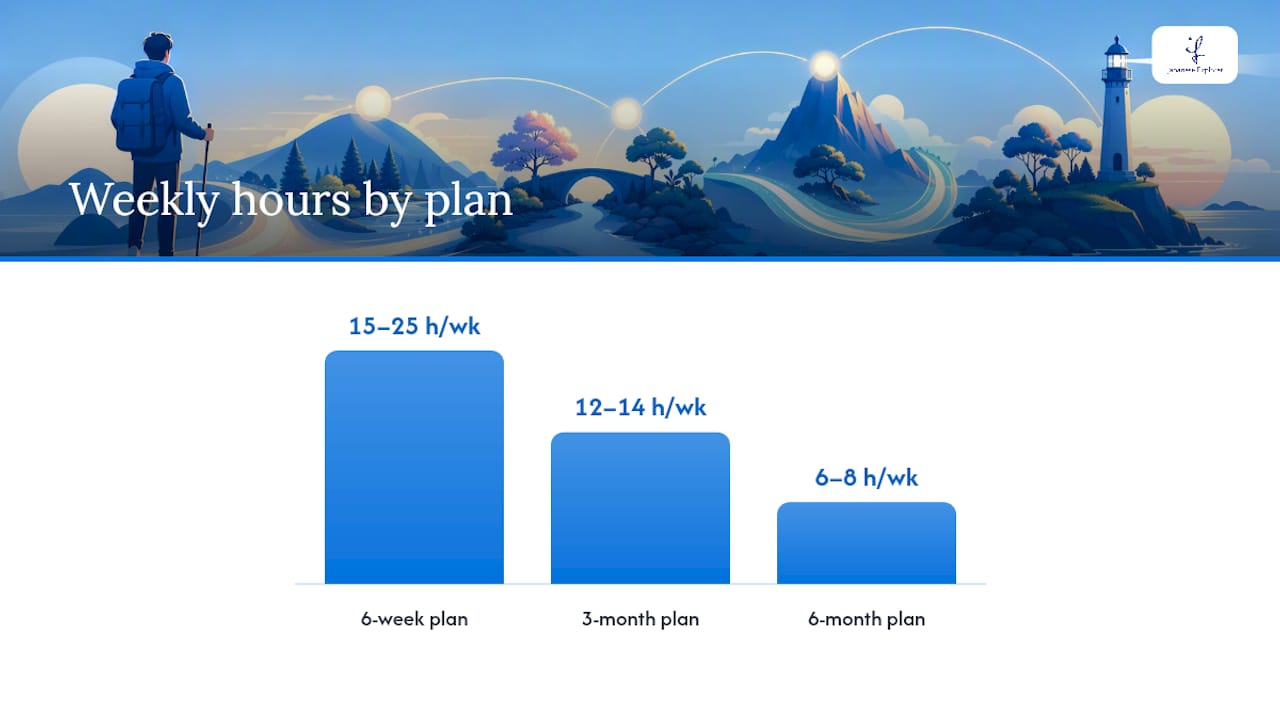
Total hours matter more than calendar length. A realistic accelerated pace runs 15 to 25 hours per week for the 6-week route, which is why it suits students without a full-time job or heavy course load. The 3-month plan spreads similar total hours across 12 to 14 hours per week. The 6-month version drops to 6 to 8 hours weekly, prioritizing volume of exposure over speed.
Whichever timeline you pick, build in one buffer week for every four to six weeks of study. Diagnostic mocks reveal gaps you didn’t know existed, and buffer time is where you fix them instead of panicking the week before the test.
Vocabulary and Kanji: Building Recall That Survives Exam Pressure
Set a daily spaced repetition system (SRS) target and stick to it, whether that’s 15 new words or 30. Apps like Anki or WaniKani work, but the habit matters more than the tool.
- Prioritize frequency over completeness. Learn the words that show up across N3 material repeatedly before chasing obscure vocabulary from a single textbook list.
- Attach a sentence to every new word. A word without context is a fact you’ll forget by Thursday; a word inside a sentence sticks because your brain files it with meaning attached.
- Learn kanji through compounds, not isolated characters. Clustering by kanji compounds and thematic groups like work, school, and news lets shared kanji reinforce each other, which cuts your review load noticeably.
- Consolidate weekly. Write five short original sentences using that week’s vocabulary, then quiz yourself cold on Friday before moving on.
Pro Tip: Skip flashcard apps that only test the word in isolation. Build your own mini quiz each week using the sentences you wrote, then test recall in context, since that’s what the reading and listening sections actually demand.
What’s the Best Way to Study N3 Grammar and Reading?
Grammar at N3 gets confusing because several patterns look similar but shift meaning in subtle ways. The fix is contrastive study.
- Learn easily confused patterns side by side (say, ~のに vs ~けど) rather than in isolation, and write one example sentence for each that highlights the difference.
- Swap the patterns into the same sentence and check whether the meaning still holds. If it doesn’t, you’ve found the nuance that actually matters.
- Studies on N3 preparation consistently point to contrastive grammar drills over rote memorization as the faster path to test-relevant fluency.
For reading, speed comes from structure recognition, not vocabulary alone. Before reading line by line, scan the passage to find the main verb in each sentence and the connecting particles. This trains your eye to parse Japanese sentence structure the way native readers do, rather than translating word by word.
Run timed reading sprints twice a week, starting with short passages and adding length as your comfort grows. Integrate your grammar review directly into these sprints. Every pattern you’ve studied should show up in real reading practice within the same week you learned it, or it won’t stick.

How Should I Practice Listening for JLPT N3?
Listening is where strong readers lose points, because reading gives you time to reconsider and listening doesn’t.
- Shadow daily for 10 to 15 minutes. Listen to a short clip, then repeat it aloud immediately, matching rhythm and pace rather than just meaning. This short daily habit builds comprehension speed more reliably than long, passive listening sessions.
- Run active drills with transcript review. Listen once without help, listen again while reading the transcript, then note exactly where comprehension broke down.
- Progress toward native speed without the transcript crutch. Start slowed down with support, then remove both supports as you improve.
- Use full mock listening sections under timed conditions to separate two different problems: not understanding the content, versus not keeping pace with delivery speed. Those require different fixes.
Pro Tip: If you keep losing points on the same question types, the problem usually isn’t your Japanese, it’s your prediction skills. Practice guessing what’s coming next based on the setup, since N3 listening rewards anticipation almost as much as comprehension. Japanese Explorer’s 4-week listening practice plan breaks this drill sequence into a calendar you can follow directly.
Sample JLPT N3 Study Plans You Can Copy This Week
The 6-week intensive plan
Sou Matome’s series structure fits this timeline almost perfectly, since each book is built for six-week completion.
- Weeks 1 to 2: Sou Matome Vocabulary and Grammar books, 30 minutes SRS plus 30 minutes grammar drills daily, 20 minutes reading.
- Weeks 3 to 4: Add Sou Matome Reading and Listening, shift to 20 minutes vocabulary, 30 minutes grammar/reading integration, 30 minutes listening.
- Week 5: First half-mock, then full mock by end of week; error-tag every miss.
- Week 6: Daily full-length mocks or sections, review only, no new material after Wednesday.
The 3-month focused plan (the pace most learners should pick)
- Month 1: Foundation building. Daily SRS, grammar introduction in contrast pairs, short reading passages, light shadowing.
- Month 2: Skill integration. Longer reading sprints, full listening drills, weekly mini-mocks on one section at a time.
- Month 3: Mock-test refinement. Weekly half-mocks scaling to full mocks in the final two weeks, targeted review of weak sections only.
The 6-month steady plan
Slower pacing works when your diagnostic score sits below 50% or your week is unpredictable. Prioritize volume: graded readers weekly, daily shadowing, and staggered mocks starting in month four rather than month three. Weekly revision sessions matter more here than intensity, since consistency beats bursts of effort over a six-month stretch.
Mock Tests, Pacing, and What to Do on Exam Day
Build mock intensity gradually rather than jumping straight to a full 105-minute run. Start with 20 to 30 minute focused drills, move to half-mocks, then full-length simulations. Many learners who skip full-length timed practice see their accuracy drop noticeably in the second half of the test, which points to stamina, not knowledge, as the real weak spot.
- After each mock, tag every wrong answer by cause: vocabulary gap, grammar confusion, misread question, or ran out of time.
- Convert those tags into next week’s drills instead of just reviewing the correct answers once.
- Practice minute-by-minute pacing per section, and decide in advance when to guess and move on rather than losing two minutes on one question.
Pro Tip: In the last 48 hours, stop learning new material entirely. Review error logs, sleep on schedule, and do one light mock at most, since cramming grammar the night before tends to hurt confidence more than it helps recall. Check your official test date and registration details early so your final mock week lines up with the real exam, not an arbitrary deadline.
Where Guided Classes Speed Up Self-Study
Self-study covers most of the work, but a few pain points respond faster to a live instructor than a textbook.
- Structured pacing keeps you from drifting off-schedule when weeks 3 and 4 of any plan get busy.
- Corrected output catches sentence-level grammar mistakes that self-checking simply misses.
- Targeted mock feedback identifies whether a listening miss was a content gap or a delivery-speed gap, faster than reviewing alone.
Book a lesson or two around your first half-mock, and ask the tutor to focus specifically on your weakest section rather than a general review. That’s where the return on guided time is highest.
Paul’s Recommended Daily N3 Routine
My honest recommendation: 30 minutes SRS, 30 minutes grammar with example sentences, 20 minutes timed reading, 20 minutes shadowing, 10 minutes review. Check progress at week 2 (can you parse mock questions faster?) and week 4 (are mock scores climbing?). When life gets busy, cut volume, not consistency. Fifteen focused minutes daily beats a missed week entirely.
— Paul
How Japanese Explorer Fits Into Your N3 Preparation
Self-study gets most learners to a solid foundation, but the sectional minimum rule means one weak area, usually listening or speaking confidence, can quietly sink an otherwise strong score. That’s where structured lessons with bilingual instructors close the gap faster than another round of solo flashcards.

Japanese Explorer runs small-group classes built around real conversation and corrected output, plus online courses over Zoom for learners who want scheduled lessons without commuting. Both formats slot directly into any of the timelines above: book a session after your first diagnostic mock and ask your instructor to target the exact section pulling your score down. If you’d rather see the full course structure before choosing a format, the JLPT preparation course page lays out how classes map to N3 exam sections. Classes run in person at 10 Anson Road, Level 22, International Plaza, Singapore 079903, right above Tanjong Pagar MRT, for anyone who wants a guided push toward that 95-point threshold instead of guessing alone.
Official JLPT Resources and Study Materials
Start with the official JLPT N3 sample questions for accurate timing and format. Pair Sou Matome for structured six-week study with graded readers and an SRS deck like Anki for daily vocabulary review. For a longer-range goal after N3, Japanese Explorer’s N1 study plan shows how the same timeline logic scales up.
Sources
- What is JLPT passing score? — JLPTBooks FAQ
- JLPT N3 in 3 Months: JLPT N3 Tips To Score 150+ — Migii
- JLPT N3 breakthrough guide — JLPTPrep
- Sou Matome N3 study plan — PassJapanese
FAQ
How many hours should I study for JLPT N3 total?
Total hours vary by starting level, but accelerated 6-week tracks often require 15 to 25 hours weekly, while 3-month and 6-month plans spread similar totals across 12 to 14 or 6 to 8 hours per week respectively.
What is the passing score for JLPT N3?
The overall passing score is 95 out of 180 points, but you must also clear the sectional minimum in each scored area to pass.
When should I start taking full mock tests?
Begin with short 20 to 30 minute drills early in your plan, then move to half-mocks, and schedule full-length mocks in your final two to three weeks regardless of which timeline you follow.
Is a 6-week JLPT N3 study plan realistic?
Otherwise, the 3-month plan is more realistic and sustainable.
What resources work best for self-study?
Sou Matome for structured six-week pacing, graded readers for reading volume, an SRS app for daily vocabulary, and Japanese Explorer’s listening practice plan for targeted drills cover most of what N3 preparation requires.